Opening speech by Nadia Calviño, president of the European Investment Bank Group, at the COR plenary session held on 2 July in Brussels.
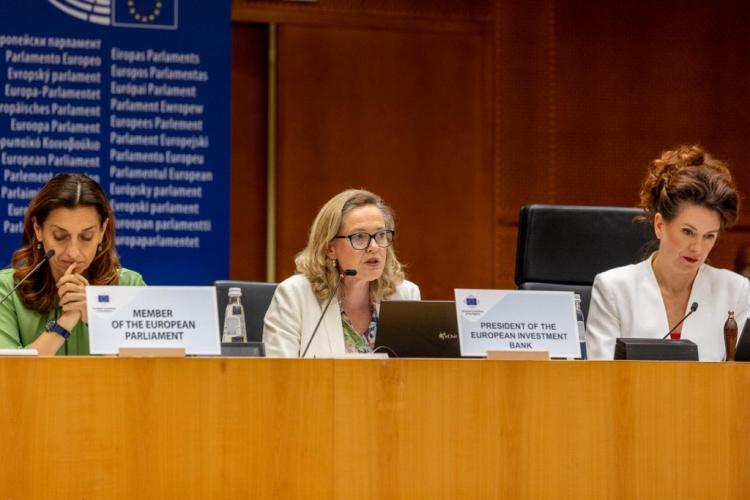
Thank you very much, dear President Tüttő. Honourable members, it is a great pleasure to return to the European Committee of the Regions. I would like to start by congratulating you, President, and the Committee for the Carlos V Prize, awarded by the King of Spain in May. It is obviously a very important award, both from the Spanish and the European perspective. It is great to be able to congratulate you in person so shortly after the award.
As you rightly say, Madame Chair, cities and regions are key partners of the European Investment Bank in building a more secure, a more competitive, more inclusive Europe. Just to illustrate the sort of projects that we are financing: last week, we announced new investments in urban development from Tallinn to Kosice in Slovakia, 100 kilometres from the border with Ukraine. We also announced investments in the just transition in Joensuu in Finland, green bus transport in the Netherlands, water service upgrades in Tuscany, wind energy in Greece, support for small and medium-sized companies and innovators in Spain and France. And these are just a few examples of the projects and the financing we are signing each and every week.
Because the European Investment Bank is truly the local bank for all of Europe, financing projects that improve lives in every single region around our Union, bringing opportunity where talent is distributed equally, also across the 27 Member States. From Turku in the north to Limassol in the south, we finance digital connectivity, sustainable mobility, clean energy, hospitals and schools. And from Prague in the east to Lisbon in the west, we are also financing affordable homes. Because every region matters, every city matters.
And today, I want to take this occasion to reaffirm the commitment of the European Investment Bank Group to work with all of you to strengthen resilience, innovation, cohesion across our Union.
The European Investment Bank Group is on track to deliver over €21 billion in new financing this year for sustainable cities and regions. And that is an increase of 21% since the adoption of our strategic roadmap two years ago, when I took the helm of the institution. And I am also proud to announce that, just after this session, we will be signing a Memorandum of Understanding to deepen our partnership and bring EIB support even closer to citizens.
Last year, the European Investment Bank Group reached a record €100 billion in new financing, with record levels for energy autonomy, technological leadership, security and defence, housing, water, and support to Ukraine. And nearly half of our financing now goes to less developed and transition regions.
These are not just numbers. These are investments that help reduce disparities and strengthen the cohesion of our Union, which is at the heart of the European Investment Bank's mission. And our commitment to cohesion is stronger than ever. At the end of the day, it is about trying to ensure affordability, which is a key concern for European citizens. This includes energy affordability: boosting clean energy production, clean tech solutions, and energy efficiency. It also includes affordability of transport through improvements to public transport infrastructure, rolling stock in cities, and connectivity across regions. And affordability of housing, which brings me to the heart of the matter that we are discussing today. Because securing affordable, energy efficient and high-quality homes for all is one of the top priorities we all share - especially when it comes to affordability and access for young people.
Across the European Union, 8 out of 10 young people are saying that affordable housing is their top concern. It is no longer just a social issue. It is an economic issue, a competitiveness issue, and of course also a climate one. Ultimately, I would say it's an issue of democracy. It's an issue of institutions responding to the expectations of citizens. It is a challenge, but it is also an opportunity. Because if we modernise the European construction sector, if we accelerate the green transition, if we strengthen availability of affordable housing, we can also strengthen our competitiveness and social cohesion. Our European Investment Bank investment report shows that by increasing housing supply, we can raise the European Union's GDP by nearly 2%. And in some Member States, over 7%. The diagnosis is clear. I think, as we will see in the debate, it is unanimously shared. Europe needs more homes, better homes built faster, cheaper and cleaner.
And that's why one year ago, the European Investment Bank adopted the first ever action plan to scale up housing support. I have to say, we have drafted this action plan in close cooperation with the European Commission and with the European Parliament. And I'm very grateful to Madame Tinagli for the excellent cooperation that we have had in this area.
We have since expanded the scope, the scale and the speed of our financing. And 12 months on, we're walking the talk. With concrete results. We doubled the number of new homes supported last year. This year, we aim for €6 billion in financial support in the area of housing, and that's almost double since 2024. By 2030, our aim is to deliver around 1 million more affordable and sustainable homes. And we are co-financing major national and regional programmes because we all know that the primary competence in this area is within the local authorities, the regional authorities, and the European Union can accompany and support what is primarily a national responsibility.
In Portugal, we are co-investing over €2.3 billion alongside recovery and resilience facility funding for the country's social and affordable housing programme.
In Spain, we support many regions, I see some of them represented here today, from Catalonia to Andalusia, Castilla y León, Valencia, to build and renovate over 11,000 affordable homes. And that means doubling the support of the European Investment Bank in just two years.
In Italy, we are supporting urban development in Naples. We are advising the housing strategy in Florence. We are helping the Emilia-Romagna region to renovate vacant social housing by combining European Investment Bank and EU funds.
And we are expanding our support in all Member States. Last month, we signed the first ever EIB loan for public rental housing in Slovenia.
In Czechia, in Prague, we are financing affordable rental homes for key public workers, nurses, teachers, police officers, at prices that are 20% below the market level.
We are also making progress with student housing in Cyprus, Italy, Greece, Central and Eastern Europe, and all across Europe, including Berlin.
So, where policy frameworks are still evolving, we have strengthened also our advisory support in this area. In Croatia, Latvia, and Estonia, we are helping local authorities set up public-private partnerships so that they can deliver their commitments to society.
Now, we are walking the talk. We have made very significant progress in the last two years in terms of financing this important area. What are the lessons learned and what is the outlook for the future?
Three reflections from my side.
First, partnerships are key to amplify impact. As I mentioned a moment ago, the key competence in the area of housing is local and regional. It is of the essence that we cooperate at all levels of administration, so that this financial support really reaches the citizens. For example, in France, we are partnering not only with the public authorities, but also with private banks like Caisse des Dépôts to mobilise €5 billion for municipalities and housing providers. And we are having a similar cooperation with national promotional banks in Poland, in Italy, in other member states.
Second reflection is that we need a strategic shift in the construction value chain. We do not need only to build new homes. We do not only need to renovate the existing housing stock. We also need to innovate in terms of building materials and building techniques. So, we launched a €400 million housing TechEU programme precisely for that, to reduce the cost of building and increase the sustainability and circularity of the building sector.
And third reflection, we need strategic use of EU funding. As we are approaching what I would call the heat phase of the negotiation of the next multi-annual financial framework, we need to ensure that every euro in the multi-annual financial framework in the EU budget is leveraged as much as possible, bringing together grants and financial instruments. And this being one of the top priorities for European citizens, I am quite sure that we will have a good European budget, and you can count on the European Investment Bank to continue to maximise the impact of every euro trying to deliver positive results for European citizens throughout the 27 Member States.
Let me leave it here and thank you very much for the opportunity, dear Chair.