Key takeaways
Investment has proved resilient
The EU economy and investment resisted global shifts and various shocks remarkably well in recent years. Investment has benefitted significantly from strong public support, which has focused on structurally transforming European economies. Public investment grew faster than gross domestic product, and government incentives for private investment remain above levels before the COVID-19 pandemic.
Despite heightened uncertainty, corporate investment has remained broadly stable in real terms. EU firms managed sharp rises in US tariffs well. So far, the impact of tariffs has largely been absorbed by American companies that rely on importers, with the effect remaining manageable for EU exporters. Investment in intangibles (research and development, innovation and skills) continues to grow, but is particularly vulnerable to uncertainty.
Europe is now at a critical turning point. Decisive policy action and large-scale capital investments are needed to mitigate risks and seize opportunities.
EU single market drives investment
The EU single market provides scale, business opportunities and efficient and secure European supply chains. It has a clear track record, underpinning 25% of new investment recorded in the European Union since the 1980s. Yet integration is stalling:
- 62% of EU firms have difficulty exporting to other EU countries because of fragmented rules and regulations.
- Removing these barriers could boost the ratio of firm investment to assets by 10%, with even stronger gains for intangible investment – which is critical for EU innovation.
The EU single market also drives resilience and economic security. Analysis shows that even limited trade among EU countries helps companies better weather shocks. When global volatility hits, intra-EU trade offsets disruptions in trade with countries beyond the European Union.
European firms rapidly adopt AI
Digitalisation and artificial intelligence (AI) are making EU firms’ more productive, but reliance on these technologies are also creating strategic dependencies in an increasingly polarised world. European Investment Bank Group analysis shows that a similar share of EU firms use big data analytics and AI as American firms.
- AI adoption is already having a material impact on EU firms’ productivity. It accounts for about 12% of the total increase in productivity recorded since 2019.
Looking ahead, the expansion of generative AI will intensify Europe’s dependency on foreign-based technologies. To keep up, Europe will need to invest heavily in innovation, data centres and energy infrastructure. A coordinated pan-European approach is needed. One that aligns initiatives and investment to support frontier computational infrastructure, data hubs and increased cybersecurity.
How to address energy bottlenecks
Addressing bottlenecks and better integrating European energy systems are essential to unlocking the benefits of growing renewable energy production. Energy costs are slowly being pushed down as clean energy is rolled out and markets become better integrated. Costs remain an issue in energy-intensive industries, however.
- For manufacturing firms, lower energy costs have been shown to support more productive investment and improve short-term profit margins and turnover, particularly when firms compete internationally.
More specifically, investment is needed to accelerate cross-border interconnections and improve flexibility – combining energy storage with generation, for example – in the electricity grid. Transforming the energy sector involves substantial upfront costs. To attract capital, the use of proven financial instruments could be expanded to reduce investment risks.
Instruments can pull in investment
Given limited available resources, future public policy support will need to focus more on impact and mobilising private capital. Targeted EU policies have proven effective at mobilising private investment for specific policy goals, such as those linked to the digital and green transitions. Experience with the European Fund for Strategic Investment (EFSI) and InvestEU shows the power of mobilising EU resources:
- A guarantee of €1 from the EU budget under InvestEU delivers an estimated €15 of investment in the real economy.
A deep dive into EIB Group data shows that well-designed financial instruments deliver tangible impact, strengthening firms’ performance and promoting innovation and EU competitiveness.
- Firms receiving EIB loans invest 15% more than their peers and have 5% higher productivity.
Venture debt financed by the European Investment Fund (EIF), which accounted for around 30% of the EU market, enables beneficiary companies to raise 1.5 times more finance.
The report’s executive summary is available here.
Table of contents
Part I: From investment resilience to acceleration
- 1. Europe in a shifting global order: Risks, resilience and investment trends
- 2. Government investment in a time of increased defence spending
- 3. Accelerating firms’ investment amid uncertainty
- 4. Maximising the impact of policy instruments
Part II: Boosting the competitiveness of the European economy
Latest editions

EIB Investment Report 2024/2025
European Union needs to solidify its position as a global leader in technology, innovation and clean energy.
EIB Investment Report 2023/2024
The European economy is under pressure. Growth is slowing and competitive challenges are rising, all while EU firms navigate the demands of the green transition.
EIB Investment Report 2022/2023
Political strife caused by the war in Ukraine, an energy crisis and tightening credit are weighing on EU firms, just as they were beginning to emerge from the COVID-19 crisis.
PUBLICATIONS you may like
Mid-term report: EIB Group Strategic Roadmap 2024/2027
The EIB Group is stepping up its investments in support of EU priorities. The mid-term review of the Strategic Roadmap 2024/2027 highlights the progress made.
EIB Group Compliance Activity Report 2025
The EIB Group Compliance Activity Report for 2025 describes the EIB Group Compliance Functions’ organisational set-up and activities.
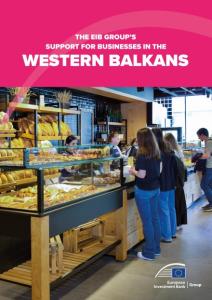
The EIB Group's support for businesses in the Western Balkans
The EIB Group plays one of the central roles in driving economic development, job creation and innovation across the Western Balkans region. Discover how our financing can empower your business to grow, decarbonise and stay competitive.