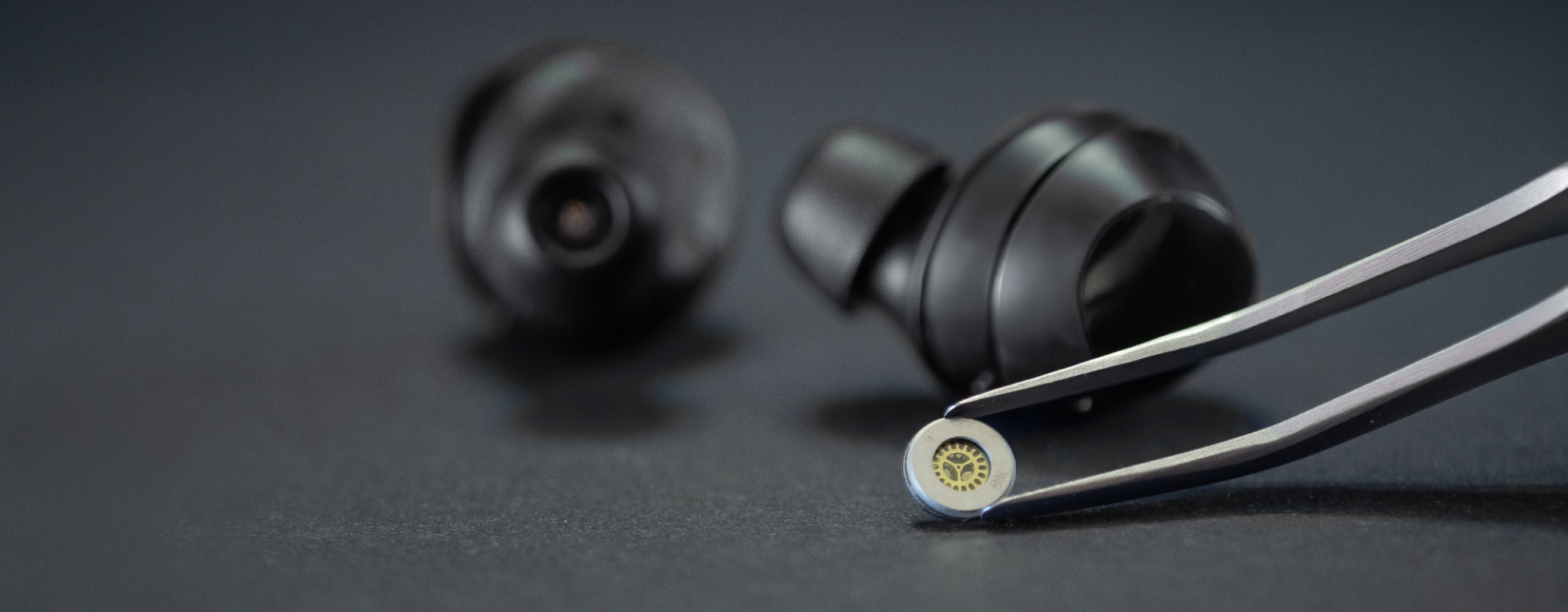
"USound has brought the next level of integration to the audio industry"
Other links
Summary sheet
Release date
6 October 2021
Status
Reference
Signed | 23/07/2021
20210236
Project name
Promoter - financial intermediary
USOUND (EGF VD)
USOUND GMBH
Proposed EIB finance (Approximate amount)
Total cost (Approximate amount)
EUR 15 million
EUR 33 million
Description
Objectives
USound is an Austrian company active in the development of MEMS (Micro-Electro-Mechanical Systems) technologies for audio applications. The fabless company offers its silicon-based speakers to be integrated into a variety of personal electronic devices, enabling their miniaturisation and lower power consumption.
The objectives of the EIB financing are to support the company to mitigate the impact from the COVID-19 pandemic and to execute its growth investments, mainly in research and development (R&D) and commercial expansion.
Additionality and Impact
The project supports the policy objective of support for SMEs, as well as research and development by providing tailored venture debt financing to an innovative start-up in the area of MEMS (Micro-Electro-Mechanical Systems) technologies for audio applications, enabling miniaturisation and lower power consumption of audio devices such as smartphones and wearables.
The project entails positive knowledge spillovers related to audio technologies, MEMS and integrated circuit design, strengthening EU innovation in key enabling technologies.
EIB's financial contribution facilitates the SME's sustainable growth and helps to maintain its technological edge, despite the adverse economic conditions resulting from the COVID-19 outbreak. Furthermore, it provides a positive signalling effect to crowd-in further financing from private investors.
Environmental aspects
Procurement
The project activities do not fall under the Annexes I or II of the EU Directive2014/52/EU amending the EIA Directive 2011/92/EU. The project will be carried out in existing facilities, already authorised, that will not change their scope due to the project. As such, the project activities are not subject to a mandatory environmental impact assessment (EIA).
The Promoter is a private company not operating in the utilities sector and not having the status of a contracting entity, and thus is not subject to EU rules on public procurement. Under these conditions, the procurement procedures followed by the Promoter are suitable for the project.
Related documents
Other links
Documents
Environmental and Social Data Sheet (ESDS) - USOUND (EGF VD)
Publication Date
12 Jun 2025
Document language
Main Topic
Lending
Document Number
247487903
Document Focus
Environmental Information
Document Type
Project Number
20210236
Sector(s)
Regions
Countries
Publicly available
Download now
Environmental and Social Completion Sheet (ESCS) - USOUND (EGF VD)
Publication Date
12 Jun 2025
Document language
Main Topic
Lending
Document Number
240314242
Document Focus
Environmental Information
Document Type
Project Number
20210236
Sector(s)
Regions
Countries
Publicly available
Download now
Link to source
Other links
News & Stories
Link to source
Other links
Inside the project
How and Why
From mechanics to microelectronics
Why
- The audio components in smartphones, tablets and headphones haven’t transitioned yet to digital electronics
- Components in this sector are “technologically obsolete”
- Microelectromechanical speakers did not exist until now
How
- By replacing the coil in conventional speakers with silicon, USound speakers are lighter and smaller
- TMicro-loudspeakers based on MEMS (microelectromechanical system) technology
- Microelectromechanical systems combine mechanical and electrical components and are made using semiconductor fabrication techniques
- To radiate sound, air must be moved. To move more air, the small MEMS structure is connected to a membrane that expands the movement over a larger surface
Sectors & Countries

"The European Investment Bank has given us a tremendous boost to ramp-up and scale in the midst of a pandemic"
Listen with your eyes

USound partnered with companies around the world to enable state-of-the-art audio devices. Focally is launching the world's first full-colour, micro-LED augmented-reality glasses with fully see-through display and USound MEMS speakers.
Luxshare-ICT, one of the largest suppliers for global consumer electronics brands, chose USound as its strategic MEMS speaker supplier for its new ultra-compact hybrid audio module, in mass production throughout 2023.
USound has also recently launched a new audio amplifier to boost the battery life of hearing aids and smart glasses. Its next challenge is to scale mass production for this new audio amplifier and market devices for headphones, mobile phones and tablets, and televisions.
Digitalisation also has a role to play in fighting climate change. With artificial intelligence and the internet of things, digitalisation may help us reuse things we currently throw away.
Related media
Podcast: An energy efficient future
Energy efficient climate solutions could shave a huge slice off global emissions. Here’s how our buildings are going to change, as we stop global warming.
Podcast: Digitalising the climate fight
Circular economy climate solutions are more than just recycling. With artificial intelligence and the internet of things, digitalisation is a big tool for reusing things we currently throw away.
The sound of glasses
Austrian high-tech company USound pioneers the world’s smallest loudspeakers based on a piezoelectric technology that requires 80% less power, using a Micro-Electro-Mechanical System (MEMS).
Links
Related projects and stories
Energy storage: EIB Group supports EU tripartite initiative
The European Investment Bank (EIB) Group supports a new EU-level initiative to scale up energy storage as part of the clean energy transition. Announced alongside the meeting of EU energy ministers in Luxembourg, the tripartite agreement brings together public authorities, energy storage and renewables developers, and financial institutions to accelerate storage deployment, strengthen the energy system, stabilise prices and reduce reliance on fossil fuels.
Investment that keeps Ukraine moving
EU investments in trains, winter heating, schools and hospitals help keep Ukraine moving, despite the Russian invasion - and give hope to Ukrainians
Why deep tech matters for Europe’s economy and everyday life
What deep tech really means, how it differs from conventional tech, and why it is critical for Europe’s competitiveness, security and future growth.