


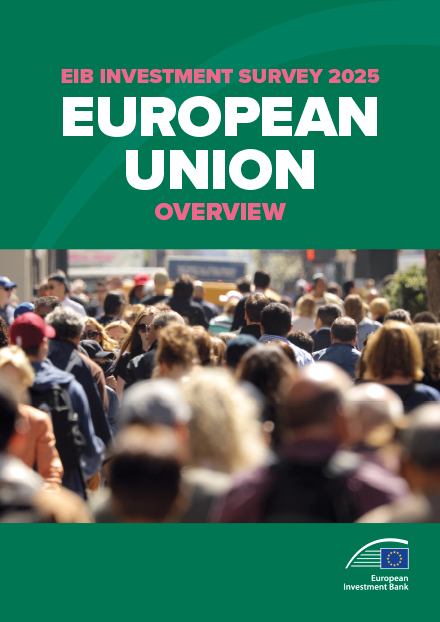
Individual country reports
are now available
Key takeaways
Investment growth is waning
Businesses are finding it difficult to plan. They are trying to understand the ultimate effect of US tariffs and potentially profound geopolitical changes.
Those pressures could have depressed investment, but the EIB Investment Survey for 2025 finds that investment is showing remarkable resilience so far – although companies are more cautious about the economic outlook and the political and regulatory environment.
- The European Investment Bank Investment Survey finds that 86% of EU firms still plan to invest, compared with 87% in the 2024 survey, although their appetite has somewhat weakened.
- A marginally higher share of EU firms still expects to increase rather than decrease investment in 2025, and investment growth is waning. The pattern in the United States is broadly similar.
Upheaval in global supply chains
EU firms are strongly integrated into global trade. This is particularly true for large firms and those in the manufacturing sector. They are worried about current geopolitical risks and trade tensions, although concerns about supply chain disruptions have eased. Companies are investing to make their supply chains more efficient and resilient, but they are not radically overhauling their approach.
Only 7% of importing firms in the European Union have reduced their imports of goods and services, while 19% are diversifying or increasing the number of countries they import from.
Tariffs shook US firms more. They are more concerned about changes in customs and tariffs than EU firms (77% vs. 48%). US firms reacted to the new political pressures and tariffs by increasing inventories before prices rose, but also by replacing foreign suppliers with domestic ones and diversifying the countries they import from. In short, US firms are rethinking trade and globalisation.
Read more about How EU and US firms are navigating higher tariffs
Green transition moves ahead
EU firms appear more aware of the consequences of decarbonisation and the transition to green energy than their American counterparts.
- 36% of EU firms view the transition to stricter climate standards and regulations as a risk over the next five years, compared with 27% of US firms.
- 27% of EU firms see the transition as an opportunity, compared to 23% of US ones.
- Large firms are more likely than small and medium firms to view the transition as both a risk and an opportunity.
EU firms have been more proactive in reducing their greenhouse gas emissions. A higher share of them, 92%, have taken action to reduce those emissions.
When considering transition risks, firms in Eastern Europe and some Central European countries are particularly aware of the associated risks, while firms in Northern Europe are more attuned to the opportunities.
Adaptation spending rises
Overall, businesses are more aware of the physical risks associated with climate change and are slowly starting to act on climate adaptation.
- On both sides of the Atlantic, the share of firms faced with costs from extreme climate-related events is high: 68% in Europe, and 64% in the United States.
The share of firms acting to deal with physical risks has increased steadily and is relatively similar (55% in the United States vs. 53% in the European Union), however, US firms are more likely to have implemented adaptation strategies or investments. Investment in climate adaptation is generally on the rise.
Read more about How EU firms are adapting to climate change
US-EU digital gap closes
EU firms have accelerated their adoption of advanced digital technologies to the extent that their adoption rate now matches those of US firms (77% vs. 78% for US firms).
This trend is particularly strong in large firms and in the manufacturing sector. They are also adopting AI technologies quickly.
- A new question in this the EIBIS 2025 survey shows that the adoption rate of generative AI technology is roughly the same on both sides of the Atlantic, 37% in the European Union vs. 36% in the United States.
However, US firms that use big data or AI technologies tend to apply them across more business areas than their European counterparts. European firms thus still need to fully exploit the benefits that AI offers.
Read more about How EU firms are using AI
Other key takeaways
- The 2025 survey underlines the importance of simplifying regulation, procedures and market access in the European Union. Time spent meeting regulatory requirements is significant for EU firms, with the cost estimated to be 1.1% of turnover, and as much as to 1.8% among small and medium companies.
- Deepening the single market remains vital to enhancing the European Union’s competitiveness and to spurring faster growth. 62% of firms say the EU market is fragmented for their main product, the same as in 2024.
Latest editions

Enquête 2024 de la BEI sur l’investissement – Synthèse concernant l’Union européenne
Les entreprises de l’UE ont relativement bien résisté aux chocs récents tels que la crise énergétique, mais le durcissement de l’environnement économique pèse sur leur volonté de procéder à des investissements.
Enquête 2023 de la BEI sur l’investissement – Synthèse concernant l’Union européenne
Cet aperçu unique de l’investissement privé dans l’Union européenne examine les besoins financiers des entreprises et les contraintes auxquelles elles sont confrontées.
Enquête 2022 de la BEI sur l’investissement – Synthèse concernant l’UE
Soutenir les investissements transformateurs malgré des chocs multiples
PUBLICATIONS you may like
Mid-term report: EIB Group Strategic Roadmap 2024/2027
The EIB Group is stepping up its investments in support of EU priorities. The mid-term review of the Strategic Roadmap 2024/2027 highlights the progress made.

EIB Group Compliance Activity Report 2025
The EIB Group Compliance Activity Report for 2025 describes the EIB Group Compliance Functions’ organisational set-up and activities.
The EIB Group's support for businesses in the Western Balkans
The EIB Group plays one of the central roles in driving economic development, job creation and innovation across the Western Balkans region. Discover how our financing can empower your business to grow, decarbonise and stay competitive.