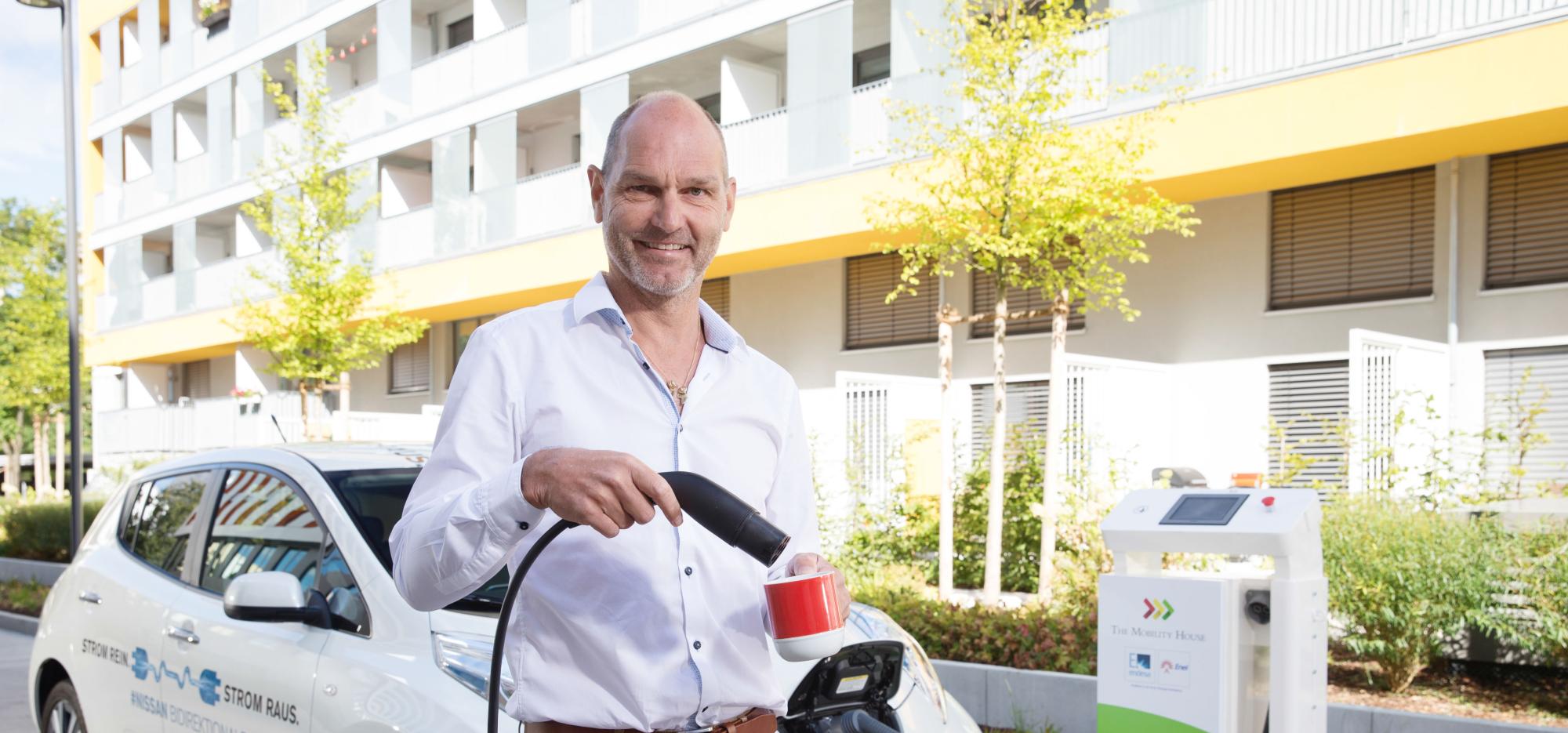
"Notre système de recharge et de gestion de l’énergie contribue à réduire jusqu’à 70 % les coûts d’extension du réseau, en stabilisant l’alimentation électrique et en divisant presque par deux le bilan carbone d’une voiture électrique."
Autres liens
Fiche récapitulative
Date de publication
14 avril 2020
Statut
Référence
Signé | 07/08/2020
20180604
Nom du projet
Promoteur – Intermédiaire financier
NEW CHARGING AND ENERGY STORAGE SOLUTIONS (EDP)
THE MOBILITY HOUSE AG
Montant BEI envisagé (montant approximatif)
Coût total (montant approximatif)
EUR 15 million
EUR 31 million
Lieu
Secteur(s)
Description
Objectifs
The project will finance the growth of the company in the energy storage and vehicle-to-grid sectors in the period 2020-2023.
The company provides innovative charging and energy storage solutions for the mobility and energy industries. Its proprietary technology digital platform allows the integration of electric vehicles (EVs) into the power grid to charge and discharge their batteries along with stationary battery storage assets. This requires the aggregation and leverage of the energy storage potential of pools of EVs batteries as stationary storage devices in order to provide energy and power services to the electricity grid and thereby enabling "internet of storage" solutions.
Aspects environnementaux
Passation des marchés
The project concerns the installation of smart charging devices in residential and commercial/industrial facilities. As per Environmental Impact Assessment (EIA) Directive 2014/52/EU amending the Directive 2011/92/EU, an EIA is not required for this project. E&S related topics will be investigated at appraisal.
The promoters have been assessed by the EIB as being private companies not being subject to EU rules on public procurement or concessions.
Documents liés
Autres liens
Documents
Fiche technique sur les aspects sociaux et environnementaux - NEW CHARGING AND ENERGY STORAGE SOLUTIONS (EDP)
Date de publication
3 Jul 2020
Langue
Sujet général
Prêts
Numéro du document
130222049
Thématique du document
Information Environnementale
Type de document
Numéro du projet
20180604
Secteur(s)
Régions
Disponible au public
Télécharger maintenant
Environmental and Social Completion Sheet - NEW CHARGING AND ENERGY STORAGE SOLUTIONS (EDP)
Date de publication
28 Nov 2024
Langue
Sujet général
Prêts
Numéro du document
223763116
Thématique du document
Information Environnementale
Type de document
Numéro du projet
20180604
Secteur(s)
Régions
Disponible au public
Télécharger maintenant
Lien vers la source
Autres liens
À la une
Lien vers la source
Autres liens
Au cœur du projet
Comment et pourquoi
Des voitures électriques raccordées au réseau
Pourquoi
- L’électricité produite par des sources renouvelables varie en fonction des conditions météorologiques plutôt que de la demande. Les batteries des véhicules électriques peuvent contribuer à compenser les écarts et à mieux utiliser l’énergie renouvelable.
- Les véhicules électriques sont nécessaires pour réduire les émissions de CO2 dues aux transports. La recharge bidirectionnelle améliore considérablement le bilan CO2 des voitures électriques, ce qui les rend encore plus durables et compétitives.
- Une jeune pousse européenne innovante, créatrice d’emplois, dont la technologie rend les transports plus durables.
Comment
- La technologie innovante de l’entreprise permet aux voitures électriques d’alimenter le réseau et de s’y recharger, les transformant en batteries sur roues qui peuvent aider à stabiliser le réseau et à réduire la nécessité d’accroître celui-ci.
- En permettant aux voitures électriques de jouer un rôle actif au sein du réseau, cette technologie améliore considérablement leur bilan CO2.
- Fondée en 2009, The Mobility House emploie environ 160 personnes en Allemagne, en Suisse et aux États-Unis.
Secteurs et pays

Récit
Préparer du café avec l’énergie propre des voitures
Thomas Raffeiner est directeur général de The Mobility House, une entreprise munichoise dont la technologie permet d’utiliser l’énergie des véhicules électriques en stationnement pour alimenter le réseau électrique ou des logements. Cette « recharge bidirectionnelle » est considérée comme une avancée importante dans la transition vers les énergies renouvelables.
« Notre système de recharge et de gestion de l’énergie contribue à réduire jusqu’à 70 % les coûts d’extension du réseau, en stabilisant l’alimentation électrique et en divisant presque par deux le bilan carbone d’une voiture électrique », affirme Thomas Raffeiner. « Nous voulons façonner un avenir sans émissions polluantes et la recharge bidirectionnelle est un bon moyen d’y parvenir. »
Sa technologie de recharge et de gestion de l’énergie, ChargePilot, repose sur une architecture d’interface ouverte qui permet le contrôle à distance et intelligent des processus de recharge, en fonction des besoins du réseau. Le logiciel surveille les pics d’électricité et les heures creuses, donnant aux utilisateurs de ChargePilot la possibilité de décider s’ils souhaitent charger ou décharger leurs batteries et quand le faire, en fonction de la demande d’énergie.
L’électricité excédentaire produite peut être restituée au réseau, optimisant ainsi les coûts de recharge et la performance du réseau. Même les véhicules électriques en stationnement pourraient jouer un rôle dans cette révolution de l’électrification en tant que dispositifs de stockage temporaire de l’énergie.

"Grâce à des enveloppes de financement thématique comme le volet « Projets de démonstration liés à l’énergie » du dispositif InnovFin ou le programme pour la mobilité future du Mécanisme pour l’interconnexion en Europe, la BEI, en tant que banque européenne du climat, dispose des outils adaptés pour soutenir des entreprises innovantes telles que The Mobility House."
L’investissement dans la recharge bidirectionnelle donne un coup d’accélérateur à ChargePilot
La technologie de The Mobility House appuie le déploiement de véhicules électriques ainsi que leur intégration rentable dans le réseau électrique européen via la recharge bidirectionnelle. Elle recouvre à la fois les services « véhicule à réseau » et « véhicule à domicile ».
Sa technologie de recharge et de gestion de l’énergie, ChargePilot, repose sur une architecture d’interface ouverte qui permet le contrôle à distance et intelligent des processus de recharge, en fonction des besoins du réseau. Le logiciel surveille les pics d’électricité et les heures creuses, donnant aux utilisateurs de ChargePilot la possibilité de décider s’ils souhaitent charger ou décharger leurs batteries et quand le faire, en fonction de la demande d’énergie.
L’électricité excédentaire produite peut être restituée au réseau, optimisant ainsi les coûts de recharge et la performance du réseau. Même les véhicules électriques en stationnement pourraient jouer un rôle dans cette révolution de l’électrification en tant que dispositifs de stockage temporaire de l’énergie.
The Mobility House a démontré qu’il est même possible de préparer son café avec de l’énergie verte provenant de la batterie d’un véhicule électrique en stationnement.

Sur le même sujet
Un emploi pour moi : Elizabeta et des voitures plus propres en Croatie
Comme en Croatie les emplois n’étaient pas légion, Elizabeta Žalac pensait qu’elle devrait partir pour trouver du travail. Mais grâce à un investissement de l’UE, cette jeune ingénieure talentueuse a pu rester dans son pays de naissance.
L’Autriche fait passer la recherche automobile à la vitesse supérieure
La R-D dans les groupes motopropulseurs de voitures électriques vise à lutter contre les changements climatiques et à doper l’innovation, grâce aussi aux véhicules hybrides et automatisés
Liens
Projets et articles associés
Energy storage: EIB Group supports EU tripartite initiative
The European Investment Bank (EIB) Group supports a new EU-level initiative to scale up energy storage as part of the clean energy transition. Announced alongside the meeting of EU energy ministers in Luxembourg, the tripartite agreement brings together public authorities, energy storage and renewables developers, and financial institutions to accelerate storage deployment, strengthen the energy system, stabilise prices and reduce reliance on fossil fuels.
EIB Global supports Trans-Caspian Transport Corridor with €150 million for road rehabilitation in Kazakhstan
The European Investment Bank (EIB) is providing a €150 million framework loan to Kazakhstan to support the rehabilitation of strategic road infrastructure along the Trans-Caspian Transport Corridor (TCTC), a key route connecting Central Asia and Europe.
Backed by the European Union under the Global Europe (NDICI) framework, the financing will support investments implemented by Kazakhstan's national road operator QazAvtoZhol. The operation will improve transport connectivity, strengthen road safety and climate resilience, and facilitate trade and economic development across the region.
The investment forms part of the European Union's Global Gateway strategy and follows the Memorandum of Understanding signed between the EIB and Kazakhstan in 2024 to strengthen sustainable transport connections between Europe and Asia.
The programme will finance the rehabilitation of approximately 1,370 kilometres of roads across central and southern Kazakhstan, including sections linking the country with neighbouring Central Asian states. By improving transport efficiency and resilience, the investment will reduce travel times, improve road conditions and facilitate the movement of goods and people along one of the region's most important transport corridors.
EIB Vice-President Marek Mora, who oversees the Bank's operations in Central Asia, including Kazakhstan, said:
"Good roads do more than connect places on a map. They connect people, they let businesses reach new markets, make travel safer and faster, and create opportunities for communities. By investing in key transport links across Kazakhstan, we are supporting a corridor that is becoming increasingly important for trade between Europe and Central Asia while delivering tangible benefits locally. Hard infrastructure is the backbone for trades. This is what sustainable connectivity is about: creating practical connections that support growth, resilience and cooperation."
EU Commissioner for International Partnerships, Jozef Síkela, stated:
"The Trans-Caspian Transport Corridor is playing an increasingly important role in connecting Europe and Central Asia. Through this investment, and together with our partners, we are supporting the development of safer, more resilient and more efficient transport infrastructure in Kazakhstan. This is a tangible example of Global Gateway in action, strengthening regional connectivity, supporting sustainable economic development and deepening our partnership with Kazakhstan and the wider region."
EU Ambassador to Kazakhstan Aleška Simkić commented:
"The Trans-Caspian Transport Corridor is one of the key priorities under the EU's Global Gateway strategy. Developing efficient, reliable and sustainable transport connections between Central Asia and Europe strengthens trade, enhances economic cooperation and contributes to the resilience of global supply chains. This investment demonstrates the European Union's long-term commitment to fostering connectivity, prosperity, and strong partnerships across the region."
The programme is expected to generate around 5,900 person-years of employment during implementation, creating opportunities for local communities and supporting economic activity. By strengthening one of the main transport links between Central Asia and Europe, the investment will facilitate trade, improve regional connectivity and contribute to the objectives of the EU-Kazakhstan partnership and the Global Gateway strategy.
EIB and Swedbank have secured EUR 200.75 million in financing for the developer of the Rūdninkai Military Town
The developer of part A of stage II of the Rūdninkai Military Town project, Rudina, has signed loan agreements with the European Investment Bank (EIB) and Swedbank: each institution is providing a loan of EUR 100.37 million. Rudina is indirectly managed by the INVL fund ‘INVL Defence Infrastructure Fund I’, together with the construction companies Conres and Fegda.