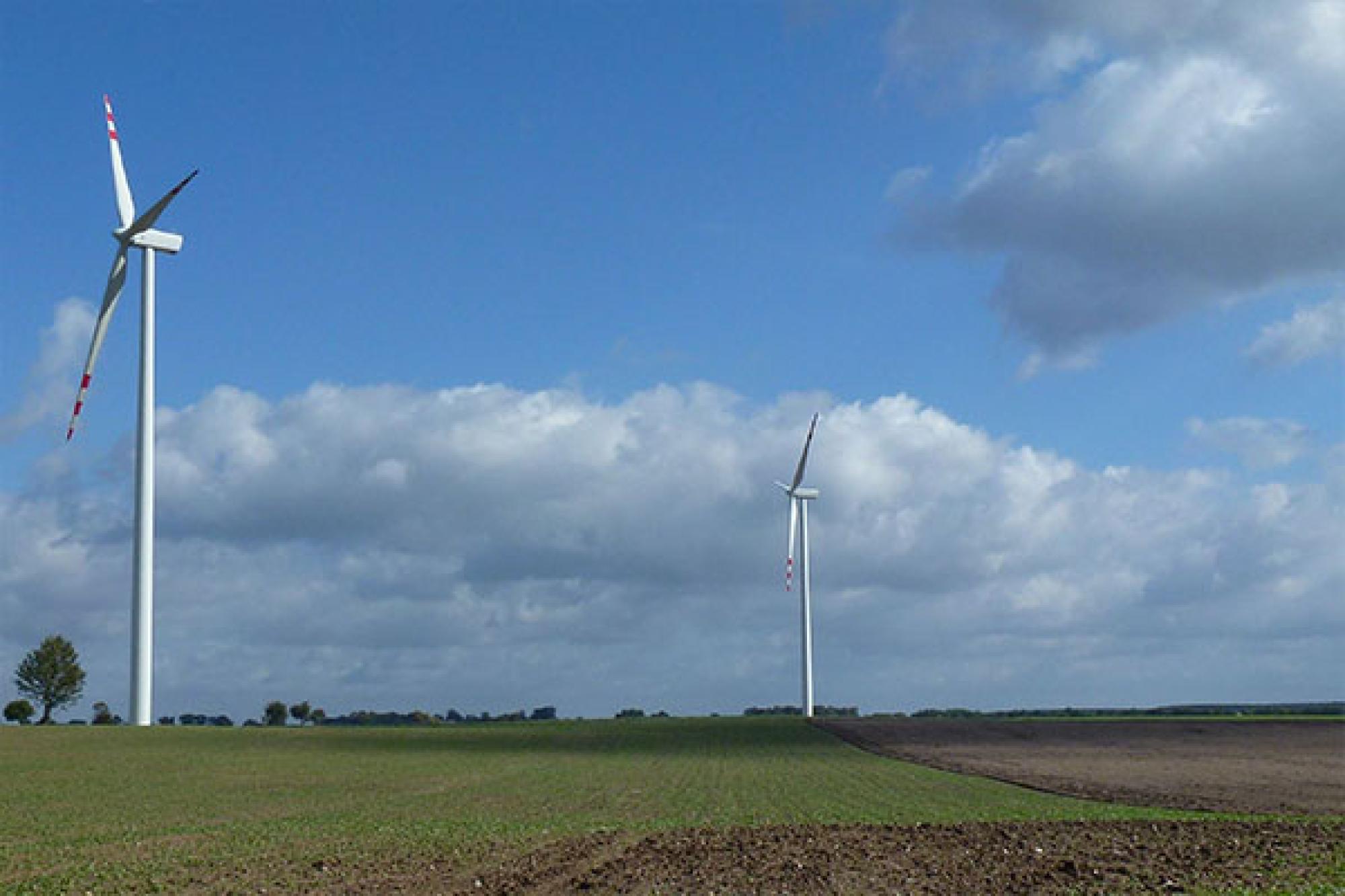
"I’m very proud of the way our wind farm shows that nature and electricity generation can exist side by side. In Poland, electricity has so often not been good for nature."
Other links
Summary sheet
Release date
6 April 2020
Status
Reference
Signed | 09/03/2020
20180740
Project name
Promoter - financial intermediary
LE POMERANIA WIND FARM
UAB IGNITIS GRUPE
Proposed EIB finance (Approximate amount)
Total cost (Approximate amount)
PLN 258 million (EUR 60 million)
PLN 581 million (EUR 134 million)
Description
Objectives
The project will finance a 94 MW onshore wind farm located in the northern part of Poland in Pomeranian Voivodship, approximately 50 km from the coastline of the Bay of Gdansk.
The project will contribute to environmental and security of energy supply objectives. The project is located in a Cohesion priority region. It is therefore eligible under Article 309 (a) projects for developing less-developed regions and (c) common interest. The financing of this project would contribute to the EIB's lending priority policy on social cohesion, renewable energy and climate action.
Environmental aspects
Procurement
Windfarms falls under Annex II of Directive 2011/92/EU (as amended by Directive 2014/52/EU) according to which the Member States shall determine whether the project shall be made subject to an assessment based on defined criteria. According to national legislation, windfarms exceeding certain criteria are subject to a mandatory Environmental Impact Assessment (EIA). This was the case for the project. The environmental studies for the EIA process were undertaken and the competent authorities have granted approval containing requirements to mitigate environmental impacts accordingly. Residual impacts were classified of small magnitude and low significance.
The project will be operating without exclusive or special rights within the meaning of the EU Utilities Directive 2004/17/EC c.q. 2014/25/EU hence private sector procurement procedures will apply. Equipment and works will be purchased through at least two contracts ?one for supply and installation of turbines, others for infrastructure works (Balance of Plant), electrical works etc.
Related documents
Other links
Documents
Environmental and Social Impact Assessment (ESIA) - LE POMERANIA WIND FARM - Streszczenie w języku niespecjalistycznym
Publication Date
9 Apr 2020
Document language
Main Topic
Lending
Document Number
129369190
Document Focus
Environmental Information
Document Type
Project Number
20180740
Sector(s)
Regions
Countries
Publicly available
Download now
Environmental and Social Impact Assessment (ESIA) - LE POMERANIA WIND FARM - Raport o oddziaływania na środowisko
Publication Date
9 Apr 2020
Document language
Main Topic
Lending
Document Number
92571920
Document Focus
Environmental Information
Document Type
Project Number
20180740
Sector(s)
Regions
Countries
Publicly available
Download now
Environmental and Social Data Sheet (ESDS) - LE POMERANIA WIND FARM
Publication Date
8 Apr 2020
Document language
Main Topic
Lending
Document Number
94479943
Document Focus
Environmental Information
Document Type
Project Number
20180740
Sector(s)
Regions
Countries
Publicly available
Download now
Environmental and Social Completion Sheet (ESCS) - LE POMERANIA WIND FARM
Publication Date
15 Dec 2022
Document language
Main Topic
Lending
Document Number
164055073
Document Focus
Environmental Information
Document Type
Project Number
20180740
Sector(s)
Regions
Countries
Publicly available
Download now
scoreboard - LE POMERANIA WIND FARM
Publication Date
13 May 2020
Document Language
English
Main Topic
lending
Document Number
130644046
Document Focus
EFSI legal requirements
Document Type
Scoreboard
Project Number
20180740
Last update
14 May 2020
Sector(s)
Energy
Countries
Poland
Publicly available
Download now
Link to source
Other links
News & Stories
Link to source
Other links
Inside the project
How & why
Supporting a green, just transition
Why
- To combat climate change we need to stop burning coal to produce electricity and use renewable sources instead
- Lower income regions dependent on coal need new industries so that they don’t lose out in the EU’s transition to a carbon-neutral economy
How
- Wind farms generate electricity without emitting CO2
- The project supports job creation in the green energy sector in a cohesion priority region historically dependent on coal
Sectors & Countries

New Poland renewable energy deals
The Ignitis project was one of the first deals to be made under a new law designed to encourage renewable energy in Poland. “Poland is becoming almost a trendy country for renewable energy investment,” says Diana Kazakevic, head of the Poland region for Ignitis Group, the Lithuanian energy company listed in Vilnius and London that’s building the wind farm.

The European Commission’s plan to combat climate change, which it announced in 2020, is based on a commitment to make Europe a net-zero emitter of greenhouse gases by 2050 and makes significant provisions to ensure that regions currently dependent on fossil fuels should not be left behind by the transition to clean technology.
Related media
Green Deal in motion
In Poland renewable energy gets a boost as a change in legislation attracts international investors—and shows the way for the green transition
Links
Related projects and stories
Energy storage: EIB Group supports EU tripartite initiative
The European Investment Bank (EIB) Group supports a new EU-level initiative to scale up energy storage as part of the clean energy transition. Announced alongside the meeting of EU energy ministers in Luxembourg, the tripartite agreement brings together public authorities, energy storage and renewables developers, and financial institutions to accelerate storage deployment, strengthen the energy system, stabilise prices and reduce reliance on fossil fuels.
EIB Global supports Trans-Caspian Transport Corridor with €150 million for road rehabilitation in Kazakhstan
The European Investment Bank (EIB) is providing a €150 million framework loan to Kazakhstan to support the rehabilitation of strategic road infrastructure along the Trans-Caspian Transport Corridor (TCTC), a key route connecting Central Asia and Europe.
Backed by the European Union under the Global Europe (NDICI) framework, the financing will support investments implemented by Kazakhstan's national road operator QazAvtoZhol. The operation will improve transport connectivity, strengthen road safety and climate resilience, and facilitate trade and economic development across the region.
The investment forms part of the European Union's Global Gateway strategy and follows the Memorandum of Understanding signed between the EIB and Kazakhstan in 2024 to strengthen sustainable transport connections between Europe and Asia.
The programme will finance the rehabilitation of approximately 1,370 kilometres of roads across central and southern Kazakhstan, including sections linking the country with neighbouring Central Asian states. By improving transport efficiency and resilience, the investment will reduce travel times, improve road conditions and facilitate the movement of goods and people along one of the region's most important transport corridors.
EIB Vice-President Marek Mora, who oversees the Bank's operations in Central Asia, including Kazakhstan, said:
"Good roads do more than connect places on a map. They connect people, they let businesses reach new markets, make travel safer and faster, and create opportunities for communities. By investing in key transport links across Kazakhstan, we are supporting a corridor that is becoming increasingly important for trade between Europe and Central Asia while delivering tangible benefits locally. Hard infrastructure is the backbone for trades. This is what sustainable connectivity is about: creating practical connections that support growth, resilience and cooperation."
EU Commissioner for International Partnerships, Jozef Síkela, stated:
"The Trans-Caspian Transport Corridor is playing an increasingly important role in connecting Europe and Central Asia. Through this investment, and together with our partners, we are supporting the development of safer, more resilient and more efficient transport infrastructure in Kazakhstan. This is a tangible example of Global Gateway in action, strengthening regional connectivity, supporting sustainable economic development and deepening our partnership with Kazakhstan and the wider region."
EU Ambassador to Kazakhstan Aleška Simkić commented:
"The Trans-Caspian Transport Corridor is one of the key priorities under the EU's Global Gateway strategy. Developing efficient, reliable and sustainable transport connections between Central Asia and Europe strengthens trade, enhances economic cooperation and contributes to the resilience of global supply chains. This investment demonstrates the European Union's long-term commitment to fostering connectivity, prosperity, and strong partnerships across the region."
The programme is expected to generate around 5,900 person-years of employment during implementation, creating opportunities for local communities and supporting economic activity. By strengthening one of the main transport links between Central Asia and Europe, the investment will facilitate trade, improve regional connectivity and contribute to the objectives of the EU-Kazakhstan partnership and the Global Gateway strategy.
EIB and Swedbank have secured EUR 200.75 million in financing for the developer of the Rūdninkai Military Town
The developer of part A of stage II of the Rūdninkai Military Town project, Rudina, has signed loan agreements with the European Investment Bank (EIB) and Swedbank: each institution is providing a loan of EUR 100.37 million. Rudina is indirectly managed by the INVL fund ‘INVL Defence Infrastructure Fund I’, together with the construction companies Conres and Fegda.
Photogallery
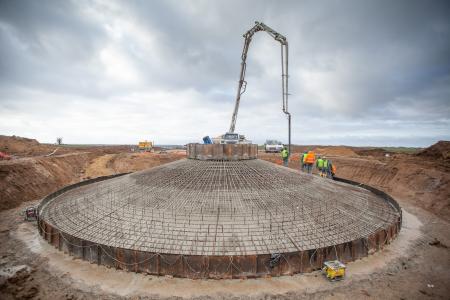
©Ignitis