"As the EU climate bank, we’re proud to support Poste Italiane’s ambitious decarbonisation plan."
Other links
Summary sheet
Release date
4 April 2022
Status
Reference
Signed | 31/03/2022
20200752
Project name
Promoter - financial intermediary
POSTE ITALIANE GREEN MOBILITY
POSTE ITALIANE SPA
Proposed EIB finance (Approximate amount)
Total cost (Approximate amount)
EUR 100 million
EUR 145 million
Description
Objectives
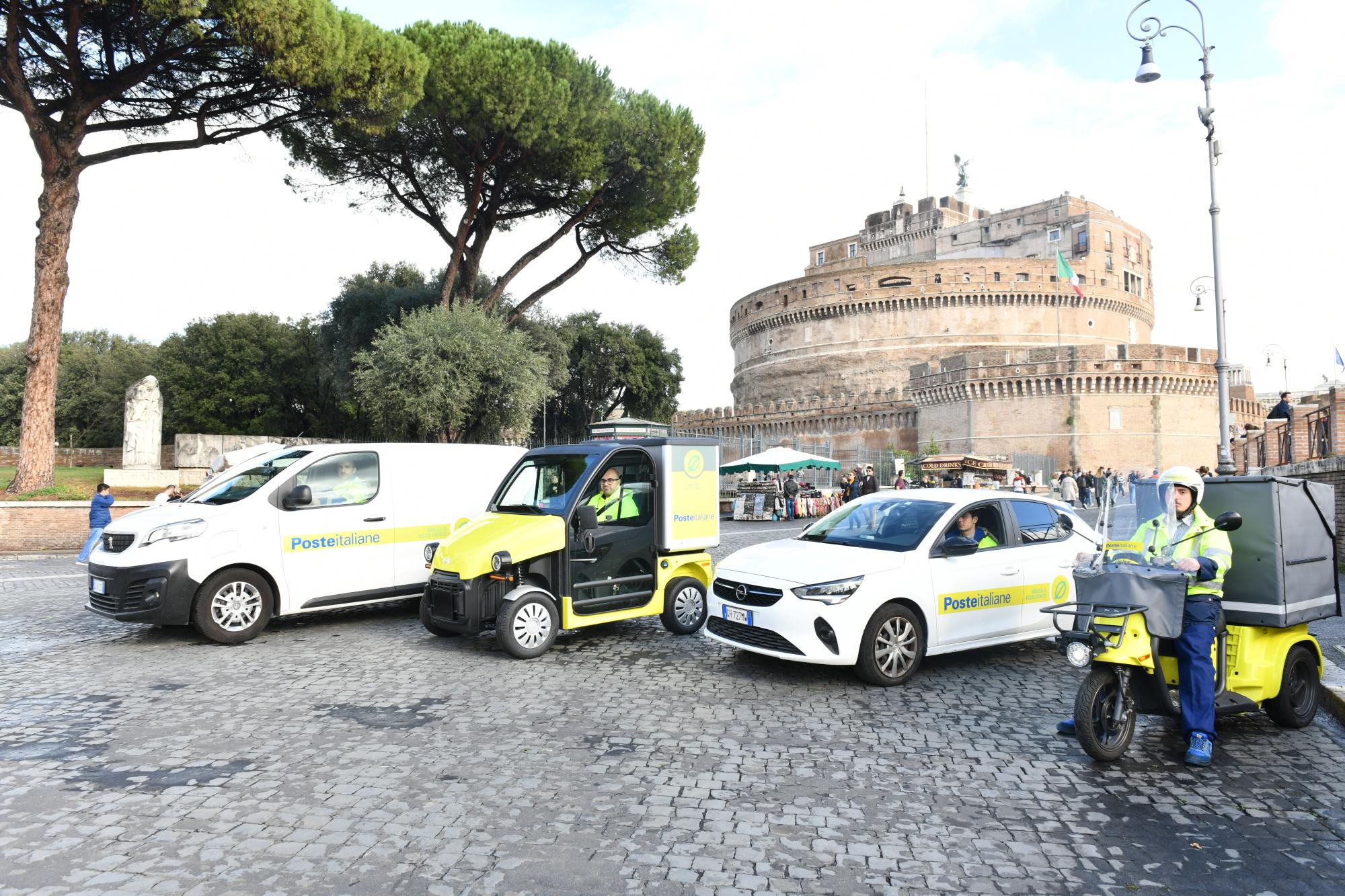
The project consists of the financing of Poste Italiane vehicle fleet renovation in the 2021-2026 period. The project covers the deployment of about 1 300 new zero emissions battery electric tricycles and quadricycles and about 2 850 new zero emissions battery electric cars and vans, focusing on last mile delivery in urban environment. The project also covers the installation of the associated charging points and information technology (IT) systems.
The project has the objective of reducing air pollution, reducing greenhouse gas emissions and lowering noise in urban areas. The project will also contribute to support the deployment of electric vehicles and their associated infrastructure.
Additionality and Impact
The project concerns the roll-out of a major zero-emission mobility solution (vehicles, charging stations and integrated IT platform) with the goal of considerably reducing CO2 emissions especially for last-mile deliveries in urban environment.
The project contributes to the EIB's objectives of sustainable and decarbonised road transport thereby supporting EU policy objectives. The project is consistent with the EU Green Deal and the Sustainable and Smart Mobility Strategy as well as the Bank's CBR and its TLP. It mitigates negative externalities in the form of the reduction of GHG, air pollutants (Nitrogen Oxides, Particulate Matter) and noise emissions through the electrification of road transport in an urban context. These benefits are not fully captured by postal mail and parcel related tariffs.
The project has a 100% share of Climate Action and is eligible under Article 309 point (a) projects for developing less-developed regions and point (c) common interest. The EIB investment in the project support the 2030 targets set out in Italy's Integrated National Energy and Climate Plan released in December 2019.
The project is an essential component of the promoter's long-term strategy for a sustainable business development. The EIB's contribution to this investment in logistics decarbonisation is expected to materially contribute to the Promoter's effort to meet its ESG targets and crowd-in Green Finance investors.
Environmental aspects
Procurement
The acquisition of electric vehicles and electrical charging points and deployment of IT systems does not fall under Annex I or Annex II of the Directive 2014/52/EU amending Directive 2011/92/EU on the assessment of the effects of certain public and private projects on the environment (EIA Directive).
The Bank will require the Promoter to ensure that contracts for the implementation of the Project have been and will be tendered in accordance with the relevant applicable EU procurement legislation, in particular Directive 2014/25/EU, as implemented by national legislation and interpreted by the Court of Justice of the EU, with publication of tender notices in the Official Journal of the EU, as and where required.
Related documents
Documents
Environmental and Social Data Sheet (ESDS) - POSTE ITALIANE GREEN MOBILITY
Publication Date
27 Apr 2022
Document language
Main Topic
Lending
Document Number
135308380
Document Focus
Environmental Information
Document Type
Project Number
20200752
Sector(s)
Regions
Countries
Publicly available
Download now
Link to source
Other links
News & Stories
Link to source
Other links
Inside the project
How and Why
The last green mile
Why
- The boom in deliveries from online shopping since the COVID-19 pandemic has worsened transport-related carbon emissions
- Cities and logistics companies have struggled with unnecessary delivery journeys, congestion, parking and local residents’ concerns about noise and air pollution
- The trickiest part of a parcel’s journey from warehouse to doorstep is the so-called “last mile”, the final step in the delivery process from a distribution centre to the recipient.
How
- Replacement of Poste italiane fuel and petrol vehicles with 4 150 electric vehicles for deliveries
- The electricity used to charge these vehicles comes from renewable sources
- An innovative IT platform optimizes the postman’s route according to mail, distance, type of road, traffic and parcel volume.
Sectors & Countries

Story
Green parcels and a unique loan
The Green Mobility project is about the replacement of the company’s traditional fuel and petrol vehicles with 4 150 electric vehicles for deliveries in cities and their surroundings. This also includes the associated charging stations and IT platform at a total cost of €145 million.
The European Investment Bank’s loan to Poste Italiane has a number of unique features:
- It covers the rental fees for the renewal of the electric fleet, the installation of the associated recharging points and IT platform
- It finances the leasing fees of the electric fleet
- It is higher (69%) than the Bank’s 50% standard financing ceiling, to help Poste Italiane speed up its green transition.

"It's a rather small sum that can go a long way."
“Data in real time”
To further reduce its environmental impact, Poste will also use the European Investment Bank financing to support its IT platform. The innovative model optimizes the postman’s route according to mail traffic, distance, type of road, traffic restrictions and parcel volume. The route planning integrates the range limits of electric vehicles and the availability of charging stations.

“The success of this project depends on the interpretation of a big amount of data gathered in real time,” says Tiago Lopes, a European Investment Bank senior engineer who has worked on this operation. “This is the future.”
As technology evolves and battery capacity increases in the years to come, Lopes’ idea is to “go the extra mile”: to extend the project to the middle-mile fleet (from the warehouse to the local post office) and to the first-mile fleet (from the factory to the distribution centre).
Related media
Car conundrum
Transport accounts for one-quarter of Europe’s emissions. They switch to electric vehicles will help reduce those emissions, but it’s not enough to meet the continent’s climate targets.
Podcast: Urban climate checklist
If you were mayor of your city, what urban climate solutions would you put in place to cut carbon emissions and improve the quality of life? Here’s a checklist
Links
Related projects and stories
Energy storage: EIB Group supports EU tripartite initiative
The European Investment Bank (EIB) Group supports a new EU-level initiative to scale up energy storage as part of the clean energy transition. Announced alongside the meeting of EU energy ministers in Luxembourg, the tripartite agreement brings together public authorities, energy storage and renewables developers, and financial institutions to accelerate storage deployment, strengthen the energy system, stabilise prices and reduce reliance on fossil fuels.
EIB Global supports Trans-Caspian Transport Corridor with €150 million for road rehabilitation in Kazakhstan
The European Investment Bank (EIB) is providing a €150 million framework loan to Kazakhstan to support the rehabilitation of strategic road infrastructure along the Trans-Caspian Transport Corridor (TCTC), a key route connecting Central Asia and Europe.
Backed by the European Union under the Global Europe (NDICI) framework, the financing will support investments implemented by Kazakhstan's national road operator QazAvtoZhol. The operation will improve transport connectivity, strengthen road safety and climate resilience, and facilitate trade and economic development across the region.
The investment forms part of the European Union's Global Gateway strategy and follows the Memorandum of Understanding signed between the EIB and Kazakhstan in 2024 to strengthen sustainable transport connections between Europe and Asia.
The programme will finance the rehabilitation of approximately 1,370 kilometres of roads across central and southern Kazakhstan, including sections linking the country with neighbouring Central Asian states. By improving transport efficiency and resilience, the investment will reduce travel times, improve road conditions and facilitate the movement of goods and people along one of the region's most important transport corridors.
EIB Vice-President Marek Mora, who oversees the Bank's operations in Central Asia, including Kazakhstan, said:
"Good roads do more than connect places on a map. They connect people, they let businesses reach new markets, make travel safer and faster, and create opportunities for communities. By investing in key transport links across Kazakhstan, we are supporting a corridor that is becoming increasingly important for trade between Europe and Central Asia while delivering tangible benefits locally. Hard infrastructure is the backbone for trades. This is what sustainable connectivity is about: creating practical connections that support growth, resilience and cooperation."
EU Commissioner for International Partnerships, Jozef Síkela, stated:
"The Trans-Caspian Transport Corridor is playing an increasingly important role in connecting Europe and Central Asia. Through this investment, and together with our partners, we are supporting the development of safer, more resilient and more efficient transport infrastructure in Kazakhstan. This is a tangible example of Global Gateway in action, strengthening regional connectivity, supporting sustainable economic development and deepening our partnership with Kazakhstan and the wider region."
EU Ambassador to Kazakhstan Aleška Simkić commented:
"The Trans-Caspian Transport Corridor is one of the key priorities under the EU's Global Gateway strategy. Developing efficient, reliable and sustainable transport connections between Central Asia and Europe strengthens trade, enhances economic cooperation and contributes to the resilience of global supply chains. This investment demonstrates the European Union's long-term commitment to fostering connectivity, prosperity, and strong partnerships across the region."
The programme is expected to generate around 5,900 person-years of employment during implementation, creating opportunities for local communities and supporting economic activity. By strengthening one of the main transport links between Central Asia and Europe, the investment will facilitate trade, improve regional connectivity and contribute to the objectives of the EU-Kazakhstan partnership and the Global Gateway strategy.
EIB and Swedbank have secured EUR 200.75 million in financing for the developer of the Rūdninkai Military Town
The developer of part A of stage II of the Rūdninkai Military Town project, Rudina, has signed loan agreements with the European Investment Bank (EIB) and Swedbank: each institution is providing a loan of EUR 100.37 million. Rudina is indirectly managed by the INVL fund ‘INVL Defence Infrastructure Fund I’, together with the construction companies Conres and Fegda.