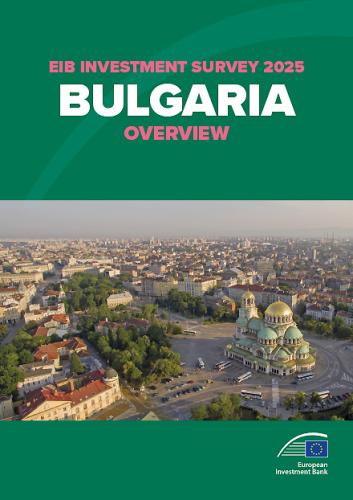
- Global uncertainty weighs on investment activity, but firms in Bulgaria remain cautiously optimistic
- Capacity expansion will be top investment priority over the next 3 years
- Companies step up investment in innovation
- About eight in 10 businesses have taken steps to reduce greenhouse gas emissions
- Transition to net zero economy is seen more as a risk than an opportunity
The geopolitical and domestic uncertainty has exerted downward pressure on investment activity in Bulgaria, but companies remain cautiously optimistic about their business prospects, expanding investments in innovation and benefitting from policy support, grants and favourable bank financing, new country results from the 2025 EIB Group Investment Survey (EIBIS) show.
Seven in 10 Bulgarian companies - 71% - have continued to invest, slightly below the levels in 2024, and way below the EU average of 86%, according to the survey. The investment outlook - the share of firms expecting to increase rather than decrease their investments – dropped to a five-year low of 3%, in line with EU’s average of 4%, given the geopolitical and trade tensions that have slowed investment on both sides of the Atlantic.
Still, Bulgarian companies remain more optimistic about business prospects compared to a 2024 EIBIS (16% vs 6%) and about their access to external finance (18% vs 13%). Over the next three years the key focus of their investments will be in capacity expansion (40%), way higher than the EU average of 26%, the 2025 EIBIS shows.
“We will continue helping Bulgarian business to invest in sustainable projects and push forward with its green and digital transitions to strengthen their economic competitiveness and resilience,” said EIB Vice-President Marek Mora.
EIBIS is an annual report based on polling of approximately 13,000 firms in all EU Member States plus a sample from the United States. Its main results were released in October 2025, showing that EU businesses show resilience in face of a volatile global landscape, stay the course investing in the green and energy transitions and adopting advanced forms of artificial intelligence (AI) at broadly the same pace as their US counterparts.
The survey shows that the policy support Bulgarian firms are receiving for their financial investments is 1.5 times higher than the EU average. They have also benefitted more from grants and bank finance with favourable conditions than their EU peers. Despite that, the number of firms, which report financial constraints has increased and is at 14.2% - nearly 2.5 times higher than the EU average.
Around seven in 10 of Bulgarian firms are involved in international trade, and thus sensitive to geopolitical risks and trade tensions. The survey shows they are less concerned about recent changes in customs and tariffs (36%) in comparison with EU companies (48%). Bulgarian firms were also faster to diversify or increase the number of countries they import from. About 31% of the firms adopted that strategy, above the EU average of 19%.
Bulgarian companies have stepped up investment in innovation, with 35% putting funds to developing or introducing new products, processes or services. This is a 9-percentage point increase compared to 2024 EIBIS and above the EU average of 32%. The firms are yet to catch up with their EU peers in investing in digital solutions and in adopting AI tools.
When it comes to the green transition, most Bulgarian companies, 81%, say they have taken steps to cut greenhouse gas emissions, with a focus on energy efficiency and waste reduction. Their number is lagging the EU average of 92%. A serious part of the business still views the transition to stricter climate standards as a risk (38%) rather than an opportunity (10%).
“While uncertainty weighs on firms, they are so far weathering the shock,” said EIB’s Chief Economist Debora Revoltella. “In Bulgaria, we see a clear commitment to expand capacity and invest in innovation, that drive growth and competitiveness, but there is still room for improvement when it comes to climate action.”
The full country report about Bulgaria is available here.
Background information
The European Investment Bank (ElB) is the long-term lending institution of the European Union, owned by its Member States. Built around eight core priorities, we finance investments that contribute to EU policy objectives by bolstering climate action and the environment, digitalisation and technological innovation, security and defence, cohesion, agriculture and bioeconomy, social infrastructure, the capital markets union, and a stronger Europe in a more peaceful and prosperous world.
The EIB Group, which also includes the European Investment Fund (EIF), signed nearly €89 billion in new financing for over 900 high-impact projects in 2024, boosting Europe’s competitiveness and security.
Since the start of its operations in Bulgaria, the EIB Group has invested over €10 billion in the country, financing projects that reduce regional disparities, strengthen economic competitiveness, and boost growth. In 2024 alone, the EIB Group funding volume reached €388 million in Bulgaria.