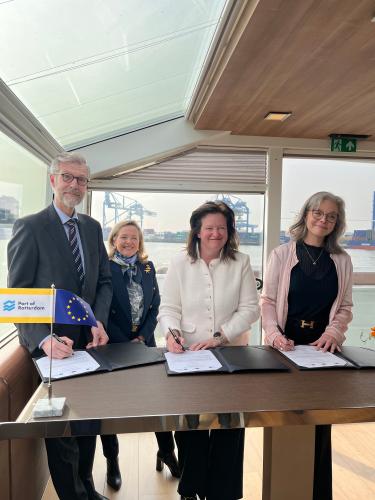
- A €90 million loan from the European Investment Bank will help large container ships make use of shore power in the port of Rotterdam.
- The project will also receive a grant from the European Commission under the Connecting Europe Facility for alternative fuels in the transport sector.
- At present, ships still burn fossil fuels to run generators for their onboard electrical systems. Switching to shore power will benefit both people and the environment.
The European Investment Bank (EIB) is lending €90 million to the Port of Rotterdam Authority for the installation of shore power facilities at three deep-sea container terminals in the port of Rotterdam. The loan will finance Rotterdam Shore Power, a joint venture between the Port of Rotterdam Authority and Eneco. In addition to the onshore power supply installation, Rotterdam Shore Power will deliver the grid connection, cabling and other associated construction and excavation works. In total, eight kilometres of quay will be equipped with shore power, with 35 connection points for seagoing container vessels.
Alongside the EIB loan, the project is also eligible for a European Commission grant of around €70 million under the Alternative Fuels Infrastructure Facility (AFIF) of the Connecting Europe Facility (CEF).
“Rotterdam is Europe’s most important port and continues to innovate to stay at the forefront. Connecting large container ships to shore power is a major step towards reducing our reliance on fossil fuels. This is not only good for the environment, air quality and public health, but also for our economy, as it will help Europe become less dependent on energy from further afield. The geopolitical situation makes it clear that Europe needs greater autonomy when it comes to its energy supply,” said EIB Vice‑President Robert de Groot.
“Shore power plays a vital role in the energy transition. As the port of Rotterdam works towards climate‑neutral operations by 2050, while safeguarding its competitive position, investments like this are indispensable. They bring our climate goals within reach and reinforce the port’s role as a sustainable, future‑proof container hub in north‑west Europe,” said Vivienne de Leeuw, chief financial officer of the Port of Rotterdam Authority.
“The current geopolitical context forces Europe to make critical choices if it is to remain competitive while also becoming energy independent. For the port of Rotterdam, as Europe’s largest port, more sustainable transport is essential to staying connected. Through Connecting Europe Facility grants, the European Commission is supporting the ambitious rollout of the alternative fuel infrastructure needed to make this happen,” added Cecilia Thorfinn, acting head of the Commission Representation in the Netherlands.
The EIB financing for shore power and the EU grant under the Connecting Europe Facility directly support the ambition to equip the European transport network with infrastructure for electric mobility. Today, large container ships still rely on engines or fossil fuel generators to supply power to onboard electrical systems, causing not only CO₂ emissions but also noise nuisance and particulate emissions. The shore power installations are expected to be delivered and brought into operation in phases from the second half of 2028.
Background information:
The European Investment Bank (EIB) is the long-term lending institution of the European Union, owned by its Member States. The Netherlands owns a 5.2% share in the EIB. The Bank provides long-term financing for sound investments that contribute to EU policy objectives and national priorities. More than 90% of its operations are within Europe. Over the years, the EIB has made more than €36 billion in financing available for projects in the Netherlands across a wide range of sectors, including social infrastructure, research and development, sustainable transport, drinking water, healthcare and small and medium-sized enterprises.
The Connecting Europe Facility (CEF) supports the development of high-quality, sustainable and efficient trans-European networks in the fields of transport, energy and digital services. It is an EU funding instrument for delivering the green transition and a key driver in achieving Europe’s emissions targets. The Connecting Europe Facility makes travel easier and more sustainable, strengthens energy security and promotes the use of renewable energy, while facilitating cross-border cooperation between governments, businesses and the public. It provides funding in the form of grants and procurement and helps to attract private investment.
Port of Rotterdam Authority: The core tasks of the Port Authority are the sustainable development, management and operation of the port and industrial area, and ensuring efficient, safe and smooth shipping services in the port and its approaches and anchorages. It aims to strengthen the position of the port as a future‑proof logistics hub and industrial complex, with quality at its core. Its ambition is to develop a climate‑neutral port that respects its environment.
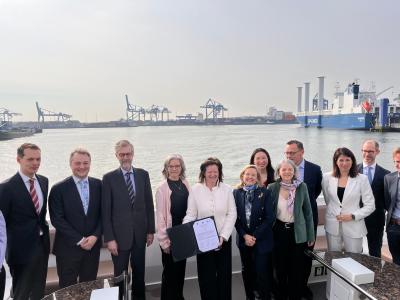
Port of Rotterdam continues greening efforts with EU financing
©EIB
Download original
Port of Rotterdam continues greening efforts with EU financing
©EIB
Download original
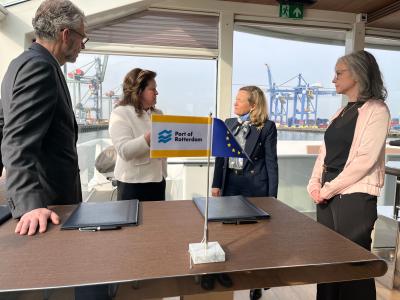
Port of Rotterdam continues greening efforts with EU financing
©EIB
Download original
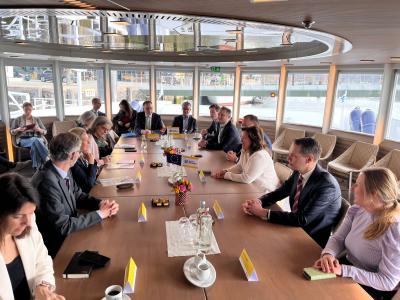
Port of Rotterdam continues greening efforts with EU financing
©EIB
Download original
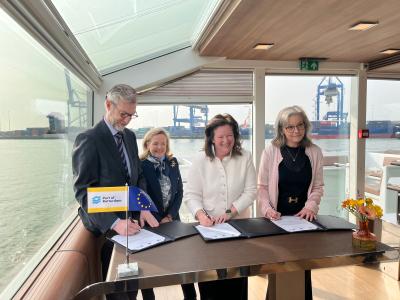
Port of Rotterdam continues greening efforts with EU financing
©EIB
Download original