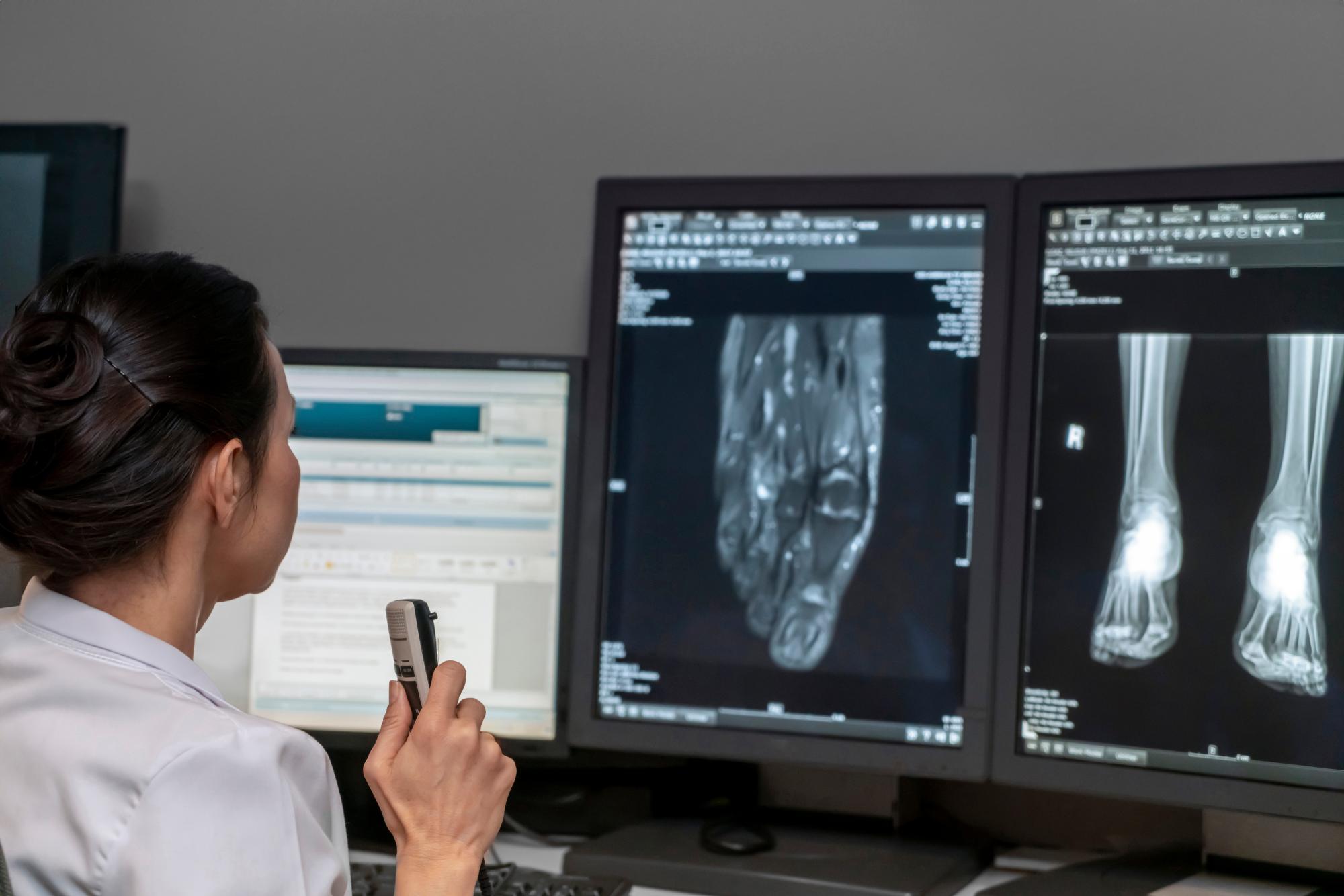
The company has more than 80 employees, including a significant number of clinicians. Its software has more than 15 000 users in over 90 countries.
Other links
Summary sheet
Release date
18 April 2023
Status
Reference
Signed | 04/04/2023
20210254
Project name
Promoter - financial intermediary
SMART REPORTING (IEU LS)
SMART REPORTING GMBH
Proposed EIB finance (Approximate amount)
Total cost (Approximate amount)
EUR 15 million
EUR 31 million
Description
Objectives
The promoter develops artificial intelligence (AI) enabled medical documentation technology to efficiently capture, structure and process clinical data at the source. The investment plan will mostly cover the development of the next generation reporting software.
The project will contribute to the digitalisation of healthcare, thereby improving efficiency and quality level, thus creating new possibilities for the use of healthcare data in clinical trials and drug development.
Additionality and Impact
The purpose of the loan is to provide direct equity-type financing under the Research, Innovation and Digitalization window of InvestEU, benefiting from the EC guarantee, to finance research and development activities of an innovative synoptic and data-driven reporting solution Company that speeds up reporting time, enhances reporting quality and improves the communication in radiology and beyond. The financing of this project addresses the failure in financial markets for RDI-driven European SMEs suffering from systemic shortages of large, non-dilutive financing options for growth investments. Creation of knowledge and support of skilled jobs in Germany will further contribute positively towards the EU's 3% RDI intensity target. Currently, the Company does not have access either to non-dilutive or to long-term debt funding sources in the necessary amount. Due to volatility of European markets which has significantly increased in 2022, access to both equity markets and commercial debt providers has been highly limited for innovative but risky companies such as Smart Reporting.
Structuring the financing as venture debt caters to the investment needs of the Company, with a long tenor and deferred interest minimising cash outflows during the investment period, while most of the EIB remuneration will be driven by the equity kicker.
Environmental aspects
Procurement
The project concerns investments in research and development activities carried out by the promoter and its partners in existing facilities without changing their already authorised scope. The research and development activities of the project do not fall under either Annex I or Annex II of the Environmental Impact Assessment (EIA) Directive 2011/92/EU amended by Directive 2014/52/EU.
The promoter is a private company not operating in the utilities sector and not having the status of a contracting authority. Thus, it is not covered by EU Directives on procurement. The Bank will require that all project contracts are procured in accordance with the applicable EU procurement legislation.
Milestone
Under appraisal
Approved
Signed
27 March 2023
4 April 2023
Related documents
Related projects
Other links
Documents
Environmental and Social Data Sheet (ESDS) - SMART REPORTING (IEU LS)
Publication Date
20 Apr 2023
Document language
Main Topic
Lending
Document Number
164611148
Document Focus
Environmental Information
Document Type
Project Number
20210254
Sector(s)
Regions
Countries
Publicly available
Download now
Link to source
Other links
News & Stories
Link to source
Other links
Inside the project
How and Why
Minimising time spent on documentation
Why
- The average doctor spends more than a third of their working hours on documentation
- 40% of European doctors are close to retirement age, so Europe has a looming physician shortage
- Radiologists are particularly in demand. Over 80% of health systems report radiology shortages
How
- Smart Reporting uses digital technology to standardise reporting and minimise time spent on documentation
- The company works with software engineers and clinicians to develop templates that could be updated regularly
- The templates include predetermined fields to input relevant information, as well as clinical background information and most recent research available on the topic
- The software is voice-controlled, so doctors operate it without a single click
Sectors & Countries

Story
Templates that save lives
In the early 2010s, Wieland Sommer was a young, enthusiastic radiologist who had just started working in one of Europe’s biggest hospitals, LMU Klinikum in Munich. It didn’t take him long to realise that, instead of focusing on his patients, he was spending most of his time on documentation. “Even in a field like radiology, which traditionally relies heavily on reporting, I felt my time could have been used better,” he says.

Then, Sommer had an idea: use digital technology to standardise reporting and minimise time spent on documentation. He founded the company and worked with software engineers to develop templates that could be updated regularly, so that clinicians always have access to the most relevant information.
Take, for example, a thorax scan. Almost 40% of thorax scans are lung cancer screenings. In that case, a radiologist can simply select the template developed for that screening. The template includes preordained fields to input relevant information, as well as clinical background information and most recent research available on the topic. The radiologist doesn’t have to start their report from scratch.
The company’s system could prove very useful for less specialised doctors in smaller hospitals who will be able to pick a relevant template to assess the patient, allowing them to make more informed decisions and diagnoses.
Story
Artificial intelligence and human doctors
Smart Reporting is also integrating artificial intelligence into its tool. AI measures the size of registered anomalies on a patient’s scan, so when they take their next scan, their doctor can easily compare the results and see if any significant changes occurred since their previous visit. “The software automatically integrates the AI findings into the report, without replacing the doctor,” says Peter Vanovertveld, the company’s co-chief executive.

Making invisible visible
Reports produced with Smart Reporting software consist of data that can be mined for further medical research. Currently, only 3% of the data collected in hospitals can be evaluated for other purposes.
Much as radiology turns the invisible visible, this software detects what is hidden below the surface. For example, trends in population health. “Imagine if this tool had been widespread back in 2019 when the first COVID-19 cases started popping up,” says Vanovertveld. “Hospital management, with access to the platform, could have noticed that something unusual was happening.”
Maybe, we will be able to prevent the next pandemic.
Related media
The invisible made visible
A German health tech startup is using artificial intelligence to reduce time spent on medical reports, digitalise healthcare and improve patient care.
Links
Related projects and stories
Energy storage: EIB Group supports EU tripartite initiative
The European Investment Bank (EIB) Group supports a new EU-level initiative to scale up energy storage as part of the clean energy transition. Announced alongside the meeting of EU energy ministers in Luxembourg, the tripartite agreement brings together public authorities, energy storage and renewables developers, and financial institutions to accelerate storage deployment, strengthen the energy system, stabilise prices and reduce reliance on fossil fuels.
EIB Global supports Trans-Caspian Transport Corridor with €150 million for road rehabilitation in Kazakhstan
The European Investment Bank (EIB) is providing a €150 million framework loan to Kazakhstan to support the rehabilitation of strategic road infrastructure along the Trans-Caspian Transport Corridor (TCTC), a key route connecting Central Asia and Europe.
Backed by the European Union under the Global Europe (NDICI) framework, the financing will support investments implemented by Kazakhstan's national road operator QazAvtoZhol. The operation will improve transport connectivity, strengthen road safety and climate resilience, and facilitate trade and economic development across the region.
The investment forms part of the European Union's Global Gateway strategy and follows the Memorandum of Understanding signed between the EIB and Kazakhstan in 2024 to strengthen sustainable transport connections between Europe and Asia.
The programme will finance the rehabilitation of approximately 1,370 kilometres of roads across central and southern Kazakhstan, including sections linking the country with neighbouring Central Asian states. By improving transport efficiency and resilience, the investment will reduce travel times, improve road conditions and facilitate the movement of goods and people along one of the region's most important transport corridors.
EIB Vice-President Marek Mora, who oversees the Bank's operations in Central Asia, including Kazakhstan, said:
"Good roads do more than connect places on a map. They connect people, they let businesses reach new markets, make travel safer and faster, and create opportunities for communities. By investing in key transport links across Kazakhstan, we are supporting a corridor that is becoming increasingly important for trade between Europe and Central Asia while delivering tangible benefits locally. Hard infrastructure is the backbone for trades. This is what sustainable connectivity is about: creating practical connections that support growth, resilience and cooperation."
EU Commissioner for International Partnerships, Jozef Síkela, stated:
"The Trans-Caspian Transport Corridor is playing an increasingly important role in connecting Europe and Central Asia. Through this investment, and together with our partners, we are supporting the development of safer, more resilient and more efficient transport infrastructure in Kazakhstan. This is a tangible example of Global Gateway in action, strengthening regional connectivity, supporting sustainable economic development and deepening our partnership with Kazakhstan and the wider region."
EU Ambassador to Kazakhstan Aleška Simkić commented:
"The Trans-Caspian Transport Corridor is one of the key priorities under the EU's Global Gateway strategy. Developing efficient, reliable and sustainable transport connections between Central Asia and Europe strengthens trade, enhances economic cooperation and contributes to the resilience of global supply chains. This investment demonstrates the European Union's long-term commitment to fostering connectivity, prosperity, and strong partnerships across the region."
The programme is expected to generate around 5,900 person-years of employment during implementation, creating opportunities for local communities and supporting economic activity. By strengthening one of the main transport links between Central Asia and Europe, the investment will facilitate trade, improve regional connectivity and contribute to the objectives of the EU-Kazakhstan partnership and the Global Gateway strategy.
EIB and Swedbank have secured EUR 200.75 million in financing for the developer of the Rūdninkai Military Town
The developer of part A of stage II of the Rūdninkai Military Town project, Rudina, has signed loan agreements with the European Investment Bank (EIB) and Swedbank: each institution is providing a loan of EUR 100.37 million. Rudina is indirectly managed by the INVL fund ‘INVL Defence Infrastructure Fund I’, together with the construction companies Conres and Fegda.