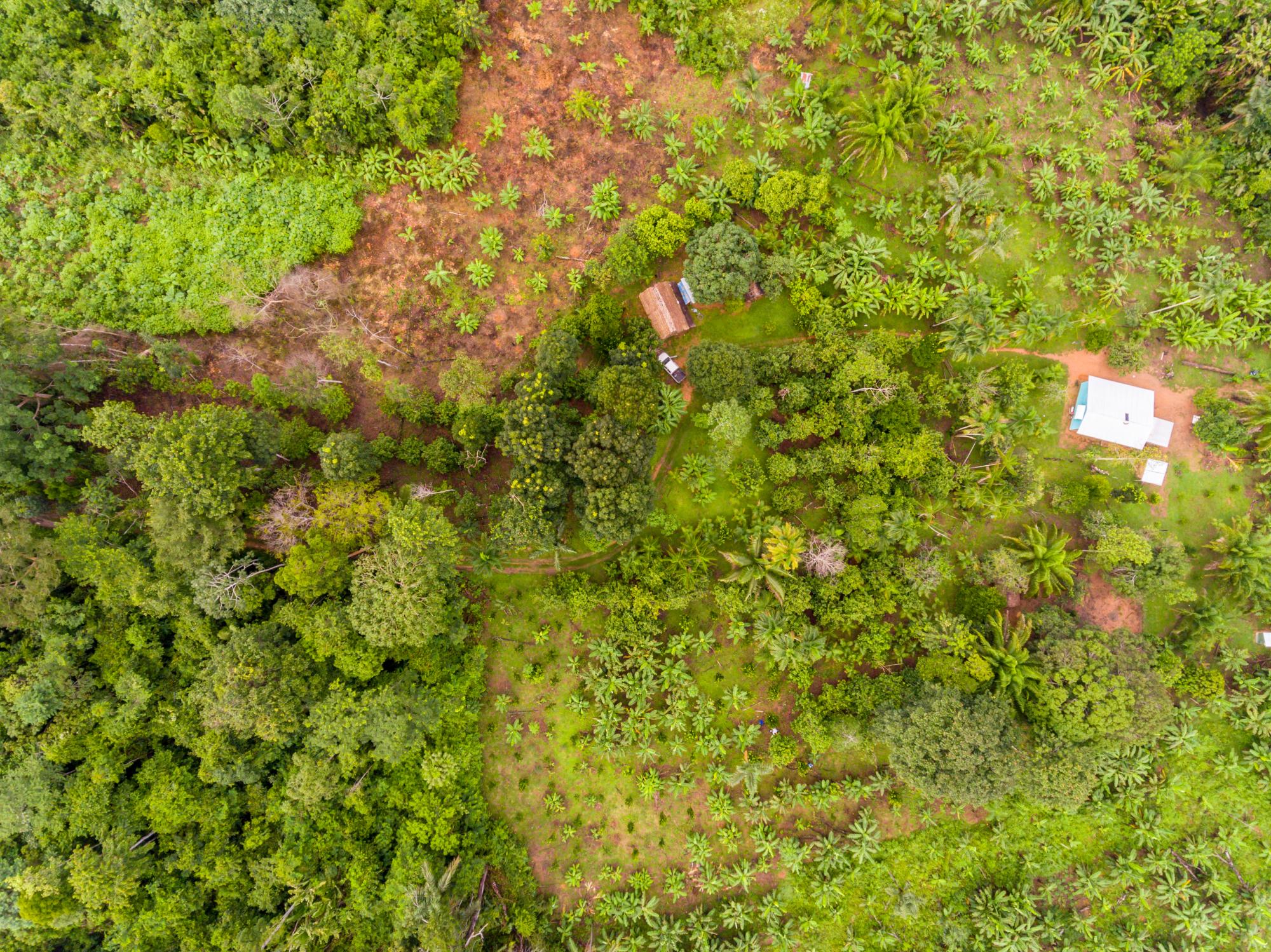
We have to make agriculture less resource-intensive, more productive and more sustainable.
>> “Climate Solutions” is also available as a podcast and an e-book.
By Janel Siemplenski Lefort, Arnold Verbeek, Surya Fackelmann and Brendan McDonagh
Our quest for food has historically come at the planet’s expense. For millennia, nature was pushed aside to make room for growing crops and raising animals.
As much as half of the Earth’s forests were felled over the last 5 000 years. In the first decade of this century, tropical countries lost seven million hectares of forests each year, mainly for agriculture.
Nourishing the world’s 7.6 billion people is degrading ecosystems, depleting water resources and driving climate change. Agriculture for food and for non-food products like leather accounts for over one-third of global greenhouse gas emissions and roughly one-third of global energy demand, much of which comes from non-renewable sources. Part of the carbon emissions come from food production, but another big part comes from the clearing of forests, which eliminates important carbon sinks.
The world’s population is expected to hit 11 billion by 2100. If we are to feed everybody without destroying the last of our natural resources, agriculture needs to find a way to coexist with Mother Nature. We have to make agriculture more efficient through innovation, reduce the roughly 30% of food that is currently lost or wasted and rethink what and how we eat.
What is agriculture’s carbon footprint?
Agriculture for food and other products like leather account for over 30% of global greenhouse gas emissions and roughly 30% of global energy demand, much of which comes from non-renewable sources. Part of the carbon emissions come from food production, but another big part comes from the clearing of forests, which eliminates important carbon sinks.
Europe’s role
The European Union is the largest trader of agricultural goods in the world. As such, it has an important role to play in reshaping agriculture.
Along with being an important source of exports, agriculture is also a major employer in Europe. The food and beverage industry accounts for 9% of the European Union’s gross domestic product and employs about 15.4 million people. It is often the biggest employer in disadvantaged regions.
Despite its huge size, European agriculture isn’t as productive as it could be. Small-scale farms dominate – 73% of all farms are family businesses. The owners of those small farms often have difficulty getting financing for innovative projects. New innovative machinery, for example, is expensive and the investment is hard to recoup on a small farm. Farmers are also naturally cautious and reluctant to take risks with new ways of working. That lack of innovation weighs on agriculture’s productivity. Labour productivity in European agrifoods is equal to about 67% of the automotive industry and 71% of the engineering sector.
One reason for that lower productivity is a lack of investment. Agrifood companies in the European Union invest only 0.2% of their annual revenue in innovation, according to research by the European Investment Bank, compared with 0.44% for American firms or 0.65% for Japanese companies.
Those low investment levels are partly due to a dearth of financing in Europe, particularly venture capital funds for start-ups and innovative projects. Total annual venture capital investment in the United States is four times the level of the European Union.
That gap needs to close if Europe is going to produce more food, more sustainably.
What is the amount of food waste globally?
About 25-30% of the food produced globally is wasted. Wasted food accounted for 8-10% of greenhouse gas emissions (carbon, methane, nitrous oxide and fluorinated gases) from 2010-2016.
Food waste apps
A host of apps have sprung up in recent years to help combat food waste. Some of them, like FoodCloud, put restaurants and other businesses with surplus food in touch with local charities. Others, like Karma and OptiMiam, help restaurants, cafes and grocery stores sell their leftover food to individuals.
Other apps, like Too Good To Go, are veritable “waste warriors.” Too Good to Go has a four-pillar approach to cutting waste – households, businesses, education and politics – with specific outreach goals assigned to each pillar. Originally inspired by a Dutch food app, Too Good to Go has lists of food offerings from local stores and restaurants that individuals can order and then pick up at a specified time. The rapidly expanding company has 350 employees and a long list of job openings in Europe. Too Good To Go currently operates in 12 European countries.
Apps to cut food waste
A number of apps have sprung up in recent years to help individuals and businesses tackle food waste. Some of them sell restaurants’ leftover food at discounted prices, while others help people better organise their kitchens to prevent food from being forgotten at the back of the pantry.
Below are just some of the food waste apps available.
- FoodCloud puts restaurants and other businesses with surplus food in touch with local charities.
- OptiMiam helps restaurants, cafes and grocery stores sell their leftover food to individuals.
- Too Good to Go has lists of food offerings from local stores and restaurants that individuals can order and then pick up at a specified time.
- Olio connects neighbours and local businesses with each other to avoid good food being thrown away, be it vegetables from your garden or food in your fridge before you leave on vacation.
- Magic Fridge helps cut down on food waste at home by offering recipes that use food you already have in your kitchen.
- Karma connects consumers with low-price surplus food from restaurants, cafes and grocery stores. Founded in Stockholm in 2016, the company is now active in 150 Swedish cities along with London and Paris.
- Zéro Gachis (No Waste – not to be confused with the No Waste food inventory app) is another app that links soon-to-expire products from supermarkets with local consumers.
- A Consommer. (To Consume) allows you to register the food in your cupboard and be alerted when it is about to expire. You simply enter the details of the food, where it is stored in your kitchen and the expiry date (or an estimation for fresh fruits and vegetables).
- Save Eat stores an inventory of your fridge and kitchen pantry, and can alert you when items are about to expire. In addition, the app proposes recipes using the food you already have at hand.
Arnold Verbeek is a senior adviser and Surya Fackelmann is an analyst in Innovation Finance Advisory at the European Investment Bank. Brendan McDonagh is an advisor at the European Investment Advisory Hub, but contributed through his previous work at Innovation Finance.
>> “Climate Solutions” is also available as a podcast and an e-book.
1. Kritikos, 2017
2. Blockchain: A blockchain records data across a peer-to-peer network. Every participant can see the data and verify or reject it using consensus algorithms. Approved data is entered into the ledger as a collection of “blocks” and stored in a chronological "chain" that cannot be altered (SAP, 2018).
3. Blockchain, 2018