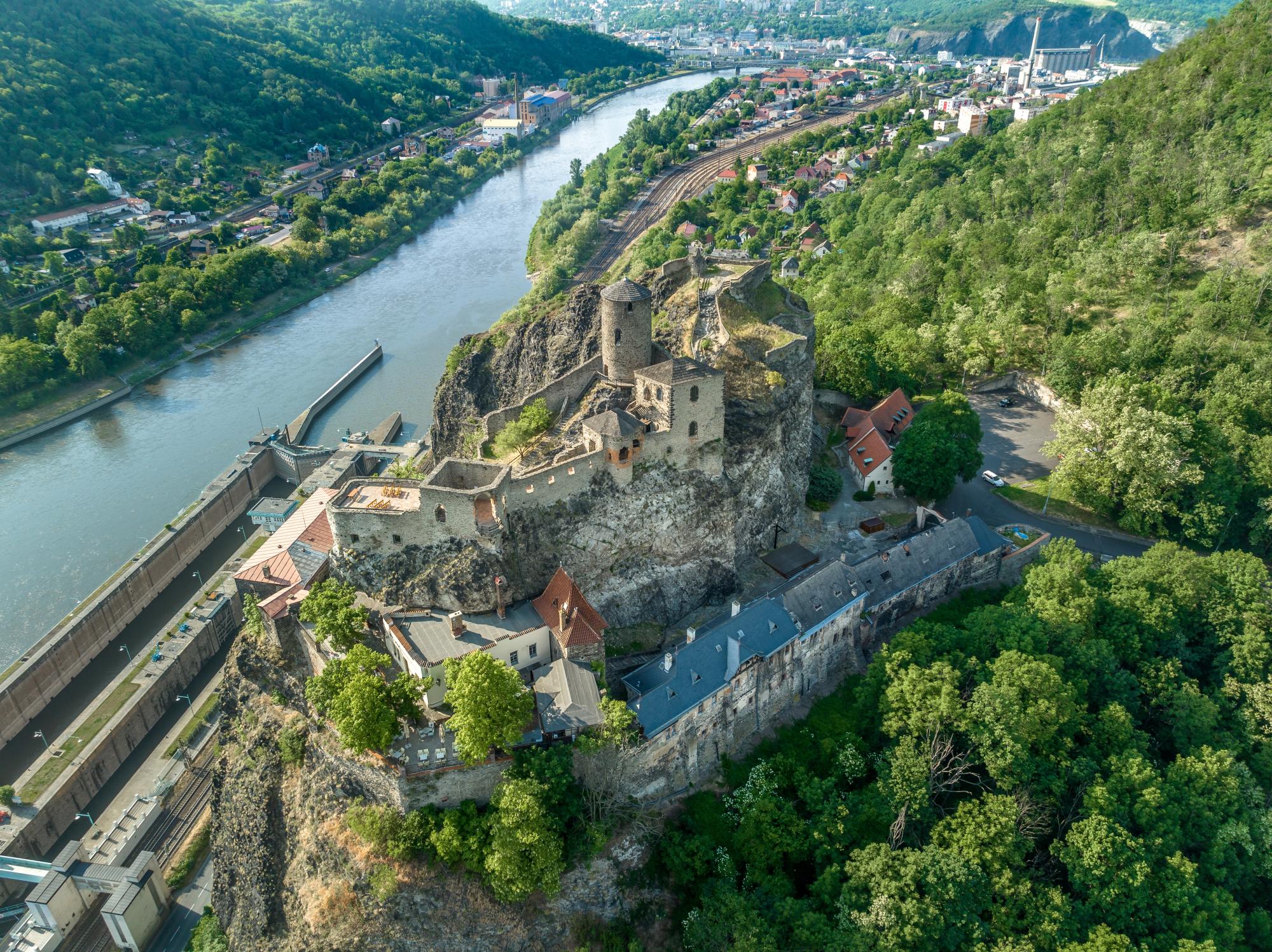
Střekov Castle (pictured above) overlooks the Czech city of Ústí nad Labem and is a marker of its early years, the beginning of a rich history that saw the area reach a peak of influence and prosperity during the industrial era.
“The view from Střekov Castle is beautiful in every season,” says Petr Nedvědický, the mayor of Ústí nad Labem, “but I personally prefer autumn, because it is incredibly picturesque. I love the colours.”
Nowadays, Ústí nad Labem faces new challenges. It remains a university town with almost 9,000 students enrolled at Jan Evangelista Purkyně University. It is in a good geographical location, but it wants to modernise and create a sustainable and liveable place with a thriving local economy and all the attributes needed for residents of all ages.
The European Investment Bank and EIB Advisory officers are helping the city to do exactly that. The city and the Bank signed a loan worth about €43 million in 2024 to help a variety of targets in energy efficiency and renewable energy in municipal buildings.

The importance of experience
The city also used an EIB technical assistance programme, including an ELENA grant that helps energy efficiency and renewables, as well as availing of advisory for project preparation channelled through the InvestEU Advisory Hub. The city has targeted several areas for energy efficiency projects, including public administration buildings, educational facilities, care homes for the elderly and the city zoo.
“We are not building new public buildings, but we are investing in our inherited assets and addressing them in the way they deserve, from measures in energy efficiency to accessibility for all,” the mayor explains.
The ELENA programme provided the city with a team that offered knowledge sharing and other advice. “Before, we had city officials who have different levels of project management experience, but perhaps not in the exact fields required,” Nedvědický says.
Petr Krause, the project manager for the city, stresses the importance of applying lessons learnt elsewhere. “This is a new kind of programme for our city,” he explains. “EIB technical assistance is enabling us to put the right teams and people in place. The expertise is there, and now the important aspects are to communicate effectively, and to explain complex topics clearly.”
EIB technical support helped select appropriate technologies, establish monitoring systems as well as enhancing planning and tender preparation, Krause says.

A symbol of the city
One of the most visible investments is the city’s zoo, which attracts around 160 000 visitors a year.
“In many Czech cities, the local zoo is a point of pride,” says Kamil Dörfler, an urban development specialist at the European Investment Bank, “It is part of the heritage.”
The city gave priority to zoo projects because this can save a lot of energy and cut running costs. The zoo is using geothermal energy for part of its heating.
All the zoo’s upgrades “start with the animals in mind,’’ says Ilona Pšenková, director of the zoo. “Improving their living conditions is imperative.” This approach is reflected in the renovated spaces for endangered primates, including aye-ayes and lorises, and in new areas that help visitors learn about biodiversity in the Congo rainforest.
The EIB technical assistance also improves people’s skills and gives access to practical sustainability solutions that weren’t available before, Pšenková adds.
All zoo facilities are about conservation and education. For example, the Slow Loris Ark installation is part of a wider loris breeding programme, but also serves coffee grown in Indonesia, from growers committed to not hunting endangered species. Madagascar at Night reverses day and night to inform visitors about the island’s nocturnal species and show them in action.
Improving the conditions for young and old
All the steps taken for the city improve lives and create opportunities for people. The building upgrades and renewable energy installations will cut electricity and gas consumption, reduce emissions and save money. And people are happier when they live or work in renovated buildings, Krause says. For young people, all the projects should offer them what they expect – quality housing, affordability and proximity to major centres like Dresden and Prague, says Nedvědický, the mayor.
Even the zoo is helping to keep people happy.
“We may just be a zoo, but we play a different role to different people,” Pšenková says. “For some, we might be a place to have a coffee on a Sunday afternoon, for others we are a place to learn about nature and the environment. But if we can show 160,000 visitors a successful move to sustainability, that is mission accomplished.”

USTI NAD LABEM MUNICIPAL INFRA
Improvement of municipal infrastructure in the City of Usti nad Labem.
USTI NAD LABEM MUNICIPAL INFRASTRUCTURE II
Modernisation of municipal infrastructure of the City of Usti nad Labem.