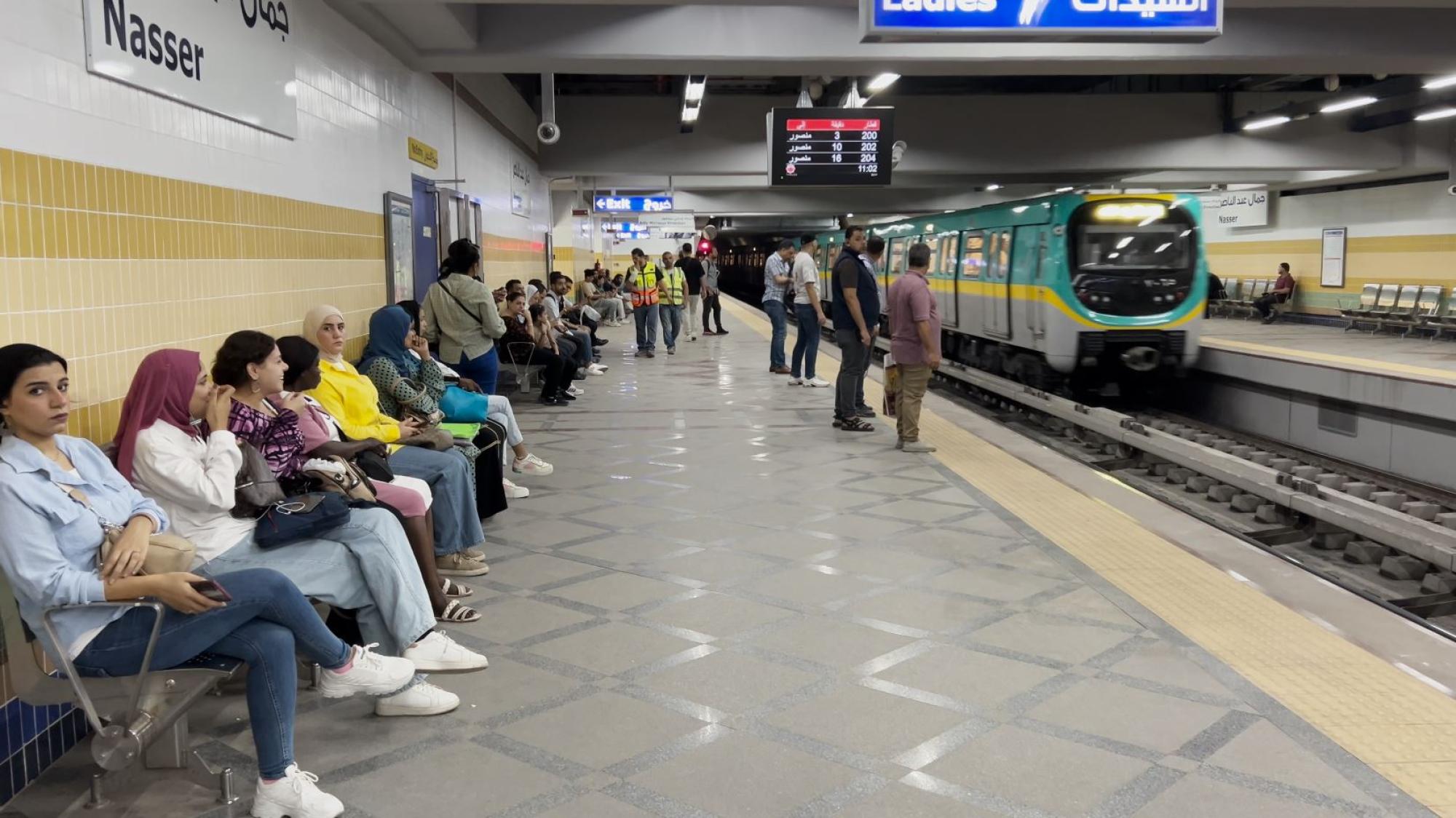
The metro is one of the greatest projects in Egypt. The metro has been made very simple, safe and easy for everyone.
Other links
Summary sheet
Release date
4 November 2011
Status
Reference
Signed | 14/11/2012
20100613
Project name
Promoter - financial intermediary
CAIRO METRO LINE 3 (PHASE 3)
National Authority for Tunnels (NAT)
Proposed EIB finance (Approximate amount)
Total cost (Approximate amount)
EUR 600 million
EUR 2418 million
Description
Objectives
Extension of Line 3 (Phase 3) of the Cairo Metro with 17 km to serve the main transportation corridors of urban greater Cairo.
The project is part of the Greater Cairo's Transport Master Plan and is expected to greatly reinforce the public transport system in this area, thus promoting a positive modal shift from private cars and therefore alleviating congestion and associated environmental problems, contributing to climate change mitigation.
Environmental aspects
Procurement
The project has to meet the environmental and social requirements of the Bank based on EU policy. If located in the EU, the project would fall under Annex II of EIA Directive 85/337/EEC as amended, leaving it up to the competent authority to decide whether an EIA is required or not. A full ESIA is required for metro projects by the Egyptian legislation, including public consultation. The Promoter is at an early stage of the EIA process and in the preparation of the project's resettlement related documents. The Bank shall verify if the EIA process, including public consultation, is carried out in accordance to the Bank's environmental and social requirements and that appropriate mitigation and compensation measures are properly identified and adopted as part of an Environmental and Social Management Plan. The legal and policy framework for compensation, resettlement and rehabilitation under the project is defined by the relevant Egyptian laws and regulations and by EIB's guidance note on involuntary resettlement. An acceptable progress on these aspects will include the preparation of a Resettlement Framework (RF) and a Resettlement Action plan (RAP).
The project has to comply with the basic principles of the EU policy on procurement, in particular as established in Directives 2004/17/EU and 2004/18/EU, and with the EIB's Guide to Procurement. As usual, the Bank will include a clause to this effect in the finance contract. The Promoter has already started the procurement process by launching the prequalification processes for both the consultancy services for works supervision and for the construction works. The Bank has reviewed the corresponding prequalification documents and has provided its comments. Both tender notices have been published in Egyptian newspapers and in the OJEU. During appraisal, the procurement procedures followed by the Promoter will be analysed in order to ensure that the project is being procured on the basis of an open and international competition and in line with the principles of transparency and fairness. The procurement plan of the Promoter will also be carefully analysed.
Under ELM Guarantee
Comments
This operation is covered by the ELM Guarantee.
This operation is covered by the EU Guarantee for EIB loans outside the EU.
Related documents
Other links
Related publications
Documents
Environmental and Social Impact Assessment (ESIA) - CAIRO METRO LINE 3 (PHASE 3) - Resettlement Action Plan
Publication Date
5 Mar 2016
Document language
Main Topic
Lending
Document Number
47048404
Document Focus
Environmental Information
Document Type
Project Number
20100613
Sector(s)
Regions
Countries
Publicly available
Download now
Environmental and Social Impact Assessment (ESIA) - CAIRO METRO LINE 3 (PHASE 3) - Additional Services for Cairo Metro Line 3 - Phase 3
Publication Date
16 Apr 2016
Document language
Main Topic
Lending
Document Number
47052553
Document Focus
Environmental Information
Document Type
Project Number
20100613
Sector(s)
Regions
Countries
Publicly available
Download now
Environmental and Social Impact Assessment (ESIA) - CAIRO METRO LINE 3 (PHASE 3) - Stakeholder Engagement Plan
Publication Date
5 Mar 2016
Document language
Main Topic
Lending
Document Number
47050790
Document Focus
Environmental Information
Document Type
Project Number
20100613
Sector(s)
Regions
Countries
Publicly available
Download now
Environmental and Social Impact Assessment (ESIA) - CAIRO METRO LINE 3 (PHASE 3) - Public Consultation Report
Publication Date
5 Mar 2016
Document language
Main Topic
Lending
Document Number
47048709
Document Focus
Environmental Information
Document Type
Project Number
20100613
Sector(s)
Regions
Countries
Publicly available
Download now
Environmental and Social Data Sheet (ESDS) - CAIRO METRO LINE 3 (PHASE 3)
Publication Date
29 May 2015
Document language
Main Topic
Lending
Document Number
54885885
Document Focus
Environmental Information
Document Type
Project Number
20100613
Sector(s)
Regions
Countries
Publicly available
Download now
Environmental and Social Impact Assessment (ESIA) - CAIRO METRO LINE 3 (PHASE 3) - Resettlement Action Plan - Metro Line_Phase 3_Line 3
Publication Date
9 Dec 2016
Document language
Main Topic
Lending
Document Number
66530980
Document Focus
Environmental Information
Document Type
Project Number
20100613
Sector(s)
Regions
Countries
Publicly available
Download now
Link to source
Other links
News & Stories
Link to source
Other links
Inside the project
How and Why
Disconnecting transport from pollution
Why
- Reduce pollution and noise
- More efficient transport
- Climate action with clean energy (electric-powered transport)
- Gender equality – women feel safer using new metro
- Helps employment and education
How
- Encouraging people to leave cars at home and to use the metro cuts down on emissions and traffic noise
- Fewer cars on the road means fewer traffic jams
- Electric trains are better for the environment
- When women feel safer using public transport, they can get better jobs and an improved education
Sectors & Countries

Story
Leaving cars at home
Kristeen Emad, who works in the accounts department at Cairo Tower, the best place for a panoramic view of the city from nearly 200 metres up, says the recent expansion and improvement of the Cairo metro makes life easier. There are too many cars and other vehicles on the roads, she says.

“If there is a lot of traffic, I always take the metro, as I know it will save me a lot of time and effort getting from one point to another,” she says. “If a trip normally takes an hour in a car or bus, the metro may take half an hour.”
Cairo’s metro system opened in 1987 and was one of the first of its kind in Africa and the Middle East. Several metro lines cover a large part of the city and carry millions of passengers each day.
The European Investment Bank helped to expand many parts of the metro and has been assisting other big transport projects for more than four decades. In 2021, the Bank announced it would invest more than €1 billion on metro and tram projects in Cairo and Alexandria over five years.
Line 3 is as modern as any metro service in the world, with air conditioning, security and lighting, modern ticket booths and separate cars for women. In 2023, the Bank is working on a new investment to expand and modernize line 1 of Cairo’s metro.
Today in Cairo, many people can’t imagine not having a metro. From an economic point of view, the metro is very important in cutting down on congestion and helping people get to their jobs.
Story
Ancient monuments, modern metro
Noura Saad works as a librarian in Giza, on the west bank of the Nile near the famous Sphinx and the Great Pyramid. For many years, she used a car or bus to get work, battling traffic jams and delays. Today, her commute is very different.
"The metro, for me, is the fastest way in Cairo's traffic, as I save more than an hour when I take the metro to work,” says Saad. "It is indispensable for most of my trips, to escape from Cairo's transport congestion and avoid using buses or taxis."

When Saad takes the metro from her home in Al Marj, 30 kilometres from her job, she avoids using a car or bus and no longer wastes two hours or more in traffic.
The transport changes are also good for the climate. There is a considerable need to reduce car use in Cairo, one of most congested cities in the world, where air pollution is often higher than the World Health Organisation’s recommendations.
Related media
Ancient monuments, modern metro
Egypt green transport projects transform travel in two of Africa’s biggest cities, Cairo and Alexandria. Here’s how Egypt plans to make big cities sustainable
A drive to develop
In developing countries transport drives economic growth and social inclusion. Here’s how transport projects help people live better lives around the world—and fight the emissions that fuel climate change
Four decades in Egypt
From massive transport projects to loans for small businesses, the European Investment Bank has backed Egyptian development since 1979.
Links
Related projects and stories
EIB and Swedbank have secured EUR 200.75 million in financing for the developer of the Rūdninkai Military Town
The developer of part A of stage II of the Rūdninkai Military Town project, Rudina, has signed loan agreements with the European Investment Bank (EIB) and Swedbank: each institution is providing a loan of EUR 100.37 million. Rudina is indirectly managed by the INVL fund ‘INVL Defence Infrastructure Fund I’, together with the construction companies Conres and Fegda.
Transport Investment Summit to Accelerate Projects in the Western Balkans, Ukraine and Moldova
Under the theme “Delivering Growth and Competitiveness through Connectivity,” the Transport Summit opened today in Thessaloniki, with a focus on turning strategic connectivity priorities into investment-ready projects. Bringing together partners from the Western Balkans, Ukraine and Moldova, discussions will focus on the implementation of the TEN-T extension, opportunities related to the EU Growth Plan, donor coordination, project preparation and enhanced public-private cooperation.
EIB Global named Development Lender of the year by Uxolo Pathfinder Awards
The European Investment Bank’s (EIB) development arm, EIB Global, today received the “Development Lender of the Year” title at the prestigious Uxolo Pathfinder Awards.