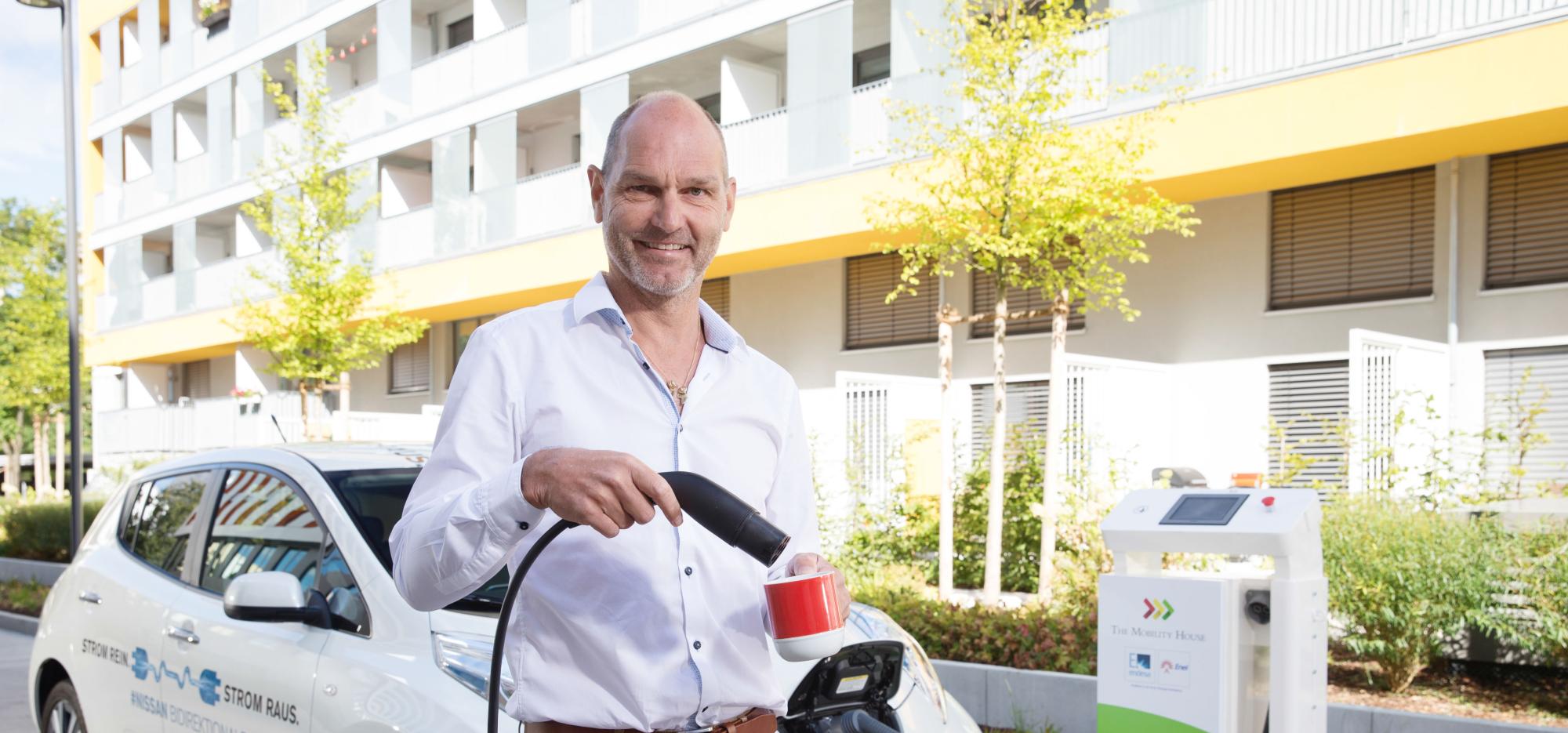
"Our charging and energy management system helps minimise grid expansion costs by up to 70%, stabilising the power supply and improving the CO2 balance of an electric car by almost double."
Signature(s)
Amount
€ 15,000,000
Countries
Sector(s)
Energy
: € 15,000,000
Signature date(s)
7/08/2020 : € 2,875,000
7/08/2020 : € 2,875,000
7/08/2020 : € 9,250,000
Other links
Summary sheet
Release date
14 April 2020
Status
Reference
Signed | 07/08/2020
20180604
Project name
Promoter - financial intermediary
NEW CHARGING AND ENERGY STORAGE SOLUTIONS (EDP)
THE MOBILITY HOUSE AG
Proposed EIB finance (Approximate amount)
Total cost (Approximate amount)
EUR 15 million
EUR 31 million
Location
Sector(s)
- Energy - Electricity, gas, steam and air conditioning supply
Description
Objectives
The project will finance the growth of the company in the energy storage and vehicle-to-grid sectors in the period 2020-2023.
The company provides innovative charging and energy storage solutions for the mobility and energy industries. Its proprietary technology digital platform allows the integration of electric vehicles (EVs) into the power grid to charge and discharge their batteries along with stationary battery storage assets. This requires the aggregation and leverage of the energy storage potential of pools of EVs batteries as stationary storage devices in order to provide energy and power services to the electricity grid and thereby enabling "internet of storage" solutions.
Environmental aspects
Procurement
The project concerns the installation of smart charging devices in residential and commercial/industrial facilities. As per Environmental Impact Assessment (EIA) Directive 2014/52/EU amending the Directive 2011/92/EU, an EIA is not required for this project. E&S related topics will be investigated at appraisal.
The promoters have been assessed by the EIB as being private companies not being subject to EU rules on public procurement or concessions.
Related documents
Other links
Documents
Environmental and Social Data Sheet (ESDS) - NEW CHARGING AND ENERGY STORAGE SOLUTIONS (EDP)
Publication Date
3 Jul 2020
Document language
Main Topic
Lending
Document Number
130222049
Document Focus
Environmental Information
Document Type
Project Number
20180604
Sector(s)
Regions
Countries
Publicly available
Download now
Environmental and Social Completion Sheet (ESCS) - NEW CHARGING AND ENERGY STORAGE SOLUTIONS (EDP)
Publication Date
28 Nov 2024
Document language
Main Topic
Lending
Document Number
223763116
Document Focus
Environmental Information
Document Type
Project Number
20180604
Sector(s)
Regions
Countries
Publicly available
Download now
Link to source
Other links
News & Stories
Link to source
Other links
Inside the project
How and Why
Electric cars on the grid
Why
- Power generated by renewable sources varies with the weather rather than demand. The batteries in electric vehicles can help balance mismatches and make better use of renewable power
- Electric vehicles are needed to reduce CO2 emissions from transport. Bidirectional charging greatly improves the CO2 balance of electric cars, making them even more sustainable and competitive
- An innovative European start-up with technology to make transport more sustainable that’s creating jobs
How
- The company’s innovative technology enables electric cars to contribute to the grid, as well as draw from it, turning them into batteries on wheels that can help stabilise the network and reduce the need for grid expansion
- By allowing electric cars to play an active role in the network, the technology dramatically improves their CO2 balance
- Founded in 2009, The Mobility House employs around 160 people in Germany, Switzerland and the US
Sectors & Countries

Story
Clean energy in cars brewing coffee
Thomas Raffeiner is chief executive of The Mobility House, a Munich-based company whose technology allows the use of electricity from parked electric vehicles to be fed into the electrical grid or used to power homes. This so-called “bidirectional charging” is viewed as an important step in the transition to renewable energy.
"Our charging and energy management system helps minimise grid expansion costs by up to 70%, stabilising the power supply and improving the CO2 balance of an electric car by almost double,” says Raffeiner. “We want to create a zero-emission future, and bidirectional charging is a good way to reach this goal."
The company’s charging and energy management technology, ChargePilot, is based on an open interface architecture which allows the remote and intelligent control of charging processes, according to the grid’s needs. The software monitors electricity peaks and off-peak hours, giving ChargePilot users the opportunity to decide whether and when to charge or discharge their batteries, depending on the demand for energy.
Excess generated power can be returned to the grid, optimising charging costs and grid performance. Even parked e-vehicles would have a role in this electrification revolution, since they would act as temporary energy storage devices.

"Thanks to thematic finance envelopes such as the InnovFin Energy Demonstration Projects facility or the CEF Future Mobility programme, the EIB, as Europe’s climate bank, has the right tools to support innovative companies like The Mobility House."
Bidirectional charging investment boosts ChargePilot
The Mobility House’s technology supports the rollout of electric vehicles along with their cost-effective integration into the power grid in Europe through bidirectional charging. It’s split between Vehicle-to-Grid (V2G) and Vehicle-to-Home (V2H) applications.
The company’s charging and energy management technology, ChargePilot, is based on an open interface architecture which allows the remote and intelligent control of charging processes, according to the grid’s needs. The software monitors electricity peaks and off-peak hours, giving ChargePilot users the opportunity to decide whether and when to charge or discharge their batteries, depending on the demand for energy.
Excess generated power can be returned to the grid, optimising charging costs and grid performance. Even parked e-vehicles would have a role in this electrification revolution, since they would act as temporary energy storage devices.
The Mobility House has proven that it is even possible to brew your own coffee with green energy derived from a parked e-vehicle’s battery.

Related media
I Got a Job: Elizabeta and the car industry clean-up in Croatia
In Croatia jobs were scarce, so Elizabeta Žalac thought she would have to leave home to find work. But an EU investment helped keep this talented young engineer in her native country.
Austria drives car research
Powertrain R&D for Austria electric car aims to fight climate change and boost innovation, with hybrids and automated cars too
Links
Related projects and stories
Energy storage: EIB Group supports EU tripartite initiative
The European Investment Bank (EIB) Group supports a new EU-level initiative to scale up energy storage as part of the clean energy transition. Announced alongside the meeting of EU energy ministers in Luxembourg, the tripartite agreement brings together public authorities, energy storage and renewables developers, and financial institutions to accelerate storage deployment, strengthen the energy system, stabilise prices and reduce reliance on fossil fuels.
EIB Global supports Trans-Caspian Transport Corridor with €150 million for road rehabilitation in Kazakhstan
The European Investment Bank (EIB) is providing a €150 million framework loan to Kazakhstan to support the rehabilitation of strategic road infrastructure along the Trans-Caspian Transport Corridor (TCTC), a key route connecting Central Asia and Europe.
Backed by the European Union under the Global Europe (NDICI) framework, the financing will support investments implemented by Kazakhstan's national road operator QazAvtoZhol. The operation will improve transport connectivity, strengthen road safety and climate resilience, and facilitate trade and economic development across the region.
The investment forms part of the European Union's Global Gateway strategy and follows the Memorandum of Understanding signed between the EIB and Kazakhstan in 2024 to strengthen sustainable transport connections between Europe and Asia.
The programme will finance the rehabilitation of approximately 1,370 kilometres of roads across central and southern Kazakhstan, including sections linking the country with neighbouring Central Asian states. By improving transport efficiency and resilience, the investment will reduce travel times, improve road conditions and facilitate the movement of goods and people along one of the region's most important transport corridors.
EIB Vice-President Marek Mora, who oversees the Bank's operations in Central Asia, including Kazakhstan, said:
"Good roads do more than connect places on a map. They connect people, they let businesses reach new markets, make travel safer and faster, and create opportunities for communities. By investing in key transport links across Kazakhstan, we are supporting a corridor that is becoming increasingly important for trade between Europe and Central Asia while delivering tangible benefits locally. Hard infrastructure is the backbone for trades. This is what sustainable connectivity is about: creating practical connections that support growth, resilience and cooperation."
EU Commissioner for International Partnerships, Jozef Síkela, stated:
"The Trans-Caspian Transport Corridor is playing an increasingly important role in connecting Europe and Central Asia. Through this investment, and together with our partners, we are supporting the development of safer, more resilient and more efficient transport infrastructure in Kazakhstan. This is a tangible example of Global Gateway in action, strengthening regional connectivity, supporting sustainable economic development and deepening our partnership with Kazakhstan and the wider region."
EU Ambassador to Kazakhstan Aleška Simkić commented:
"The Trans-Caspian Transport Corridor is one of the key priorities under the EU's Global Gateway strategy. Developing efficient, reliable and sustainable transport connections between Central Asia and Europe strengthens trade, enhances economic cooperation and contributes to the resilience of global supply chains. This investment demonstrates the European Union's long-term commitment to fostering connectivity, prosperity, and strong partnerships across the region."
The programme is expected to generate around 5,900 person-years of employment during implementation, creating opportunities for local communities and supporting economic activity. By strengthening one of the main transport links between Central Asia and Europe, the investment will facilitate trade, improve regional connectivity and contribute to the objectives of the EU-Kazakhstan partnership and the Global Gateway strategy.
EIB and Swedbank have secured EUR 200.75 million in financing for the developer of the Rūdninkai Military Town
The developer of part A of stage II of the Rūdninkai Military Town project, Rudina, has signed loan agreements with the European Investment Bank (EIB) and Swedbank: each institution is providing a loan of EUR 100.37 million. Rudina is indirectly managed by the INVL fund ‘INVL Defence Infrastructure Fund I’, together with the construction companies Conres and Fegda.