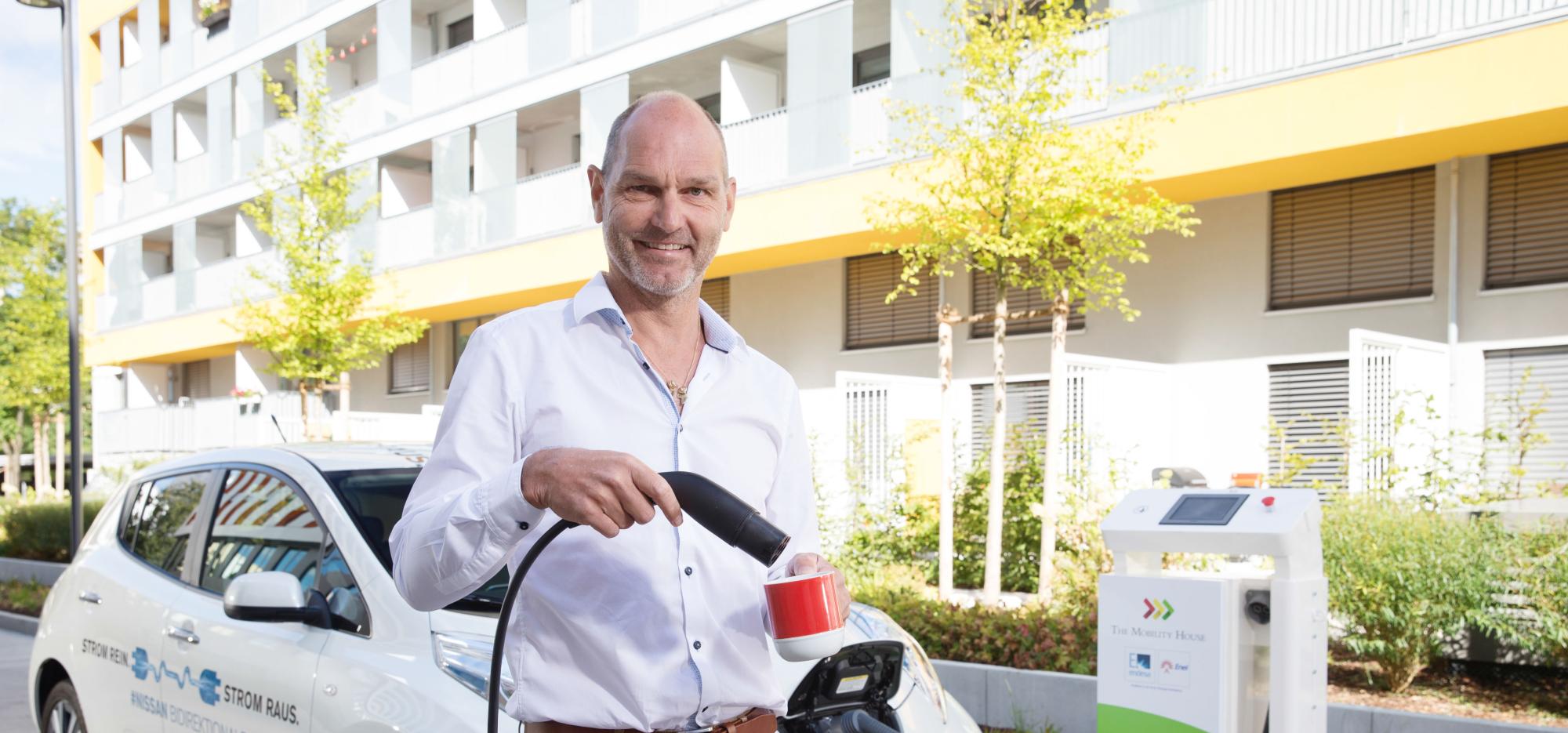
"Our charging and energy management system helps minimise grid expansion costs by up to 70%, stabilising the power supply and improving the CO2 balance of an electric car by almost double."
Signature(s)
Amount
€ 15,000,000
Countries
Sector(s)
Energy
: € 15,000,000
Signature date(s)
7/08/2020 : € 2,875,000
7/08/2020 : € 2,875,000
7/08/2020 : € 9,250,000
Other links
Summary sheet
Release date
14 April 2020
Status
Reference
Signed | 07/08/2020
20180604
Project name
Promoter - financial intermediary
NEW CHARGING AND ENERGY STORAGE SOLUTIONS (EDP)
THE MOBILITY HOUSE AG
Proposed EIB finance (Approximate amount)
Total cost (Approximate amount)
EUR 15 million
EUR 31 million
Location
Sector(s)
- Energy - Electricity, gas, steam and air conditioning supply
Description
Objectives
The project will finance the growth of the company in the energy storage and vehicle-to-grid sectors in the period 2020-2023.
The company provides innovative charging and energy storage solutions for the mobility and energy industries. Its proprietary technology digital platform allows the integration of electric vehicles (EVs) into the power grid to charge and discharge their batteries along with stationary battery storage assets. This requires the aggregation and leverage of the energy storage potential of pools of EVs batteries as stationary storage devices in order to provide energy and power services to the electricity grid and thereby enabling "internet of storage" solutions.
Environmental aspects
Procurement
The project concerns the installation of smart charging devices in residential and commercial/industrial facilities. As per Environmental Impact Assessment (EIA) Directive 2014/52/EU amending the Directive 2011/92/EU, an EIA is not required for this project. E&S related topics will be investigated at appraisal.
The promoters have been assessed by the EIB as being private companies not being subject to EU rules on public procurement or concessions.
Related documents
Other links
Documents
Environmental and Social Data Sheet (ESDS) - NEW CHARGING AND ENERGY STORAGE SOLUTIONS (EDP)
Publication Date
3 Jul 2020
Document language
Main Topic
Lending
Document Number
130222049
Document Focus
Environmental Information
Document Type
Project Number
20180604
Sector(s)
Regions
Countries
Publicly available
Download now
Environmental and Social Completion Sheet (ESCS) - NEW CHARGING AND ENERGY STORAGE SOLUTIONS (EDP)
Publication Date
28 Nov 2024
Document language
Main Topic
Lending
Document Number
223763116
Document Focus
Environmental Information
Document Type
Project Number
20180604
Sector(s)
Regions
Countries
Publicly available
Download now
Link to source
Other links
News & Stories
Link to source
Other links
Inside the project
How and Why
Electric cars on the grid
Why
- Power generated by renewable sources varies with the weather rather than demand. The batteries in electric vehicles can help balance mismatches and make better use of renewable power
- Electric vehicles are needed to reduce CO2 emissions from transport. Bidirectional charging greatly improves the CO2 balance of electric cars, making them even more sustainable and competitive
- An innovative European start-up with technology to make transport more sustainable that’s creating jobs
How
- The company’s innovative technology enables electric cars to contribute to the grid, as well as draw from it, turning them into batteries on wheels that can help stabilise the network and reduce the need for grid expansion
- By allowing electric cars to play an active role in the network, the technology dramatically improves their CO2 balance
- Founded in 2009, The Mobility House employs around 160 people in Germany, Switzerland and the US
Sectors & Countries

Story
Clean energy in cars brewing coffee
Thomas Raffeiner is chief executive of The Mobility House, a Munich-based company whose technology allows the use of electricity from parked electric vehicles to be fed into the electrical grid or used to power homes. This so-called “bidirectional charging” is viewed as an important step in the transition to renewable energy.
"Our charging and energy management system helps minimise grid expansion costs by up to 70%, stabilising the power supply and improving the CO2 balance of an electric car by almost double,” says Raffeiner. “We want to create a zero-emission future, and bidirectional charging is a good way to reach this goal."
The company’s charging and energy management technology, ChargePilot, is based on an open interface architecture which allows the remote and intelligent control of charging processes, according to the grid’s needs. The software monitors electricity peaks and off-peak hours, giving ChargePilot users the opportunity to decide whether and when to charge or discharge their batteries, depending on the demand for energy.
Excess generated power can be returned to the grid, optimising charging costs and grid performance. Even parked e-vehicles would have a role in this electrification revolution, since they would act as temporary energy storage devices.

"Thanks to thematic finance envelopes such as the InnovFin Energy Demonstration Projects facility or the CEF Future Mobility programme, the EIB, as Europe’s climate bank, has the right tools to support innovative companies like The Mobility House."
Bidirectional charging investment boosts ChargePilot
The Mobility House’s technology supports the rollout of electric vehicles along with their cost-effective integration into the power grid in Europe through bidirectional charging. It’s split between Vehicle-to-Grid (V2G) and Vehicle-to-Home (V2H) applications.
The company’s charging and energy management technology, ChargePilot, is based on an open interface architecture which allows the remote and intelligent control of charging processes, according to the grid’s needs. The software monitors electricity peaks and off-peak hours, giving ChargePilot users the opportunity to decide whether and when to charge or discharge their batteries, depending on the demand for energy.
Excess generated power can be returned to the grid, optimising charging costs and grid performance. Even parked e-vehicles would have a role in this electrification revolution, since they would act as temporary energy storage devices.
The Mobility House has proven that it is even possible to brew your own coffee with green energy derived from a parked e-vehicle’s battery.

Related media
I Got a Job: Elizabeta and the car industry clean-up in Croatia
In Croatia jobs were scarce, so Elizabeta Žalac thought she would have to leave home to find work. But an EU investment helped keep this talented young engineer in her native country.
Austria drives car research
Powertrain R&D for Austria electric car aims to fight climate change and boost innovation, with hybrids and automated cars too
Links
Related projects and stories
Celebrating diversity, equity and inclusion at Luxembourg Pride Week
The European Investment Bank (EIB) Group is taking part in Luxembourg Pride Week from 2 to 12 July, celebrating the LGBTIQ+ community and reaffirming its strong commitment to diversity, equity and inclusion.
Local leaders and EIB join forces to pool public and private funds for affordable houses
Intensifying their cooperation with the European Investment Bank, regions and cities on 2 July discussed the EU’s housing policy with President Calvino, Members of the European Parliament and associations. During their debate in a plenary session of the European Committee of the Regions, they also voiced concerns that the next EU budget will weaken EU support for social, energy and climate projects
EIB Group Complaints Mechanism outreach and dispute resolution workshop in Zagreb, Croatia
The EIB Group Complaints Mechanism, in collaboration with the Independent Complaint Mechanism for DEG, FMO and Proparco (ICM), and the Dispute Resolution Service (DRS) of the World Bank Accountability Mechanism, organised a regional workshop in Zagreb from 8 to 11 June 2026, with the support of the CEE Bankwatch Network.