Nadia Calviño, president of the European Investment Bank Group, spoke at the London School of Economics Festival 2026: How to save the planet on 16 June 2026.
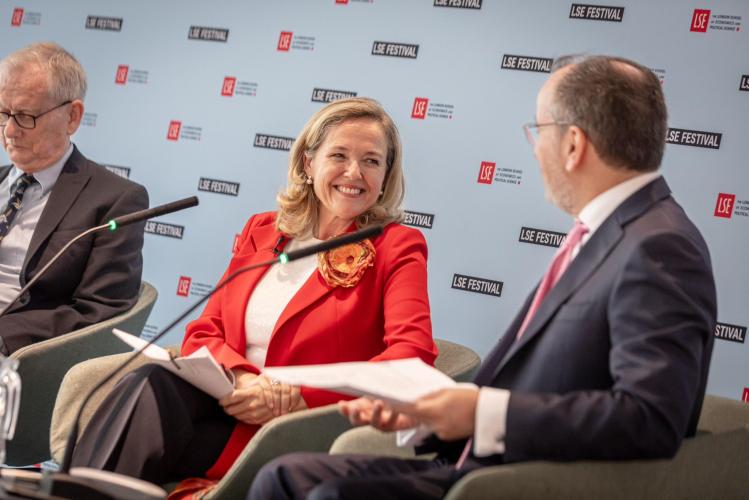
I have a very special place in my heart for the London School of Economics for many reasons. It is really a rare and a unique pleasure to be here today.
Dear ambassadors, dear professors, dear students, dear faculty members,
It's such a pleasure to be here again at the London School of Economics.
Not only because I have a personal relationship with this institution and it's full of dear friends, but because the London School of Economics has long been a place where ideas meet action. Where economic thinking is connected to the practical questions that shape our societies and actually it is the incubator – the accelerator of the leaders of tomorrow.
It is a great opportunity to be able to address you today and share with you some thoughts on some of the current issues that are bothering all of us and that will have a structural impact on our economies and our societies. Geopolitical changes and conflicts, emerging global powers and shifting strategic alliances, the impact of artificial intelligence and other disruptive technologies. There is around us huge volatility and uncertainty and that spreads a feeling of insecurity to citizens around the world.
And I'm sure you feel it. I'm sure you see it around you. All this together with the growing impact of climate change, which seems to have dropped down the public attention hit parade, partly due to turnarounds of the political narrative in some countries, but I think also because of the overflow, the sheer rhythm of news and issues that are occupying our space, our brain space, our media, the historical developments that we are living.
That makes this issue, climate change and climate action, feature less when we are looking around and reading the news. But actually, I think this should feature as the top priority, on its own merits, because it is good for our planet, and also because it is very closely linked to all of the above, all these other concerns that I have just mentioned. In this context, the question that we are discussing today, which – I agree with Andrés – this could have sounded a bit arrogant and a bit excessive in the past actually. But, in fact, I think that the question is spot on, as the defining one of our time.
How do we save the planet?
I would suggest that as economists, policymakers, researchers, future leaders, we begin by framing it correctly. Because the challenge in front of us is not abstract, it is not distant, it is not only environmental. Climate change is already affecting our economies, our competitiveness, our public finances, our security, our social cohesion.
The growing costs of extreme weather events are a clear reminder of the need to tackle this challenge. So, this is not only about protecting nature, and that would be reason enough. It is not only about what is the right thing to do. It is rather about what is the smart thing to do, to preserve prosperity, stability, opportunity and our way of life for future generations. In my view, climate action must not be understood as an alternative to other pressing priorities, from security to competitiveness, as some want to portray it. It is not a constraint on growth, as some also are repeatedly wanting to frame it. But it is a central pillar of economic efficiency and sustainable prosperity.
I have to admit, today this is perceived to be a very European perspective. Because Europe has always, or at least for the past 80 years, understood that prosperity and solidarity have to go hand in hand. And this is the underlying cause of the phenomenal success of our continent for the past 80 years, since the end of World War II.
Furthermore, Europe is at the forefront of the impact of climate change and also the vulnerabilities that come from excessive dependence on fossil fuels. As we have certainly discovered, if we didn't know it before with Russia’s attempt to invade Ukraine and of course the escalation of the crisis in the Middle East.
In Europe, we know that long-term investment matters, that resilience matters because every euro we invest in adaptation and prevention saves €5 to €7 in repairs. Not to talk about the losses that are irreparable like the loss of human life. We Europeans also know that collective challenges require collective solutions. And if we look at the history of European integration, some of the greatest advances come in response to profound challenges.
After the war, Europe invested in peace. After the great financial crisis, we strengthened our institutions. After the pandemic, we mobilized together at unprecedented scale, public and private investment to address the shock from the health, economic and social points of view. I think that today, climate change requires the same ambition, the same unity and determination.
But let me also be very clear, saving the planet is not about one single policy. There is not a magic wand, there is no silver bullet. This is about transforming the way we produce energy, the way we move people and goods, we build our cities, we manage water, we grow food, we finance innovation. And this is an economic transformation of historic scale. Transformations of this magnitude require investments, as you have already mentioned, and time. Very substantial investment, and the numbers are well known, sustained for a long period of time.
The current decade is key to make this transition a success, notwithstanding national political changes, conflicting priorities, urgent needs. And this is precisely why institutions like the European Investment Bank play a key role in ensuring that we make the green transition a European success. Because the European Investment Bank Group is the Climate Bank of the European Union. More and more I have the feeling it is the Climate Bank of the world, as many institutions are no longer even using the word. But most importantly, our institution is focusing on long-term impact. The role of the EIB is to support projects that strengthen Europe's competitiveness and security with a multi-annual approach that complements national, budgetary and political cycles. And this is very relevant.
Since the adoption of the Climate Bank Roadmap, we have significantly increased financing for climate and environmental projects to reach €57 billion in 2025, that's 60% of the total. We are on track to mobilise €1 trillion in this decade with public and private investment and we have doubled financing for energy since Russia started the aggression against Ukraine.
So actually, the European Investment Bank Group is currently the main financier of the energy transition in Europe. We are currently financing half of the grid projects going on, one out of five solar plants, one out of three onshore wind parks, and the majority of offshore wind projects.
I could mention many projects in Poland, but let me just mention one that was signed, I don't know, 10, 15 minutes ago, which is going to be financing the largest onshore wind farm in the Baltic countries, in Lithuania. It is a very important project. It is really a game changer. It will actually provide energy to one third of the population of the country.
Beyond Europe, we are also working globally. For example, contributing to the Mission 300 with the World Bank and the African Development Bank. We have recently pledged €1 billion to expand access to clean, affordable electricity across Africa for 300 million persons by the end of the decade.
It is quite clear that the public sector has been leading and supporting this process for the past five years, but the scale of the challenge requires the private sector to get active. So, what is the role of institutions like the European Investment Bank?
We have a catalytic role to play. We need to mobilise this private investment, reducing risk, crowding-in financing, with a seal of quality those projects that can really make a difference on the ground. Because ultimately what matters is not only innovation, it is also implementation. We already have many of the technologies we need, and this is very good news.
Renewable energy, storage, grid modernisation, clean transport, energy efficiency, sustainable industrial processes, adaptation infrastructure. The question is no longer whether the solutions exist. The question is whether we can deploy them fast enough, fairly enough, and at sufficient scale.
Let me emphasise one word that actually Professor Rodriguez-Pose already mentioned, which is “fairness.” Because transitions only succeed when people believe they are fair. Multiplying the success stories can actually translate the positive impact of this green transition in our economies.
And that means we need to show the impact of our policies when it comes to more stability, stronger security and lower energy bills. If climate action is seen as something imposed from above, it will face resistance. If regions feel they are left behind, the transition will lose legitimacy. If households feel only the costs, not the benefits – then the clean transition is perceived to be only affordable to some, and then we lose this discussion. And that's why the green transition needs to be also a just transition.
And actually competitiveness and cohesion, I go back to the same idea, are just two sides of the same coin. Now, the same applies globally because climate change does not recognize borders and so developing economies also need to have access to affordable finance and international cooperation remains essential in this regard. I was very happy to hold a meeting today with Baroness Chapman precisely in the run-up to the presidency of the G20 by the United Kingdom next year. How can we join forces so that we make sure that there is finance for development, finance for the clean transition around the world?
And that also makes it, I think, prominent, the role of multilateral institutions. Multilateral institutions matter. Partnerships matter. If we get it right, we strengthen more than our energy system. We power real progress. We strengthen trust in our democracies and our institutions, as well as the multilateral system. And I think this provides a broader view of what we are discussing, and the role of institutions like the European Investment Bank.
Let me share a final thought with you. And many people tell me, oh, you are always so positive. You're always so optimistic. Is this idealism? And I don't think so. I think this is sheer realism. And when I speak with students, many of you are talking about the one question that Professor Rodríguez-Pose did not mention, which is: when. When? Because many, many young people are feeling that the change is not fast enough, that we're moving too slowly. Their progress is insufficient. And I understand that concern, but I would also say this: transformation at scale is happening.
It has moved to a new phase, which is much more led by the private sector. It is accelerating. Of course, the crises around us are good wake-up calls to all institutions and private companies to realize they need to actually move ahead faster. Look at the speed of renewable deployment. Look at innovation in clean technologies. We already have the tools to make this a success.
Look at the evolution of sustainable finance. The success of the green bond market is a good message. Look at the increasing percentage of companies that are investing in energy efficiency and in the green transition of their businesses. So, I think that we need to bypass public rhetoric and ideological positions and focus on what is really happening and there's an energy transition which is in full swing.
Current geopolitical developments will increase this trend because I think it's quite clear that we Europeans, the EU, the UK alike, we need to break free from our excessive dependence on fossil fuels. The way forward is clear. We do have the tools to do this. It is not only the right path for the planet, it is also Europe's strongest economic strategy.
Progress is not always linear, but it is real, it requires persistence. And then this brings me to my final question, which is: who. Who should lead this? I got this question just from one of your colleagues for a podcast a moment ago. And let me respond, reply to this question. It's all of you. It's all of us.
Because when we are asked how to save the planet, we are also asking who will lead this transformation and the answer is that you will. Not only activists, not only scientists, not only political leaders, it is economists, it's engineers, lawyers, entrepreneurs, investors, public servants, researchers, designers, data specialists. Every profession represented in this university has a role to play. Because climate action is no longer a niche issue, it is becoming central to every major economic decision. What infrastructure we finance, what technologies we scale, how we price risk, how we regulate markets, how companies define long-term risks and value. And these are the decisions that will shape the future and many of you will be the ones making those decisions.
That's why I am really confident every time I meet with a group of young students that we will be successful in tackling this challenge like we human beings have done, always, throughout our history. Europe has a particular responsibility. I think we will discuss that in the debate in a moment. And in my view, optimism and confidence is not naivety. It's not being naive. It is a strategic choice. Because building the future requires confidence that change is possible. And I know it is. I know it because at the European Investment Bank we see every day what becomes possible when public purpose and private investment work together.
When we look back, we see what we have achieved by joining our forces and that's what gives me confidence. So how do we save the planet? By investing in innovation, by accelerating implementation, by ensuring fairness, by strengthening our unity and international cooperation, and by understanding that climate action is not separate from economic efficiency and security. It is central to it. The choices made in this decade will shape the lives of generations to come, and that is a profound responsibility, but it is also an extraordinary opportunity. And I'm really proud to be at the helm of an institution that can make a difference for the future, trying to make the right choices, every day.
Thank you very much.