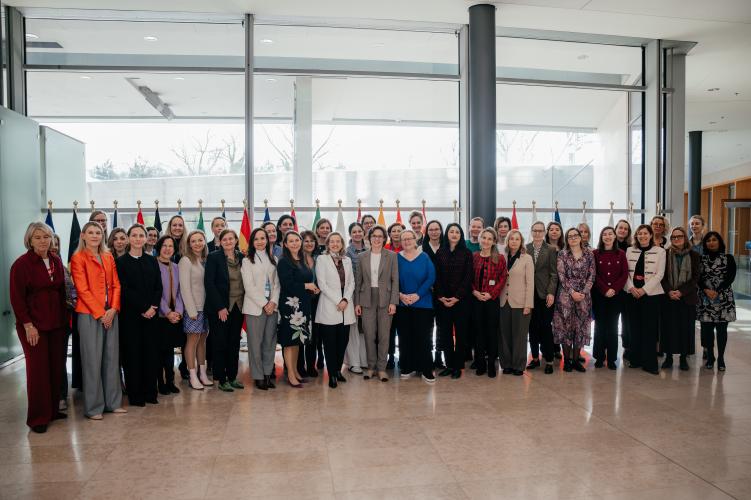
Women climate leaders from the 27 EU Member States, representing the private sector, gathered this week at the EIB Group Forum 2026, bringing together leaders from politics, public institutions, finance, business and civil society to explore how Europe can strengthen its global role through innovation, investment and partnerships.
Launched in 2024, the Women Climate Leaders Network was created by the EIB Group to increase the visibility and cross-sector collaboration of businesswomen who are successfully leading on climate action, environmental sustainability and green innovation across the European Union.
Addressing the Network members at the EIB Group Forum, EIB Group President Nadia Calviño remarked: “Surveys consistently show that women are more attuned to climate issues — whether in daily decisions or in leading organisations. Women have the power to change the world, and when we stand together, we are truly unstoppable. That is why partnerships and networks like this one are so essential.”
The Network also had the opportunity to exchange with Jessika Roswall, European Commissioner for Environment, Water Resilience and a Competitive Circular Economy, and share the conclusions of their discussion on water, circular economy and blue economy. Commissioner Roswall highlighted that “seven out of ten companies in the Europe area are critically dependent on nature. At least three million companies in the EU are highly dependent on at least one ecosystem. Action on climate and nature is an investment in our economic resilience. It is an investment in quality jobs, and in our health and well‑being.”
This year’s meeting agenda was firmly anchored in EU policy priorities and the EIB Group’s strategic focus. Sessions included an update from the Chair of the EU Platform on Sustainable Finance, a discussion on tokenisation and its potential to unlock new forms of sustainable investment. Across all discussions, members emphasised the importance of mobilising capital for climate and environmental action through market‑based solutions that support scale.
A Results-driven Network
In 2025, to mark its first anniversary, the Women Climate Leaders Network published a paper outlining five actionable recommendations to help SMEs and mid-caps accelerate green investment as well as scale innovation. This publication has since guided regular exchanges with partners in Brussels.
“We wanted to create a trusted space to connect, exchange, and find meaningful ways to work and advance together on this green journey,” said EIB Secretary General Barbara Balke, one of the Network's co-chairs. “In the past two years, this network played a central role in boosting the visibility of women driving climate action, while coming up with pragmatic recommendations for better results.”
Highlighting the Network’s collaborative nature as a defining feature, Laura Piovesan, Director General of the EIB's Projects Directorate and the Network's co-chair, said, “We know that going green makes our economy more competitive and our systems more resilient and secure. Women business leaders have understood that perfectly and act upon it. Women Climate Leaders Network members are actively working with us to come up with market solutions.”
While the Network comprises private-sector representatives, its sessions often include invited experts from public institutions, think-tanks, civil society, and EU bodies, enriching exchanges with diverse perspectives.
Merete Clausen, Deputy CEO of the European Investment Fund and the Network’s Co-Chair, also underlined its continued relevance: “The green transition is and remains a key priority for the EIB Group. Through its equity and guarantee instruments, the EIF finances the development of new technologies but also the adoption of climate and environment-friendly solutions by thousands of European SMEs and mid-caps. The Women Climate Leaders Network makes a difference by helping translate new technology development into broad adoption, creating scale and impact throughout the economy.”
Women leading climate action: EIB Group's pioneering network drives sustainable market solutions
©EIB
Download original
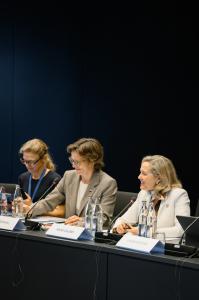
Women leading climate action: EIB Group's pioneering network drives sustainable market solutions
©EIB
Download original
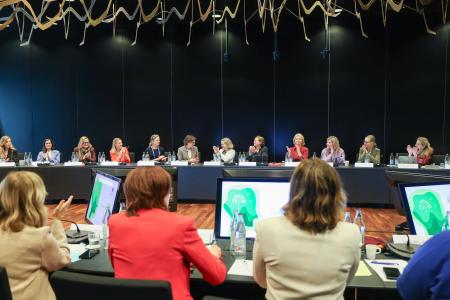
Women leading climate action: EIB Group's pioneering network drives sustainable market solutions
©EIB
Download original