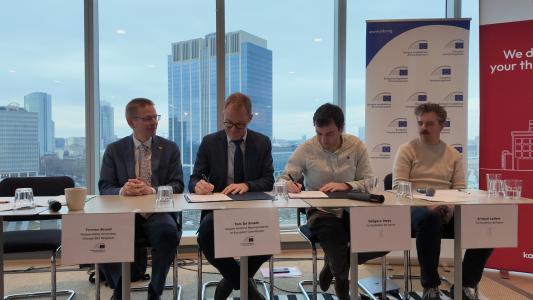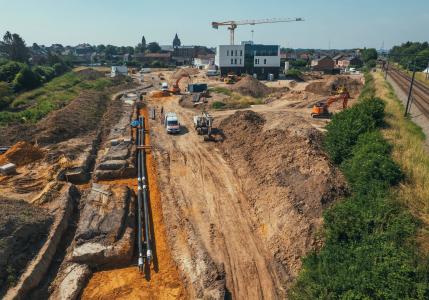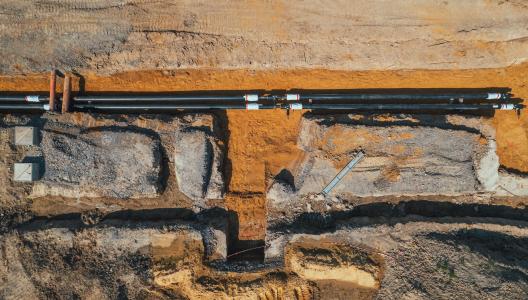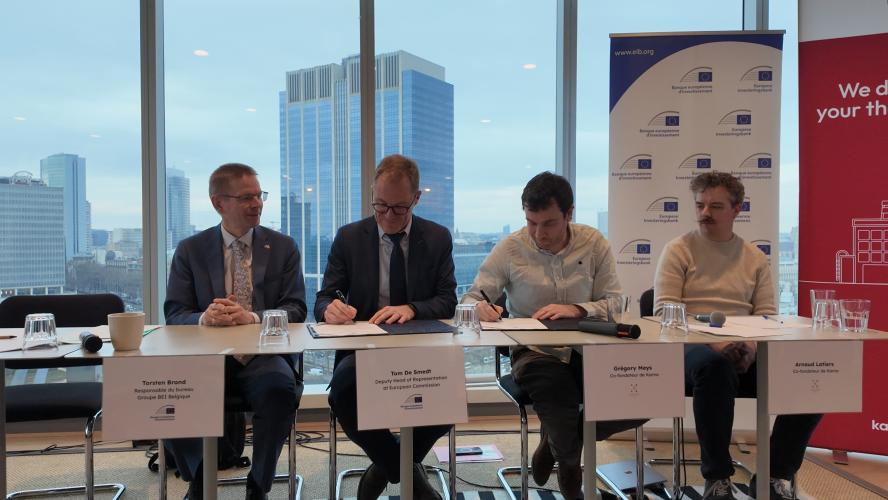
This signing of an ELENA agreement with the European Investment Bank (EIB) will support KARNO in scaling up the deployment of decarbonised heating and cooling solutions at the heart of the energy transition.
ELENA is a grant facility for energy efficiency, financed by the European Commission’s InvestEU programme and implemented by the EIB Advisory Services.
Against the backdrop of the energy crisis, gas dependency and the climate emergency, the ELENA programme will provide KARNO with a €2.97 million grant to help establish a sustainable market framework for district heating networks in projects launched in Belgium and Luxembourg. The European Union is thus focusing on the importance of structuring decarbonised heating via a regulated model, deployed operationally by KARNO in Belgium and Luxembourg. The technical assistance provided under ELENA includes feasibility studies, project management, energy audits, technical studies, legal advisory services and support with procurement procedures.
District heating networks are considered by the European Union as a major asset for strengthening strategic autonomy. By pooling local renewable resources, reducing dependence on imported gas and optimising electricity use through reduced additional generation needs, KARNO's programme contributes directly to the EU objective of a fair and inclusive energy transition.
KARNO's programme provides for a total of €82.5 million in targeted investments over three years, enabling a regulated developer to deploy several infrastructure networks simultaneously.
Turning Europe's vision into regulated real-world projects
Through the ELENA programme, which supports the energy transition of local authorities, this agreement backs the development of KARNO’s growing portfolio of district heating and cooling projects in Belgium. KARNO develops these projects in line with EU directives. As such, the company operates in the public domain, obtains operating licences, is supervised by regional/national authorities and ensures open access and connection to the network, as well as protecting the end consumer.
This regulated framework enables efficient, accessible and fair use of local energy resources. These zero-carbon networks rely primarily on geothermal and aquathermal energy, waste heat recovery (high and low temperature) and biomethanisation. The distribution systems are designed to minimise losses, optimise temperatures and guarantee long-term sustainable energy performance, notably through multi-sourcing to enhance network resilience.

“From the outset, we designed KARNO as an industrial tool serving the energy transition, capable of transforming political and climate ambitions into concrete, reliable and measurable energy systems.
The projects we are now developing – whether for urban districts, industrial sites or residential housing – show that heat decarbonisation is both technically mature and economically viable. This regulated framework secures investments, guarantees service quality and ensures long-term protection for end users.”

“ELENA has been supporting energy efficiency projects in Belgium since 2013, mainly in buildings, both residential and non-residential.
KARNO's EU4H project enables ELENA to broaden this support with a dedicated focus on district heating network development in Belgium and Luxembourg.
These networks not only decarbonise heat but also enable its electrification, thereby contributing to the country’s energy security.”

"Heat now accounts for 60% of CO₂ emissions in urban areas, yet it remains heavily dependent on gas. Our ambition is to build sustainable, open and competitive infrastructure capable of harnessing local renewable resources at scale.
Thanks to the ELENA grant, over a three-year horizon we can accelerate the simultaneous development of several networks and move from standalone projects to a truly industrial dynamic, overseen and controlled by public authorities.”
European Investment Bank, ELENA and InvestEU
EIB Advisory Services play a key role in delivering the EIB Group’s ambition to develop markets, strengthen capacities and support high-impact projects. The ELENA (European Local ENergy Assistance) programme is a joint initiative of the European Investment Bank and the European Commission designed to promote investments in energy efficiency and renewable energy in buildings and transport.
The InvestEU programme provides the European Union with long-term financing by mobilising substantial public and private funds to support a sustainable recovery. It also helps attract private investment supporting the European Union’s strategic priorities, including the European Green Deal and the digital transition. InvestEU brings together under one roof all EU financial instruments currently available to support investment in the European Union, making project financing in Europe simpler, more efficient and more flexible. The programme's three pillars are the InvestEU Fund, the InvestEU Advisory Hub and the InvestEU Portal. The InvestEU Fund is deployed through implementing partners that invest in projects backed by the EU budget guarantee of €26.2 billion. The entire budget guarantee backs the investment projects of the implementing partners and increases their risk-bearing capacity, thus leveraging at least €372 billion in additional investment.
The situation in Belgium
Belgium is lagging behind neighbouring countries in the deployment of decarbonised heat. Less than 1% of national heat demand is currently met by district heating networks. The EU target for Belgium is 10% by 2030, with a long-term goal to supply 45% of thermal energy through these networks by 2050.
France has achieved much better results, increasing its share from 1% to 18% in just ten years. In Nordic countries, integration of these networks is even more advanced: in Copenhagen, for example, more than 90% of heat is supplied via district heating networks.
Far from being a disadvantage, the fact that Belgium lags behind other countries offers an opportunity to learn from international experience and adopt best practices for developing its own district heating networks effectively.
An integrated approach and a proven model
KARNO’s approach covers the entire project life cycle:
1. Energy supply: identifying suitable consumers and appropriate energy sources (geothermal, aquathermal, river thermal energy, waste heat, etc.).
2. Project development and construction.
KARNO operates across all sectors (tertiary, industrial and public) and aims to meet the thermal needs of each client. The company works on all building types, roughly half of which are new builds, the other half being renovations or existing buildings. The main challenge now lies in decarbonising the thermal energy systems of existing buildings.
3. Organisation and management of the public utility operator throughout its life cycle.
Flagship heat decarbonisation projects in progress.
1. Kuebebierg, Luxembourg
Europe's first large-scale 100% decarbonised district heating network
The Kuebebierg district project is now Europe’s benchmark for decarbonised heating networks. This project was awarded by Fonds Kirchberg to the KARNO – Cordeel – Hydrogaz (KCH) consortium. The network will cover 33 hectares and provide thermal energy to 3 500 homes, schools and care facilities – around 8 000 inhabitants.
The infrastructure is based on 21 geothermal hubs combining deep geothermal energy with high-efficiency heat pumps. This project, the largest ever awarded to KARNO, validates at scale its technical and economic model based on regulation, competitiveness and adaptability to the needs of users. It is also a catalyst for the international deployment of this model.
2. Be.SHARE – Parc Maximilien, Brussels
Urban park serves as an energy reservoir
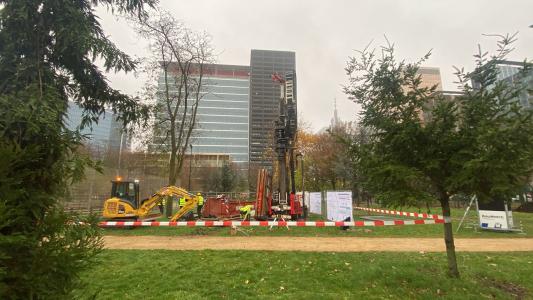
As part of the Be.SHARE project, KARNO provides expertise to a low-carbon heating and cooling network developed around Parc Maximilien. A shallow geothermal energy system turns the park's subsoil into a thermal energy storage reservoir: heat is stored in summer for winter use, while the system also provides cooling in summer. In the long term, this network will supply heating and cooling to offices, mixed-use buildings and social housing in the city's North district, helping to reduce CO2 emissions and lower energy bills.
3. Namur – ENHAIVE
Decarbonised residential heating for the Walloon capital
Created by Thomas & Piron and UNIBRA, the Parc d'Enhaive project deploys a decarbonised energy solution: a fifth-generation open geothermal network. This high-performance system pools the heating and cooling needs of the site’s 391 homes and school, creating a sustainable ecosystem where smart energy sharing helps minimise the district's carbon footprint.
4. Charleroi – Aerospacelab/Sambrinvest
Wallonia’s largest geothermal installation for the industry of the future
In Charleroi, KARNO is helping to decarbonise the industry with the largest geothermal probe field in Wallonia: 93 probes sunk to a depth of 140 metres to provide energy to Aerospacelab’s “megafactory”. This project demonstrates that geothermal energy can meet the thermal needs of high-tech industrial sites, while supporting low-carbon reindustrialisation.
5. Liège – MontLégia and LégiaPark
Geothermal energy for housing and healthcare
The MontLégia project already provides geothermal heat to nearly 100 apartments, with planned extensions to LégiaPark and other developments. In association with the promoter D2B and the construction company Thomas & Piron, and with support from SPW Énergie, this project illustrates district heating networks’ capacity for development in order to support the transformation of hospitals and residential areas.
6. Jodoigne – Matexi
Belgium's first geothermal district heating network for a private housing development
In Jodoigne, KARNO is developing the municipality's first geothermal district heating network for 140 homes. With support from SPW Énergie, this project is an important milestone for medium-sized towns in Wallonia, demonstrating that heat decarbonisation is not reserved for large cities.
7. Fleurus
Renewable heat from biomethanisation
In Fleurus, a high-temperature network (85°C–65°C) supplies heating to 120 homes and the municipality's new administration building. In collaboration with Cinergie, the inter-municipal authority CENEO and the municipality of Fleurus, heat is generated from a local biomethanisation unit, illustrating the complementarity between thermal networks and organic waste recovery.
8. Nivelles
Heating networks in business parks
Two heating networks are being developed in business parks in Nivelles. These projects demonstrate the regulated model’s value in pooling companies’ energy needs and improving the competitiveness of economic areas while reducing their carbon footprint.
9. Brugelette – Pairi Daiza opens its tenth world: Edenya
Decarbonised energy for biodiversity and zoological and leisure parks
At the Pairi Daiza theme park, KARNO designed a sustainable heating system for Edenya, the largest tropical greenhouse ever built. Across four hectares, a stable equatorial climate is maintained thanks to a low-carbon solution, drastically reducing the environmental impact while supporting the park’s conservation mission. This system uses medium-depth geothermal energy and draws heat from around 100 metres underground. The natural temperature reaches an average of 14 °C with a gain of 3 °C every additional 100 metres. Thanks to this inexhaustible and clean source, Edenya will be able to maintain a tropical environment in all seasons without using fossil fuels. This project is made possible thanks to our collaboration with the Resolia consultancy and with the support of SPW Énergie.
10. Anderlecht, Brussels
Fifth-generation heating and cooling network
In Anderlecht, KARNO is developing a fifth-generation heating and cooling network powered by geothermal energy. The project will serve 160 homes, 1 000 m2 of tertiary spaces and 500 m2 of community spaces. This type of low-temperature network illustrates regulated infrastructure’s ability to integrate neatly into a dense urban fabric while offering heating and cooling with a minimal carbon footprint.
Press contacts:
Karno: Mathias Langre | communication@karno.energy | +32 490/30 57 00
European Investment Bank: Tim Smit | t.smit@eib.org | +352 691 286423