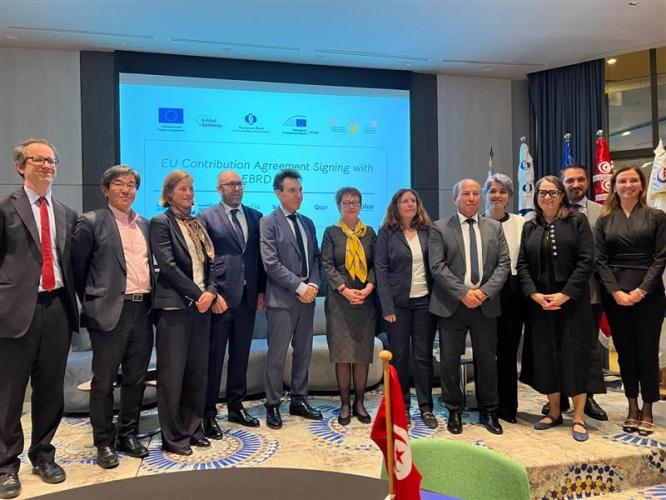
- New EU Contribution Agreements signed with EBRD (€20 million) and EIB Global (€15 million) to support solar photovoltaic projects and electricity grid infrastructure
- Coordinated Team Europe action to help Tunisia reach 35% renewable electricity by 2030 and supply the ELMED interconnector with renewable energy
- First investments include 400 MW of solar capacity across Sidi Bouzid and Gafsa
The European Union (EU) is strengthening its support for Tunisia’s energy transition with €35.8 million in grant financing provided under the Neighbourhood Investment Platform (NIP), to accelerate the development of renewable energy generation and electricity infrastructure in the country.
The EU has signed a €20.4 million contribution agreement with the European Bank for Reconstruction and Development (EBRD) and a €15.4 million contribution agreement with the European Investment Bank (EIB Global). These grants will enhance the bankability of large-scale renewable energy projects and support investments in grid connections and transmission infrastructure, helping to unlock additional public and private financing. The project is also supported by EFSD+ guarantees from the EU.
The first projects supported under this framework include a 100 MW solar photovoltaic power plant in Sidi Bouzid, developed by Scatec and Aeolus, and a 300 MW solar PV portfolio in Gafsa led by Qair. Together, these initial investments represent a total installed capacity of 400 MW and are expected to mobilise further private sector participation and international co-financing.
“Tunisia is a key partner for EIB Global, and this €15 million EU contribution agreement is a decisive step towards turning priority renewable energy projects into bankable investments,” said EIB Vice-President Ioannis Tsakiris. “It clearly illustrates how EU grant support, combined with EIB Global financing, can mobilise large-scale investment in solar power and the grid infrastructure required to deliver it, accelerating Tunisia’s energy transition and strengthening the impact of the Global Gateway.”
Giuseppe Perrone, Ambassador of the European Union to Tunisia, said: “In close alignment with Tunisia’s national energy strategy, the European Union is investing in renewable energy and modern infrastructure to accelerate the country’s energy autonomy, drive sustainable growth, and reinforce climate resilience. These efforts deliver concrete improvements for citizens while contributing to wider stability across the Mediterranean.”
Odile Renaud-Basso, President of the European Bank for Reconstruction and Development, said: “We are proud to be partnering with the EU and EIB to accelerate Tunisia’s green transition. By combining EU grant support with financing, we can unlock large-scale investment in renewable energy and grid infrastructure. These projects will help unlocking Tunisia’s abundant energy resources to deliver secure and domestic cheap power.”
These agreements directly contribute to Tunisia’s 1.7 GW renewable energy programme and its objective to generate 35% of electricity from renewable sources by 2035, as set out in the EU–Tunisia Memorandum of Understanding on energy cooperation.
The EU grants, financed through the Neighbourhood Investment Platform, will help de-risk strategic investments and mobilise public and private co-investment. They form part of the Global Gateway Africa–Europe Investment Package and reflect the EU’s commitment, through a Team Europe approach, to supporting sustainable, secure and inclusive energy systems in partner countries.
Background information
About the EU
The EU is Tunisia’s largest investor and trading partner, with European companies already creating over 400,000 jobs in the country. Cooperation spans over trade, renewable energy, mobility and migration, education and youth opportunities, rural development and women’s empowerment – reflecting our shared commitment to prosperity, stability and opportunity for all. Since the signature of the MoU on the Strategic and Comprehensive Partnership in 2023, the EU has mobilised its financing instruments, including over EUR 600 million grants in sectors such as energy, transport, and SMEs, to support an estimated 5 billion EUR of investments.
About EBRD
The EBRD is a multilateral bank that promotes the development of the private sector and entrepreneurial initiative in 42 economies across three continents. The Bank is owned by 77 countries as well as the EU and the EIB. EBRD investments are aimed at making the economies in its regions competitive, inclusive, well governed, green, resilient and integrated. Follow us on the web, Facebook, LinkedIn, Instagram, X and YouTube.
About EIB Global
The European Investment Bank (ElB) is the long-term lending institution of the European Union, owned by its Member States. It finances investments that contribute to EU policy objectives.
EIB Global is the EIB Group’s specialised arm devoted to increasing the impact of international partnerships and development finance, and a key partner of Global Gateway. It aims to support €100 billion of investment by the end of 2027 – around one-third of the overall target of this EU initiative. Within Team Europe, EIB Global fosters strong, focused partnerships alongside fellow development finance institutions and civil society. EIB Global brings the EIB Group closer to people, companies and institutions through its offices across the world.
Photos of EIB headquarters for media use are available here.
About the Global Gateway
Global Gateway is the European initiative to boost smart, clean and secure links in digital, energy and transport sectors and to strengthen health, education and research systems across the world. Global Gateway aims to mobilise up to €300 billion in investments through a Team Europe approach, bringing together the EU, its Member States and their financial and development institutions. It seeks a transformational impact in the digital, climate and energy, transport, health, and education and research sectors.