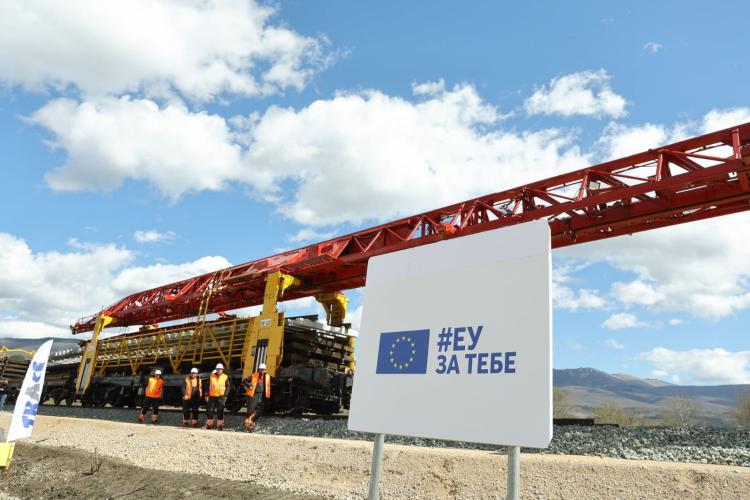
- EIB Global has signed a €100 million loan agreement and secured a €34 million EU grant to upgrade a key railway section connecting Serbia and Bulgaria.
- The financing will support the modernisation of the Sićevo-Dimitrovgrad railway section, the construction of a rail bypass around Niš and the electrification and signalling of the entire railway line.
The European Union has committed €134 million to modernise, reconstruct and electrify the Niš-Dimitrovgrad railway section. The financing package includes a €100 million European Investment Bank (EIB Global) loan to upgrade the Sićevo-Dimitrovgrad rail line, electrify and install signalling along the entire Niš-Dimitrovgrad route. This is complemented by a €34 million EU grant for constructing a rail bypass around Niš.
These investments will significantly improve railway capacity, safety and service quality, while decreasing traffic bottlenecks in the city of Niš. With these latest agreements, the European Union’s support for this section has reached €342 million, including €234 million in EIB Global loans and €108 million in EU grants. The project benefited from EIB advisory support via the JASPERS programme and the Western Balkans Investment Framework (WBIF), covering advanced preparation of the Niš bypass and support for implementing the Niš-Dimitrovgrad rail link.
“As part of a vital international transport network linking Serbia to EU countries, the project is of critical importance for stronger economic integration, boosting trade flows, attracting investment, and accelerating regional growth. said EIB Vice-President Robert de Groot. “It will improve the quality, availability and reliability of national and cross-border rail services, while enabling a gradual shift to greener transportation options,”
The €34 million EU grant provided under the WBIF will enable the construction of the railway bypass around Niš. Through integrated transport planning for the city of Niš aligned with EU standards, the project aims to reduce congestion and enhance traffic functionality.
“This project forms a key part of Serbia’s wider sustainable transport investment programme, which benefits from strong backing under the Team Europe initiative, bringing together substantial financial resources and technical expertise. The Niš-Dimitrovgrad railway link is a subsequent section of Corridor X, itself part of the wider Western Balkans-Eastern Mediterranean European Corridor that connects central European states with major ports of the Adriatic and Eastern Mediterranean. Together, these upgrades will strengthen regional connectivity and bring lasting benefits to people and businesses across Serbia,” said EU Ambassador to Serbia Andreas von Beckerath.
“The reconstruction of the Niš-Dimitrovgrad railway line is a very important project for our country, through which we are continuing to modernise and improve the quality of Serbia’s railway network. The importance of this line is immense, given that it is part of Corridor X and serves as a link between Serbia and Bulgaria, as well as a route along which large volumes of goods move. At the same time, it resolves the issue of the Niš junction, an important hub in southern Serbia. We are continuing to foster Serbia’s development and improving the quality of life in our country, and establishing a state-of-the-art railway network is a significant step in that process,” said Minister of Finance Siniša Mali.
Improved infrastructure along this key railway route will help push speeds from a current average of 50 km/h to up to 120km/h and positively impact travelling habits by increasing the annual number of passengers from around 170 000 to some 550 000, and total freight transport from 3.2 million to around 6.2 million tonnes a year.
“Thanks to the support of the European Union and the European Investment Bank, the implementation of the Niš–Dimitrovgrad project began at the end of 2023”, said Minister of Construction, Transportation and Infrastructure Aleksandra Sofronijević. “The EIB and the EU have continued to support the development and construction of this infrastructure project of high public importance by signing new loan agreements and granting non-refundable funds, thereby creating a key financial prerequisite for the continuous modernization of the Niš–Dimitrovgrad railway section. This modernization enables better connectivity with the TEN-T network, representing a crucial step toward electrifying the last non-electrified section of Corridor X.”
Minister Sofronijević thanked the European Investment Bank for its ongoing support of the Niš–Dimitrovgrad project and affirmed Serbia’s commitment to partnering with the EIB to build a modern and competitive railway network that boosts economic growth and strengthens Serbia’s role as a transit hub in Southeast Europe.
Background information
About the EIB and EIB Global
The EIB is the long-term financing institution of the European Union, owned by its Member States. It makes long-term finance available for sound investment in order to contribute towards EU policy goals. The EIB supports projects in four priority areas: infrastructure, innovation, climate and environment, and small and medium-sized enterprises (SMEs). EIB Global is the EIB Group’s specialised arm devoted to increasing the impact of international partnerships and development finance, and a key partner of Global Gateway. It aims to support €100 billion of investment by the end of 2027 – around one-third of the overall target of this EU initiative. Within Team Europe, EIB Global fosters strong, focused partnerships alongside fellow development finance institutions and civil society. EIB Global brings the EIB Group closer to local people, companies and institutions through its offices around the world.
About the EIB in Serbia and the Western Balkans
The EIB has been active in Serbia since 1977, providing finance to support key infrastructure projects as well as SMEs, industry, services and local authorities. Since the start of its activities in the country, it has enabled over €7.2 billion of investment in SMEs and the revitalisation of transportation, education, healthcare and utility infrastructure.
The EIB is one of the leading international financiers in the Western Balkans. For detailed information on the EIB’s activities in this region, visit www.eib.org/publications/the-eib-in-the-western-balkans.