After the initial period of institutional convergence, a few years ago a stream of right-wing populism movements emerged and spread in most of the CEE countries, and the European values of deliberative democracy and the rule of law have come to be replaced by growing centralisation.
The findings, interpretations and conclusions are those of the authors and do not necessarily reflect the views of the European Investment Bank
You can download the essay here
The trajectories of the countries and regions of Central and Eastern Europe (CEE) during the last hundred years do prove that almost everything is possible. In this relatively short period these countries have regained independence, have suffered during World War Two, have gone through totalitarian and authoritarian communist regimes and lastly they have rejoined Europe, moving from the second to the “first periphery” of the developed world. Although at the start of their EU membership the “end of history” may have appeared as a plausible way to look to the future of CEE, recently unexpected phenomena have questioned these hopes and placed several new challenges before the new Member States.


These two challenges have a clear regional manifestation. The political changes clearly negatively affect local and regional governments, which in some CEE countries have already acquired a strong position in the institutional order of public management. The economic crisis may affect the metropolitan cores of the CEE countries which since the post-socialist transition have become the main engines of transformation, attracting FDI into the modern value and knowledge-intensive services. The switch to teleworking and telecommuting may negatively influence metropolitan employment in CEE and leave many new offices idle, as well as hotels, apartments and tourist services in the largest cities of CEE. By the same token, weakening of industrial networks may jeopardise the development of several industrial regions in CEE which have gone through successful industrial restructuring, to a large extent due to the involvement of western European capital (now under protectionist pressure of several EU governments).
Should one be pessimistic? Probably not, since the CEE countries have proved – over the last century – that they are able to overcome even the most severe difficulties, and nowadays they may enjoy encouragement, shelter and assistance from the European Union, so widely appreciated by the societies of CEE, even if some political elites of these countries may sound Eurosceptical (but not when financial transfers are involved).

The issue of convergence is2 especially important since the CEE countries have for centuries been less developed than their western counterparts. This was due to long historical processes (what F. Braudel called the longue durée3) whose foundations were laid by the Roman Empire (many of the present CEE countries were located beyond its boundaries, i.e. beyond the limes). This situation was further reinforced by the division of Europe into its more developed western part which, from the 16th century onwards, moved from agriculture to industry and from feudalism to capitalism, and its eastern part, which remained feudal for a long time (until the 19th century), and whose economy was based on agriculture. More recently, the East-West division of Europe by the Iron Curtain after the Second World War aggravated the backwardness of Central and Eastern Europe4. The last 30 years have not closed this structural gap, but have reduced it to a large extent. To use Wallerstein’s5 terminology, Central and Eastern Europe has begun its journey from the second to the first periphery of Europe, bringing most of its regions closer to the centres of capital, technology and democracy.

The Central and Eastern European countries are internally differentiated, and the national processes assumed varied forms and shapes in their particular territorial entities. Also, a number of the challenges the CEE countries faced have a clear regional dimension.
The CEE countries have benefited from the EU Cohesion Policy and Common Agricultural Policy, two major priorities of the European Union. The current political climates in certain CEE countries may pose some of the most difficult challenges for the future of European integration and continued cohesion with the West.
The Central and Eastern European regions after socialism
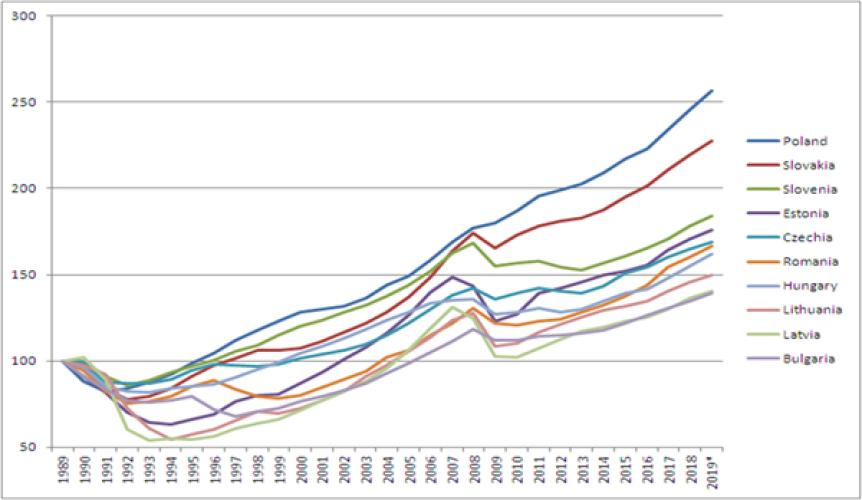
The CEE countries entered the challenging phase of transformation (the majority in 1990, although the Baltic Republics reached this point slightly later with the collapse of the Soviet Union) with strongly polarised regional structures and deep spatial inequalities, a number of over-industrialised cities, underdeveloped infrastructure, a polluted environment and limited private ownership of agricultural land. All of them had to struggle with a deep recession that consumed as much as 20 % of their GDP (see Figure 1). The collapse of several industrial plants – mostly caused by their lack of competitiveness in a new, open economy – radical changes in the agricultural ownership structure, and unprecedented unemployment with growing niches of poverty, shaped the socio-economic reality of these countries at the beginning of the post-socialist transition.

The CEE countries entered the challenging phase of transformation with strongly polarised regional structures and deep spatial inequalities, some over-industrialised cities, underdeveloped infrastructure, polluted environment, limited private ownership of agricultural land.
During the first phase of the post-socialist transformation, the regional patterns showed a strong differentiation. Few types of regional reactions to transformation can be identified.
|
|
Regional reaction to transformation |
||
|
positive |
negative |
||
|
Position of the regions in the socialist economy |
strong |
LEADERS positive continuity Capital and large cities
Diversified economy, skilled labour, good infrastructure and rich institutions |
LOSERS negative discontinuity Industrial regions
Specialised industry, derelict land, biased qualifications |
|
weak |
WINNERS positive discontinuity Tourist & re-industrialised regions
External demand for their potentials |
LAGGARDS negative continuity Rural, peripheral
Poorly accessible, obsolete structures, low qualifications, outmigration |
|
Table 1. Regional reactions to the post-socialist transformation. Source: Gorzelak G., “Regional development in Central and Eastern Europe”, in: Blokker P. and Dalago B. (eds.): Regional Diversity and Local Development in New Member States, New York, Palgrave Macmillan, 2009.
- The leaders – the metropolitan regions. In the socialist economy heavily industrialised, large cities were the strongest nodes of the territorial systems of Central and Eastern Europe. After the fall of the Soviet Union, those regions went through the process of restructuring, the main phenomenon of which was deindustrialisation. However, due to their diversified socio-economic structures and good connectivity, they were able to offer the best location conditions for the most dynamic sectors – internationally connected knowledge-intensive services (financial, managerial, tourist, scientific, etc.), high-quality commerce – the so-called metropolitan functions6. Moreover, their suburban rings have been growing even faster due to the rapid and, in most cases, uncontrolled suburbanisation of the residential areas of the middle and upper classes. All capital cities of the CEE countries and large (over half a million inhabitants) cities in Poland are examples of regional leaders.
- The losers were the old industrial regions, which had played an important role in the socialist economy, attracting migrants from the countryside and offering relatively highly paid jobs. However, their economies were not diversified, living conditions were relatively poor due to delayed urbanisation (or under-urbanisation, as I. Szelenyi labelled it7, the qualifications of the labour force were relatively low and narrowly specialised, and the natural environment deteriorated over time. As a result, their restructuring was long and painful, and some of these industrial cities and regions have only recently been able to re-enter on a new line and develop modern industrial sectors and certain metropolitan functions. The coal and steel region of Upper Silesia, the cities with shipyards along the Baltic Sea, the textile industry regions like Łódź and its surroundings in Poland, the region of Maribor in Slovenia are some examples of industrial regions that had to go through difficult restructuring, in several cases with high social costs.

- The winners – tourist and re-industralised regions. These were several regions that had possessed potentials which were overlooked in the socialist, industrial pattern of development, but which were given an opportunity to respond to emerging demand in the open, competitive economy, e.g. the tourist regions. A number of other regions in which re-industrialisation occurred (often due to foreign investment that brought new technologies, new products and opened new markets) have also been doing rather well. Special Economic Zones, located in previously problematic areas, spurred economic revival. The Rzeszów region in south-east Poland is an excellent example of a region whose industry was reborn after receiving foreign investment, mostly in the high-tech sector; the Budapest-Gyor road corridor, extending to Vienna, became a business cluster after the borders were opened; north-west Romanian regions also accelerated their growth due to their location (shorter distance to the core of Europe) and tourist potential.
- In most countries, the laggards were the eastern regions. This structural underdevelopment has to be attributed to the processes of Braudelian longue durée, since the late medieval modernisation divided the CEE countries along the line Gdańsk – Vistula river – Pest – Pécs – Ragusa (nowadays Dubrovnik) line: technological (mostly agricultural) and institutional innovations (from towns under Magdeburg and Lübeck laws, cloisters and universities) spreading from Western Europe to the East lost their momentum at that point, thus causing most of the eastern regions to lag behind their western counterparts. Also, several border regions, located on the eastern edge of EU-15, such as the Sudeten region of Czechia, near the German border, or the northern regions of Bulgaria along the border with Romania, as well as the southern Bulgarian regions bordering Greece, have stagnated. In the Baltic States the regions bordering Belarus and Russia have also suffered most (the capital city region of Vilnius is an exception). These areas are less developed and lack major urban centres, as well as major modern transport infrastructure. The majority of these regions are losing population due to outmigration to larger cities and abroad. Most of them are not attractive for foreign capital, and domestic capital is scarce.

Early 1990s: first democratic elections
The institutional reforms, aiming at building the democratic system, also embraced territorial public management and politics. The restoration of local and regional government8 was an important part of building democratic institutions. This was an intellectual and political revolution, as well as a change in the mechanisms of economic development.

After the collapse of the centralised system, a comprehensive regional policy was not formulated in any of the CEE countries and the regional aspects of social or economic policies were almost non-existent9. In fact, the governments of all these countries left "regional problems" to so-called market forces, allowing the new economic patterns in their countries to be reshaped by sectoral processes. Employment/unemployment policies became the main field of government interventions, which have had some spatial/regional dimensions in terms of the application of certain economic instruments (investment incentives, extended unemployment benefits, etc.) in regions affected by exceptionally high unemployment10. Regional policies slowly developed, and accession to the EU forced the preparation of national development strategies and their spatial/regional components. Also, the regions of the CEE countries were obliged to draw up their own strategic documents.


All NUTS3 regions in Eastern Europe11 with big cities present higher GDP values per inhabitant. According to the ranking based on business connections12, Warsaw is included among the Alpha cities, Prague and Budapest are in the group Alpha minus, Bucharest in Beta plus, Sofia and Zagreb in Beta, Bratislava in Beta minus, Riga in Gamma +, Ljubljana, Tallinn and Vilnius in Gamma. These cities are visible on the maps of global business, which allows them to develop their modern economies based on knowledge-intensive services. Conversely, several eastern, peripheral regions – such as the south-eastern region of Latvia, and eastern regions of Poland, Hungary, Slovakia, Czechia, Hungary and Romania – still have the lowest GDP values per person. This is largely because the industry there is mostly agricultural. But it is also caused by poor accessibility, the relatively low level of skills and qualifications, and outmigration. These areas are of little interest to foreign investors. All these factors have led to their economic stagnation.
Generally speaking, since the 1990s regional divergence has clearly been the predominant trend in the CEE macroregion, caused both by metropolisation and by stagnation in the weakest, peripheral regions – the factors most responsible for this process. However, in the aftermath of the financial crisis of 2008-2010, some signs of reversal of this pattern could be observed (Figure 4). In most of the CEE countries – excluding Romania and Bulgaria – the regional differentiation of GDP per inhabitant unexpectedly came to a halt, and in some CEE countries even reversed.

There are a few hypotheses explaining this fact. In between the extremes of ‘"leaders’ and ‘laggards", which remain in the highest and the lowest positions on the GDP per person rankings, considerable changes took place among the group of regions whose rates of development depended on the progress of restructuring processes and diversification of local economic structures. Firstly, several industrial regions (but rarely those dominated by traditional industries) have undergone successful restructuring, thus moving up in the regional GDP per person rankings (e.g. the above-mentioned Rzeszów region, but also the Debrecen and Miskolc regions, and a number of Slovak regions). Secondly, most of the "winners" that used to be relatively less developed, developed fast, and advanced in these rankings. Thirdly, the initially spatially limited diffusion of growth from the metropolitan cores has begun to reach greater distances. Additionally, outmigration from the less developed, peripheral eastern regions has led to the simple statistical effect of increased GDP values per person there. Finally, the impact of EU policies (Cohesion Policy and Common Agricultural Policy) can perhaps be observed, since per capita outlays of Cohesion Policy are greater in the less developed regions of the CEE countries, and Common Agricultural Policy spending in absolute terms obviously favours less developed territories in which agriculture plays a relatively more important role than in urbanised areas, thus assisting these regions in their economic development.

A clear convergence of GDP per inhabitant between the set of NUTS314 regions of Central and Eastern Europe can be observed (Figure 5). This is the combined result of convergence between the Central and Eastern European countries, and regional convergence within them.

Until 2010-2012, the convergence effect observed for all regions of CEE was mainly due to convergence between countries that had been regionally diverging, and since the between-country convergence was stronger than within-country regional divergence, the overall result was general regional convergence. However, later convergence occurred at both these levels (this has also been demonstrated by the ex post evaluation of the Cohesion Policy 2007-2013)13. This process possibly confirms the so-called Williamson’s hypothesis14, according to which the relationship between levels of development of a given country and its internal territorial differentiation assumes the shape of an inverted U: in the first stages of development the differences grow, but after reaching a certain level they begin to decline15. This may mean that the CEE countries have reached "maturity" in terms of level and regional structure of development.


The environmental situation in the CEE countries is also a concern. In spite of considerable progress in energy production and consumption, as well as in environmental protection, in several regions and localities of CEE the air quality is very poor (Figures 8 and 9). Dependence on individual heating systems running on poor quality coal is still a problem in several countries (mostly Poland, a country reluctant to switch to other sources of energy), resulting in heavily polluted air during the heating season.

General dependence on coal, the most severe pollutant, is still high in some CEE countries: in Poland slightly less than 80 %, in Bulgaria and Czechia around 40-50 %. In the Baltic States, however, coal dependency is equal to zero in Lithuania and Latvia, and close to zero in Estonia. In most CEE countries coal dependency is decreasing.
In 2020, Poland was the only country that did not support the 2019 EU goal of making the European Union climate neutral by 2050. Moving to a green economy mostly depending on renewable energy will require time, effort and investment in the majority of the CEE countries. It can be expected, however, that efforts will be made to secure cleaner sources of energy, and technological progress in producing and using energy (for example by replacing old stoves in private houses by modern ones, and shifting to gas and renewable energy) will continue to support these positive changes.

In January 2020 the European Commission announced the establishment of a Just Transition Mechanism, part of the Green Deal and the Sustainable Europe Investment Plan. As declared by the Commission, the Just Transition Mechanism will provide tailored financial (at least €100 billion) and practical support for the necessary investments in regions most affected by the transition.17
The transition towards a more sustainable economic model is not impossible. Some regions and cities, like Katowice in Silesia, have already gone through a process of renewal and regeneration. The city centre of Katowice, once an industrial town, has been completely revamped in the last ten years and now hosts the Museum of Silesia, the Polish National Radio Symphony Orchestra and the Congress Centre. Investments in cultural upgrading and urban development have had a positive impact on the local economy and on the city itself, which is now considered to be an emerging metropolis18. In the Czech Karlove Vary region, cooperation between the spa resort and industrial tourism has been established. The Hungarian VisitFactories initiative aims to develop post-industrial cities, and several initiatives in Romania demonstrate how industrial sites can take on a new role as assets promoting material culture19.

Cohesion policy in CEE: role and achievements
From the very beginning of modern regional policies, most of their patterns were subject to the principle of "equity", and very few followed "efficiency" goals. Moreover, the regional policy of the European Union has tended to prioritise equalising the level of regional development rather than stimulating the growth of particular Member States or the EU as a whole, although in recent periods new goals, such as promoting competitiveness and the efficiency of invested resources, have supplemented the "traditional" equalisation approach.


However, some negative effects have also occurred:
- subordination of national preferences to the requirements of the European institutions, in terms of both the priorities selected for intervention and the resources assigned in the form of national funds supplementing the EU funds in order to satisfy the "additionality" principle, i.e. securing (public and private) funding that is additional to the funds assigned by the EU;
- fixation on "absorption" and ‘regularity’ as the main criteria for assessing the quality of implementation of the projects co-financed by the EU: most progress in capacity-building has been made in terms of strengthening the ability to strictly obey formal procedural or operational compliance with EU regulations and requirements, especially regarding financial management and control, sometimes at the expense of the rationale and purpose of spending the EU funds22.
Research has indicated23 that the institutional reforms have not yet been fully completed and that the CEE countries still lag behind Western Europe with respect to the level of governance. Recent recentralisation processes, seen mostly in Hungary and Poland, but also visible in Czechia and Slovakia, may challenge the efficiency of preparing and implementing innovative strategies for regional development. In a centralised institutional setting it would be difficult (if not impossible) to (re)build regional and local government structures as credible, capable entities able to prepare and implement strategies tailored to the needs and potentials of the respective regions.
Regional development: what’s next?
The future of regional development and regional policies in the CEE countries is still uncertain. The peak of funding through the EU Cohesion Policy has come to an end for most CEE Member States, and it appears that the European Union is determined to prioritise other spending goals (such as innovation development, tackling climate change, coping with migration pressures, strengthening integration within the eurozone) through the EU budget, over those which used to be the most important for the New Member States (support for the less-developed regions, building basic infrastructure, improving the environment). This is due to the reforms of the Cohesion Policy, which have dominated the national regional policies of the New Member States, and to a large extent have shaped the processes of regional and local development.

The recent discussions seemed to indicate that the traditional support for less-developed regions may be curbed, and that the shares of the total Cohesion Policy budget dedicated to innovation, research and development, small and medium-sized enterprises, competitiveness, climate action, development of sustainable sources of energy and social inclusion and poverty relief measures may be significantly increased. Also cuts in the CAP may be harmful to the less-developed regions, in which agriculture plays a relatively important role. This may place the strongest urban centres of the CEE countries, which are best prepared for developing knowledge-intensive services, even in an even more favourable position, and thus reverse the new trend of regional equalisation. Also, this evolution of EU priorities may pose a difficult task for some of the CEE countries that have not yet been able to develop a sound and solid R&D base and strong capabilities for creating their own innovations, and thus would not be able to attract a large share of funds towards these targets.
Dependence of the least-developed CEE regions on transfers from the European Union (in some less-developed regions as much as over 10% of their yearly GDP) for financing most of their infrastructure may jeopardise the resilience of these regions to the forthcoming reduction of these transfers, and to the demographic crisis which several of these regions are facing. If these regions are to continue their economic growth, the national governments will have to rethink the regional allocations of funds coming from the EU.

The above remarks were made before the recent coronavirus epidemic. The shape of the global economy, and of the situation of the EU as a whole as well as of its Member States cannot be foreseen yet: all scenarios are still possible. No matter which materialises, EU policies will have to be fundamentally reshaped and adapted to the new, perhaps even dramatic challenges and pressing needs of the societies and economies of the EU. In any case, it cannot be expected that the needs and interests of the CEE countries will be prioritised in the same way as during the first period of their membership. Therefore, the reservations formulated concerning the future situation of the countries within the EU should, perhaps, even be strengthened.
End of history?
In 2004-2007, after the accession of CEE countries to the EU, a conviction of "end of history" emerged. Many people in these countries believed that the path to a mature democracy and efficient market economy was straight and that the New Member States would proceed along this path without major upheavals. This attitude was first undermined by the financial crisis of 2008-2010, which reduced economic output in some CEE countries by as much as 20 %. Then came the migration crisis of 2015-2016, which was used by populist politicians to challenge the principles of European solidarity, and in some countries (especially Hungary and Poland) subsequently served to support the trends of weakening the rule of law and the foundations of deliberative, liberal democracy.

There may be several explanations for these developments. Some relate to global trends and suggest that globalisation has led to feelings of uncertainty, and that simple explanations delivered by populist politicians are more plausible than sophisticated analyses. According to this line of reasoning, the CEE countries are following these global trends, and the weaknesses of their relatively new institutions of democracy mean that they are unable to defend themselves against the pressures of populism. Other explanations24 indicate that the CEE societies have become tired of imitating the West, or that they have begun to doubt that western values are appropriate for Central and Eastern European societies. Although this may not reach the extent of rejecting those values, the CEE societies may have come to the conclusion that they will never meet western standards and are starting to defend themselves by challenging these standards. Frustration and feelings of exploitation and humiliation may create the foundations for approval of authoritarian rule and for agreement to breaching the rules of democracy. Also, resentments could have been triggered by the partial abandonment by political elites of the notion of a "nation" and ‘nation state’, which would be replaced by regionalism and Europeanism25. It should be observed that during the coronavirus crisis the role of the EU is being challenged by some authoritarian regimes of CEE, and claims of reinforcing the nation states are being openly expressed.
Finally, support for populist attitudes may stem from the feelings of rejection and being forgotten that affect the relatively less educated strata of the economically active population, which have become unneeded as a result of the relocation of factories to countries with lower labour costs and also the cutting of jobs due to automation and robotisation26.
Notes
- Convergence happens when the differences between countries or regions decrease, and divergence denotes the opposite process. See https://en.wikipedia.org/wiki/Convergence_(economics).
- Braudel F., A History of Civilizations, London, Penguin Books, 1993.
- More on historical divisions of CEE in Gorzelak G. and Jałowiecki B., “European Boundaries: Unity or Division of the Continent?”, Regional Studies Vol. 36.4, 2002, pp. 409-419.
- Wallerstein I. M., The Modern World-System I: Capitalist Agriculture and the Origins of the European World-Economy in the Sixteenth Century, New York, Academic Press, 1974.
- https://www.lboro.ac.uk/gawc/rb/rb248.html
- Szelenyi I., “Urban Development and Regional Management in Eastern Europe”, Theory and Society Vol. 10, No. 2 (March 1981), pp. 169-205
- Swianiewicz P., Local Government: Progress in Decentralisation, in: Gorzelak G. (ed.), Social and Economic… op.cit., pp. 54-74.
- Gorzelak G., Jałowiecki B., Kukliński A. and Zienkowski L., Eastern and Central Europe 2000 - Final Report. Luxembourg: European Commission, 1994.
- Gorzelak G., “Regional Policies in East-Central Europe”, in Fischer M. and Nijkamp P. (eds.) Handbook of Regional Science, 2nd edition, Springer-Verlag Berlin Heidelberg, 2020.
- Statistical measures of differentiation depend strongly on delimitation of the territorial units and on measures of differentiation. In general, the more the units, the greater the statistical differences. Also, the existence of city-regions increases the values of differentiation statistics.
- The NUTS classification (nomenclature of territorial units for statistics) is a hierarchical system for dividing up the economic territory of the EU. Source: Eurostat: https://ec.europa.eu/eurostat/web/nuts/background
- https://www.lboro.ac.uk/gawc/world2018t.html
- Applica, Ismeri Europa, Ex post evaluation of Cohesion Policy programmes 2007-2013, focusing on the European Regional Development Fund (ERDF) and the Cohesion Fund (CF). Synthesis report, Brussels, DG Regio, 2016.
- Williamson J.G., “Regional inequalities and the process of national development”, Economic Development and Cultural Change, 13: 3-45, 1965.
- Capello R., Regional economics, London and New York, Routledge, 2007.
- Radosevic R., Yoruk D.E. and Yoruk E., “Technology upgrading and growth in Central and Eastern Europe”, in: G. Gorzelak (ed.), Social and Economic… op.cit. , pp. 178-204.
- https://ec.europa.eu/commission/presscorner/detail/en/fs_20_39
- Source: EIB, https://www.eib.org/en/press/all/2011-094-poland-eib-supports-redevelopment-of-katowice-city-centre.htm
- https://doi.org/10.1016/j.sbspro.2014.01.1320
- Applica, Ismeri Europa & WIIW, Ex Post Evaluation of Cohesion Policy Programmes 2000–2006 Co-Financed by ERDF – Financial Implementation of Structural Funds. Brussels, DG Regio, 2009.
- Major infrastructure projects co-financed under the Cohesion Policy in the period 2007-2020 are displayed on a map under the address https://ec.europa.eu/regional_policy/mapapps/major_projects/mpall.html.
- Bachtler J., Mendez C. and Wishlade F., EU Cohesion Policy and European Integration: The Dynamics of EU Budget and Regional Policy Reform, Ashgate, Aldershot, 2013.
- Bachtler J. and Ferry M., “Cohesion Policy in Central and Eastern Europe. Is it fit for purpose?”. In: Gorzelak G. (ed.), Social and Economic Development… op.cit., pp. 313-344.
- Krastev I. and Holmes S., “Explaining Eastern Europe: Imitation and Its Discontents”, Journal of Democracy, July 2018.
- Fukuyama F., Identity: The Demand for Dignity and the Politics of Resentment, Farrar, Straus and Giroux, New York, 2018.
- Fukuyama F., op.cit.
- Rodrígues-Pose A., “The revenge of the places that don’t matter (and what to do about it)”, Cambridge Journal of Regions, Economy and Society, 11(1), pp189-209, 2018.
- Spicer J., “Electoral Systems, Regional Resentment and the Surprising Success of Anglo-American Populism”, Cambridge Journal of Regions, Economy and Society, 11(1), pp15-41, 2018.