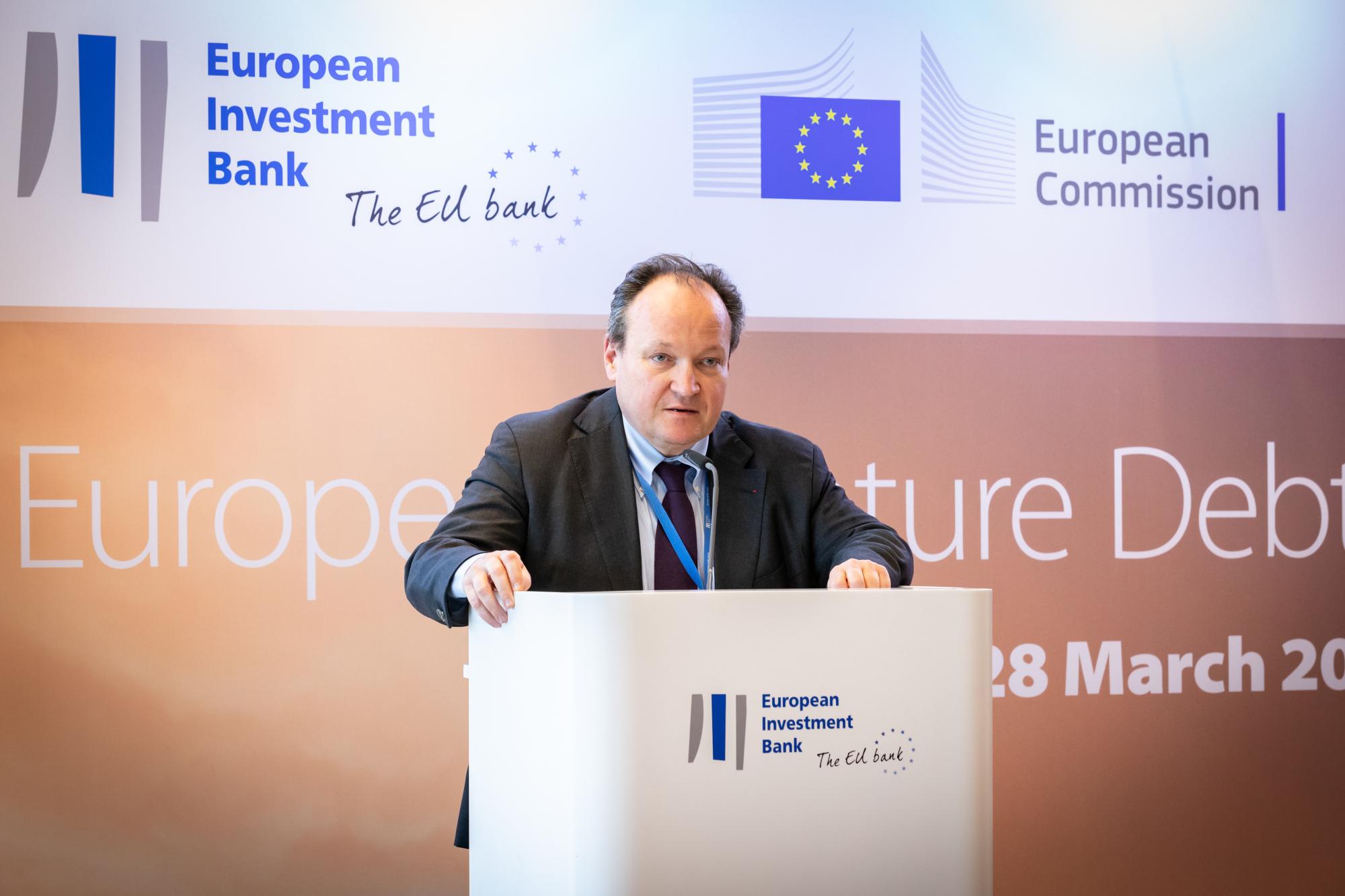
EFSI has been a milestone and a key reference point in the way in which we pursue and carry out projects of public interest.
Part 4 in ‘The EFSI Legacy’ series
The European Fund for Strategic Investments has been a game-changer for economic stimulus programmes backed by EU public financing and for the European Investment Bank. ‘The Legacy’ is a series that tells the story of the European Fund for Strategic Investments (EFSI) from 2015 to 2020 through interviews with the Managing Director, Deputy Managing Director, members of the Investment Committee and final beneficiaries across Europe
Download ‘The EFSI Legacy’ book here.
By the mission and yardstick that were defined in the EFSI regulation, it has been a success. It is also still relevant as it reaches the end of its life, even though the focus of the initiative has naturally changed with the emergence of new policy goals (for example, a 40% target for investment in climate action) and the evolution of different market failures or suboptimal investment situations.
Fabio Pammolli, Investment Committee member and professor of economics and management at Politecnico di Milano
EFSI has been a milestone and a key reference point in the way in which we pursue and carry out projects of public interest. This idea of having a complex financial architecture combining the European guarantee with the activity, experience and market outreach of the European Investment Bank, together with an independent committee made up of market experts or academics is an important contribution, and must be carefully assessed as a template and as a benchmark for the future. We were addressing market failures without asking states and the European Commission to intervene. We occupied a grey area between markets and states, and the overall architecture is EFSI’s most important contribution.
EFSI dashboard*
European Investment Bank economists used a well-established economic model to assess the future impact of the investments supported by all its operations, as well as for the loans made by the Bank specifically with the EFSI guarantee. Their findings demonstrate that the EIB Group’s loans laid the foundation for long-term growth, beyond providing an immediate boost to the economy. The impact of the EFSI loans is significant. Economists estimate that by 2022, investment under EFSI will increase EU gross domestic product by 1.9% and add 1.8 million jobs compared to the baseline scenario.

Expected impact
To measure EFSI’s impact, EIB economists had to account for the complex interaction between the Bank’s operations and other activities in the economy. They teamed up with the European Commission’s Joint Research Centre in Seville and worked with an economic model called RHOMOLO that was used to calculate whether increasingly scarce public financing was being used effectively.
One of RHOMOLO’s main strengths is that it captures:
- the short-term impact on economic activity;
- changes in productivity and growth in the longer term.
For example, if the EIB finances a road with EFSI support, there is increased economic activity as the road is built. Once the road is complete, the EIB financing continues to generate positive effects because the road reduces travel times and transport costs, thus increasing productivity, growth and job creation. To truly assess the impact of EFSI financing, all these factors have to be measured.
Wilhelm Molterer
The higher you raise the level of ambition, the more you are at risk. But, on the other hand, if you succeed, then you have really done something great. The Commission and the EIB Group can be proud that the two institutions took responsibility. We had a discussion in the Parliament where I had to answer a question about whether it was possible that we might lose some money out of a €26 billion guarantee. I said, “That’s the nature of a guarantee. If you offer a guarantee, you must be ready to lose. That’s not our intention, for sure, but the reality is that money could be lost.” The vast majority of parliamentarians and the staff at the Commission were used to the grants world, whereas the EIB had a keen interest in financial instruments. To blend the two was also a bit of a cultural shock. President Hoyer started to talk about a paradigm shift for the EU.
Another crucial element was the cooperation with national promotional banks. If you want to be successful in any market, you need their capacity and their market knowledge. Also not everybody was happy about the advisory component. The staff at the Advisory Hub were strict about the prerequisites for going to the financing stage. The learning curve was steep for everybody in this endeavour.
Where do you think the impact of EFSI has been the greatest in the economy?
I would turn it the other way around. The biggest impact has been on the institutional side. The institutions—the Commission, which is responsible for European taxpayers’ money and the EU budget, and the EIB Group—have learned that if you put the strengths of these two big institutions together you achieve a higher impact, much higher than when using just the old instruments.
I would say you can see it most in the three Cs, Competitiveness, Cohesion and Climate. You can showcase the fact that EFSI has supported a huge number of projects in RDI (Research, Development and Innovation) to strengthen competitiveness (and the digital sector). If you look at the distribution of EFSI deals in Member States and compare these volumes to the size of the countries’ GDPs, you can see that the right ones are getting EFSI deals into their economies. As for the climate, the 40% target of the Infrastructure and Innovation Window will be achieved. These key points are also a good answer to the criticism we heard at the beginning.
There is a third component I want to highlight—flexibility. The 40% climate target was added to the regulation in 2018 when EFSI had already been in full swing for three years, and yet we managed to achieve the target.
And this year, 2020, when COVID-19 has created such turmoil for people and the markets, the EIB Group reacted immediately. The EFSI guarantee was crucial for this quick and bold move.
The EFSI Steering Board
In setting up and operating EFSI, the role of the Steering Board was vital. EFSI Managing Director Wilhelm Molterer and Deputy Managing Director Iliyana Tsanova would like to thank the Steering Board, in particular for the insights and guidance of Chairpersons Kerstin Jorna and Gerassimos Thomas and European Investment Bank Vice President Ambroise Fayolle. Molterer and Tsanova add that they are also deeply grateful for the dedication of the staff of the European Investment Bank and European Investment Fund and for the work of the EFSI Secretariat.

Iliyana Tsanova
EFSI is a market-driven instrument and the money flowed where demand was the strongest. EFSI investments in each individual country reflect the specific structure of its economy, the level of economic activity and business dynamics, the level of development of the capital markets and the banking sector, as well as the business environment. In addition, the active role of governments at national and local level is a decisive factor in paving the way to attracting investment for larger-scale initiatives, for example, the deployment of broadband infrastructure or construction of social housing.
These factors have an impact on investment activity and demand for EFSI funding. For example, most RDI projects were proposed by the private sector, from leading industry corporates to medium-sized innovative companies. The top three countries that rapidly attracted EFSI financing for RDI were those that have the strong industries and well-developed national programmes to support it.
In the energy sector, EFSI investments were distributed more evenly across the European Union. However, the nature of the projects differed. In the western Member States, energy efficiency and renewable energy projects attracted close to 75% of the investments. In the eastern countries, the focus was on electricity grids and district heating, and many of the investments were sponsored or co-supported by national programmes.

Wilhelm Molterer
What were the public and political expectations of EFSI?
At the beginning, there was scepticism. People asked whether it was really possible to achieve all this in a short period of time. Remember when EFSI was invented, it was supposed to cover a three-year period to put €315 billion in investment in place. There was scepticism about whether it could be really additional. I would say such scepticism is quite normal and a natural reaction.
Soon enough, however, we saw that the vast majority of EFSI deals came from the private sector. Of that private sector investment, three out of four clients were new clients to the EIB Group. That was a clear indication that we were on the right track.
Another question was whether it would be possible to bring this to the market quickly. It was. In the first phase, we had warehousing over the first six months, without an Investment Committee, when the Commission decided about the use of the guarantee.
This quick start was very convincing. It was a strong argument for increasing both EFSI’s duration to five years and its target to €500 billion by the end of 2020.
The Parliament used the extension of the EFSI regulation to increase the level of transparency and to fine-tune the concept of additionality. Since then, the Investment Committee has been obliged to publish the reasons for our decisions in the EFSI Investment Committee rationale document. Furthermore, the EIB has to publish the scoreboard, which lays out the fundamentals of additionality.
The main concerns were allayed fairly quickly. We also had a huge number of EFSI evaluations that were very welcome, even though the occasional critical remark created some disappointment. But that’s normal and it didn’t surprise me. It gave us some strong arguments for increasing, for instance, the quality of the documents, going in the direction of transparency and making clearly visible the fundamentals of additionality in the decisions of the Investment Committee. We had an evaluation by the Bank twice, an evaluation by the European Commission and by the European Court of Auditors. We all—the EIB and the Commission—learned a lot from all of the evaluations.
A report by the European Court of Auditors published in early 2019 found that “EFSI has been effective in raising finance to support substantial additional investment in the EU.” The Court of Auditors added that “EFSI support enabled the EIB to achieve a four-fold increase in its higher-risk financing operations compared to 2014.” That’s a four-fold increase in projects that are risky, but also viable and bankable.

Iliyana Tsanova
There were a number of debates about whether the instrument was big enough or too small and whether the structure was right. There was also a lot of scepticism on the market about whether the instrument would work. I was confident at the time that de-risking was key to stimulating investment and that EFSI had the right structure for the challenge. For me, the question was, “Are we going to implement it the right way so that we can achieve our objectives and really support the projects that deserve support?” That was the biggest risk. My greatest concern was implementing it in the way that would achieve the best possible impact with public money.
Even though cohesion was only introduced as a separate EFSI eligibility criterion in 2018, four out of ten EIB operations directly benefit cohesion regions.

Iliyana Tsanova
I can confidently say that the public support from the EU budget has been pivotal in sustaining risk capital across the European Union, when it suffered from investment gaps, both cyclical and structural. If there wasn’t EFSI public support, we wouldn’t have been able to support projects that created jobs and boosted the competitiveness of the EU economy. If we measure our contribution against the size of the economy, the countries that were hit hardest by the financial crisis, such as Greece, Italy, Portugal and Spain, were among the biggest recipients.
Were there sectors where the impact was surprisingly high?
Innovation finance in Europe got quite a boost thanks to EFSI, making significant headway as a result. If you look at our portfolio, you can see that one-third supports research and innovation. We tripled the capacity of the European Investment Fund, which plays an important catalytic role in the venture capital markets in Europe. At the EIB, we developed a range of new products to support high growth in innovative European companies operating in sectors like life science, robotics or artificial intelligence. Such investments will ensure that Europe is at the forefront of the digital and innovation age.
The second major gain can be seen among small and medium-sized enterprises, which are the backbone of the EU economy. Through a wide range of guarantees, we have increased access to finance for these firms under better terms, such as reduced collateral requirements or lower interest rates. For some countries that have a smaller banking system, that was a game-changer.
The third point is really the climate, and the impact there is cross-sectoral—in transport, energy, manufacturing and RDI, we have investments that tackle the challenges of climate change head-on.
These investments will ensure that Europe is at the forefront of the digital and innovation age.

Inside EFSI: Confronting COVID-19
EFSI has demonstrated the significant potential harboured by the use of public financing via loans and guarantees, which are an important complement to direct grant financing. It also provides a blueprint for how to fight a crisis. The role it played in the EIB’s response to COVID-19 is a telling example.
When the coronavirus struck, the European Commission joined forces with EU Member States and European institutions to prepare a swift and massive relief package for businesses devastated by the pandemic. EFSI was already at work, immediately delivering hundreds of millions of euros in financing for projects aiming to fight COVID-19.
With EFSI backing, the EIB financed a €50 million deal in May 2020 to fund the COVID-19 trials run by German-Israeli company Pluristem for its treatment using placenta cells to fight infections. In June, the Bank used the EFSI guarantee to provide Germany’s BioNTech with €100 million in financing for its COVID-19 vaccine programme.
“EFSI shows what can be achieved with scarce financing when public and private forces are combined,” says Wilhelm Molterer. “This experience is becoming even more important, given the huge challenges ahead of us.”
One such challenge is climate action. Despite the demands of COVID-19, EFSI is surpassing its targets on this front too. With its mandate extended and increased in 2017, EFSI exceeded its final target of supporting €500 billion in investment six months ahead of schedule, even as it adapted to the impact of COVID-19 on Europe’s economy.
Tsanova adds, “I was excited to see how fast we managed to adapt our strategy and respond to the COVID-19 crisis. We were able to quickly provide urgently needed liquidity to support companies impacted by the pandemic as well as funding for companies working on the development of cures and vaccines. Flexibility is the key to success.”
EFSI shows what can be achieved with scarce financing when public and private forces are combined
At a time when budgets are tight and public financing must make every euro go further, EFSI’s structure—and its success—has been remarkable. Its record “will prove useful in the time ahead,” says Molterer.
Before the COVID-19 crisis, Molterer might have expected that the “time ahead” would mainly include the investment components of the European Commission’s European Green Deal and InvestEU, the investment programme planned in part as the successor to EFSI. Unexpectedly, EFSI had to show how it could cope with the devastating blow to Europe’s economy delivered by COVID-19.
EFSI has changed the way public finance is used
EFSI’s immediate response to COVID-19 illustrates the careful thought that went into its original structure and governance, and how finely tuned its operations have become. Some of those best placed to observe these workings sit on EFSI’s independent Investment Committee, which ensures that the European Investment Bank deals proposed for backing by the EFSI guarantee meet the criteria defined in the programme’s regulations.
One member of the Investment Committee, Gordon Bajnai, a former prime minister of Hungary who heads global infrastructure at investment adviser Campbell Lutyens, describes a crisis such as COVID-19 as “like a tsunami. If you survive the first wave, you have a chance to rebuild. If the systems of industrial production are broken and collapse, it can take decades to rebuild—or they might be rebuilt somewhere else, not in Europe.”
That makes EFSI’s swift response to the coronavirus pandemic key. Bajnai, who led Hungary during the financial crisis, says that “in a crisis, money that is given fast is worth three times as much as money given later on.”
*This report is published before the final meeting of the EFSI Investment Committee in December 2020. Therefore the final amount of investment supported is expected to exceed the one disclosed here.