EIB Group President Nadia Calviño's keynote speech at the Brussels Economic Security Forum 2026
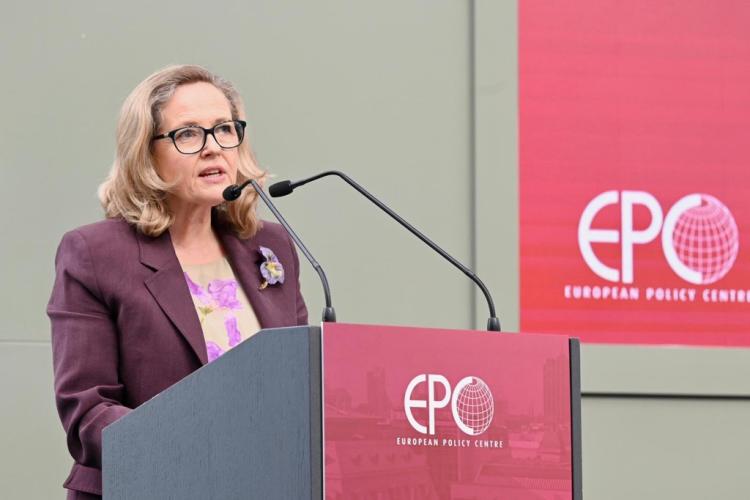
Good morning, everyone. Congratulations for this very interesting programme, which is also extremely timely. The tech sovereignty package that was unveiled by the European Commission this week shows how serious the European Union is about economic security. Next week in the Eurogroup meeting of finance ministers, we will have an in-depth discussion about how to follow up and what the next steps are on the path to sovereignty. And I think this reflects that Europe is moving from principles and plans to delivery, execution and enforcement.
It's clear that strengthening the European Union's strategic and critical infrastructure and ensuring that European companies can produce, innovate, and compete at home and globally is, at the end of the day, what economic security is about. We have the power, we have the money and if we act with unity and determination, I think we can have a strong voice in this new world order that is in the making.
And the second message I'm going to be sharing with you is that economic security is at the core of the European Investment Bank Group's mission. Every euro invested by the European Investment Bank contributes to this goal because securing Europe's strategic autonomy and economic security means energy independence, technological leadership, resilient infrastructures and strong partnerships. And this is exactly what the European Investment Bank is about. So, I'm going to start with this note of confidence, which is well grounded on Europe's strengths as an industrial powerhouse, trade and technology superpower. And it is also grounded on recent experience because after Russia's full-scale invasion of Ukraine, Europe massively scaled up investment in low-carbon energy, grids and interconnectors, clean technologies to break free from our excessive dependence on fossil fuels. I think this is the main lesson that we take from the war in Ukraine and the escalation of the conflict in the Middle East. Europe needs to break free from its dependence on fossil fuels. And these investments made in the last couple of years kept the lights on and kept electricity prices in check this year when this crisis in the Middle East escalated, which is disrupting global oil and gas supplies.
Just let me mention the example of Spain where, as you know, I was First Vice-President before joining as President of the European Investment Bank. What you see is that wholesale electricity prices were actually lower in the first half of this year than they were over the same period last year. And that's largely thanks to the strong growth of wind and solar capacity in the Iberian Peninsula. The electrification of the economy from heavy industry to transport is advancing, too. And these are the foundations for this energy transition. A successful energy transition is, on its own, one of the key foundations of Europe’s sovereignty, economic security and economic competitiveness.
And the European Investment Bank is a key player in the area of energy autonomy. We have consolidated our role as the leading financier of this clean transition. Last year alone, the EIB Group mobilised over €100 billion of clean energy investment – public and private investment – in the European Union, supporting and financing around half of all ongoing energy grid projects, one in five solar plants, one in three onshore wind projects and most offshore wind developments in Europe. And given the news headlines, you will not be surprised to hear that there is a very robust demand for EIB Group financing in these areas also this year.
We are on course to exceed targets again and maintain record investment volumes in 2026, from flagship nuclear power projects to grids, innovative securitisation solutions that will free up liquidity to support efficiency upgrades for small businesses, and clean tech and new fuels. So, the first example is investing in this energy transition, which is in full swing right now in Europe.
The second example that gives me confidence is how Europe is rising to the challenge in the area of security and defence. Faced with a new geopolitical reality, Europe is boosting its defence investments on a scale that would have been unthinkable only a few years ago.
For the European Investment Bank Group, this has been a game changer. By expanding eligibilities for our finance to pure military projects and also to companies and investment funds with activities in all areas of defence, we have quadrupled defence sector financing in a couple of years. This year, the EIB Group is on track to reach a new record in security and defence financing corresponding to around 5% of our annual business in the EU. And there is a very robust pipeline of around 25 flagship projects supporting industrial leaders and infrastructure, but also innovative firms developing breakthrough new technologies and also supporting small and medium-sized companies in the supply chain of Europe's large contractors.
Unicorns like Quantum Systems and Harmattan AI developing the next generation of drones to reinforce Europe's capabilities, or Tytan, another startup that develops autonomous interceptors to protect EU skies. And together with Member States and the Commission, the European Investment Bank Group is currently expanding its defence equity facility, a pioneering fund of funds nurturing the development of a venture capital ecosystem that invests in pioneering firms across the security and defence supply chain. So, my message this morning is quite clear. Europe can move fast and at scale. We're doing it with energy. We're doing it with security and defence and yes, we can do it in the area of frontier technologies. This is a long game, as the headline of this event goes, which is played by research laboratories, factories, capital markets, industries and corporates.
And Europe is well-placed to play and to win this long game because Europe has very relevant strengths, and the European Investment Bank Group is a strategic enabler. The Group is pan-European by design with projects and operations in every corner of our Union and in 160 countries around the world. The Group has a €600 billion balance sheet, a robust AAA rating, and €100 billion more or less in annual financing for Europe’s shared priorities. It is owned by the 27 Member States of the EU. And this is extremely important when we're talking about economic security. And the Group has a diversified portfolio that enables investment in large-scale infrastructures, but also very innovative and high-risk projects that are quite key for Europe's technological leadership, always crowding in private finance. The EIB leverages every euro of guarantees from the European budget to mobilise €15 of investment in shared priorities.
Next week, we will be announcing with the European Commission an amendment to one of those key guarantees, the InvestEU guarantee, so that we can maximise its impact and mobilise an additional €70 billion within the current multi-annual financial framework. Thanks to the successful leveraging of such instruments, the European Investment Bank Group has grown into Europe's largest venture financier, with a 30% market share in venture debt and 24% in venture capital through our subsidiary, the European Investment Fund. We're working every day with our continent's most brilliant innovators and drawing on this experience and expertise.
I spoke about energy autonomy. I spoke about security and defence capabilities. The third axis is technological innovation. Because the deepest economic security does not come from what we keep out. It comes from what we are able to do ourselves. Europe's hand is quite strong because the EU is one of the centres of excellence in quantum and high-performance computing, a powerhouse for industrial robotics and advanced manufacturing in aerospace technologies, in biotech, health tech and medical devices, in advanced pharmaceuticals. And these are the frontier fields where tomorrow's security and prosperity will be determined.
And these are not abstractions. These are concrete names of corporates and companies that reflect this leadership. Of course, everybody has Airbus in mind when I'm talking about aerospace, but I'd like to mention smaller companies that are making a difference, like Quandela in France building industry-grade quantum computers. Like Isar Aerospace in Germany, which is developing a new generation of rockets to strengthen Europe's autonomous access to space. Like the Polish deep-tech company Synerise, developing behavioural artificial intelligence, big-data solutions that enable personalised customer experience and also help organisations track and avoid fraud.
Earlier this week, I was in Spain for a new financing agreement with Ingeteam, a leading company in a number of electrical devices, including solar inverters. We are going to be financing their research programme, which is key to develop Europe's autonomy in an area that is a potential source of security vulnerabilities for the energy transition.
This is the spirit of the Tech Sovereignty package: the new Chips Act, the push on sovereign cloud, open source, of a genuinely European technology stack that was presented by the Commission only yesterday.
My second point on technology, and it is at the heart of our priorities, is that we must close the gap between the laboratory and the factory. Europe invents, our researchers publish cutting-edge research, our universities are second to none. They win prizes, they file for patents. There is a vibrant ecosystem of startups, which is comparable to that of the United States. But then too often our companies need to leave to find the growth capital and to scale up in other markets under someone else's flag. Let us be clear about this scale-up gap. The scale-up gap is a security gap. It's an economic security gap. So we are closing it.
Last year, we launched TechEU, which is the biggest ever financing programme to support investment in new disruptive technologies. Under this umbrella, we are expanding the European Tech Champions Initiative, which is the largest fund of funds of its kind in Europe dedicated entirely to scale-ups, and we are opening it up to private institutional investors. In phase one, the European Tech Champions Initiative has anchored the creation of 15 mega-funds in Europe – and this is almost doubling the number of mega funds with more than €1 billion in capital in Europe – and it has also enabled the creation of 12 unicorns. The latest one is Mews, a Dutch company developing cloud solutions for the hospitality industry.
Now at the same time as supporting scale ups, what we are doing is rolling out a comprehensive exit toolbox for venture founders: convertible instruments, acquisition finance, support for companies that choose to list on European markets, etc. In this context, we also launched a new pilot initiative with Inbonis exploring how independent credit ratings can help innovative companies demonstrate their creditworthiness and access bank financing more easily. We are constantly conducting a market test to identify where the market gaps are and seeing how the European Investment Bank Group can fill those gaps and provide leverage.
Scale and speed are of the essence and that is also why we're also reducing red tape, accelerating processes so that we can respond to the real speed of corporates’ needs. And all of this feeds into the Savings and Investment Union, complementing regulatory reforms, which are also gathering pace with the leadership of the six largest Member States. Every second week, we see how they meet, how they are determined to make progress between now and end of the year.
The European Investment Bank, as I was saying, complements these regulatory initiatives with a bottom-up approach, with concrete pan-European instruments that are offering options for investors to allocate capital and for companies to grow. We, the European Investment Bank Group, act as a non-core investor, playing a leading role in deepening Europe's capital markets, reducing fragmentation, attracting investors and sharing predictability. We do this always in very close partnership with the European Commission and complementing European and national initiatives like the Scaleup Europe Fund, with the goal of offering investors and startup founders the full palette of financing options, a comprehensive platform to fit the needs of investors and corporates.
My third and final point is that we will win this long game with partners, not behind walls. Strategic autonomy has never meant doing everything alone. It means a diversified network of suppliers and markets and being a trusted partner to those who feel the same and share our values. So, where some are pulling out, Europe is stepping up. The European Investment Bank Group invests around 10% of annual financing into building such partner networks around the world, outside the EU.
We are trying to secure the inputs that these frontier technologies depend on, backing early-stage critical raw materials projects, for example, such as graphite and lithium in Tanzania and Namibia, to diversify the supply chains that feed our industries. We're also deepening trusted partnerships with like-minded economies from Canada and Australia to our partners across Latin America. I was in Mexico last week, after the high-level summit that took place the previous week, to put our money where our mouth is. In a nutshell, we had a very important meeting, and we have a very important partnership with Mexico and Latin American countries, and also of course with our partners across the Indo-Pacific. Next year, the European Investment Bank Group will chair the group of multilateral development banks because supporting a multilateral, rules-based order is in itself a form of security.
Let me close with this idea. Openness is security. Diversification is security. Partnership is security. An economy that takes its talent and keeps it, finances its own champions and trades on fair terms with friends is a secure economy. Robert Schuman said – and this quote is so much repeated, but it is so true – that Europe would not be built at once or according to a single plan. I see this quote every day as I walk to the European Investment Bank across the bridge in Luxembourg and it's really inspiring us today.
Europe will not be built all at once or according to a single plan, but through concrete achievements. And the same is true for economic security. It is built achievement by achievement, project by project. A quantum company that is financed. A scale up that stays in Europe. A wind farm that is connected to our grids. A partnership signed. An artificial intelligence breakthrough designed and made in Europe. That's what's relevant for the long game. It rewards not only the loudest player, but also the most patient and the most committed. And frankly, on both counts, I put my money on Europe.
Let me leave you with this positive idea. I wish you a very productive discussion today. Thank you very much.