Nadia Calviño, présidente du Groupe BEI, a prononcé un discours à la Brookings Institution sur le thème « Investir dans un avenir commun », à l’occasion des réunions de printemps 2026 du Groupe de la Banque mondiale et du FMI.
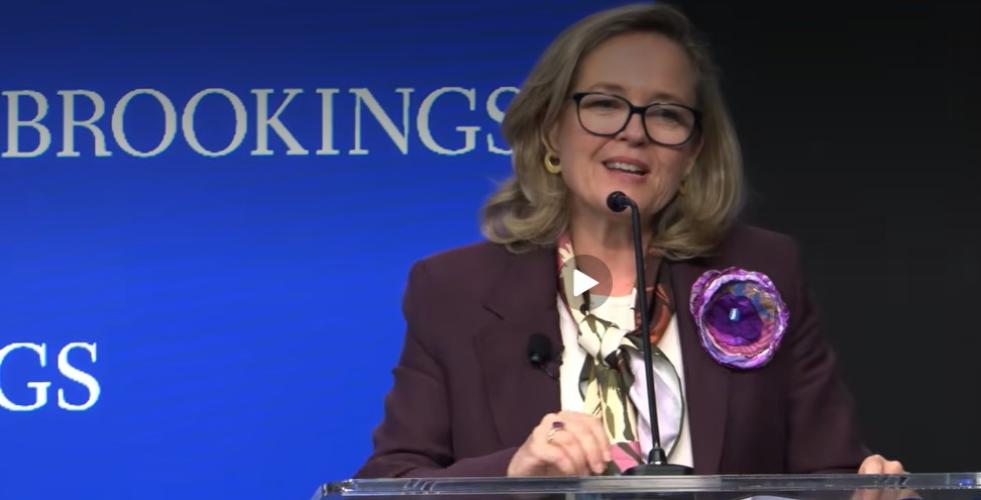
Merci beaucoup de votre participation cet après-midi. Merci tout particulièrement à la Brookings Institution d’organiser ce débat et, d’une manière générale, d’offrir un espace, un forum où l’on peut débattre, discuter, échanger des points de vue et s’attacher à bâtir un avenir meilleur, plus solide et plus pacifique pour nous tous et toutes. C’est un grand plaisir d’entamer cette semaine de réunions très intense par un échange avec le public.
Nous nous retrouvons aujourd’hui à un moment où il est tout à fait clair que les plaques tectoniques sur lesquelles reposait l’ordre mondial depuis 80 ans sont en train de bouger. Et ces changements sont profonds et rapides, et ils génèrent des conflits dans certaines régions et des fractures ailleurs. L’escalade du conflit au Moyen-Orient, les tensions géopolitiques et l’incertitude économique sont des réalités qui frappent le monde, qui le marquent et qui nous réveillent chaque matin. Et je pense que dans des moments comme celui-ci, il importe plus que jamais de concevoir une autre voie et de montrer qu’elle existe.
C’est le premier message que je souhaite vous transmettre aujourd’hui. Il existe une autre voie. Il existe une autre voie qui ne passe pas par des conflits et se construit non sur la confrontation mais sur la coopération. Une voie où nous travaillons avec nos partenaires, car ensemble, nous pouvons accomplir bien plus que chacun d’entre nous individuellement. Et c’est, je crois, l’état d’esprit qui nous habite tous et toutes en cette semaine des réunions de printemps.
Je sais que le président Stubb s’est exprimé avant moi à cette tribune, président de la Finlande mais aussi ancien vice-président de la Banque européenne d’investissement que j’ai aujourd’hui l’honneur de diriger. Et je suis sûre qu’il a fait passer le même message. Nous devons fonder ce nouvel ordre mondial sur la coopération, sur le respect. Nous devons avancer ensemble dans la bonne direction.
L’autre sentiment que je perçois autour de nous est de la détermination. Nous sommes déterminés à unir nos forces et à faire en sorte que toutes les banques multilatérales de développement travaillent ensemble en tant que système. Nous sommes déterminés à jeter des ponts, à trouver des moyens de dialoguer avec respect et de manière constructive, parce que ces réunions du Fonds monétaire international et du Groupe de la Banque mondiale sont une excellente occasion de renforcer notre collaboration, notamment pour consolider le filet de sécurité mondial. En unissant nos forces, en travaillant en tant que système et à grande échelle, nous pouvons contribuer à assurer la stabilité financière et la résilience là où les besoins sont les plus aigus. Et ce n’est pas qu’un objectif, c’est déjà une réalité.
Ces dernières années, nous avons amélioré les synergies et la coordination entre les institutions multilatérales afin de gagner en efficacité et de produire un impact positif sur le terrain partout dans le monde. Nous avons entendu l’appel à la réforme, un autre sujet qui fera certainement l’objet d’un débat approfondi cette semaine ici, à Washington. Nous harmonisons de plus en plus nos stratégies, nous partageons les risques, nous nous appuyons sur nos normes et nos systèmes de passation de marchés respectifs et nous mobilisons des capitaux privés à grande échelle.
Et cette coopération nous permet déjà d’aller plus vite, de réduire les doubles emplois, d’éliminer les chevauchements et de produire le plus grand impact positif pour nos pays partenaires. J’ai d’ailleurs rencontré Ajay Banga plus tôt aujourd’hui et nous avons abordé ces questions. J’ai également eu une réunion avec Kristalina Georgieva pour discuter de ces questions. Comment pouvons-nous être plus efficaces ? Comment pouvons-nous mieux travailler ensemble en tant que système ? D’ici la fin de la semaine, vendredi, nous aurons une réunion avec l’ensemble des institutions multilatérales de développement pour voir comment passer à l’étape suivante.
Donc, je voudrais partager une idée clé, celle de partenariats solides permettant de concevoir cette voie plus positive pour l’avenir du monde.
Pour illustrer cette coopération, la Banque européenne d’investissement signera cette semaine plusieurs accords. Par exemple, dans le secteur de l’eau, nous rejoignons l’initiative Water Forward, avec un engagement de la BEI pour la sécurité hydrique de 300 millions de personnes. C’est une contribution majeure à la réalisation de l’objectif global de couverture d’un milliard de personnes d’ici 2030.
La BEI accorde également la priorité à la santé mondiale. Nous soutenons les infrastructures de santé, les sciences de la vie et la production de vaccins dans le monde entier. D’ailleurs, cette semaine, avec nos partenaires, nous allons signer un contrat de financement pour un projet très novateur dans ce domaine : le premier centre de fabrication multi-vaccins couvrant toute la chaîne de valeur en Afrique du Sud. Ce contrat s’inscrit dans le prolongement d’accords visant à financer des installations de production de vaccins au Sénégal, au Ghana et au Rwanda.
Et c’est là un modèle de coopération. Nous œuvrons dans ce domaine avec le Groupe de la Banque mondiale. Nous travaillons également avec le secteur privé, l’Alliance du vaccin et l’Organisation mondiale de la santé pour changer la donne en matière de santé mondiale.
Je tenais à partager cet exemple pour montrer comment nous passons des paroles aux actes. Ce ne sont pas des paroles en l’air. Cette semaine à Washington, nous signerons des accords qui illustrent le rôle majeur des institutions multilatérales pour soutenir la croissance et la prospérité dans le monde.
Cela m’amène à mon deuxième message : la coopération doit se traduire par un impact systémique à grande échelle, parce que la coopération, au-delà des belles paroles, n’a de sens que si elle permet de produire des résultats à grande échelle et avec rapidité. Dans ce monde en mutation rapide, nous avons besoin de systèmes efficaces. Et les ressources publiques ne suffiront pas à elles seules.
Et c’est pourquoi une autre question que nous aborderons, cette semaine mais aussi dans les mois à venir, porte sur la manière de mobiliser des capitaux privés, afin d’associer pleinement le secteur privé à la réalisation de ces objectifs communs, au soutien de ces biens publics communs qui devraient façonner le monde de demain.
Cela passe par des financements, mais aussi par les données et l’information.
Aujourd’hui, lors de ma réunion avec Ajay Banga, nous avons également souligné l’importance de la base de données mondiale sur les risques des marchés émergents. Cette base intègre les données des 40 dernières années provenant de toutes les institutions multilatérales et de certaines institutions financières nationales de développement, et constitue une ressource précieuse pour les agences de notation et les investisseurs privés. Et cette base de données raconte une histoire forte. Les taux de défaut des prêts dans les marchés émergents sont comparables à ceux observés dans les économies avancées et les taux de recouvrement y sont souvent plus élevés. C’est là un message très important pour mobiliser le secteur privé, encourager les investissements privés et soutenir le développement et le progrès dans le monde.
Nous sommes donc très fiers d’appartenir à la famille des banques multilatérales de développement. Nous estimons que notre contribution ne repose pas seulement sur le financement et le cofinancement de projets individuels, mais aussi sur les actifs et les informations que nous pouvons mettre en commun à l’échelle mondiale pour mobiliser les investissements privés.
L’année prochaine, le Groupe Banque européenne d’investissement assurera la présidence de cette famille des institutions multilatérales de développement. C’est une responsabilité que nous prenons très au sérieux, en particulier dans le contexte géopolitique actuel.
Nous discuterons cette semaine des priorités que nous entendons mettre en œuvre. Nul doute que la mobilisation du secteur privé sera l’une de ces priorités, l’eau et la durabilité, une autre, et la santé mondiale et le capital humain en seront une troisième. Nous avons également évoqué aujourd’hui avec Kristalina Georgieva l’importance de l’intelligence artificielle et son impact sur nos économies et nos sociétés ainsi que, bien sûr, la question des matières premières critiques, un sujet nouveau qui est essentiel pour l’autonomie stratégique de nos économies.
Et cela m’amène à mon troisième et dernier point : la force de nos valeurs. La Banque européenne d’investissement occupe une position quelque peu unique dans le monde d’aujourd’hui. Nos actionnaires sont les 27 États membres de l’Union européenne, ni plus ni moins.
Et comme nous le disions précédemment, ils ont approuvé à l’unanimité notre orientation stratégique tant pour nos opérations à l’intérieur de l’UE que pour nos opérations ailleurs dans le monde. Les opérations à l’extérieur de l’UE représentent environ 10 % de nos volumes de financement annuels qui se sont élevés l’année dernière à 100 milliards d’euros au total.
Nos activités en dehors de l’UE concordent donc parfaitement avec l’objectif de bâtir des partenariats mutuellement bénéfiques et de soutenir le développement et la prospérité, mais aussi avec les priorités et les valeurs européennes. Nos engagements se traduisent concrètement dans nos investissements. Chaque projet que nous finançons incarne nos engagements. Chaque école reconstruite en Ukraine. Chaque jeune fille vaccinée contre le cancer du col de l’utérus en Angola. Chaque femme qui a accès à la contraception et prend, en fin de compte, son destin en main dans le monde. Chaque goutte d’eau propre au Bangladesh, en Gambie, en Jordanie. Chaque ligne de métro financée par la Banque européenne d’investissement au Viêt Nam ou en Inde. Chaque projet d’énergie propre en Égypte, en Amérique centrale. Chaque prêt qui soutient des agriculteurs et des agricultrices en Côte d’Ivoire ou en Sierra Leone, ou qui relie des régions isolées du Cameroun. Nous sommes convaincus que chacun de nos projets soutient la prospérité. Ils reflètent également les valeurs européennes, nos valeurs communes.
Grâce à ces projets, nous contribuons concrètement à la paix, à la croissance, à la stabilité et à la sécurité dans le monde. Permettez-moi à présent de conclure mon discours d’ouverture. Nous aurons dans un instant un échange très intense et intéressant, j’espère, avec vous et avec le public. Mais je tiens à réaffirmer publiquement l’engagement de la Banque européenne d’investissement, le bras financier de l’Union européenne.
Nous sommes pleinement déterminés à continuer de bâtir des partenariats mutuellement bénéfiques. Je tiens à souligner cette idée : des partenariats où nous sommes tous et toutes gagnants, où l’un ne doit pas nécessairement perdre pour que l’autre gagne. Des partenariats fondés sur le respect mutuel, la démocratie et la paix. Cette démarche est non seulement juste, mais aussi judicieuse. Investir dans les échanges commerciaux ouverts, le commerce fondé sur des règles, la croissance, en veillant à ce que cette prospérité soit durable du point de vue environnemental également, à ce que nos sociétés soient justes et stables dans le monde entier, en particulier dans le voisinage de l’Europe, à ce que nous puissions diversifier les chaînes d’approvisionnement, renforcer la sécurité, protéger la santé, la santé mondiale, élargir les marchés, créer des emplois de qualité, tout cela revient, en fin de compte, à investir dans notre avenir commun et à bâtir une prospérité durable partagée, selon le mot d’ordre des réunions de cette semaine.
C’est là ma conclusion. Je vous remercie pour votre attention.