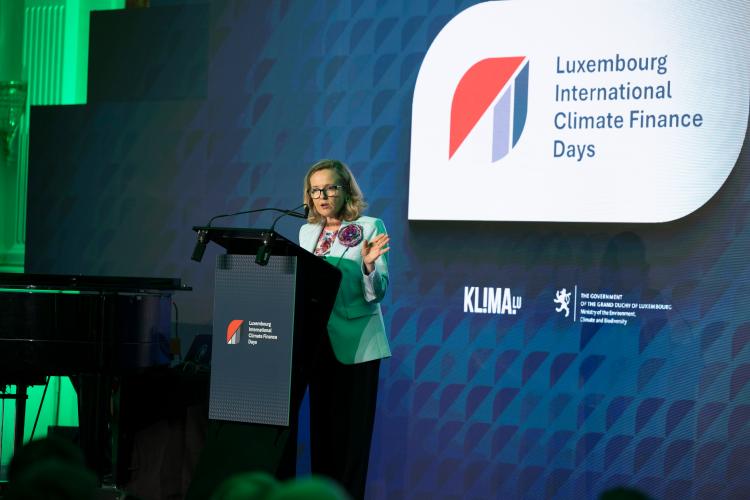
Nadia Calviño, présidente du Groupe BEI, a participé à la cérémonie d’ouverture de l’édition 2026 des Luxembourg International Climate Finance Days.
Monsieur le ministre Wilmes, cher Serge.
Monsieur le commissaire Hoekstra, cher Wopke.
Chère Marie-Ange.
Tant d’amis, de collègues et de partenaires sont réunis aujourd’hui. C’est un immense plaisir d’être parmi vous. Je souhaite commencer par remercier le ministère luxembourgeois de l’environnement, du climat et de la biodiversité d’avoir pris cette initiative et, en six mois seulement, vous nous l’avez dit, organisé ce grand événement. Il s’agit aujourd’hui de réunir les partenaires et de traduire l’ambition climatique en projets d’investissement et en résultats tangibles sur le terrain.
C’est également l’occasion, je tiens à le souligner, de célébrer le 10e anniversaire de Luxembourg Green Exchange, la première plateforme au monde entièrement dédiée à la cotation de titres verts et l’exemple éclatant du rôle de premier plan du Luxembourg en matière de financement de l’action climatique.
Nous sommes très fiers de soutenir cette initiative et, bien entendu, en tant que banque européenne du climat, le Groupe Banque européenne d’investissement se sent ici au Grand-Duché comme chez lui.
Après l’intervention du commissaire, de Wopke, qui a souligné les défis et les mesures à prendre, je souhaiterais vous exposer trois points pour égayer un peu la soirée. Premièrement – cela transparaissait déjà dans vos discours mais mérite d’être dit explicitement –, investir en faveur du climat n’est pas seulement ce qu’il convient de faire pour la planète, c’est aussi un choix judicieux pour nos économies. Comme l’a mentionné le commissaire Hoekstra, les entreprises, les assureurs, les investisseurs institutionnels sont de plus en plus conscients qu’il s’agit d’un risque réel qui doit être intégré, notamment dans leurs bilans.
Dans un contexte géopolitique en mutation rapide, l’action pour le climat est un moteur essentiel de la compétitivité économique, de la sécurité et de la prospérité. S’il est une leçon à tirer de l’escalade du conflit au Moyen-Orient, c’est que l’Europe doit s’affranchir de sa dépendance aux combustibles fossiles. Nous devons renforcer notre autonomie énergétique et accélérer la transition écologique.
Le morceau pour piano que nous venons d’entendre reflétait d’ailleurs cette nécessité d’accélération et le fait que la transition énergétique est déjà bien engagée.
C’est une leçon que nous avons apprise à nos dépens après l’invasion à grande échelle de l’Ukraine par la Russie. Je pense que chacun ici en conviendra, tout comme nos partenaires économiques en Europe : il est clair qu’une transition écologique réussie constitue le socle de la souveraineté et de la croissance économique.
Comme je l’ai indiqué, la Banque européenne d’investissement a consolidé sa position de principal bailleur de fonds de la transition, en Europe et ailleurs dans le monde. Rien que l’année dernière, nous avons mobilisé plus de 100 milliards d’euros d’investissements dans les énergies propres au sein de l’UE. Nous finançons environ la moitié des projets en cours dans les réseaux et interconnexions, une centrale solaire sur cinq, un projet éolien terrestre sur trois et la majorité des projets éoliens en mer.
Je suis particulièrement fière que certains de ces projets contribuent à assurer le bon fonctionnement des systèmes énergétiques dans un contexte de fortes perturbations des marchés mondiaux du pétrole et du gaz. Compte tenu de l’actualité des derniers mois, il n’est guère surprenant que la demande pour des financements du Groupe BEI dans le domaine de l’énergie propre soit très forte cette année. Nous sommes en bonne voie pour dépasser nos objectifs et maintenir des volumes d’investissement record en 2026.
J’ai beaucoup apprécié l’expression selon laquelle la finance verte est une finance pour la paix. Cela rejoint une expression que nous utilisons fréquemment : chaque euro financé par la Banque européenne d’investissement contribue effectivement à la sécurité de l’Europe. Car en investissant dans l’efficacité énergétique, les nouveaux carburants et la décarbonation de l’industrie lourde, nous renforçons notre autonomie stratégique et notre sécurité.
Mon deuxième point concerne l’importance des partenariats. Permettez-moi de vous donner un exemple : cela fait des décennies que le Luxembourg et le Groupe BEI travaillent main dans la main pour mobiliser des financements climatiques à grande échelle. Nous avons lancé ensemble la première obligation verte au monde en 2007. Il s’agit là d’une étape majeure à l’échelle mondiale. L’obligation a été émise par la BEI et cotée au Luxembourg.
Ces instruments innovants sont devenus une classe d’actifs à part entière, mobilisant des milliers de milliards pour des projets durables dans le monde. Ils contribuent également à renforcer le rôle international de l’euro, et les émetteurs européens jouent un rôle de premier plan sur ce segment. Le Groupe BEI a émis, à lui seul, 145 milliards d’euros d’obligations vertes et durables et il est le premier émetteur de titres alignés sur la norme des obligations vertes européennes.
Ces émissions d’obligations de première catégorie ont rencontré un grand succès auprès des investisseurs et favorisent l’approfondissement des marchés des capitaux européens. Pas plus tard qu’hier, nous avons émis pour 5 milliards d’euros d’obligations vertes à la Bourse de Luxembourg, une émission sursouscrite 7 fois. J’insiste sur ce point parce qu’au-delà des débats politiques et du bruit ambiant, la réalité est que les marchés financiers manifestent un réel intérêt pour la finance verte. Les entreprises progressent dans la transition écologique, c’est la réalité que l’on observe sur le terrain.
Le Groupe BEI renforce également ses achats d’obligations vertes. Il s’impose à la fois comme un émetteur de premier plan et comme un investisseur, jouant un rôle pionnier en faveur de l’intégration des marchés, comme je l’ai mentionné il y a un instant. Cette semaine, nous avons annoncé un investissement de 20 millions d’euros dans la première obligation verte de l’entreprise énergétique estonienne Eesti Energia. Il s’agit du premier investissement de la BEI dans une obligation verte de premier rang dans les pays baltes. Il illustre l’engagement accru de la Banque à renforcer la finance verte et à développer les émissions publiques dans la région.
Je peux vous dire aujourd’hui que de nombreux accords similaires vont suivre, de sorte à orienter les capitaux vers des investissements dans les réseaux électriques, la production d’électricité et le stockage.
Tout cela montre qu’en adoptant une approche fondée sur la coopération, on peut obtenir bien plus que la somme des contributions de chacun. Les partenariats, l’unité portent leurs fruits. Grâce à ces partenariats, le Luxembourg est devenu un pôle international de premier plan pour la finance durable.
Je veux rendre hommage, de nouveau, à la Bourse de Luxembourg et, tout particulièrement, à Julie Becker. Permettez-moi également de saluer mon vice-président, Ambroise Fayolle, qui est parmi nous, car il promeut l’action climatique avec professionnalisme et enthousiasme. Je pense que sans son dynamisme, nous n’aurions probablement pas une présence aussi importante dans le domaine des financements climatiques.
En ce qui concerne les partenariats, nous travaillons en étroite collaboration avec la Commission européenne. Vous savez, cher Wopke, cher commissaire Hoekstra, que vous pouvez compter sur la Banque européenne d’investissement pour soutenir la mise en place de partenariats avec des pays du monde entier.
Cela est très pertinent d’un point de vue géopolitique, comme nous le comprenons tous. Il est également important de souligner que l’année prochaine, lorsque nous prendrons la présidence du groupe des banques multilatérales de développement, nous avons l’intention de poursuivre ce programme d’action climatique. Cela est d’autant plus précieux aujourd’hui, alors que les temps évoluent, que les discours changent et qu’il devient de plus en plus difficile pour de nombreuses autres institutions multilatérales de continuer à parler du climat et de poursuivre ce programme, entre autres priorités.
J’en viens à mon dernier point : les transitions réussissent lorsque les populations en perçoivent concrètement les bénéfices. Nous devons susciter l’adhésion de la société. Les investissements climatiques ont pour corollaire des tarifs énergétiques plus bas pour les entreprises et les ménages, de meilleures solutions de transport pour les villes et les régions et des conditions de financement plus avantageuses pour les entreprises. En outre, les technologies propres et l’innovation offrent également de nouvelles perspectives d’emplois de qualité et de croissance.
Il s’agit là d’une excellente nouvelle. Dans les faits, l’économie verte est l’un des secteurs les plus dynamiques du marché du travail européen et crée des millions d’emplois.
Et une autre bonne nouvelle pour vous : l’Europe est une puissance dans les technologies propres, telles que l’éolien. Je reviens tout juste d’Espagne, où nous avons signé lundi un nouvel accord de financement avec Ingeteam, une entreprise innovante qui met au point des onduleurs solaires et d’autres technologies propres essentielles, un enjeu crucial pour la sécurité de l’Europe. Il s’agit d’une opération clé pour l’autonomie énergétique de l’Europe, car elle nous permettra de réduire notre dépendance à l’égard de fournisseurs non européens, tout en renforçant la stabilité des tarifs de l’électricité.
Je pense qu’il est très important d’unir nos forces, non seulement pour mobiliser des fonds, mais aussi pour communiquer ces bonnes nouvelles, pour porter un message positif sur les succès de cette transition écologique, qui est déjà engagée.
Permettez-moi de conclure en réaffirmant ma grande confiance dans les succès à venir. La révolution énergétique est déjà bien engagée, elle s’accélère. Les investissements en faveur de la transition énergétique dans l’UE et ailleurs dans le monde atteignent chaque année de nouveaux records, malgré les informations que nous lisons au quotidien dans les médias.
Les technologies propres progressent et offrent des solutions concrètes pour fournir de l’énergie et soutenir l’économie à moindre coût. Les entreprises considèrent de plus en plus la résilience climatique comme une priorité stratégique et investissent à l’appui de l’efficacité et de l’innovation. C’est ce que nous constatons à la Banque européenne d’investissement dans le cadre de nos activités et c’est ce que nous observons sur le terrain. Si les discours politiques peuvent évoluer, la voie à suivre et la logique économique sont claires.
Les valeurs européennes du secteur des énergies renouvelables ont augmenté de plus de 70 % au cours de l’année écoulée, ce qui illustre la solidité de nos industries. Le Groupe Banque européenne d’investissement est résolu à soutenir cette réussite européenne et à faire de la transition écologique une réussite mondiale, en collaboration avec ses partenaires dans le monde entier.
Je me réjouis de constater, et l’audience réunie aujourd’hui en est le reflet, que dans cette démarche, nous ne sommes pas seuls. Nous pouvons compter sur de nombreux amis et partenaires.
Je vous remercie vivement pour cette initiative et je vous souhaite des échanges très fructueux.
Merci.