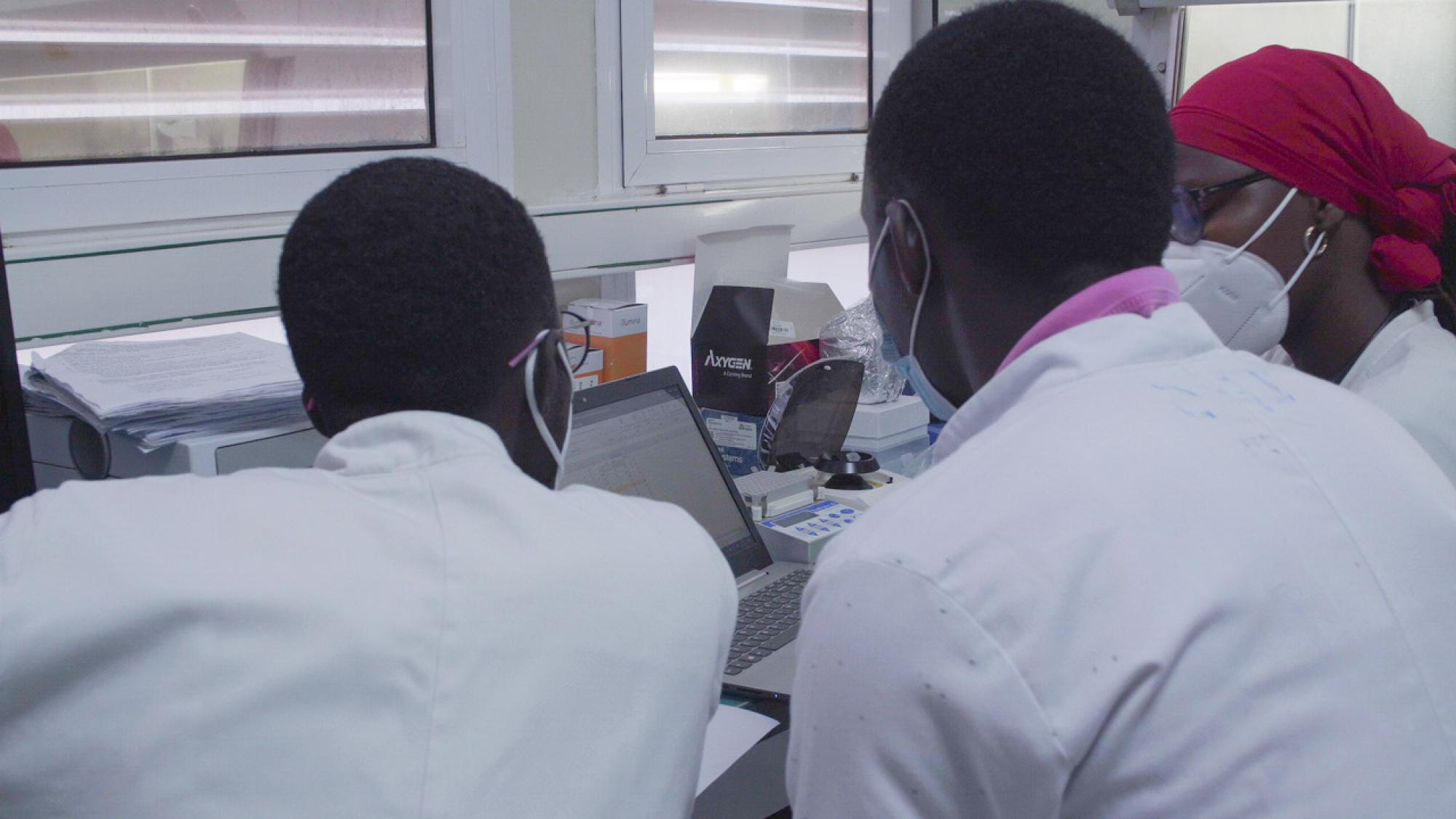
"The COVID pandemic has highlighted the need to increase vaccination in Africa"
Signature(s)
Amount (.*)
€ 4,750,000
Sector(s)
Industry
: € 4,750,000
Signature date(s)
8/07/2021 : € 4,750,000
Other links
News & Stories
Link to source
Other links
Inside the project
How and Why
Accessible health products and vaccines produced in Africa
Why
- Fewer than 2% of the three billion vaccine doses administered globally have been in Africa
- New manufacturing facilities on the continent are essential, as Africa currently imports 99% of its vaccines
- The COVID-19 pandemic highlighted the need to increase vaccination in Africa
How
- The vaccine production facility at the Institut Pasteur de Dakar plans to produce as many as 25 million doses of an approved COVID-19 vaccine a month by the end of 2022
- Improve investment in Africa’s health sector and boost the production and accessibility of heath products and technologies
- Support technology transfer and the creation of regional vaccine manufacturing hubs in other regions of Africa
Sectors & Countries

Story
A COVID-19 vaccine of its own for Africa
To increase vaccination rates, Africa needs to secure more doses. New manufacturing facilities on the continent are essential, as Africa currently imports 99% of its vaccines. The new vaccine production facility at the Institut Pasteur de Dakar is a key link in a vaccine strategy developed by the African Union and the Africa Centres for Disease Control and Prevention.
“Not only does this reinforce the health system, but also through this particular project it will create jobs, develop capacities in terms of knowhow and workforce, while bringing in new technology,” says Sall.

"It’s very important that we have this solidarity between African countries and European countries because it helps to build up a global ecosystem for global health security."
Related media
A COVID-19 vaccine of its own for Africa
Europe backs COVID-19 vaccine production in Africa with an investment in Senegal’s Institut Pasteur de Dakar.
What’s the impact of an impact investment?
A study supported by the EU bank examines how an impact investment is contributing to improved maternal health services for Senegalese women
Links
Related projects and stories
Energy storage: EIB Group supports EU tripartite initiative
The European Investment Bank (EIB) Group supports a new EU-level initiative to scale up energy storage as part of the clean energy transition. Announced alongside the meeting of EU energy ministers in Luxembourg, the tripartite agreement brings together public authorities, energy storage and renewables developers, and financial institutions to accelerate storage deployment, strengthen the energy system, stabilise prices and reduce reliance on fossil fuels.
EIB Global supports Trans-Caspian Transport Corridor with €150 million for road rehabilitation in Kazakhstan
The European Investment Bank (EIB) is providing a €150 million framework loan to Kazakhstan to support the rehabilitation of strategic road infrastructure along the Trans-Caspian Transport Corridor (TCTC), a key route connecting Central Asia and Europe.
Backed by the European Union under the Global Europe (NDICI) framework, the financing will support investments implemented by Kazakhstan's national road operator QazAvtoZhol. The operation will improve transport connectivity, strengthen road safety and climate resilience, and facilitate trade and economic development across the region.
The investment forms part of the European Union's Global Gateway strategy and follows the Memorandum of Understanding signed between the EIB and Kazakhstan in 2024 to strengthen sustainable transport connections between Europe and Asia.
The programme will finance the rehabilitation of approximately 1,370 kilometres of roads across central and southern Kazakhstan, including sections linking the country with neighbouring Central Asian states. By improving transport efficiency and resilience, the investment will reduce travel times, improve road conditions and facilitate the movement of goods and people along one of the region's most important transport corridors.
EIB Vice-President Marek Mora, who oversees the Bank's operations in Central Asia, including Kazakhstan, said:
"Good roads do more than connect places on a map. They connect people, they let businesses reach new markets, make travel safer and faster, and create opportunities for communities. By investing in key transport links across Kazakhstan, we are supporting a corridor that is becoming increasingly important for trade between Europe and Central Asia while delivering tangible benefits locally. Hard infrastructure is the backbone for trades. This is what sustainable connectivity is about: creating practical connections that support growth, resilience and cooperation."
EU Commissioner for International Partnerships, Jozef Síkela, stated:
"The Trans-Caspian Transport Corridor is playing an increasingly important role in connecting Europe and Central Asia. Through this investment, and together with our partners, we are supporting the development of safer, more resilient and more efficient transport infrastructure in Kazakhstan. This is a tangible example of Global Gateway in action, strengthening regional connectivity, supporting sustainable economic development and deepening our partnership with Kazakhstan and the wider region."
EU Ambassador to Kazakhstan Aleška Simkić commented:
"The Trans-Caspian Transport Corridor is one of the key priorities under the EU's Global Gateway strategy. Developing efficient, reliable and sustainable transport connections between Central Asia and Europe strengthens trade, enhances economic cooperation and contributes to the resilience of global supply chains. This investment demonstrates the European Union's long-term commitment to fostering connectivity, prosperity, and strong partnerships across the region."
The programme is expected to generate around 5,900 person-years of employment during implementation, creating opportunities for local communities and supporting economic activity. By strengthening one of the main transport links between Central Asia and Europe, the investment will facilitate trade, improve regional connectivity and contribute to the objectives of the EU-Kazakhstan partnership and the Global Gateway strategy.
EIB and Swedbank have secured EUR 200.75 million in financing for the developer of the Rūdninkai Military Town
The developer of part A of stage II of the Rūdninkai Military Town project, Rudina, has signed loan agreements with the European Investment Bank (EIB) and Swedbank: each institution is providing a loan of EUR 100.37 million. Rudina is indirectly managed by the INVL fund ‘INVL Defence Infrastructure Fund I’, together with the construction companies Conres and Fegda.