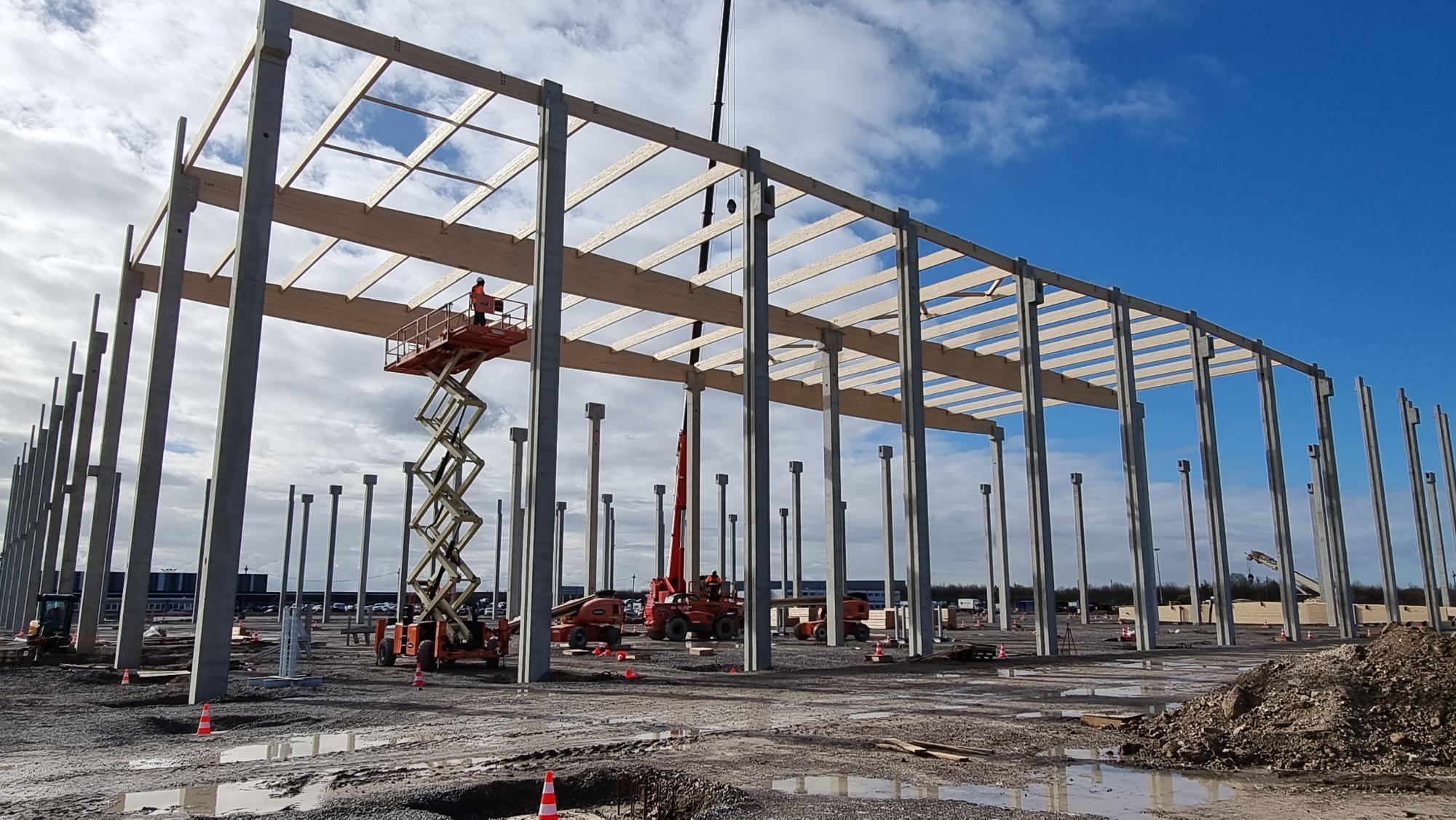
Cette giga-usine est source de progrès, non seulement pour AESC, mais aussi pour les ambitions écologiques de la France et de l’Europe. Nous sommes fiers de pouvoir faire avancer la mobilité propre en rendant les batteries et les véhicules électriques plus abordables.
Autres liens
Fiche récapitulative
Date de publication
18 juillet 2022
Statut
Référence
Signé | 28/09/2023
20220168
Nom du projet
Promoteur – Intermédiaire financier
DOUAI EV BATTERY GIGAFACTORY
ENVISION AESC GROUP LTD
Montant BEI envisagé (montant approximatif)
Coût total (montant approximatif)
EUR 450 million
EUR 1317 million
Description
Objectifs
The project will finance the construction and operation of an advanced manufacturing plant in Douai, France.
The aim is to supply the Renault Group with a new generation of Lithium-ion batteries for Electric Vehicles (EV). The project is eligible under Article 309 point (a) projects for developing less-developed regions and point (c) common interest.
Additionnalité et impact
The project concerns the implementation in Europe of an advanced manufacturing technology for the production of advanced li-ion battery cells. The latter is considered a key enabler for the development of the European EV industry.
The company achieved an important milestone in the prototyping of the cells and now needs to follow suit with getting it in a stable serial production at acceptable scrap rate, the hardest part in this high-tech industry by some accounts.
The project could make a substantial contribution to the development of the EU-based battery industry. The knowledge spillovers in Europe are related to the cooperation with the French EPC constructor for the development and construction of the highly specialised building (clean room, utilities), and with regional technical schools for the up/re-skilling of the labour force.
The project caters for the transition in e-mobility by supplying the growing demand in Europe for EV Batteries with advanced battery cells. It therefore qualifies in full as Climate Action (mitigation).
The project is located in a cohesion region where it will create significant long-term skilled employment. It therefore qualifies in full under Cohesion.
The operation qualifies for InvestEU eligibility under the following main policy priority areas:
SIW:
1.1.6 Modernisation and decarbonisation of industry
(a) decarbonisation investments in industries, in particular transport, aiming at significant reduction or avoidance of GHG emissions; and
(c) investments in assets enabling the flow of low-carbon energy.
Europe must master the de-carbonisation of its transport sector. This passes through the transformation of its automotive industry from supplying vehicles running on carbon fuels to vehicles running on electricity. This in turn requires the build-up of an innovative European battery industry. Europe lags behind in the development and industrialisation of battery technologies and the related know-how.
The project addresses these failures.
The project:
(a) has the nature of a public good for which the operator or company cannot capture sufficient financial benefits (knowledge dissemination through technology transfer and education and skills of the local labour, and a lasting specialised infrastructure being made available at no or negligible cost, both in a Cohesion Region);
(b) generates externalities which the operator or company fails to internalise, such as climate mitigation.
The financing also addresses the market failure of insufficient investment in a transition region and thus supporting the strengthening of the EU's economic, social and territorial cohesion.
The Project's external benefits are potentially high as it contributes to the establishment of an industrial value chain in Europe of a competitive battery technology. The Project will lead to important knowledge transfer to Europe. It will deploy advanced manufacturing activities and related high skilled jobs in Europe. The Project will furthermore help creating the conditions for the deployment of e-mobility, and the development of a cleaner and more sustainable transport system In Europe and lead to lower emissions of pollutants (health benefits) and CO2 (climate benefits) on the roads.
The proposed non-recourse structure is innovative for this type of project, traditionally financed through corporate loans by commercial banks at sponsors' level. EIB's capability to appraise and structure the Project with unmatched terms and conditions on the commercial market would bring significant added value to the Promoter. EIB will not only close a large financing gap but also crowd in other financiers. The increased risk profile of the loans (loan tenor potentially going beyond the Renault offtake contract and being exposed to a mix of substantial market / technology / offtaker creditworthiness risks, subject to acceptability being confirmed during appraisal) beyond what the Bank traditionally regards as acceptable, can be considered thanks to Invest EU protection.
Considering the above, the project will generate economic benefits that are greater than those captured by the investor's financial returns.
The operation would not be carried out to the same extent by the EIB without the InvestEU support.
Aspects environnementaux
Passation des marchés
The implementation of an industrial scale plant for serial production of lithium-ion battery cells requires a full environmental impact assessment (EIA) or a screening decision in accordance with the EIA directive. This and other environmental, climate and social aspects will be appraised during project due diligence.
The promoter has been assessed by the EIB as being a private company not subject to EU rules on public procurement or concessions.
Commentaires
The project concerns a first implementation in Europe of an advanced manufacturing technology tailored to the production of a sub-type of advanced li-ion battery cells. The latter is considered a key enabler for the development of the European EV industry. The project could make a substantial contribution to the development of the EU-based battery industry. The knowledge spillovers in Europe are related to the cooperation with the French EPC constructor for the development and construction of the highly specialised building (clean room, utilities), and with regional technical schools for the up/re-skilling of the labour force. The project caters for the transition in e-mobility by supplying the growing demand in Europe for EV batteries with advanced battery cells. It therefore qualifies in full as Climate Action (mitigation). The project is located in a cohesion region where it will create significant long-term skilled employment. It therefore qualifies in full under EU Cohesion.
Documents liés
Documents
Évaluation des incidences environnementales et sociales - DOUAI EV BATTERY GIGAFACTORY - Etude d'impact
Date de publication
28 Feb 2023
Langue
Sujet général
Prêts
Numéro du document
160491980
Thématique du document
Information Environnementale
Type de document
Numéro du projet
20220168
Secteur(s)
Régions
Pays
Disponible au public
Télécharger maintenant
Fiche technique sur les aspects sociaux et environnementaux - DOUAI EV BATTERY GIGAFACTORY
Date de publication
18 Apr 2023
Langue
Sujet général
Prêts
Numéro du document
162765287
Thématique du document
Information Environnementale
Type de document
Numéro du projet
20220168
Secteur(s)
Régions
Pays
Disponible au public
Télécharger maintenant
Lien vers la source
Autres liens
À la une
Lien vers la source
Autres liens
Au cœur du projet
Pourquoi et comment
Un écosystème de l’automobile dans le nord de la France
Pourquoi
- La demande mondiale de batteries lithium-ion est en augmentation.
- L’Europe doit accroître sa capacité de production de batteries.
- Les véhicules électriques réduisent les émissions et stimulent la transition écologique.
- Objectif de cohésion : aligner le niveau des Hauts-de-France sur celui des économies de l’UE.
Comment
- Production de batteries lithium-ion pour les voitures électriques Renault, qui permettent une conduite beaucoup plus écologique.
- Construction d’une usine d’une capacité combinée de 9 gigawatts-heure, qui sera portée jusqu’à 24-30 gigawatts-heure à l’horizon 2030.
- Création d’emplois et utilisation de nouvelles technologies dans la région des Hauts-de-France.
Secteurs et pays

Récit
La France recharge ses batteries
Depuis toujours, Anastasia Walch-Guinebert aime résoudre des problèmes et réfléchir à des moyens d’améliorer les choses. En outre, elle est fascinée par l’innovation constante dans le domaine de la transition énergétique. Pouvoir conjuguer ces deux intérêts, c’est ce qui l’a motivée à rejoindre Automotive Energy Supply Corporation (AESC) en tant qu’ingénieure procédés. Son travail au sein de cette grande entreprise internationale spécialisée dans les batteries, dont le siège se situe au Japon, consiste à améliorer la production des batteries pour véhicules électriques afin de veiller à ce qu’elles soient sûres, efficaces, de haute qualité et durables sur le plan environnemental.
« Lorsqu’il y a un problème de qualité du produit, nous sommes chargés d’évaluer le procédé et de trouver des solutions », explique-t-elle. « Ce travail me permet d’avoir une incidence positive sur l’environnement et sur le monde qui m’entoure. »
Avec l’ouverture en 2025 d’une giga-usine de batteries AESC à Douai, dans la région des Hauts-de-France, son rôle prendra encore plus d’importance.
Douai, autrefois connue pour son industrie minière, est devenue un pôle automobile. Des entreprises comme Renault y ont installé leurs usines de fabrication. Notre projet viendra compléter cet écosystème automobile en pleine croissance.

AESC apporte un savoir-faire de pointe en France et contribuera ainsi au développement durable de l’industrie des batteries en Europe. Ce projet permettra aussi de soutenir la réindustrialisation de la région des Hauts-de-France, baptisée la nouvelle « vallée de la batterie », et d’accompagner la transition stratégique de Renault.
Qu’est-ce qu’une giga-usine ?
Les giga-usines, ou gigafactories en anglais, sont de gigantesques sites généralement destinés à produire des batteries pour véhicules électriques, des solutions de stockage de l’énergie et d’autres technologies connexes. Elles se spécialisent dans la fabrication d’un seul produit prisé à grande échelle, tandis que les usines ordinaires, plus petites, peuvent répondre à divers besoins de fabrication. La giga-usine d’AESC à Douai se consacrera à la production en grande série de batteries lithium-ion pour véhicules électriques.
Pour les véhicules électriques, les constructeurs préfèrent les batteries lithium-ion à celles au sodium, au magnésium ou à l’hydrogène, car elles offrent une haute densité énergétique et une durée de vie plus longue, des critères essentiels compte tenu de l’espace limité à bord. Le lithium étant le métal le plus léger, son utilisation permet aussi de réduire l’énergie nécessaire pour déplacer la voiture, ce qui se traduit par une meilleure efficience et une plus grande distance parcourue.

Sur le même sujet
La France recharge ses batteries
Une giga-usine de batteries lithium-ion créera des emplois et stimulera l’industrie européenne des batteries en faveur d’une mobilité plus propre
Un électrochoc vert pour l'Europe
L'usine de batteries lithium-ion de Northvolt en Suède aidera l'Europe à réduire sa dépendance au pétrole et aux batteries importées.
Préparer du café avec l’énergie verte des voitures
Un investissement dans une entreprise allemande spécialisée dans la recharge bidirectionnelle rend les voitures électriques encore meilleures pour l’environnement
Liens
Projets et articles associés
Energy storage: EIB Group supports EU tripartite initiative
The European Investment Bank (EIB) Group supports a new EU-level initiative to scale up energy storage as part of the clean energy transition. Announced alongside the meeting of EU energy ministers in Luxembourg, the tripartite agreement brings together public authorities, energy storage and renewables developers, and financial institutions to accelerate storage deployment, strengthen the energy system, stabilise prices and reduce reliance on fossil fuels.
EIB Global supports Trans-Caspian Transport Corridor with €150 million for road rehabilitation in Kazakhstan
The European Investment Bank (EIB) is providing a €150 million framework loan to Kazakhstan to support the rehabilitation of strategic road infrastructure along the Trans-Caspian Transport Corridor (TCTC), a key route connecting Central Asia and Europe.
Backed by the European Union under the Global Europe (NDICI) framework, the financing will support investments implemented by Kazakhstan's national road operator QazAvtoZhol. The operation will improve transport connectivity, strengthen road safety and climate resilience, and facilitate trade and economic development across the region.
The investment forms part of the European Union's Global Gateway strategy and follows the Memorandum of Understanding signed between the EIB and Kazakhstan in 2024 to strengthen sustainable transport connections between Europe and Asia.
The programme will finance the rehabilitation of approximately 1,370 kilometres of roads across central and southern Kazakhstan, including sections linking the country with neighbouring Central Asian states. By improving transport efficiency and resilience, the investment will reduce travel times, improve road conditions and facilitate the movement of goods and people along one of the region's most important transport corridors.
EIB Vice-President Marek Mora, who oversees the Bank's operations in Central Asia, including Kazakhstan, said:
"Good roads do more than connect places on a map. They connect people, they let businesses reach new markets, make travel safer and faster, and create opportunities for communities. By investing in key transport links across Kazakhstan, we are supporting a corridor that is becoming increasingly important for trade between Europe and Central Asia while delivering tangible benefits locally. Hard infrastructure is the backbone for trades. This is what sustainable connectivity is about: creating practical connections that support growth, resilience and cooperation."
EU Commissioner for International Partnerships, Jozef Síkela, stated:
"The Trans-Caspian Transport Corridor is playing an increasingly important role in connecting Europe and Central Asia. Through this investment, and together with our partners, we are supporting the development of safer, more resilient and more efficient transport infrastructure in Kazakhstan. This is a tangible example of Global Gateway in action, strengthening regional connectivity, supporting sustainable economic development and deepening our partnership with Kazakhstan and the wider region."
EU Ambassador to Kazakhstan Aleška Simkić commented:
"The Trans-Caspian Transport Corridor is one of the key priorities under the EU's Global Gateway strategy. Developing efficient, reliable and sustainable transport connections between Central Asia and Europe strengthens trade, enhances economic cooperation and contributes to the resilience of global supply chains. This investment demonstrates the European Union's long-term commitment to fostering connectivity, prosperity, and strong partnerships across the region."
The programme is expected to generate around 5,900 person-years of employment during implementation, creating opportunities for local communities and supporting economic activity. By strengthening one of the main transport links between Central Asia and Europe, the investment will facilitate trade, improve regional connectivity and contribute to the objectives of the EU-Kazakhstan partnership and the Global Gateway strategy.
EIB and Swedbank have secured EUR 200.75 million in financing for the developer of the Rūdninkai Military Town
The developer of part A of stage II of the Rūdninkai Military Town project, Rudina, has signed loan agreements with the European Investment Bank (EIB) and Swedbank: each institution is providing a loan of EUR 100.37 million. Rudina is indirectly managed by the INVL fund ‘INVL Defence Infrastructure Fund I’, together with the construction companies Conres and Fegda.