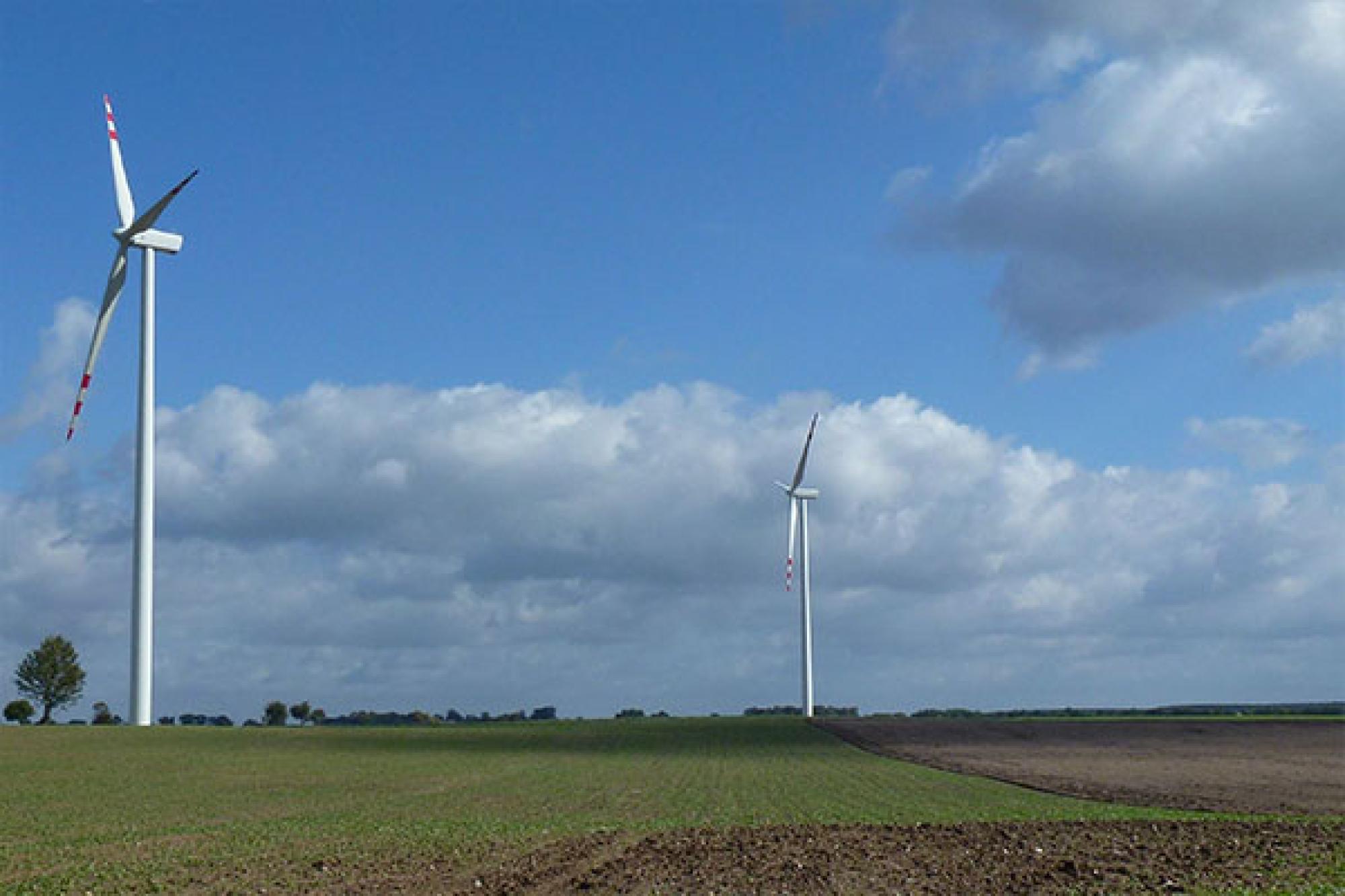
"Je suis très fière de la façon dont notre parc éolien apporte la preuve que la nature et la production d’électricité peuvent coexister. En Pologne, la production d’électricité a si souvent fait du tort à la nature."
Autres liens
Fiche récapitulative
Date de publication
6 avril 2020
Statut
Référence
Signé | 09/03/2020
20180740
Nom du projet
Promoteur – Intermédiaire financier
LE POMERANIA WIND FARM
UAB IGNITIS GRUPE
Montant BEI envisagé (montant approximatif)
Coût total (montant approximatif)
PLN 258 million (EUR 60 million)
PLN 581 million (EUR 134 million)
Lieu
Secteur(s)
Description
Objectifs
The project will finance a 94 MW onshore wind farm located in the northern part of Poland in Pomeranian Voivodship, approximately 50 km from the coastline of the Bay of Gdansk.
The project will contribute to environmental and security of energy supply objectives. The project is located in a Cohesion priority region. It is therefore eligible under Article 309 (a) projects for developing less-developed regions and (c) common interest. The financing of this project would contribute to the EIB's lending priority policy on social cohesion, renewable energy and climate action.
Aspects environnementaux
Passation des marchés
Windfarms falls under Annex II of Directive 2011/92/EU (as amended by Directive 2014/52/EU) according to which the Member States shall determine whether the project shall be made subject to an assessment based on defined criteria. According to national legislation, windfarms exceeding certain criteria are subject to a mandatory Environmental Impact Assessment (EIA). This was the case for the project. The environmental studies for the EIA process were undertaken and the competent authorities have granted approval containing requirements to mitigate environmental impacts accordingly. Residual impacts were classified of small magnitude and low significance.
The project will be operating without exclusive or special rights within the meaning of the EU Utilities Directive 2004/17/EC c.q. 2014/25/EU hence private sector procurement procedures will apply. Equipment and works will be purchased through at least two contracts ?one for supply and installation of turbines, others for infrastructure works (Balance of Plant), electrical works etc.
Documents liés
Autres liens
Documents
Évaluation des incidences environnementales et sociales - LE POMERANIA WIND FARM - Streszczenie w języku niespecjalistycznym
Date de publication
9 Apr 2020
Langue
Sujet général
Prêts
Numéro du document
129369190
Thématique du document
Information Environnementale
Type de document
Numéro du projet
20180740
Secteur(s)
Régions
Pays
Disponible au public
Télécharger maintenant
Évaluation des incidences environnementales et sociales - LE POMERANIA WIND FARM - Raport o oddziaływania na środowisko
Date de publication
9 Apr 2020
Langue
Sujet général
Prêts
Numéro du document
92571920
Thématique du document
Information Environnementale
Type de document
Numéro du projet
20180740
Secteur(s)
Régions
Pays
Disponible au public
Télécharger maintenant
Fiche technique sur les aspects sociaux et environnementaux - LE POMERANIA WIND FARM
Date de publication
8 Apr 2020
Langue
Sujet général
Prêts
Numéro du document
94479943
Thématique du document
Information Environnementale
Type de document
Numéro du projet
20180740
Secteur(s)
Régions
Pays
Disponible au public
Télécharger maintenant
Environmental and Social Completion Sheet - LE POMERANIA WIND FARM
Date de publication
15 Dec 2022
Langue
Sujet général
Prêts
Numéro du document
164055073
Thématique du document
Information Environnementale
Type de document
Numéro du projet
20180740
Secteur(s)
Régions
Pays
Disponible au public
Télécharger maintenant
scoreboard - LE POMERANIA WIND FARM
Date de publication
13 May 2020
Langue
anglais
Sujet général
prêts
Numéro du document
130644046
Thématique du document
EFSI Obligation légale
Type de document
Tableau de bord
Numéro du projet
20180740
Dernière mise à jour
14 May 2020
Secteur(s)
Énergie
Pays
Pologne
Disponible au public
Télécharger maintenant
Lien vers la source
Autres liens
À la une
Lien vers la source
Autres liens
Au cœur du projet
Comment et pourquoi
Soutenir une transition juste et écologique
Pourquoi
- Pour lutter contre les changements climatiques, nous devons cesser de brûler du charbon pour produire de l’électricité et le remplacer par des sources renouvelables.
- Les régions à faibles revenus tributaires du charbon ont besoin de nouvelles industries afin qu’elles ne soient pas perdantes dans la transition de l’UE vers une économie neutre en carbone.
Comment
- Les parcs éoliens produisent de l’électricité sans émettre de CO2.
- Le projet soutient la création d’emplois dans le secteur des énergies vertes dans une région prioritaire au titre de l’objectif de cohésion, qui a toujours dépendu du charbon.
Secteurs et pays
REGARDER LA VIDÉO
0:55
Nouvelles opérations dans le secteur des énergies renouvelables en Pologne
Le projet d’Ignitis est l’une des premières opérations à avoir été conclues au titre d’une nouvelle loi destinée à encourager les énergies renouvelables en Pologne. « La Pologne devient presque un pays en vogue pour les investissements dans les énergies renouvelables », s’enthousiasme Diana Kazakevič, directrice d’Ignitis Pologne, une entité du groupe Ignitis, le fournisseur lituanien d’énergie, coté à Vilnius et à Londres, qui construit ce parc éolien.

En 2020, la Commission européenne a annoncé un plan de lutte contre les changements climatiques, lequel repose sur l’engagement de parvenir à zéro émission nette de gaz à effet de serre d’ici 2050 en Europe et prévoit des dispositions importantes veillant à ce que les régions qui dépendent actuellement des combustibles fossiles ne soient pas laissées de côté dans la transition vers les technologies propres.
Sur le même sujet
Le pacte vert en action
En Pologne, une modification de la législation attire les investisseurs internationaux, ce qui donne un coup de pouce aux énergies renouvelables et ouvre la voie à la transition verte
Liens
Projets et articles associés
MDB heads deepen collaboration to support countries through heightened global uncertainty
In a period of heightened global uncertainty, including the evolving situation in the Middle East, the heads of MDBs today underscored the importance of close cooperation to support stability, safeguarding development progress, and responding to mounting pressures in their member economies.
Joint Multilateral Development Bank statement on critical minerals to manufacturing value chains
The following joint statement was adopted by MDBs including the EIB Group at the World Bank Group/International Monetary Fund Spring Meetings on 17 April 2026.
Waterworks: Who gains from improving access?
Impact evaluation can be a useful tool to measure the benefits of water infrastructure investment – but first you need an accurate baseline
Photogallery
©Ignitis