
What you need to know
EU-backed investments are helping Ukraine maintain essential services—from healthcare to heating and transport—during the war.
Why this matters
Across Ukraine, surgery continues during air-raid alerts, communities rely on emergency responders, cities are repairing heating systems after repeated attacks, and the railways remain a lifeline for people moving inside the country and to Europe.
A number that tells the story
€1.5 billion: In 2025, the European Investment Bank Group supported projects worth €1.5 billion to help families heat homes, help children return to school and ensure that people receive medical care.
Better medical care under wartime conditions
On a cold evening at a hospital in Zhytomyr in northern Ukraine, surgery goes on without a pause, despite fires and explosions that continue to bring in new injuries. Every movement in the operating room must be carefully planned and coordinated.
“There is no place for panic,” says Viktor Pomyrlianu, medical director of Pavlusenko Hospital No. 2, located west of Kyiv. “You must stay focused, because a patient’s life depends on it.”
A new surgical unit, opened in May 2025, doubled the hospital’s capacity to treat patients and introduced state-of-the-art medical equipment and infrastructure. The project forms part of the European Investment Bank’s recovery programme for Ukraine, carried out with support from the United Nations Development Programme.

“In Ukraine now, you cannot build a big hospital because it will be immediately attacked,” says Violaine Silvestro von Kameke, head of public sector operations in Ukraine, Moldova and the South Caucasus at the European Investment Bank. “You need to build small things. This costs more but it’s safer.”
Before reconstruction, working conditions were described as minimally sufficient. Operating rooms were cramped, equipment outdated and ventilation inadequate.
The project introduced new heating, ventilation and cooling systems, upgraded water and wastewater pipes, renewed electrical wiring and improved fire safety equipment. Additional systems such as compressors and chillers now help regulate temperature and maintain sterile conditions.
The impact has been transformative. Doctors can now work according to European standards, and the unit is able to support more than 6 000 patients each year, giving people access to high-quality care closer to home.
In the same region, additional projects are improving daily life. In the village of Vysoke, a preschool opened in October 2025. Built in just 11 months despite wartime conditions, the building can host 40 children and includes a shelter for use during air-raid alerts. Outside school hours, the shelter is available to the entire community.

Long-term recovery supported by local projects
Ukraine’s reconstruction needs are estimated at $524 billion over the next decade. In response, the European Investment Bank focuses on smaller, practical projects designed to deliver immediate benefits even in wartime conditions.
In 2025, the Bank supported projects worth €1.5 billion, targeting essential services that directly affect daily life, including heating, healthcare, water supply and education.
Energy security remains a priority. A €300 million loan to the public utility Naftogaz was provided to help secure gas supplies ahead of winter, ensuring that households can stay warm and businesses can continue operating.
Additional agreements worth €400 million were signed to support water infrastructure, district heating and general reconstruction efforts in cities across the country.
Across Ukraine, more than 500 public buildings are being repaired or upgraded in around 150 communities, improving resilience and service delivery at local level.

©pop_jop/Getty Images
Expert insight
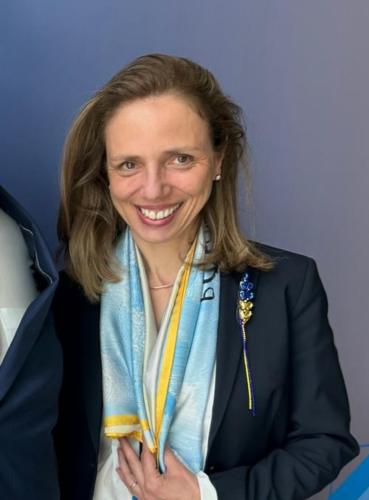
Violaine Silvestro von Kameke is head of public sector operations in Ukraine, Moldova and the South Caucasus at the European Investment Bank.
Q: Why is it important to carry out basic renovation works in Ukraine?
A: When buildings are properly insulated and systems upgraded, every additional investment, such as adding renewable energy measures or a bomb shelter, goes much further.
Q: How does the European Investment Bank’s financing contribute to daily life for Ukrainians?
A: Ukraine needs practical, scalable solutions during the war, and that means combining loans and grants so that communities can keep critical services running. The EIB’s work with municipalities helps repair damaged public buildings and infrastructure. By targeting critical needs, we help millions of Ukrainians access drinking water, heating, healthcare, education and housing.
Keeping people safe, warm and connected
The urgency of maintaining safety is visible in Avangard, a community in Odesa Oblast. The local Community Safety Centre, led by Yurii Halchynskyi, serves more than 36 000 residents and responds to fires, accidents, shelling and floods.
“Courage is when you do the right thing, even if no one applauds you,” Halchynskyi says. “Simply because you cannot do otherwise.”
The centre’s work extends beyond emergency response to prevention and education, helping residents learn how to act in dangerous situations.
In April 2025, the centre expanded into a new facility with improved operational capacity. The building includes vehicle bays, training rooms and shelter space, allowing teams to continue working during air raids.

Energy infrastructure is another critical challenge. Repeated attacks have caused severe damage to Ukraine’s heating systems. District heating damage alone is estimated at more than €2.5 billion, with total rebuilding expected to cost between €6 billion and €10 billion.
To address this, the European Investment Bank has supported decentralised solutions and energy resilience. Financing is delivered through local partner banks to ensure rapid distribution to municipalities.
A total of €200 million is being channelled through Ukrainian banks, with €30 million already disbursed to support heating systems that keep homes, schools and hospitals operational during winter.

Transport infrastructure also plays a vital role. With airports closed and roads disrupted, railways have become essential for mobility and evacuation.
A 22-kilometre rail line connecting the western cities of Uzhhorod and Chop opened in September 2025. Built to European standard track widths, it allows trains to travel directly between Ukraine and countries such as Austria, Hungary and Slovakia.
Passenger demand increased quickly as journeys became faster and more reliable. The line is part of a broader effort to integrate Ukraine’s railway network with the European Union.
A €50 million loan supports upgrades to railway border crossings with Poland, Slovakia, Hungary and Romania, helping to strengthen connections further.
In Lviv, more than 70% of Ukrainians travelling to Europe now depart from the city, which is expected to develop into a major railway hub.
“When life in Ukraine feels unpredictable, the railway gives consistency,” says Oleg Yakovenko. “You can still plan your journey, and the trains keep moving.”
Key facts summary
- €1.5 billion EIB support in 2025
- 500+ public buildings upgraded across ~150 communities
- 36 000 residents served by safety centre
Read more about
Ukraine realigns its future with Europe
Ukraine is modernizing its railways with EIB Advisory support and switching to European gauges to ensure faster travel and trade
What actually makes affordable housing possible
What affordable housing really means, who it’s for and how Europe can build more — with long-term finance, planning and smart regulation.
Green rooftops cut energy costs and cool Serbian cities
Green rooftops and walls in Serbia are improving energy efficiency, cooling cities and helping residents live more comfortably with climate change.