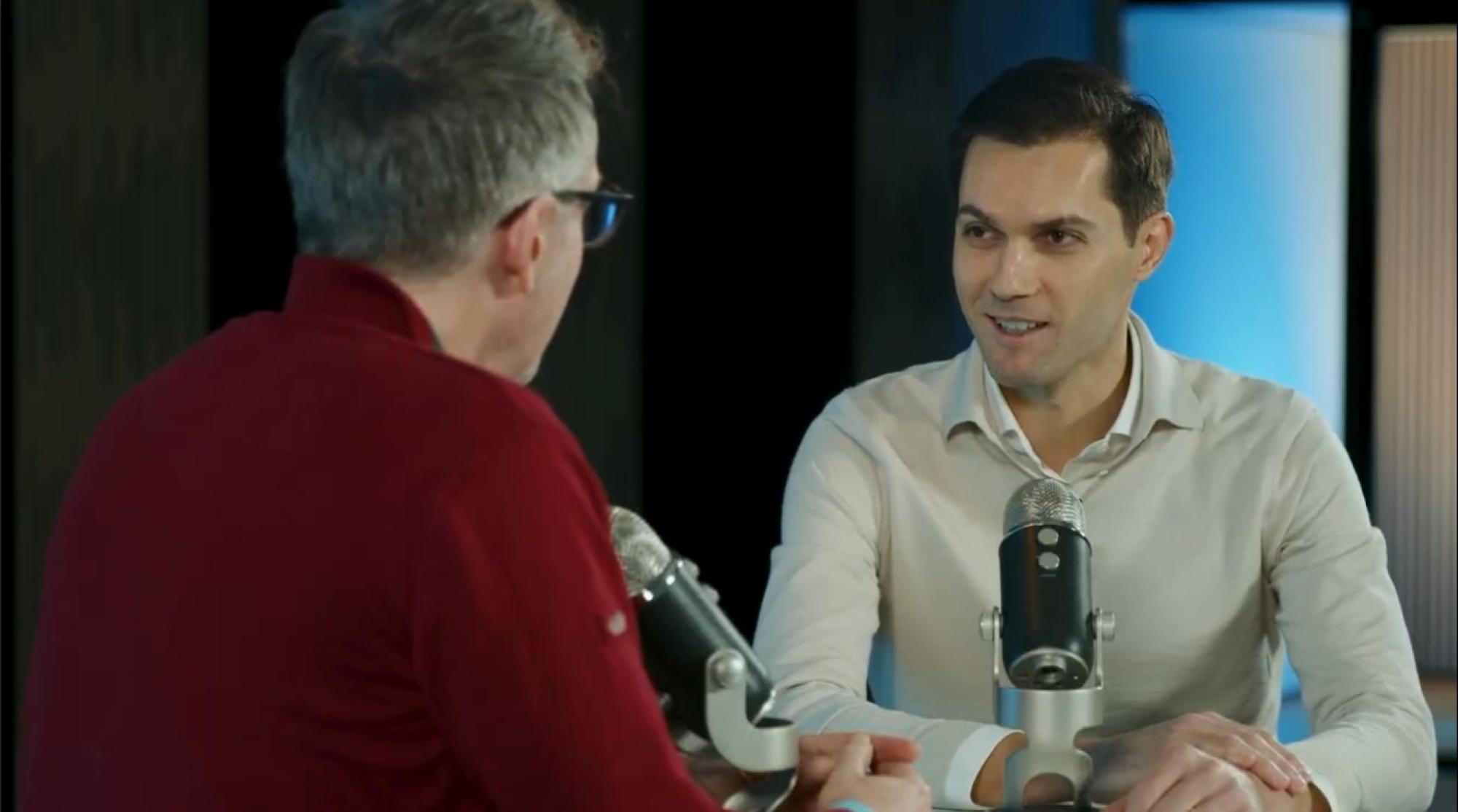
“If fusion succeeds, there is no need for any other source of energy.”

Invested by Europe explores the forces shaping the European economy. In each episode, we hear from experts tackling the most pressing challenges—from housing and energy to innovation and infrastructure, security and defence. We look at what’s changing, what the solutions are, and how Europe is investing in its future.

What this episode is about
Nuclear fusion is the process that powers the sun and the stars. It releases vast amounts of energy when two atomic nuclei fuse into one — with a small loss of mass converted into energy through Einstein’s equation E = mc². That tiny loss of mass translates into an enormous energy output.
Fusion has been achieved in laboratories, but not yet at efficient, scalable levels. In this episode of Invested by Europe, Franz Derler, a European Investment Bank investment officer, explains what fusion is, why it matters, how investors approach this deep tech field, and what it means for Europe’s strategic position.

The conversation in brief
If fusion succeeds, the implications for energy systems are enormous. In theory, fusion could provide a virtually limitless source of clean energy. But in practice, other energy sources — including renewables and nuclear fission — will continue to coexist for many decades. Energy demand is rising rapidly, and existing technologies with installed capacity will not be abandoned. However, the relative importance of fossil fuels could decline significantly if fusion becomes a reality, because fusion could provide the stable baseload power that fossil fuels supply today.
Fusion sits within the broader category of deep tech — technologies based on scientific breakthroughs that represent fundamental change rather than incremental improvements. For investors, fusion is very different from established renewable energy or fission projects. Traditional energy investments rely on mature regulatory frameworks and predictable returns. Fusion requires patient, long-term capital willing to take risks on milestones that are still ahead. This attracts a different investor profile: public and private venture capital, sovereign wealth funds, and those prepared to invest for the long-term in technologies that could deliver very large payoffs if successful.
There are two major technological approaches to fusion:
• Magnetic confinement fusion, which uses strong magnets to confine extremely hot plasma containing fusion fuel
• Inertial (laser) confinement fusion, which uses powerful lasers to compress a fuel target
Both aim ultimately to produce heat and electricity. Both approaches have attracted significant funding. Over the last five years, more than $10 billion has gone into private fusion projects, with magnetic confinement receiving the largest share. The best-funded company is Commonwealth Fusion Systems in the United States, which bases its research on tokamak reactors — large machines that use strong magnets to contain plasma.
Europe retains the capability to play an important role in the future of fusion, but only a small share of the global private fusion funding has gone to European companies. Still, firms such as Proxima Fusion and Marvel Fusion have raised major rounds from prominent investors, showing strong momentum.
If fusion becomes a reality, the consequences would be immense — for the climate, the economy and even global geopolitics. Some say that if fusion succeeds, it could solve half of the world’s major problems.
Key takeaways
- Fusion releases vast amounts of energy when atomic nuclei fuse.
- If successful at scale, fusion could transform global energy systems.
- Europe has strong capabilities but must strengthen its competitive position.
About the guest
Franz Derler has worked at the European Investment Bank since 2015 and joined the European Investment Council Fund Investment Advisory team in 2022. He has been involved in fusion-related investments and now leads the Fund’s activities in this sector. He brings extensive experience at the intersection of finance and deep tech, with a particular focus on innovative energy technologies. Franz holds a Master’s degree in Finance from the University of Liechtenstein and is a CFA charter holder.
Listen and subscribe to Invested by Europe
You can watch or listen to Invested by Europe on:
- The full series on our website
- Apple Podcasts
- Spotify
- Deezer
- — or find us on your favourite podcast platform.
New episodes are released weekly.
Explore more
Cold fusion? You’re getting warmer
How does cold fusion work? How is the EIB helping renewable energy companies?
Italy: Juncker Plan - EIB lends EUR 250m to ENEA for research into clean fusion energy
The challenge to produce safe, clean nuclear fusion energy by 2050 can now count on a ground-breaking experimental device that will be built in Italy. ENEA's Divertor Tokamak Test (DTT) is ready to be launched thanks to EIB financing and the support of the Lazio Region, both announced today.
TechEU
EU's largest ever financing programme to support Europe's innovators from idea to IPO and from lab to leadership
ENEA - DIVERTOR TOKAMAK TEST FACILITY
Design and construction of the Divertor Tokamak Test facility ("DTT"), a research infrastructure that is aimed at contributing to the realization of the fusion energy. The project is a key milestone of the European Fusion Roadmap and it is planned to be developed in Italy over the 2018-2025 period.