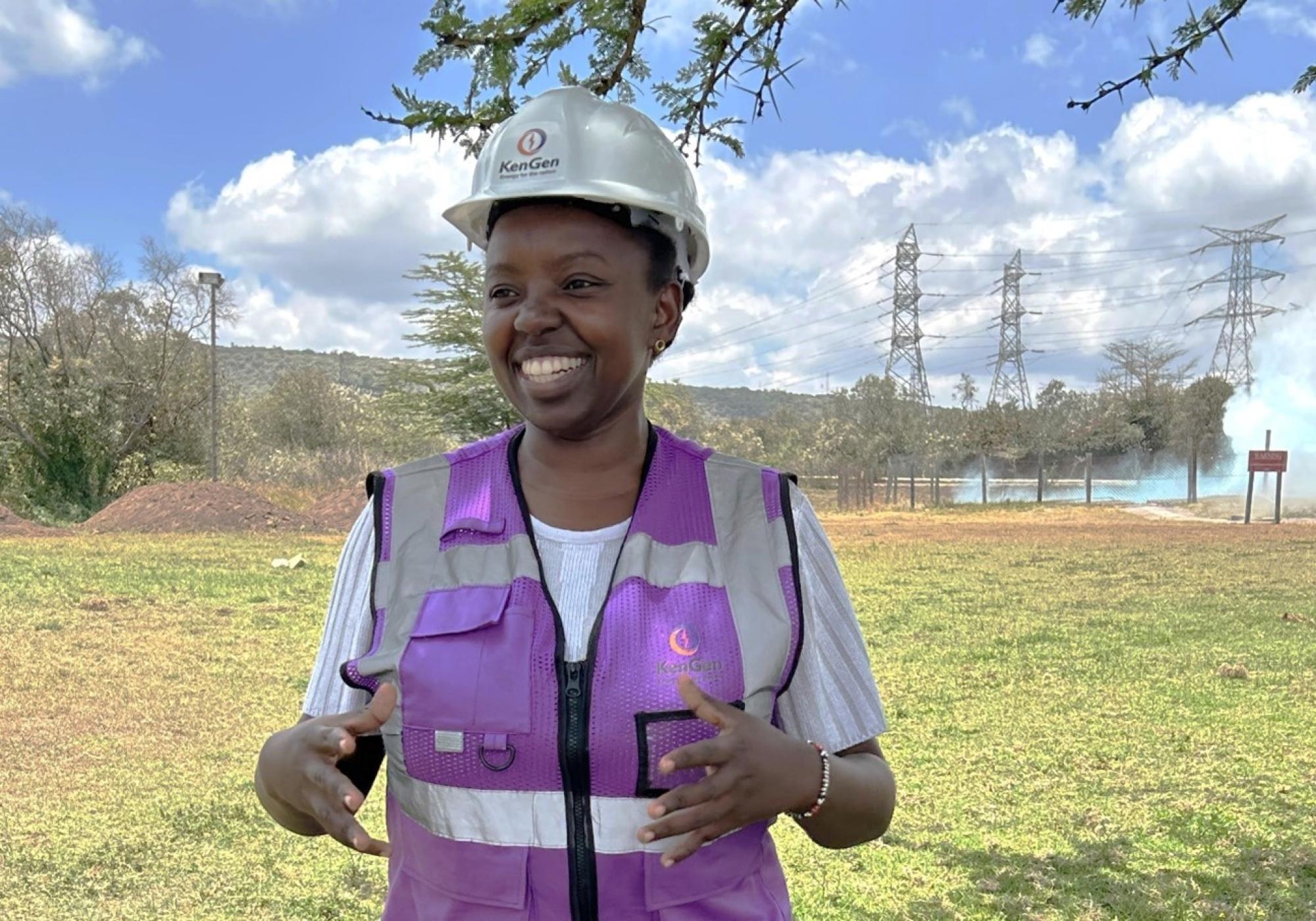
Sans la géothermie, il serait très difficile pour ce pays de répondre à la demande en énergie.
Autres liens
Fiche récapitulative
Date de publication
7 janvier 2016
Statut
Référence
Signé | 08/09/2017
20150459
Nom du projet
Promoteur – Intermédiaire financier
OLKARIA I GEOTHERMAL EXTENSION
KENYA ELECTRICITY GENERATING COMPANY LTD
Montant BEI envisagé (montant approximatif)
Coût total (montant approximatif)
EUR 72 million
EUR 311 million
Description
Objectifs
The project consists of the extension of the existing 140 MW Olkaria I Unit 4 & 5 geothermal power plant with an additional 70 MW turbine (Unit 6), the necessary wells, steam-gathering system and interconnection facilities.
The project will help meet growing electricity demand at a competitive cost. Its economic benefits include increased power generation, improved security of supply (geothermal power is unaffected by annual hydrological conditions), reduced national dependence on imported fossil fuels for electricity generation, fewer emissions associated with conventional thermal generation and additional operational flexibility with the greater Olkaria geothermal generation park.
Aspects environnementaux
Passation des marchés
If located inside the EU, the project would fall under Annex II of the Environmental Impact Assessment (EIA) Directive 2011/92/EU, requiring a screening decision by the competent authority. Kenyan law requires a full EIA. An environmental and social impact assessment (ESIA) has been established for the new unit and has been approved and a respective licence issued by the NEMA (National Environmental Management Authority). As with the other units of Olkaria I power station, the project lies in the Hells Gate National Park, where there is no human settlement. The Bank will ensure that the project complies with its environmental and social standards.
The promoter is a utility majority-owned by the Government of Kenya. For the project it will adopt open competitive tendering procedures and envisages publication in the Official Journal of the EU for the main contracts. The Bank will require the promoter to ensure that any procurement procedures are done in accordance with the Bank's Guide to Procurement.
Commentaires
The Government of Kenya, in its Vision 2030 development programme launched in 2008, has identified energy as being one of the key enablers to attain 10% GDP growth target. The project will provide renewable energy to bridge the existing gap between energy demand and supply in Kenya and it will help mitigate the impact of climate change. The investment is in line with the Sustainable Development Goals (SDGs), especially SDG 7 "Ensure access to affordable, reliable, sustainable and modern energy for all".
Documents liés
Documents
Évaluation des incidences environnementales et sociales - OLKARIA I GEOTHERMAL EXTENSION - 70MW Additional Unit 6 geothermal powerplant
Date de publication
22 Mar 2016
Langue
Sujet général
Prêts
Numéro du document
63951928
Thématique du document
Information Environnementale
Type de document
Numéro du projet
20150459
Secteur(s)
Pays
Disponible au public
Télécharger maintenant
Résumé non technique - OLKARIA I GEOTHERMAL EXTENSION - For the drilling of 80 Geothermal Steam production Wells
Date de publication
23 Mar 2016
Langue
Sujet général
Prêts
Numéro du document
65357527
Thématique du document
Information Environnementale
Type de document
Numéro du projet
20150459
Secteur(s)
Pays
Disponible au public
Télécharger maintenant
Résumé non technique - OLKARIA I GEOTHERMAL EXTENSION - NTS of the ESIA for the Additional Unit 6 Powerplant
Date de publication
22 Mar 2016
Langue
Sujet général
Prêts
Numéro du document
65362518
Thématique du document
Information Environnementale
Type de document
Numéro du projet
20150459
Secteur(s)
Pays
Disponible au public
Télécharger maintenant
Évaluation des incidences environnementales et sociales - OLKARIA I GEOTHERMAL EXTENSION - EIA for the drilling of 80 Geothermal Steam Production Wells
Date de publication
22 Mar 2016
Langue
Sujet général
Prêts
Numéro du document
65369919
Thématique du document
Information Environnementale
Type de document
Numéro du projet
20150459
Secteur(s)
Pays
Disponible au public
Télécharger maintenant
Fiche technique sur les aspects sociaux et environnementaux - OLKARIA I GEOTHERMAL EXTENSION
Date de publication
25 Jul 2016
Langue
Sujet général
Prêts
Numéro du document
67483700
Thématique du document
Information Environnementale
Type de document
Numéro du projet
20150459
Secteur(s)
Pays
Disponible au public
Télécharger maintenant
Fiche d’achèvement d’un point de vue environnemental et social - OLKARIA I GEOTHERMAL EXTENSION
Date de publication
24 Dec 2025
Langue
Sujet général
Prêts
Numéro du document
252644842
Thématique du document
Information Environnementale
Type de document
Numéro du projet
20150459
Secteur(s)
Pays
Disponible au public
Télécharger maintenant
Lien vers la source
Autres liens
Au cœur du projet
Pourquoi et comment
Le chef de file énergétique de l’Afrique
Pourquoi
- La géothermie, c’est de l’énergie propre.
- Elle contribue à la réduction des émissions dues aux combustibles fossiles.
- Elle aide le Kenya à se positionner comme chef de file des énergies renouvelables en Afrique.
Comment
- Le Kenya développe l’énergie géothermique et exporte des connaissances techniques.
- Le plan Kenya Vision 2030 vise un recours intégral aux énergies renouvelables dans tout le pays à l’horizon 2030.
- Le succès de la géothermie permet au Kenya d’investir dans d’autres énergies vertes, telles que l’hydroélectricité et les parcs solaires.
Secteurs et pays

Récit
Éviter le stade de la pollution
S’il a grandi en milieu rural dans une maison sans électricité éclairée par des lanternes enfumées, Peketsa Mangi est aujourd’hui directeur général du développement géothermique sur le site d’Olkaria au Kenya, l’un des plus grands champs de production géothermique au monde.
Depuis les années 1950, « le Kenya est le pionnier des avancées géothermiques en Afrique », explique-t-il, au milieu d’un champ luxuriant dans la vallée du Grand Rift, avec en arrière-plan le jaillissement bruyant hors de terre de panaches de vapeur épaisse.

Les centrales géothermiques d’Olkaria exploitent l’énergie de la terre en forant à plusieurs milliers de mètres dans le sol. La vapeur est captée et acheminée par des canalisations pour actionner des turbines qui produisent de l’électricité. De grandes conduites blanches transportent l’eau ou la vapeur dans tout le complexe d’Olkaria, qui couvre une superficie d’environ 70 kilomètres carrés. Ces canalisations sont montées sur pilotis afin que les animaux puissent passer dessous et forment même des boucles pour permettre aux girafes de circuler librement. Le matin, les girafes prennent leur petit déjeuner au milieu des arbres à proximité des centrales géothermiques.
Le Kenya a pris de l’avance non seulement dans le secteur de l’énergie, mais aussi dans les moyens d’action qu’il donne aux femmes dans ce domaine et dans la reconnaissance de leurs ressources.
Sur le même sujet
Pas de réseau ? Pas de problème !
Tout comme l’eau potable, l’électricité est une condition préliminaire au développement économique. Une entreprise africaine, d.light, fournit de l’énergie propre aux villages isolés.
Un coup de pouce aux éleveurs pastoraux
Au Kenya, le financement lié aux changements climatiques soulage les éleveurs pastoraux touchés par la sécheresse. L’Union européenne soutient cette activité de prêt car les banques locales se montrent réticentes à accorder des financements dans ces régions éloignées.
Liens
Projets et articles associés
Celebrating diversity, equity and inclusion at Luxembourg Pride Week
The European Investment Bank (EIB) Group is taking part in Luxembourg Pride Week from 2 to 12 July, celebrating the LGBTIQ+ community and reaffirming its strong commitment to diversity, equity and inclusion.
Local leaders and EIB join forces to pool public and private funds for affordable houses
Intensifying their cooperation with the European Investment Bank, regions and cities on 2 July discussed the EU’s housing policy with President Calvino, Members of the European Parliament and associations. During their debate in a plenary session of the European Committee of the Regions, they also voiced concerns that the next EU budget will weaken EU support for social, energy and climate projects
EIB Group Complaints Mechanism outreach and dispute resolution workshop in Zagreb, Croatia
The EIB Group Complaints Mechanism, in collaboration with the Independent Complaint Mechanism for DEG, FMO and Proparco (ICM), and the Dispute Resolution Service (DRS) of the World Bank Accountability Mechanism, organised a regional workshop in Zagreb from 8 to 11 June 2026, with the support of the CEE Bankwatch Network.