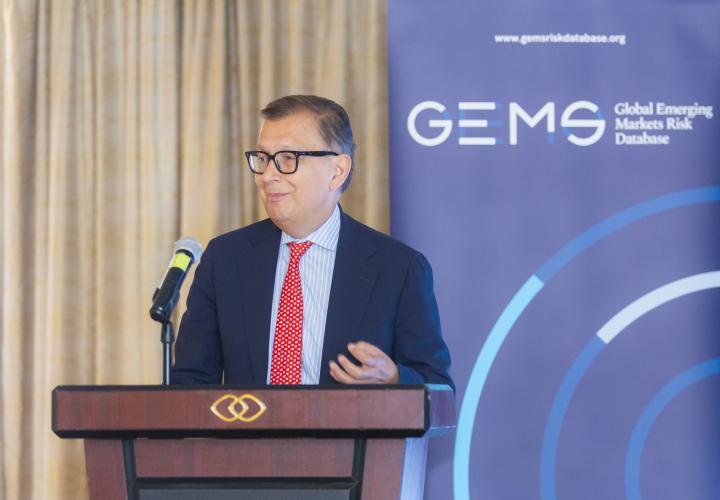
The European Investment Bank (EIB) on Monday hosted a half-day seminar focused on the Global Emerging Markets Risk Database (GEMs), the world’s largest credit risk database for emerging markets, and its role in supporting investment in Emerging Markets and Developing Economies (EMDEs).
The seminar brought together banks, funds, equity firms, micro financiers, and government and development agencies to discuss GEMs’ statistics and their insights into investing in North Africa.
“In the Middle East and North Africa region, which has been at the heart of geopolitical tensions for decades, the GEMs database provides solid and transparent elements to support investment decision making,” said Guido Clary, Head of EIB’s Regional Hub for North Africa and the Near East in Cairo.
Co-led by the EIB and the International Finance Corporation (IFC), the GEMs Consortium is a powerful alliance of multilateral development banks (MDBs) and development finance institutions (DFIs) that pools 40 years of investment experience in emerging economies and share the statistics publicly. The statistics offer insight into the true potential of emerging markets. The G20-mandated panel reviewing Capital Adequacy Frameworks of international financial institutions has recognised the significant potential of GEMs to strengthen analytical foundations and guide future reforms.
“GEMs has emerged as an important instrument for addressing global financial challenges and correcting long-standing biases and outdated assumptions toward emerging markets,” said EIB Group Chief Risk Officer and GEMs Consortium Co-Chair, Román Escolano.”
According to the GEMs statistics, the average default rate for private lending in the Middle East and North Africa (MENA) region between 1984 and 2024 was 3.39%, below the global average of 3.54%. In public lending, MENA’s average default rate was 1.89%, below the global average of 2.61%.
On recoveries, lending to MENA’s private sector showed a 71.7% recovery rate, only slightly lower than the global average of 72.9%. In public lending, MENA showed the highest average recovery rate of all regions at 93.5%.
“Investing in some markets in MENA is less risky than commonly perceived and both foreign and domestic investors looking to enter these markets—particularly when investing alongside MDBs and DFIs—stand a good chance of recovering their investment,” said Gregor Cigüt, GEMs Secretary General. He also stressed the importance of viewing the statistics alongside current macroeconomic data available for the region.
GEMs statistics are available at www.gemsriskdatabase.org as well as on Bloomberg terminals and at World Bank Data360.
EIB presents credit risk information in the Middle East and North Africa
©EIB
Download original

EIB presents credit risk information in the Middle East and North Africa
©EIB
Download original

EIB presents credit risk information in the Middle East and North Africa
©EIB
Download original

EIB presents credit risk information in the Middle East and North Africa
©EIB
Download original

EIB presents credit risk information in the Middle East and North Africa
©EIB
Download original