Nadia Calviño, president of the European Investment Bank Group, spoke at the Euronext Annual Conference in Paris, which brought together nearly 1 000 executives, advisers and investors to explore the market and macroeconomic landscape for 2026.
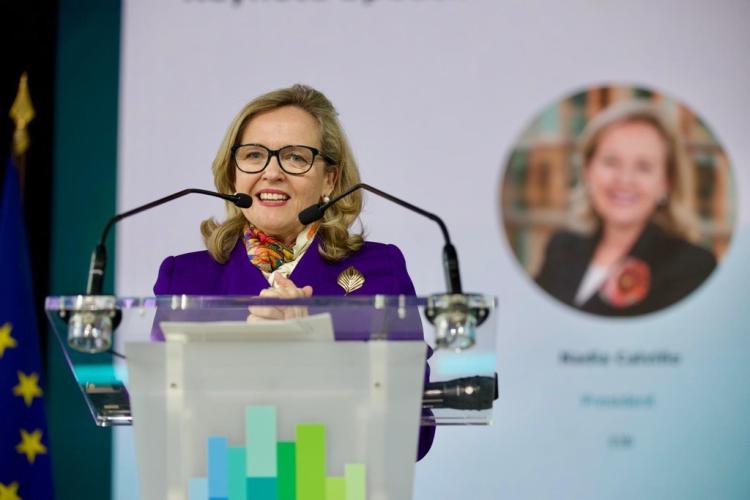
It is such a great pleasure to be with you here today in this beautiful venue at the heart of the Champs-Élysées, which, of course, is a symbol of light and peace. And we need a bit of peace and light in the world that we're living these days.
So, let me start with a touch of light and a positive message, which is a warm congratulations to all those that have just got these prizes in the previous part of the conference. And I am really happy to see that many of them were financed by the European Investment Bank Group —or they are partners of the EIB Group —, which shows that we are really where we need to be, that we are making a difference. And it also shows, in my view, that their success is Europe's success. And that we have incredible talent, incredible potential in Europe that just needs to reach scale and speed to make it into being global leaders.
The theme of this year's conference “Strengthening European Capital Markets” is extremely timely, as were yesterday's speeches by the European Commissioner, by ministers, by the Head of the Eurogroup. I think they have sent a very clear message that there is a focusing of the minds, that things are moving, that momentum is building up. Tomorrow, the European Commission will present its proposal for a 28th regime. It's this European « EU Inc. « proposal that can be a game changer if it is adopted fast and if it preserves the boldness and ambition that I hope to see in this proposal, so that we can start to build a single regulatory framework for companies and investors in Europe, trying to overcome the fragmentation of the internal market.
Only last week, there was an important letter by the six largest Member States represented by their Finance Ministers with a strong determination to make progress and to adopt, as soon as possible, the legislative initiatives to build this single capital market in Europe. From single supervision to other areas of interconnection of the different capital markets, stock markets, initiatives that have been going around for a long while - years going around - and that maybe now will actually come to fruition.
Because the time to make progress is now.
I think that this is a unanimous call on the side of the market, on the side of the institutions, on the side of our citizens. You will not be surprised to hear me say that in all of this, the European Investment Bank is very well placed to make a difference too. Pan-European by design, with projects and presence in each and every corner of our European Union and in 160 countries around the world. With a €600 billion balance sheet, a robust AAA rating and €100 billion in annual finance provided in 2025, a similar amount is expected also in 2026. Owned by the 27 Member States, neither more nor less.
This is extremely relevant in today's global context. And with a very diversified portfolio which enables the EIB to finance very large infrastructures with long-term loans, also take on high risk, supporting innovative startups, scaleups, with different financial instruments, and also leveraging guarantees from the European budget to mobilise private investment at scale. And this unique role in the market, which is reflected by the fact that the EIB provided 30% of venture debt in 2025 in Europe. Around 25% of venture capital mobilised in Europe was mobilised thanks to the European Investment Fund. So that gives the Group quite a unique position to support Europe's priorities these days.
And since many of these initiatives are top-down legislative initiatives to try to create this unique regulatory framework, this one market in Europe, what we're doing from the EIB is bottom-up initiatives to try to create instruments and scale up those instruments that work, so that we can mobilise this private investment at a larger scale.
And I'd like to share three reflections with you to complement the very good speeches and very good ideas that have already been shared in the course of the conference.
The first idea is that the current shifts in the geopolitical landscape present a window of opportunity for Europe to consolidate its position as a beacon of prosperity and security. And this was discussed yesterday, why do we say the moment is now? It is because amongst all the conflict, the uncertainty, the many challenges where the strengths that were underpinning the phenomenal success of the European Union in the last 80 years are being put to the test or even outrightly attacked by others around us, there are also good opportunities.
And Europe is standing up as a beacon of stability, of values that are more valuable than ever, if I may repeat the word. I keep saying this and it's very important that we ourselves believe it.
Europe is a global superpower with a €19 trillion economy, a vast single market, nearly half a billion people, ahead of the new wave of enlargement. It's a manufacturing, trade and technology powerhouse, home to world-class universities, research centres, as well as vibrant startups and investment funds also. Europe is a centre of excellence in key technologies like quantum, high-performance computing, health, biotech, advanced manufacturing, industrial robotics, clean-tech, aerospace. And European companies have proved again and again that they are resilient, even in the wake of unprecedented shocks and that they continue to invest and innovate.
The most recent example comes from last year. Our EIB Investment Survey, which is based on a survey of 13,000 companies in the EU and the US, shows that European companies have weathered the tariff shock better than US counterparts. European companies have adjusted their supply chains. They have looked for other markets. They have benefited from the 76 trade and investment agreements that the European Union has around the world, and the US companies have seen more disruption in their own functioning.
Equally important, Europe is emerging as a sanctuary in terms of research, in terms of science, but also a point of stability, rule of law, respect. And in this increasingly transactional world, this seems to be one of the most fashionable words these days, alliances matter most. And as I said a moment ago, trust is a very valuable asset that Europe can offer.
And that brings me to my second point, which is a repetition of some idea that we heard yesterday a lot, which is the importance of scale and speed. In order to seize these opportunities, to capitalise on these trends - and this is the message that comes from business leaders. We had a round table with investors only this morning, and this is the key message that comes to us. Yes, we have a lot of strengths. Yes, we're doing the right thing. Now we need to scale it up and move fast. And in this sense, the European Investment Bank is trying to put this capital to work, is trying to reach this scale and speed.
And it's not the first time that we do this. For example, green bonds. The European Investment Bank pioneered the creation of green bonds back in 2007, and it has been one of the key players to create this market, which is a quite thriving market. And, by the way, our issuance of green bonds is still heavily oversubscribed, which shows that the market does see a space for this asset class.
Second example, securitisation. The European Investment Bank is working very closely with commercial banks. We have a second-to-none network around Europe, and we have signed a record of securitisation transactions in 2025. The engagement with commercial banks reached €35 billion last year to channel intermediated finance, in particular to small and medium-sized companies.
And last year we reached €6 billion in securitisation transactions. I already mentioned the important role of the Group in venture capital. Let me just tell you that the European Tech Champions Initiative, which we launched a couple of years ago with the participation of six Member States and capital from the European Investment Bank, has already enabled the creation in Europe of 14 investment mega funds with more than €1 billion in capital, including the creation through these funds of 11 unicorns in Europe.
The Defence Equity Facility we also launched a year ago is already fully invested. These are two of the successful projects that we are going to be scaling up going forward. That is exactly what we're working on right now. How can we scale up these successful instruments? How can we launch new instruments so as to mobilise €340 billion in the coming three years, in the 2026-2028 period, so that we can make a difference in ensuring that European successful startups can grow and prosper here in Europe?
This contribution to the Savings and Investment Union, which I could share last week with Finance Ministers, will allow us, I think, to also partner with other very important players around Europe, scaling up venture capital, venture debt, scale-up debt, the green bonds purchasing programme, guarantees, securitisations. And so far, every investor we're discussing with says “yes, this is the right way forward”. We need to scale up what works. We need to look into new instruments and try to mobilise as much as possible the private sector.
That is why in the second generation of this European Tech Champions Initiative, we're looking for a more flexible means of participation. There are three different ways to participate. And we were discussing it this morning with insurance companies, with pension funds.
First, they can participate directly in the fund of funds, alongside European governments.
Secondly, they can participate directly in the underlying venture capital funds where we are investing or the underlying companies. And thirdly, we are assessing the viability of a fixed income instrument to invest in the European Tech Champions Initiative. So, under all these options, investors will benefit from the knowledge and the good performance of the European Investment Fund, accumulated until today. And we will try thereby to scale up those investments. We will also expand our Defence Equity Facility.
The pilot phase was extremely successful. So we fully allocated the €175 million that were allocated ahead of schedule. And now we are planning to raise €1 billion for the next phase. We have a very robust pipeline of investment funds that are specialising in this area of security and defence.
Alongside the scaling up of existing instruments, we are going to be exploring and launching new ones. And, in particular, an exit toolbox so that venture capital investors can find a way to exit these investments. The issue of liquidity is one that is repeatedly being brought to our attention as a key hindrance for investors to come in. So that's why we are exploring convertible instruments, acquisition finance, and tailored support to facilitate listings in European markets.
An issue that I know is very close to the heart of those participating in this event. We have already been working with Euronext to help European companies, including in the critical area of aerospace and defence, to prepare for public listings. And now we are following up our venture debt agreements with European pioneers with advisory services so that we can help them list in European markets. We will be soon announcing an agreement with a Swedish biotech company developing innovative cancer treatments precisely so that we can continue to support Europe's capital markets.
One of the key ideas that was shared yesterday and one of the key ideas that is brought to our attention by those companies that are fast growing startups and scaleups is the importance of interconnected capital markets, stock markets. I think that really the creation of European stock markets for highly innovative companies would be a game changer for these fast-growing companies which need to raise billions of euros of fresh financing in the coming years. And I do see a thriving ecosystem of companies that are going to come our way to ask for these deep pockets, the deep and large capital markets.
The final area that we are exploring is a more active management of our asset portfolio with secondary sales of equity investments. I already mentioned this possible bond or a fixed income instrument for the European Tech Champions Initiative. We will see if we can go even beyond so that the European Investment Bank allows this mobilisation of investors that until now have not been present in the venture capital ecosystem.
So I would say from the EIB perspective, scale and speed. We are moving quite fast, with determination, responding and listening carefully to the request from the market to respond to the seismic shifts that we are seeing around us in the world. I have been quite reassured by the fact that European Finance Ministers are sending a very strong message and a strong mandate to all of us to implement as soon as possible. And that gives me confidence.
Yesterday we heard a call for action. Stéphane, you were very convincing and very strong in this call for action. I'm sure that there have been a lot of calls for action this week and today in this session. So I think that that's exactly what we need. Not so many calls for action, but actual action. And that is what the EIB is engaged in doing. Because, and let me close with this thought, fully integrating European markets, maintaining cutting-edge technological leadership in the technologies that will lead and will shape the world of tomorrow. These are two key pillars for Europe's sovereignty.
Scaling up our support in the area of security and defence, an area where the European Investment Bank has really had a very significant turning point in 2025, where we have already reached the 5% target of our finance inside the EU devoted to security and defence. These are the three key areas where we have to join our forces, be as united as possible and make a difference.
And this is not only important from the point of view of competitiveness, economic performance, prosperity. This is extremely important for Europe to have a strong voice in the shaping of the new global order, which is happening as we speak. We need to have a strong voice that matches our weight as a trade technology and economic superpower.
And this strong voice will also be key to defend our peace, our security, and our democratic values. Because at the end of the day, where we are right now is in the middle of a fight to defend those democratic values that I'm sure we all share in this room. And my main message in this regard is that I am really glad that, in all the venues and all the events I participate, I see strong unity and determination to go and move ahead in this direction.
And I always leave these kinds of events with one key message, which is that you can count on the EIB, the financing arm of the European Union. We put our money where our mouth is and, right now, we're putting our money to support European values.
Thank you very much.