

1. Affordability
What is it?
Affordability relates to the capacity to pay for the construction, maintenance, operation and financing of a PPP project. It includes both the ability of the contracting authority to meet its payment obligations (such as, for example, availability payment obligations in a Government Payment PPP) over the duration of the PPP contract or, in the case of an End-User Payment PPP, the ability of users of the facility to pay for the services provided by the project company (an arrangement which may also involve some form of government support, such as a minimum revenue guarantee, provided by the contracting authority to the project company).
Why is it important?
A PPP contract creates long-term financial obligations for the contracting authority concerned. The contracting authority needs to understand what those financial obligations are expected to be, and how to budget for them over the duration of the PPP contract.
If a proposed PPP project turns out not to be affordable – if, for example, the bids received during the procurement phase are significantly more expensive than the contracting authority had anticipated – the PPP project is likely to be cancelled. The credibility of the contracting authority with the private sector can be severely damaged as a consequence. In addition, this results in delays in providing the infrastructure service to the public, and significant contracting authority and bidder costs will have been thrown away.
The choices made by a contracting authority have a significant impact on affordability, since it is the contracting authority which determines the scope of a PPP project and the quantity and level of public services to be provided. Accordingly, limitations on what the contracting authority and/or end users can commit to pay determines the range of project options that may be considered.
What does it involve?
An affordability assessment involves two key components:
- an analysis of the expected payments required by the contracting authority and/or end users over the life of the PPP project; and
- an analysis of the sources of funding available to make the expected payments.
If the sources of funding are available and sufficient to meet the expected payments required, then the project is affordable.
Analysis of expected payments
Estimating the total expected funding requirement for the PPP project over its life typically involves the following activities.
Estimating the project cash requirements
Both in the case of PPP projects where the contracting authority makes regular payments under an availability payment mechanism (a Government Payment PPP), or where end users make payments under a tariff mechanism (an End-User Payment PPP), the contracting authority will need to estimate the level of payments required to cover all the expected cash requirements of the PPP project over its lifetime, in ‘nominal’ (in other words, inflation-adjusted) terms. These cash requirements include:
- debt service payments to the project lenders (based on market conditions for debt pricing, debt maturity, and required financing terms such as gearing and debt service cover ratios);
- payments to the equity providers to provide an appropriate investment return;
- all operation and maintenance costs of the project, plus other costs incurred, such as insurance premia (including insurance premia related to climate change events) and other costs incurred by the project company; and
- costs yet to be incurred by the contracting authority, which could include (depending on the phase when the affordability assessment occurs) future project preparation phase costs, future procurement phase costs, and future implementation phase costs (such as contract management costs and other project-related expenditures incurred by the contracting authority, including land acquisition costs).
The debt service and equity payments are usually driven by the up-front capital costs of the project, plus other costs incurred during the construction stage (such as, for example, interest during construction). Accordingly, there is a relationship between the duration of a PPP contract and its annual affordability, in the sense that a longer duration means that payments of the construction costs can be spread over many years. There is, however, a trade-off because a longer-duration PPP contract means that the contracting authority is ‘locked into’ a longer-term commitment.
The contracting authority payments might also include any capital contributions by the contracting authority, such as, for example, grants paid during the construction stage. The contracting authority may also have responsibility, under the PPP contract, for subsidising user payments, in the case of some End-User Payment PPP arrangements.
Market sounding can play an important role in estimating up-to-date market costs, in addition to inputs provided by the external advisors. All cost estimates should be consistent with the findings of any market sounding and bankability analysis, stakeholder analysis and the required service outputs for the project (such as, for example, legal requirements to achieve prescribed energy efficiency standards).
Estimating the affordability envelopes and contingent financial obligations
The estimate of the required payments usually includes a reasonable margin over the expected costs, to allow for any changes in cost assumptions. This helps establish the ‘affordability envelope’ for the project (in other words, the maximum expected level of payments that will be required).
The estimate of required payments should also estimate any envisaged contingent payment commitments (such as, for example, revenue guarantees provided by the contracting authority in some End-User Payment PPPs), based on assumptions around the likelihood and levels of such payments. There may also be other contingent payments associated with project risks that remain with the contracting authority, such as payments related to any climate change risks that are retained by the contracting authority.
Using a financial model
With the assistance of its financial and technical advisors, the contracting authority should develop a financial model of the project, which will indicate the timing and level of the required contracting authority/end-user payments, based on the underlying cost and financing assumptions and the cash requirements over the life of the PPP contract.
The financial model is also used to test the sensitivity of the payment projections under various cost assumptions and scenarios, and to test the impact of different payment mechanisms, financing structures and technical solutions.
The financial model is refined during the project preparation phase, as more information becomes available (such as, for example, through market soundings). During the procurement phase, the financial model might be used as a ‘shadow bid model’ (to identify common assumptions to be used by bidders in their own financial models), or even to provide a template for bidders. The financial model can also be used by the contracting authority to check the validity of the bidders’ financial models, and the affordability of the bids.
Analysis of expected source of payments
If the contracting authority is expected to pay for all or most of the project company’s fees under a Government Payment PPP arrangement (also known as a ‘unitary charge’ arrangement), then it will need to identify the sources of funding for such fees over the life of the project. Alternatively, if users of the infrastructure facility are expected to be the main source of payments (as is the case under an End-User Payment PPP arrangement), then the willingness and ability of users (such as, for example, motorists paying a highway toll) will need to be determined, and appropriate limits to such payments will need to be set out in the PPP contract.
Some projects may require a mix of contracting authority funding (in the form of periodic payments and capital grants) and end-user charges. This will depend on the nature of the project and government policies on payment for public services. For example, the government may have a policy restricting the level of end-user fees that can be charged, thereby requiring the contracting authority to make up the difference by way of a subsidy. In all cases, the contracting authority should identify the range of funding sources for the project, from end-user fees, capital grants and/or contracting authority budgetary resources, depending on the nature of the project.
This analysis includes:
- checking the availability of third-party grants, their timing and likelihood, including eligibility for EU grant funding, where available (such as, for example, national or EU grants for projects which meet defined climate change objectives);
- assessing the feasibility of any proposed end-user payments, where relevant, by carrying out an analysis of the willingness and ability of end users to pay, using a recognised methodology for the relevant sector;
- assessing the potential disposal of existing assets as a source of funding, and, if applicable, their timing and value;
- assessing whether there is an opportunity to realise any associated commercial gain due to the project (for example, an increase in the value of the land close to the project);
- assessing the implications of emission-trading opportunities associated with the project; and
- assessing the availability and timing of any other public resources (other than the contracting authority’s own resources) to support the contracting authority’s payments over the life of the project.
Assessing affordability is an iterative process. For example, the affordability assessment may reveal that the required level of project payments is greater than the funding sources available. This may require the contracting authority to alter the scope or service quality of the project, so as to reduce costs to a level within the estimated availability of funding. If this is done, then the reduced scope/service level needs to be rechecked against the assessment of needs, to ensure that the project is still able to deliver the originally determined needs. This underlines the importance of starting to assess affordability from an early stage of the project cycle, so that such adjustments can be accommodated, even if the affordability assessment may be quite approximate in the early stages.
To go further…
Affordability caps
An ‘affordability cap’ is a policy instrument used by some governments to set an overall programme - wide limit to the availability of public resources for PPP payment obligations. This can help address the risk of over-committing future resources. Governments may isolate a ‘fiscal space’ for PPP projects in situations where payments committed under a PPP contract are seen as taking away resources to pay for other expenditures.
If such a cap is used, it should limit total future payments, not just a current amount, as its purpose is to safeguard against over-committing future resources. The cap should be clear and unambiguous – such as a total monetary amount, or a percentage of government revenues or government capital spending. There is no commonly accepted level for what the cap should be - but some governments may wish to analyse the level of caps used in other jurisdictions as a benchmark. A central body, such as a Ministry of Finance, should monitor the level of commitments and usage within the cap.
Affordability caps are a relatively blunt instrument to control spending on PPP projects. They could, in some instances, have the undesirable effect of excluding projects with better-value characteristics – so such caps should not be the sole method of controlling the number of PPP projects undertaken.
Budgeting
Budgeting for a PPP project is the process of ensuring that funds are appropriated and available to meet the contracting authority’s financial commitments associated with the project over the life of the PPP contract. Budgeting necessarily involves prioritising and allocating finite public resources. A common problem is that public sector budgets (and the legislative appropriations that underpin them) are usually for periods that are too short (often only one to three years in length) to accommodate the much longer time horizons of a PPP (normally well over ten years).
Medium-Term Expenditure Frameworks (MTEFs), often linked to high-level national or regional investment plans, are increasingly used by governments, and may help to address this issue. But even MTEFs may not be long enough for PPP projects, and separate longer-term budget processes are sometimes used for PPP commitments. The key objective is to ensure that future payment commitments associated with PPP projects are not ignored and are properly recognised in the budget process, in order to avoid future unwelcome fiscal surprises and ensure long-term fiscal sustainability. Tools such as the PPP Public Fiscal Risk Assessment Model (PFRAM), developed by the International Monetary Fund (IMF) and the World Bank, are available to assist governments with this issue.
Ultimately, PPP lenders and investors need to be confident that governments will honour their long- term payment commitments, and that future legislatures will appropriate the funds needed to meet those commitments. This is one of the reasons why local governments may find it necessary to have their payment commitments for PPP projects to be underwritten, in some manner, by national governments.
National accounts
The fiscal impact of a PPP and a traditional infrastructure procurement project should be quite similar in net present value terms, if considered over the whole life of the project. However, the treatment of PPP projects in national financial accounts (which may be different to the treatment of PPP commitments under EU statistical reporting obligations – see Statistical treatment) requires careful consideration. PPP contracts may have a variety of different payment profiles (in the sense that different parties may be responsible for making various types of payments at different times). The nature of how a PPP project is treated in the national financing accounts will depend on the financial accounting system used (such as cash or accrual accounting systems) and the rules of that system.
For cash accounting systems, which may only take account of cash payments during the operational phase, there is a risk that any accrued liabilities and assets may not be properly recognised.
For accrual systems, an issue arises as to whether to include the PPP project assets and corresponding financial obligations in the national accounts, as opposed to the accounts of the private party. The concept of economic ownership (as opposed to legal ownership) usually underpins this determination. Economic ownership may be based either on an approach that considers the allocation of risks and rewards or, more commonly, on who actually controls the asset. Governments increasingly follow – or use standards that are broadly consistent with – International Public Sector Accounting Standards (IPSAS), which establish common rules for how public assets and liabilities should be treated. For example, IPSAS 32 covers how PPP projects should be accounted for, although applying these rules is not always straightforward.
As noted above, national public accounting arrangements for PPP projects are not necessarily the same as the arrangements for a PPP project’s statistical treatment (which, in the European Union, is governed by Eurostat rules). Ultimately, however, both concepts deal with the same issue, namely ensuring that a government’s long-term fiscal and deficit positions are sustainable.
Fiscal risk
In the context of a PPP project, ‘fiscal risk’ is the possibility that there may be material differences between the actual impact of the project on government finances and the impact that had been forecast.
The nature of PPP projects is that they create a range of different long-term financial commitments for governments over time, some of which may not be obvious. Analysing the financial impact of a PPP project for fiscal sustainability means recognising both explicit and implicit commitments, and assessing both direct and contingent liabilities.
The unpredictable nature of contingent liabilities (whether explicit or implicit) can lead to potentially significant fiscal risks. Unfortunately, contingent liabilities are often subject to limited assessment, approval, or recognition in national public accounts. For example, payments which need to be made under a minimum revenue guarantee in a PPP contract (an explicit contingent liability) may turn out to be more frequent, and higher in value, than anticipated.
Explicit commitments are the payment commitments of the contracting authority which are explicitly prescribed in the PPP contract (such as the commitment to make availability payments). In contrast, implicit commitments are payments which a contracting authority may be required to make to ensure the continued provision of the infrastructure service (perhaps for political reasons), but which they are not contractually obliged to make under the terms of the PPP contract.
Explicit commitments under a PPP contract can be categorised as being either direct liabilities or contingent liabilities. Direct liabilities are future payment obligations, which are predictable in terms of the timing and the amount of required payments (such as, again, the liability for making availability payments). Contingent liabilities, however, are unpredictable, and contingent upon future events that may or may not occur (as is the case for a contractual obligation to make a minimum revenue guarantee payment if, for example, future traffic levels on a toll road are below an agreed minimum level).
Contracting authorities should note that implicit contingent liabilities may arise from poorly assessed projects – such as, for example, End-User Payment PPPs with tolls set at levels which later need to be subsidised by the contracting authority due to political pressure from motorists who cannot or will not pay the tolls at the levels originally set.
Monitoring and management of the various types of PPP fiscal risks vary from country to country. Approaches taken include publishing information on the sources of exposure and future fiscal implications of PPP commitments, making budget allocations for the future cost of contingent liabilities, and creating contingency reserve funds. The IPSAS 19 accounting standard sets out an approach that includes recognising and provisioning for payments that are considered to have an over 50% probability of being called, and the disclosure of less-likely contingent liabilities.
Affordability and ‘fiscal illusion’
All PPP projects have to be paid for at some point, regardless of how they are financed.
As noted in the section of Chapter 2 dealing with the project identification phase,‘funding’refers to the sources of the funds that ultimately pay for the cost of a PPP project.
Those sources broadly form two groups:
- taxpayers (whose taxes enable governments to make capital contributions or availability payments to PPP projects, or who enable the European Union to provide grant funding to such projects); or
- end users (who may, for example, pay a toll to use a highway).
‘Financing’, on the other hand, is money that is expected to be returned (such as loans or equity). Financing is used to bridge the gap between project inception (when funding may not be available or sufficient) and a later time (when there are adequate funds to pay for the project). As a result – and contrary to what is widely believed – a financing instrument, however sophisticated, will not necessarily address a funding problem.
Confusion between funding and financing may lead to a ‘fiscal illusion’. This is the illusion that PPP projects are ‘free’ and, therefore, affordable, because financing is available to pay for the up-front capital costs of the project. However, this ignores the fact that such financing eventually needs to be paid back. For End-User Payment PPPs, the illusion is seeing such projects as being ‘without cost’ to the government, while ignoring the fact that user charges are revenues that the government might otherwise have received (if, for example, the government collected tolls on a motorway). The illusion also ignores the critically important fact that such projects may give rise to contingent liabilities for the government.
Affordability, bankability and value-for-money assessment
The affordability analysis is closely linked to the bankability assessment. This is because estimates of the project costs are based on an assumption that the project will be bankable. Financial institutions (such as banks) undertake a similar exercise when evaluating their willingness to finance a project, and make a determination as to the price and conditions of that financing. Accordingly, the cost assumptions of the project used in the affordability assessment need to reflect a commercially viable financing structure that includes the terms and costs of the financing, adjusted for the relevant project risks.
In addition, the quantitative value-for-money assessment requires a similar assessment of the overall cost assumptions. However, it is important not to confuse the two very different objectives of the affordability assessment and the value-for-money assessment.
Affordability and climate change
When a contracting authority is considering climate change mitigation options or climate change adaptation options (as discussed in the section in this chapter on Climate-proofing), a whole-life approach should be taken in assessing the affordability of design alternatives. The higher initial costs which may be associated with ‘climate-proof’ designs might cause a contracting authority to be reluctant to adopt such approaches (even if such up-front costs may be spread over time for the authority/user through the payment mechanism), but it is essential that the affordability of alternative designs should be assessed over the entire lifespan of the project. This means taking into account the costs of designing a project in a manner that minimises GHG emissions and maximises the project's resilience to the potential impacts of climate change, plus contingent costs which might arise for the contracting authority due to acute or chronic climate change events.
The assessment should also take into account the affordability implications of transferring the management of climate change-related impacts from the contracting authority to the project company, as discussed below in the section on Risk management.
In summary, both climate change mitigation and climate change adaptation considerations may well give rise to affordability issues. These can either be in the form of actual cost increases or (in light of the uncertainties associated with climate change) contingent cost increases.
Using European Structural and Investment Funds for PPP projects
Combining European Structural and Investment Funds (ESIF) with private financing in a PPP structure is often referred to as ‘blending’ (although this term can also have a much wider meaning). Using ESIF grants, such as Cohesion Fund grants, can reduce the amount of national funding resources that may be required to pay for the project or, in the case of End-User Payment PPPs, the level of user charges required. The use of ESIF grants may therefore make the PPP project more affordable for the contracting authority and/or for end users. At the same time, blending may improve the bankability of the PPP as a result of lowering the levels of private finance that need to be raised.
The EU regulations that govern the use of ESIF grants include some provisions for PPPs under blending arrangements. It should also be noted that, when applying for any EU funding, climate change assessments are required, as discussed in the section of this chapter dealing with Climate-proofing.
2. Appointing advisors
What is it?
It is often necessary for a contracting authority to bring in external resources in the form of experienced advisors who possess the skills and competencies for PPP projects that might not be readily available within the contracting authority. While advisors represent a cost for the contracting authority and/ or the project, this can be a better value proposition than establishing in-house specialist capacity. However, if a programme of PPP projects is expected, it may make sense to establish such capacity in some key areas. In some countries, the central PPP unit is also a source of some specialist advice.
Why is it important?
The importance of having a project team with access to the knowledge of experienced advisors cannot be overstated. If appropriately selected and managed, advisors can:
- assist in the analysis and preparation of the PPP project, such as in the provision of cost data or in the value for money and affordability assessments;
- optimise the terms of the PPP contract, by sharing lessons learnt on other projects and providing knowledge in regard to risk allocation, commercially realistic pricing, and financing terms;
- increase interest from the market, by improving the credibility of, and confidence in, the contracting authority;
- help with organising market sounding exercises prior to the procurement phase;
- facilitate dialogue with the private sector; and
- help with managing the PPP project during key stages of the PPP project cycle, such as the procurement phase.
What does it involve?
The contracting authority’s project management team will require different types of advisors for the different phases of the PPP project cycle. The contracting authority should develop a comprehensive plan to identify and agree upon the role of the various advisors throughout the various phases of the PPP project cycle (especially during the project preparation phase and the procurement phase). Terms of Reference (ToRs) need to be developed for the various types of required advisors, and it may be useful for the contracting authority to bring in specialist support to help draft those ToRs from a central PPP unit, or from other contracting authorities with relevant experience, or (where applicable) from a donor agency, such as a multilateral financial institution, that is able to provide technical assistance support.
Selecting the right advisors
The contracting authority may sometimes use advisors to assist with particular tasks during the project identification phase, although, for larger contracting authorities this is usually done with in-house staff resources. Such staff may or may not have expertise or experience with PPP transactions.
However, for the project preparation phase, the contracting authority will need advisors with specific PPP transaction expertise, in order to develop the technical specifications and the terms of the PPP contract, and to assist with the value for money, affordability, bankability and climate change assessments.
The core team of advisors will usually consist of a financial advisor, a technical advisor (including, for example, civil/structural engineering, mechanical/electrical engineering and architecture experts), and a legal advisor. Ideally, such advisors should be in place at the start of the project preparation phase.
Other consultants may be required when specific issues need to be addressed by the project team such as, for example, issues regarding environmental and social impacts, climate change issues, regulatory risks and insurance. In certain instances, sector specialists may be required, such as, for example, education, healthcare and waste treatment specialists. The exact nature of the broad advisory team will depend on the project and the in-house resources available (see ‘To go further…’).
As the PPP project preparation phase advances, decisions about risk identification and allocation (see Risk management) may require specialist input. For example, in some projects (such as those dealing with tunnelling, excavations, or contaminated land), it may be appropriate for the contracting authority to engage external advisors to carry out an initial study of ground conditions, and to make those studies available to bidders.
When appointing advisors, the contracting authority should:
- take great care in preparing clear ToRs for the advisory mandate;
- ensure a fair and transparent competitive process to select advisors in line with public procurement rules;
- have realistic expectations about the costs of advisors;
- take into account possible conflicts of interest between advisors and potential bidders;
- ensure that the advisory firms, and individual advisors assigned to the project, have proven and relevant experience and expertise in their respective fields, and a clear understanding of the project and the contracting authority’s requirements, even if that means not selecting advisors solely on the basis of the lowest price (if procurement rules allow, interviews can play a helpful role during the advisor selection process);
- ensure that the individuals proposed are the ones that will actually be made available to the contracting authority for the assignment, or that acceptable replacements will be provided; and
- require advisors to transfer knowledge to the contracting authority, as part of their mandate.
Managing advisors
A contracting authority with considerable experience in PPP projects may decide to engage individual advisors on separate mandates, with the contracting authority coordinating the work of the various individual advisors. For a less-experienced contracting authority, it may be preferable, however, to hire a consortium of consultants, coordinated and led by one of the consortium members. Frequently, the financial advisor acts as the lead member of the consortium, but this is not always the case.
Even if a single consortium of consultants is engaged, it is useful for the contracting authority’s project director/manager to be able to discuss issues with each member of the advisory group separately, to ensure that any differences of opinion on difficult issues are elicited and appropriate solutions are identified.
Paying for advisors
The contracting authority should ensure that the incentives created when engaging advisors are consistent with the contracting authority’s overall project objectives.
For example, an appropriate alignment of advisor incentives with a contracting authority’s objectives would be where the contracting authority is focused on the climate resilience of its projects, and it includes in the advisors’ terms of reference a requirement that they prepare output specifications for the PPP contract consistent with internationally recognised climate change adaptation standards (see the section in this chapter on Climate-proofing).
Conversely, an example of an inappropriate alignment would be where the advisors that are hired to make a preliminary assessment of the feasibility of a proposed project also have a mandate to manage the procurement phase of that project. The potential problem here is that this arrangement may incentivise the advisors not to disclose major problems with the project's viability.
To go further…
PPP advisory work includes not only report writing but also active engagement in the process, and even active participation in key decision meetings. However, advisors should not be put into the position of having to make project management decisions, which may be a problem that arises with less-experienced contracting authorities, or if the project governance structure is not properly established.
The scope of services that is normally provided by advisors to the contracting authority can be quite broad, and it typically includes providing advice and support in the following areas.
Financial advisors
The services provided by financial advisors typically include:
- developing all financial aspects of the project, including taxation;
- assessing the affordability, bankability and value for money of the project;
- development of the contracting authority’s financial model and financing assumptions used;
- helping to secure grant funding for the project (if available) and advising on how such grants can be optimised in the funding structure;
- assisting with market soundings;
- scrutinising and possibly auditing the financial models submitted by bidders;
- evaluating and advising on financial proposals throughout the procurement phase;
- undertaking financial due diligence on the submitted bids;
- dealing with financial issues arising between the signing of the PPP contract (the commercial close) and the signing of the financing agreements (financial close), including:
- providing support to the contracting authority during its interactions with the project company’s lenders; and
- supporting the calculation of fixed interest rates and assisting with any currency and inflation hedging arrangements during the lead-up to financial close.
Legal advisors
The services provided by legal advisors typically include:
- examining the legal ability of the contracting authority to enter into the PPP contract and other project agreements;
- examining the legal feasibility of the PPP project;
- advising on the selection of a preferred procurement methodology;
- assisting with market soundings;
- drafting procurement notices (such as, for example, the prior information notice (if applicable); the contract notice; and the contract award notice);
- drafting of procurement documentation, such as pre-qualification questionnaires, invitations to bid and the bid evaluation criteria;
- drafting of the PPP contract and other related project agreements;
- ensuring that bids meet the legal and contractual requirements for submission;
- advising on bid evaluation, bidder due diligence, and other process and contractual issues throughout the procurement phase; and
- dealing with legal issues arising between commercial close and financial close.
Technical advisors
The services provided by technical advisors typically include:
- designing the output requirements and specifications of the PPP project for inclusion in the PPP contract;
- preparing cost estimates for the cost-benefit analysis, the affordability assessments and the value-for-money assessments;
- developing the payment mechanism set out in the PPP contract (together with the other advisors);
- assisting with market soundings;
- supporting initial traffic or demand studies, where relevant;
- reviewing technical solutions during the procurement phase;
- responding to queries and clarifications of technical aspects during the procurement phase;
- undertaking technical due diligence on bidders’ proposals;
- advising on site condition, planning and technical design work; and
- acting as the independent engineer (checker or certifier) during the construction stage (see Contract management).
Environmental and social impact assessment advisors
The services provided by environmental and social impact advisors typically include:
- assessing the potential environmental and social impact of the project;
- undertaking environmental and social due diligence, including required permits and certifications;
- advising on potential environmental and social risks and how submitted bids address those risks; and
- advising on the mitigation of environmental and social risks, and the impact of such mitigation measures on the scope and technical design of the project.
Insurance advisors
The services provided by insurance advisors typically include:
- advising on insurance terms, availability and cost assumptions in regard to the insurance aspects of the PPP contract and the affordability assessment;
- advising the contracting authority as to the suitability of the terms and conditions of the insurance secured by the project company; and
- advising on uninsurable risks and mitigation plans.
Climate change mitigation and adaptation advisors
As discussed in the section in this chapter on Climate-proofing, the services provided by climate change mitigation and adaptation advisors typically include:
- assisting with climate change assessments, including both Climate Change Mitigation Assessments and Climate Change Adaptation Assessments;
- assisting with climate change mitigation option appraisals and adaptation option appraisals;
- advising on national climate laws and applicable international climate change agreements and requirements, such as EU standards;
- advising on the capacity of government agencies to execute climate change policies;
- advising on climate change modelling;
- advising on climate change impacts and affordability scenarios for the project under consideration, in regard to both climate change mitigation and climate change adaptation design options.
- advising on climate change provisions in the PPP contract;
- advising on the availability of climate change concessional funding and financing; and
- advising on climate change monitoring and evaluation protocols.
3. Bankability
What is it?
In most PPP projects, the project company is specifically formed to undertake the project. This is why a project company is often described as a ‘special purpose company’ or ‘special purpose vehicle’ – abbreviated as ‘SPV’. The project company commonly finances the cost of a PPP project through a combination of equity provided by its shareholders and third-party debt provided by its lenders (who may be commercial banks, bond investors, institutional investors or other finance providers).
This type of arrangement, whereby a financial institution lends money to a project company based on the strength of the project’s financial viability (including the project’s cash flows, its risk profile and other factors related to the project), is known as ‘project financing’.
A less-used alternative to this approach is when a well-established private corporation undertakes a PPP project and obtains financing from lenders based on the strength of the corporation’s own balance sheet. This alternative arrangement is known as ‘corporate financing’.
A project-financed PPP project (the most common form of PPP project) is deemed ‘bankable’ when there is evidence that lenders are prepared to provide the necessary debt to a project company on acceptable financing terms.
Why is it important?
Debt providers, whether commercial banks, institutional investors (such as pension funds and insurance companies) or multilateral financial institutions (such as the EIB), are key stakeholders in the preparation and procurement of a PPP project. On a project-financed PPP project, the project company will have to raise long-term debt (sometimes in excess of 30 years) from these ‘senior’ debt providers, for amounts that will typically cover between 70% and as much as 90% of the total financing requirement. The other 10% to 30% of the necessary financing is usually provided by the project company’s equity shareholders, plus ‘junior’ or ‘mezzanine’ debt providers (who have agreed to accept a greater degree of risk than senior debt lenders).
Accordingly, senior debt providers pay close attention to the debt-to-equity ratio of the project (also known as the ‘leveraging’ or ‘gearing’ of the project). Specifically, these lenders want to be satisfied that the project company equity shareholders have an appropriate financial interest in the success of the project.
The risks attached to this type of debt financing are such that PPP lending is a very specialist area, in which only some banks participate.
Ascertaining the appetite of lenders during the preparation and procurement of a PPP project is therefore important to the successful and timely delivery of the project. Failure to do so carries the risk of launching the procurement of a project that can only attract financing on excessively onerous terms (challenging the project’s affordability and its value for money) or that is completely unable to attract financing (leading to the PPP project being cancelled).
While responsibility for arranging the financing of a PPP project ultimately rests with the project company (because the project company is the borrower), the contracting authority needs to understand the financing arrangements and their consequences, for the following reasons.
- When the contracting authority is considering the allocation of risks as between the parties to the PPP contract, the contracting authority needs to understand how different allocation arrangements can affect the availability and cost of project financing.
- In evaluating a bidder’s proposal, the contracting authority must be able to assess whether a PPP contract based on the proposal would be bankable, and whether the required financing would be obtainable. Awarding the PPP contract to a bidder that is unable to finance the project wastes the time and resources of the contracting authority.
- Financing can have an impact on the long-term robustness of the PPP project. For example, if the proportion of debt to equity is abnormally large, the project becomes less attractive to lenders. This is because there is a greater likelihood of the project company defaulting on the payment of interest and repayment of the loan (together referred to as ‘debt service’) if the project experiences adverse circumstances.
- If the PPP includes government guarantees or public grants, the contracting authority has a direct role and interest as a participant in the financing package. The amounts and details of the financing can directly affect the contingent obligations of the contracting authority (such as the payments the contracting authority would have to make if there is an early termination of the PPP contrac). This may have an impact upon the project’s overall affordability.
The contracting authority’s financial advisors should have a thorough understanding of what will be needed to make the PPP project bankable, given market conditions and practices prevalent at the time.
What does it involve?
Initial assessment
A bankability assessment is typically best carried out by an experienced financial advisor with a good understanding of the current PPP financing market for projects of the type under consideration. At an early point in the PPP project preparation phase, this involves a high-level review of the financing market to:
- identify potential financing sources for the project (such as commercial banks, domestic and multilateral financial institutions, infrastructure funds, pension funds, insurance companies, and similar entities);
- assess whether the project’s parameters (such as its risk profile, the scale of investment and its climate change mitigation and adaptation characteristics) are likely to attract financing on reasonable terms, including the cost of financing and the length of the term (also known as the ‘tenor’) of available financing; and
- determine if there will be a sufficient number of lenders to ensure healthy competition.
Full assessment
A full bankability assessment, involving market sounding, needs to be undertaken with prospective lenders before the procurement phase is launched. The form and substance of this type of market sounding exercise can vary, and it should be adapted to the specific project’s context. It is usually good practice to:
- provide prospective lenders with an overview of the project, using a format appropriate for the financial institution to whom the presentation is made;
- include, as part of the project overview, information regarding the contracting authority’s objectives, the project economics, and any unusual technical features of the project that are likely to raise questions;
- assess whether the prospective lenders have actual experience of financing PPP projects (specifically, on a project financing basis);
- ensure that prospective lenders are comfortable with the expected risk profile of the proposed PPP project, looking, in particular, at construction risks (by ensuring, for example, that the lenders are confident that contractors are likely to have the technical capabilities and the financial strength to meet their obligations to the project company), in terms of key operating risks, and climate change-related risks;
- in Government Payment PPP projects, ensure that prospective lenders are comfortable with the contracting authority’s ability to meet regular payment obligations over the term of the PPP contract; and
- check that hedging products are available from prospective lenders, or from the wider financial markets, to deal with the project’s exposure to interest rate fluctuation risks and any exchange rate fluctuation risks.
Committing lenders to the project
Once the procurement phase starts, the contracting authority should seek to raise its confidence level that the project is bankable. This is frequently achieved by requiring bidders to provide evidence that lenders are prepared to lend to the project and support the bidder’s financing plans. This evidence usually takes the form of formal commitment letters from lenders. The extent to which these commitments are binding on the lenders can depend on the stage of the bidding process and the maturity of the financing market available to the project.
In mature PPP markets and when financial markets are functioning properly (in other words, where there are enough financial institutions available to support all the bidders), it may be possible for the contracting authority to require each bidder to submit firm bids that include binding and exclusive financing offers. In this case, the lenders’ commitment letters will set out the key financing terms and a limited number of conditions to make the financing available.
Contracting authorities should, however, recognise that it may not always be possible to require bidders to have committed financing offers when they are submitting their final bids. Lenders may be reluctant to commit to the sometimes lengthy and costly process of making a fully binding financing offer (which can involve significant due diligence by the lender, and approvals from the lender’s credit committee) before having a reasonable expectation that their client (the bidder) will be awarded the PPP contract. Also, in less-mature PPP markets, lenders’ capacity constraints may make it very difficult for each bidder to provide a committed and exclusive financing offer.
In the early stages of the bidding process and/or when the market is unlikely to be in a position to provide a genuine financing commitment at the final bid submission stage, the contracting authority could require bidders to provide lenders’ letters of support. These letters, which typically follow a template provided by the contracting authority in the bid invitation documentation, are not binding on lenders – but they provide some comfort as to their interest in lending to the project.
Typically, as described above, the bidders will be responsible for securing and evidencing lender commitment (or support) in their final bids. An alternative approach is for the contracting authority to defer securing lender commitment until after a preferred bidder is appointed. With this approach, final bids are prepared on the basis of a common financing ‘term sheet’ provided by the contracting authority, and financing for the successful bidder’s solution is then sought through a financing competition. The financing competition is typically managed by the preferred bidder, under the supervision of the contracting authority.
Preferred bidder financing competitions tend to be used either where there is a lack of capacity in the financing market to support each bidder or where the contracting authority wants to test fully the competitiveness of the financing market and derive the best possible financing terms available for the project (rather than accept a particular bidder/lender combination). These arrangements require more sophistication on the part of the contracting authority, and carry certain risks that need to be managed (such as, for example, selecting a bidder or bid proposal that turns out to be difficult or expensive to finance, or lenders seeking changes to risk allocation/contract terms once the competitive stage of the procurement process for the selection of the preferred bidder has ended).
Finalising the financing arrangements
In the final stages of the procurement phase, the activities related to bankability mainly consist of ensuring a smooth process for finalising the financing arrangements. In this respect, the role of the contracting authority (assisted by its financial and legal advisors) will include:
- assisting, to the extent possible, the project company in securing the financing on optimal terms from its lenders;
- reviewing the terms of the financing documents to ensure that they do not undermine the risk allocation arrangements as set out in the PPP contract, or otherwise adversely affect the contracting authority’s position (such as, for example, a change to the amount of compensation to be paid if there is an early termination of the PPP contract);
- where applicable, approving the financing documents during the financial close process;
- fulfilling, where applicable, the relevant conditions precedent to the effectiveness of the lending agreements and other documentation during the financial close process; and
- overseeing the process of firming up the agreed interest rate hedging strategy.
To go further…
Government guarantees
Government guarantees can be used to improve the bankability of a project when, for example:
- lenders are unwilling to lend because of the perceived credit risk;
- the lending market is unable to provide adequate financing terms (such as the terms pertaining to the tenor of the loan and a need for fixed interest rates); or
- equity shareholders in the project company demand protection against certain project risks.
However, government guarantees can also create risks for a PPP project, including risks to the following aspects of the project.
- Value for money: the transfer of risk from the public sector to the private sector is a core feature of the PPP contract, and is typically a key feature of the value for money analysis. If the public sector takes on more risk through a government guarantee, this could undermine the value for money of the PPP project.
- Reduction in incentives to manage risk: as part of the risk transfer mechanism, if lenders are guaranteed to have their loans repaid or equity investors are guaranteed a return irrespective of the performance of the project, they will have little incentive to assess, manage or mitigate risks (such as a project company delivering the project facilities late or over budget).
- Conflict of interest: government guarantees can position the contracting authority as, effectively, a creditor of the project company. At the same time, the contracting authority is a party to the PPP contract. These positions may require different approaches if a project company is defaulting on its obligations.
- State aid issues: in the European Union, state aid is regulated by the Treaty on the Functioning of the European Union and by EU regulations, communications, notices and guidelines. A contracting authority will need to navigate complex rules in relation to the state aid implications of a government guarantee.
- Statistical treatment: the provision of a government guarantee is likely to have an influence on the statistical treatment of the project under Eurostat rules (due to its impact on risk transfer).
Project finance
As noted above, PPP projects are generally financed using project financing. In a project financing arrangement, lenders and investors rely either exclusively (‘non-recourse’ financing) or primarily (‘limited recourse’ financing) on the cash flow generated by the project company borrower for repayment of their loans and a return on their investment. This is in contrast to corporate financing, where lenders rely heavily on the strength of the borrower’s balance sheet for the repayment of their loans, or asset financing (such as a mortgage) where lenders have recourse to the sale of an asset in the open market for repayment of their loans, if necessary.
A project finance arrangement is structured to meet the specific features and risk allocation of the underlying PPP project. In particular, it is designed to ensure that risks are adequately managed between the project company’s equity shareholders and its lenders. This gives significant comfort to the contracting authority that both the project company and its lenders are incentivised and empowered to deal in a timely manner with issues that may occur with the project.
As noted above under ‘Why it is important’, financing from senior debt lenders (along with financing from capital markets, where a project company issues project bonds instead of receiving a bank loan), typically forms the largest share of the project company’s financing. The rest of the required financing is usually provided by the equity shareholders and/or junior (and mezzanine) debt.
As a general principle, the higher the debt-to-equity ratio (specifically, the ratio of senior debt to equity) is on a project, and the longer the tenor of the debt, the more affordable the project is likely to be for the contracting authority. This is because senior debt is less expensive than other forms of financing, and longer tenors reduce the annual payments needed for repayments. At the same time, higher leveraging/gearing (and longer tenors) create a problem for lenders in terms of the likelihood of default, as discussed above. Other things being equal, project leveraging/gearing is therefore determined by the variability and the security of a project’s cash flow (including the ratio of the cash available with regard to the required debt servicing over a defined period (such as one year). This is usually referred to as the ‘debt service coverage ratio’ – one of the most critical ratios that a project finance lender focuses on when assessing bankability.
Bankability and Climate Change Mitigation/Adaptation
Climate change-related considerations are likely to have a significant impact on a PPP project’s bankability. Many commercial lenders – such as those in the Glasgow Financial Alliance for Net Zero (GFANZ) – are now committed to accelerating decarbonisation through the mitigation of GHG emissions, and will only finance ‘green’ projects. In addition, many lenders are concerned as to the climate resilience of each asset that is being financed, and lenders will typically have internal scoring mechanisms to assess and manage their exposure to climate resilience risks.
Accordingly, contracting authorities should take into account the views of prospective lenders when undertaking climate change assessments and climate change option appraisals (as discussed in the section in this chapter on Climate-proofing of Infrastructure PPPs), during the identification phase and the project preparation phase of the PPP Project Cycle.
Contracting authorities should also be cognisant of the extensive range of ‘green finance’ instruments which are now available to support ‘climate-proof projects’. Within the European Union, there are a number of funding and financing programmes with a focus on climate change mitigation and adaptation, notably including the InvestEU programme (as discussed in Annex A of the 2021 European Commission Technical guidance on the climate proofing of infrastructure in the period 2021-2027). Regard should also be paid to the recommendations contained in the 2016 publication by the European Financing Institutions Working Group on Adaptation to Climate Change (EUFIWACC), entitled Integrating Climate Change Information and Adaptation in Project Development. Globally, there are a variety of other sources of such funding, including instruments such as concessional loans from climate funds, green bonds, sustainability-linked financing, and carbon credit mechanisms (as discussed in Appendices 1 and 2 of the 2022 World Bank’s High-level Climate Toolkit for Infrastructure PPPs, and in the 2022 Global Infrastructure Facility’s Stocktake of Approaches that Leverage Private Sector Investment in Sustainable Infrastructure).
To assist financial institutions in supporting climate change-related projects, the EIB has established the Green Gateway platform (www.greengateway.eib.org). The Green Gateway helps financial institutions assess and report on the green eligibility and green impact of their projects, and offers guidelines and case studies on green investment criteria. For the benefit of project developers, the EIB has also developed the 2023 EIB Project Carbon Footprint Methodologies publication that is listed in the Guidance materials at the end of this section.
To assist financial institutions in supporting climate change-related projects, the EIB has established the Green Gateway platform (www.greengateway.eib.org). The Green Gateway helps financial institutions assess and report on the green eligibility and green impact of their projects, and offers guidelines and case studies on green investment criteria. For the benefit of project developers, the EIB has also developed the 2023 EIB Project Carbon Footprint Methodologies publication that is listed in the Guidance materials at the end of this section.
4. Climate-proofing
What is it?
Climate-proofing of an infrastructure PPP is the process of addressing both:
- the need to mitigate climate change by minimising the emissions of greenhouse gases (GHG) associated with the project; and
- the need to ensure that the project is resilient to the potential impacts of climate change.
These two ‘pillars’ of climate-proofing are illustrated in the European Commission 2021 Technical Guidance on the climate proofing of infrastructure in the period 2021-2027, which is the authoritative guide to climate-proofing infrastructure projects in the European Union (the ‘EC Guidance’).
Figure 1 - The two pillars of the European Commission’s technical guidance on the climate proofing of infrastructure
(source: Technical guidance on the climate proofing of infrastructure in the period 2021-2027, European Commission (2021), http://eur-lex.europa.eu, © European Union, 1998-2026)
Why is it important?
In regard to mitigation, the relatively large size of many PPP projects means that the projects may significantly contribute to (or, occasionally, reduce) the GHG emissions which cause climate change. In regard to adaptation, the relatively lengthy duration of most PPP projects means that they will likely be exposed, during the course of their lifetimes, to climate change-related stresses.
These impacts may have profound effects on the economic and financial viability of the project, affecting the project's bankability, affordability and value for money. For example, lenders may refuse to finance a project with significant GHG emissions, thereby rendering the project ‘unbankable’. Similarly, the value for money associated with a project may be completely lost if insufficient attention is paid to climate resilience.
What does it involve?
Climate-proofing of a PPP project involves both (i) climate change assessments; and (ii) the consideration of options in light of the results of the assessments.
The assessment process involves both of the pillars illustrated in Figure 1 above.
The first pillar determines the GHG emissions associated with the project, that is, the project’s impact on climate neutrality. The second pillar determines how climate changes may adversely affect the project over its lifetime, that is, the resilience of the project to climate change. Within each pillar, a two-phase process is provided for, involving an initial screening (Phase 1) and, if needed, a detailed analysis (Phase 2).
If the assessments reveal the existence of significant climate change impacts, alternative project options and design choices should be considered, to reduce the carbon footprint of the project (mitigation) and/or to improve the project’s climate resilience (adaptation), as required.
Climate Change Assessments
Both types of climate change assessments should be undertaken at various stages of the PPP Project Cycle. This is particularly relevant for PPP projects targeting the use of EU funds, as this has become a formal requirement.
It is particularly important to start climate-proofing activities early on in the project development cycle. Therefore, during the identification phase, the climate neutrality and resilience assessments are used in the preliminary identification of the project and the options analysis work.
During the project preparation phase, when more detailed analyses are used to confirm the preferred project option, and when risk management issues are addressed as part of the process of preparing the draft PPP contract, both types of climate change assessments should be used to assist with the risk management processes of identifying and allocating climate-related risks associated with the project. For example, the resilience assessment will inform climate adaptation measures that aim to reduce climate risks to an acceptable level. The risk analysis should also include an analysis of transitional risks, that is, the policy, market and technology risks associated with the uncertainties of the transition to a low or zero-carbon economy.
During the procurement phase, the climate change assessments should be used to inform the bid evaluation process, in terms of assessing the bidders’ proposed approaches to climate-related issues, as set out in their technical proposals.
Finally, during the implementation phase, climate change assessments should be used to design the contract management monitoring processes, which should also include monitoring the performance of the project’s climate mitigation and adaptation measures. In addition, the previous climate change assessments should be regularly updated (such as every five years) due to the dynamic and uncertain nature of climate change, but also in response to any major events affecting the project’s climate change emissions profile or its climate resilience profile.
The two types of climate change assessments require different approaches, as explained below.
Climate Change Mitigation Assessment (Pillar 1, Climate Neutrality)
The Climate Change Mitigation Assessment involves estimating the ‘carbon footprint’ of a project, i.e., the direct and indirect GHG emissions associated with the construction, operation and decommissioning of the project.
GHGs trap heat in the atmosphere, thereby causing global warming. The United Nations Intergovernmental Panel on Climate Change (IPCC) recommends the use of the Carbon Dioxide Equivalent (CO2e) metric as the reference quantifier. This allows all types of GHGs to be expressed in relation to carbon dioxide.
In order to estimate the CO2e of an infrastructure project, all emissions produced during the construction, operation and decommissioning stages must be considered, including indirect emissions from materials used. The assessment should consider how low-carbon measures are integrated, including the principle of ‘energy efficiency first’. The EC Guidance also requires confirmation that the project is consistent with the objectives set out in the relevant national decarbonisation plans/strategies, particularly if significant emissions are anticipated.
As is the case for value-for-money assessments, a Climate Change Mitigation Assessment made during the identification phase of a project may be more qualitative than quantitative. Given the lack of detailed information as to the parameters of the proposed project, it may only be possible, during the identification phase, to produce qualitative assessments of GHG emissions (such as, for example, ‘net negative’, ‘neutral’, ‘minor levels of emissions’ and ‘major levels of emissions’). However, the EC Guidance includes certain quantitative screening thresholds, such as for CO2e , to determine if a more detailed assessment is required. As additional information becomes available during the project preparation phase, the updated climate change mitigation assessment will include the quantification of lifetime GHG emissions.
A contracting authority will likely wish to appoint advisors, with specialised knowledge, to undertake these assessments. For high-level guidance, there is the 2023 EIB Project Carbon Footprint Methodologies publication that is listed in the Guidance materials at the end of this section. In addition, there are online tools, including The GHG Protocol for Project Accounting developed by the Greenhouse Gas Protocol Secretariat, and the Greenhouse Gas Equivalencies Calculator developed by the United States Environmental Protection Agency – but these online tools should not be relied upon for a definitive assessment.
Climate Change Adaptation Assessment (Pillar 2, Climate Resilience)
A Climate Change Adaptation Assessment involves an examination of the ability of the project to withstand climate change stresses which may arise during the project’s physical/design lifetime (such as, for example, sea level rises or floods). For this reason, some reference works describe Climate Change Adaptation Assessments as “Climate Change Resilience Assessments” or “Climate Risk and Vulnerability Assessments”.
As is the case for a Climate Change Mitigation Assessment, the initial Climate Change Adaptation Assessment should be updated during the project preparation phase to provide a more detailed analysis of the vulnerability of the project to climate hazards.
Again, a contracting authority may wish to use specialised advisors to help prepare Climate Change Adaptation Assessments.
Consideration of Options in Light of the Climate Change Assessments
The consideration of alternative options and design choices primarily occurs during the identification phase and the project preparation phase of PPP projects (see the sections in this chapter on Defining the Project and on The Five Case Model, and the discussions therein on climate change issues).
Contract management involves a mix of day-to-day routine activities and occasional periods of high-intensity activity dealing with less frequent but more complex issues (such as major variations and disputes). Central PPP units can sometimes play a role in providing support to the contracting authority’s contract management team when dealing with the latter issues. External advisors might also be required at these times.
Climate Change Mitigation Options
During the identification phase, when the contracting authority is considering alternative ‘solutions’ to a perceived infrastructure need, it should take into consideration each option’s GHG emissions profile and its climate resilience profile, before selecting a ‘preferred option’.
Subsequently, during the project preparation phase, the contracting authority should examine potential adjustments to the design of the ‘preferred option’, again taking climate change into consideration. A cost-benefit analysis of the alternative design choices should be undertaken, which should include consideration of the total lifetime GHG emissions of each design alternative. Use of the EIB shadow cost of carbon is recommended in the EC Guidance to monetise GHG emissions.
In appraising different options and design alternatives, a contracting authority may need to develop or engage with specialised climate change mitigation experts to ensure that the alternatives are technically and financially feasible.
Case Study: The Wales Mutual Investment Model Schools Programme
The Mutual Investment Model (MIM) is a PPP model that has recently been successfully developed by the government of Wales (in the United Kingdom) to deliver public infrastructure across a range of sectors. One of these sectors is the GBP 1.5 billion educational infrastructure programme. The MIM model draws heavily on the lessons learnt from previous PPP programmes used in the United Kingdom.
Net zero carbon is an important objective of the MIM education sector projects. Standardised public authority construction requirements are contractualised, and include stringent energy performance targets. The targets are based on the German PassivHaus standards, without the requirement to achieve the PassivHaus accreditation. There is a requirement for the programme management company (WEPCo) and the individual PPP project companies to develop energy models through the project development process. There is also a requirement to have an independent mechanical and electrical commissioning manager, whose role is to:
- ensure that the energy model developed during the design phase is deliverable and compliant with public authority construction and service-level specifications;
- monitor the construction and operation phases to ensure all services are installed correctly and are working; and
- support seasonal commissioning and post-occupancy evaluation to ensure ongoing operation is as designed and delivering the energy targets required.
The project company will incur financial deductions if energy targets are not achieved, until the systems are corrected to meet the required standards.
Furthermore, all new schools in the MIM programme are required to be net zero carbon in operations with an embodied carbon target of 800 kg CO₂ per square metre (kgCO₂/m²).
(source: Sara Humber - Sustainable Communities for Learning MIM Programme Director, Government of Wales)
Climate Change Adaptation Options
Project designers should consider adaptation options that reduce climate change risks to an acceptable level. The contracting authority should set the acceptable level for the project and its different components that were included in the climate resilience assessment. This aspect of resilience is described as the “resilience of” the project. However, some projects may also be able to enhance the resilience of a sector or a community, and this aspect of resilience is described as “resilience through” the project.
For example, certain design features of a hospital might enable it to quickly resume operations following an event such as an extreme windstorm, and these design features would contribute to the project’s resilience to climate change. However, a road project could be designed to incorporate flood protection measures which also safeguard local communities, thereby achieving enhanced resilience through the project.
In the EU Taxonomy for Sustainable Activities (the EU Taxonomy), measures to improve the “resilience of” a project are classified as “adaptation activities”, while measures to enhance “resilience through” a project are classified as “enabling activities”.
The World Bank has developed a Resilience Rating System (RRS) to encourage climate policy-aligned project development. The RRS ratings capture both the resilience of the project and the resilience through the project.
As is the case with climate change mitigation options analyses, a contracting authority may need to engage specialised climate change adaptation experts to ensure that proposed alternatives are technically feasible and integrated effectively within the project’s life cycle.
The Global Centre on Adaptation (GCA) has developed an approach to combining a climate change adaptation assessment with a consideration of adaptation options, in a way that helps to visualise the process set out in the EC Guidance. The GCA approach is illustrated below in Figure 2, which is taken from the GCA’s 2021 Climate-Resilient Infrastructure Officer Handbook. As can be seen, the process
begins with a high-level screening of the project’s exposure to potential climate hazards, followed by an assessment of the effect of those hazards on the project. The final step, that is, the adaptation options appraisal, is a consideration of adaptation options to deal with the identified hazards, taking into account the technical feasibility and economic value of each option.
Figure 2 - Steps required for a climate change adaptation assessment and consideration of adaptation options.
To go further…
The discussion in this “To go further...” subsection is largely based upon the guidance provided in the above-noted European Commission 2021 Technical Guidance on the climate proofing of infrastructure in the period 2021-2027 (the ‘EC Guidance’). Accordingly, it is primarily applicable to projects being undertaken within the European Union, particularly projects which are receiving financial support from European Union institutions, including the European Investment Bank. However, in addition to international guidelines, it is also important to align mitigation and adaptation measures with local and national climate policies, ensuring compliance and maximising public support for the project.
The recommendations set out in the EC guidance paper in respect of ‘Pillar 2’ – namely climate resilience – are elaborated upon in very user-friendly practical guidance documents published in 2024 by JASPERS (a partnership between the European Commission and the European Investment Bank), entitled JASPERS practical sectoral guidance on climate resilience proofing. The publication has a specific focus on the sectors of energy, municipal solid waste management and transport.
It should be noted that PPP projects are not the primary focus of either of these publications. The EC guidance paper provides guidance on all infrastructure projects that may be eligible for financial support under various EU funds and facilities, and it is not specifically designed for public authorities working on PPP projects. And the language in the JASPERS 2024 paper would seem to suggest that it was primarily designed to provide guidance in respect of Traditional Infrastructure Procurement (TIP) projects. Nevertheless, all these documents are as relevant for PPP projects as for any other publicly procured infrastructure investment.
EC Guidance on Climate Neutrality (Pillar 1)
Building on Figure 1 above, Figure 3 illustrates the two-phase climate change mitigation process set out in the EC Guidance.
Figure 3 - The European Commission’s climate change mitigation process
(source: Technical guidance on the climate proofing of infrastructure in the period 2021-2027, European Commission (2021), http://eur-lex.europa.eu, © European Union, 1998-2026)
As indicated in Figure 3, Phase 1 of the two-phase process for climate change mitigation is the Screening Phase, during which a quick initial assessment is done to determine if the proposed project is likely to give rise to significant GHG emissions. To make this quick initial assessment, a “Screening List”, based on the EIB Carbon Footprinting methodology, is used to determine the potential significance of the carbon footprint of the project. In the illustrative Screening List contained in the EC guidance paper, projects such as telecommunications services and drinking water supply networks are shown as having low-carbon footprints, such that a Phase 2 Detailed Analysis is not required. In contrast, municipal solid waste projects and most energy projects are designated as having high-carbon footprints, necessitating a Detailed Analysis.
For projects requiring a Phase 2 Detailed Analysis, the EC guidance paper recommends that the EIB’s Carbon Footprint Methodologies be used to calculate the project’s GHG emissions. The EC guidance paper notes that “The EIB methodology is in line with the International Financial Institution Framework for a Harmonised Approach to Greenhouse Gas Accounting, published in November 2015”.
The EC guidance paper also recommends that the cost of these direct and indirect CO2e emissions be determined by using the EIB’s “shadow cost of carbon”, as set out in the EIB’s 2020 Climate Bank Roadmap 2021-2026.
In regard to the appraisal of mitigation options, the EC guidance paper states that carbon emission assessments should be used “as a tool to rank and select options with a view to promoting low-carbon choices and options”. The paper also states that, when appraising mitigation options, the European Union’s “energy efficiency first” principle should be followed. That principle is defined in EU legislation as follows:
‘energy efficiency first’ means taking utmost account in energy planning, and in policy and investment decisions, of alternative cost-efficient energy efficiency measures to make energy demand and energy supply more efficient, in particular by means of cost-effective end-use energy savings, demand response initiatives and more efficient conversion, transmission and distribution of energy, whilst still achieving the objectives of those decisions.
Finally, the EC guidance paper recommends that there should be a verification of the project’s compatibility with a credible pathway to achieve the European Union’s 2030 GHG emission reduction targets, as well as any applicable national energy and climate plans.
EC Guidance on Climate Resilience (Pillar 2)
Figure 4, below, illustrates the two-phase climate change adaptation process set out in the EC guidance paper.
Figure 4 - The European Commission’s climate change adaptation process
(source: Technical guidance on the climate proofing of infrastructure in the period 2021-2027, European Commission (2021), http://eur-lex.europa.eu, © European Union, 1998-2026)
Similar to the process used for the European Commission’s climate change mitigation process, Phase 1 of the two-phase EC climate change adaptation process is the Screening Phase, during which a quick initial assessment is done to determine if a Phase 2 Detailed Analysis is required.
The EC guidance paper recommends a three-step approach to the Phase 1 Screening, consisting of the following elements:
- a Sensitivity Analysis, which identifies the climate hazards relevant to the specific type of project, irrespective of its location (for example, railway projects may be adversely affected by extreme variations in temperature, regardless of their location);
- an Exposure Analysis, which identifies the hazards relevant to the planned project location, irrespective of the project type (for example, flooding is likely to be a significant hazard for any project located next to a river in a floodplain); and, finally,
- a Vulnerability Analysis, which combines the preceding two analyses so as to identify the most significant hazards associated with the project, by taking into account both the nature of the project and its location.
This three-step process is illustrated in Figure 5, which is taken from the EC guidance paper.
Figure 5 - The European Commission’s three-step process – Phase 1: screening for climate resilience
(source: Technical guidance on the climate proofing of infrastructure in the period 2021-2027, European Commission (2021), http://eur-lex.europa.eu, © European Union, 1998-2026)
If the Vulnerability Analysis indicates that all climate vulnerabilities are “Low”, then there is no need to proceed to a Phase 2 Detailed Analysis. However, if the Vulnerability Analysis does identify potential significant hazards – particularly where the vulnerability level is ranked as “Medium” or “High” – then a Phase 2 Detailed Analysis should be undertaken.
For those projects requiring a Phase 2 Detailed Analysis, the EC guidance paper again recommends a three-step approach, in this instance containing the following elements:
- a Likelihood Analysis, which takes the significant climate hazards identified during the Phase 1 process, and considers the likelihood of each hazard occurring during the lifetime of the project
- (using a range from “Rare” to “Almost Certain”);
- an Impact Analysis, which assesses the impact of each of the identified hazards (with the impacts ranging from “Insignificant” to “Catastrophic”); and, finally,
- a Risk Assessment, which combines the preceding two analyses so as to identify the degree of risk associated with each of the identified climate hazards, taking into account both the likelihood and the impact of the hazard.
This three-step process is illustrated in Figure 6, which, again, is taken from the EC guidance paper:
Figure 6 - The European Commission’s three-step process – Phase 2: detailed analysis for climate resilience
(source: Technical guidance on the climate proofing of infrastructure in the period 2021-2027, European Commission (2021), http://eur-lex.europa.eu, © European Union, 1998-2026)
If the Risk Assessment reveals that there are significant climate risks to the project, those risks must be managed, and reduced to an acceptable level through adaptation measures integrated into the design of the project and/or the manner in which the project is operated. This could include the use of elevated structures in flood-prone areas, or the use of green infrastructure to handle stormwater runoff. As noted above, the Climate Change Risk Assessment should also be an element of the project’s risk management process.
In terms of the appraisal of options for addressing climate change adaptation options, the EC guidance paper summarises the process using the following figure.
Figure 7 - The European Commission’s three-step process – Phase 2: detailed analysis for climate resilience
(source: Technical guidance on the climate proofing of infrastructure in the period 2021-2027, European Commission (2021), http://eur-lex.europa.eu, © European Union, 1998-2026)
As a final point – relevant to both climate change mitigation and climate change adaptation – it should be noted that the EC guidance paper also sets out, in Annexes D and E, recommendations as to how climate change mitigation and climate change adaptation issues should be addressed in two key project documents required by European legislation, namely the Environmental Impact Assessment document and the Strategic Environmental Assessment document.
5. Contract management
What is it?
The management of a PPP contract refers to the processes and activities undertaken by the contracting authority, after financial close, in order to:
- monitor the performance of the PPP contract, over the construction, operation and handback stages;
- fulfil the contracting authority’s obligations, as set out in the PPP contract; and
- enforce the terms of the PPP contract, as required.
What does it involve?
Effective management of the PPP contract is critical to ensuring that the PPP project outputs – and the project’s value for money – continue to be delivered over the life of the PPP contract. Contract management is an active business for the contracting authority, given that contracting authorities have the responsibility, ultimately, of ensuring that appropriate infrastructure services are provided to the public.
What does it involve?
Establishing a contract management team
Contract management usually requires a dedicated team, and funding to support it. Those managing the PPP contract should have the power to act and make decisions in accordance with the terms of the PPP contract and the overarching legal framework. The team might be responsible for a single project, or for a portfolio of projects with similar characteristics (as would be the case for a road agency, within a Ministry of Transport, that is managing a network of PPP motorways).
Attention should be paid to ensure an effective transition between the team that is managing the process prior to financial close and the contract management team that will administer the PPP contract after financial close. It is helpful if some members of the team that is managing the process prior to financial close are able to join the PPP contract management team after financial close. If this is not possible (which is frequently the case), the contracting authority should seek to have members of the contract management team work alongside the team that is managing the process prior to financial close during the project preparation and, at least, the procurement phases. Not only does this promote a good understanding of the PPP project risks and objectives, but it may also help to define reporting and other requirements to be included in the PPP contract.
Setting out the reporting requirements in the PPP contract
Effective contract management depends on the clarity of the PPP contract in detailing the obligations of both parties, including the expected service characteristics, outputs and quality standards, along with the reporting obligations of the project company.
The reporting requirements should have been developed when the PPP contract was prepared by the contracting authority during the PPP project preparation phase. These reporting requirements should specify the type, format and frequency of information that the project company must deliver to the contracting authority. This reduces uncertainty as to the project company’s reporting obligations and, therefore, the need for bidders to include a contingency allowance in their bids to mitigate any such uncertainties. Finer details of the reporting requirements can be developed during the procurement process and, if necessary, further refinements can be made at the start of the implementation phase. Given the importance of such reporting, the capacity and experience of bidders to manage reporting functions should be closely examined by the contracting authority when assessing bids (for example, does the Information Technology (IT) system that a bidder proposes to use for generating reports interface effectively with the contracting authority’s IT system?).
The reporting requirements should limit the amount of information requested from the project company to what is strictly necessary. Excessive data collection imposes an unnecessary burden on both the project company and the contracting authority, which translates into additional costs and potential delays and conflicts.
Securing adequate budget and resources to manage the PPP contract
The resourcing requirements associated with managing a PPP contract are often underestimated by contracting authorities. Contract management involves complex activities, requiring specific experience and expertise. The affordability analysis should include a realistic assessment of the costs associated with contract management, and this should form part of the decision to proceed with the PPP project during the project preparation phase. On a large hospital PPP project, for example, the contracting authority should expect that it will need to have at least four full-time staff involved in managing the PPP contract. To achieve economies of scale, a central contract management team is sometimes used by contracting authorities to handle programmes of projects.
Contract management involves a mix of day-to-day routine activities and occasional periods of high-intensity activity dealing with less frequent but more complex issues (such as major variations and disputes). Central PPP units can sometimes play a role in providing support to the contracting authority’s contract management team when dealing with the latter issues. External advisors might also be required at these times.
Contract management tools
Various tools can be used to assist the contract management team with its work. Key tools include:
- a contract management manual – while the PPP contract is the ultimate point of reference, it is often not user-friendly for the demands of routine contract management. A contract management manual can be used to explain how to carry out:
- decision-making processes, structure and organisation of the contract management team;
- the frequency and purpose of meetings between the contract management team and the project company team;
- the service specifications, payment mechanisms and funding processes;
- data collection and reporting;
- the management of PPP contract changes (and any change protocols), including the processing of major variations and disputes;
- the management of stakeholder engagement and communications;
- the financial model – this includes the base case model that is agreed at financial close and is an important tool for monitoring and/or agreeing any changes to the availability payments (under a Government Payment PPP) or the user fees (under an End-User Payment PPP), as a result of, for example, changes to the service requirements;
- user satisfaction surveys, which are periodic surveys that can help to monitor more subjective elements of service delivery – or, where such surveys are not possible, the use of regular meetings with user-group representatives (see Stakeholder engagement);
- the risk register, developed during the project preparation phase, which allows the contract management team to monitor the project risks (see the section in this chapter on Risk management).
Managing the relationship
Contract management requires ‘soft’ skills. Both parties should seek to develop a positive and constructive relationship that works as a partnership, seeking continually to improve performance and efficiencies. Unfortunately, the relationship is often more like a traditional client-contractor relationship.
While the contract management team can expect to have weekly or even daily contact with the project company team, there should also be contacts between the more senior levels of the parties, with regular, if less frequent, meetings. This can also ensure that any issues that need to be escalated can be done smoothly, and help to avoid a breakdown of the overall relationship.
The relationship depends on a mutual understanding of the objectives of the other party; fast and effective responsiveness by both sides; confidence in the ability of the other party to meet its responsibilities; and good consultation practices (such as, for example, consultations regarding changes of staff members). It is important to ensure that proper records are kept of all meetings, to minimise disagreements that may arise at a later point.
As a general rule, the contracting authority’s contract management team should route any communications with subcontractors through the project company (since the project company is responsible for managing the subcontractors). For example, during the construction stage, detailed design issues will likely arise with subcontractors and the project company should deal with such issues (although the contracting authority may occasionally wish to review or comment on such design issues, as necessary).
The contracting authority’s contract management team should be careful not to ‘over-monitor’ the construction stage, although it will ordinarily have the right, under the PPP contract, to check what is being done and point out any departures from the contractual requirements. An independent engineer (checker or certifier) may often be jointly engaged by the contracting authority and the project company to monitor the construction stage (see Appointing advisors). However, the contract management team should be careful not to over-rely on the independent engineer and should satisfy itself that the requirements of the PPP contract are being met.
The contract management team should be aware of the role of the lenders, who will also take a close interest in the performance of the project. The project company will need to seek approvals from the lenders (which may take time) in the event of any significant changes to the project.
Routine management of the PPP contract during the operations stage
Prior to the commencement of the operations stage, the performance monitoring and payment mechanisms, where relevant, should be checked with both the contract management team and the project company team, and trial runs and joint training might take place. The transition from the construction to the operations stage can also be the subject of a formal review process in some countries.
During the operations stage, the contract management team will be responsible for ensuring that the service is delivered in accordance with the PPP contract terms. Routine activities include:
- monitoring the attainment of key performance indicators;
- verifying that the invoices reflect the payment mechanism clauses of the PPP contract and the performance report (where relevant);
- reviewing quality control and quality assurance procedures to ensure that the systems are in place and effective;
- monitoring and reporting on GHG emissions, and on the state of preparedness for climate changes – including the monitoring of operations stage GHG emissions and climate change mitigation and adaptation activities undertaken by the project company, and the monitoring of the impacts of ongoing, chronic climate changes (see the sections in this chapter on Climate-proofing and on Defining the project);
- reviewing and updating the risk register to reflect the latest progress in implementation of the project (see Risk management);
- managing periodic reviews of the PPP contract;
- reporting upwards on contract performance metrics;
- extracting information from the financial model to budget for and verify invoices and other accounts (where relevant);
- reporting regularly to senior management of the contracting authority and other stakeholders, as required;
- handling communications issues (often in support of the contracting authority’s communications team) and managing stakeholders (see Stakeholder engagement);
- the climate change assessments, developed during the project identification phase, which assess the impact of the project on climate change and the impacts of climate change on the project (see the section in this chapter on Climate-proofing); and
- updating the contract management manual, as circumstances require;
- actively searching for possible savings and efficiencies (although it should be noted that achieving savings through scope or service level reductions may not always result in value for money); and
- managing minor variations and resolving any day-to-day issues with the project company, and escalating any disputes for resolution, if necessary.
Management of exceptional events during the operations stage
During the course of the operations stage, exceptional events may occasionally arise, and the contract management team should be prepared to deal with such events (see Variations and disputes and Early termination).
Some exceptional events – such as extreme weather events – may occur as a result of climate change. The contract management team should ensure that the project company responds to such climate-related emergencies in accordance with the arrangements contemplated in the Climate Risk Scenario (see the section in this chapter on Risk management).
Preparing for the handback stage
In most cases, responsibility for the maintenance and operation of the infrastructure asset will transfer back to the contracting authority on the expiry of the PPP contract. During the final years of the PPP contract, as it approaches the expiry date, the contract management team will need to draw up a plan to prepare for the operational and financial implications of this transition. An important aspect of this task for the contract management team is to monitor the project company’s performance, to ensure that, at the point of handback, the project assets are in a condition that meets the standards set out in the PPP contract.
Experience in mature markets suggests that preparation for handback should start as early as five to seven years prior to expiry of the PPP contract. This should include:
- monitoring and, where necessary, enforcing, any obligations of the project company related to the ongoing maintenance of the project assets, as well as any other specific handback provisions set out in the PPP contract;
- ensuring that any final payments are made, as required by the PPP contract;
- reviewing and updating the scope of the project and the service it provides, in line with the strategic investment plans and objectives of the contracting authority at the time of handback;
- developing and implementing a strategy to transition the management of the project assets from the project company to the new arrangements chosen by the contracting authority, minimising disruption to the delivery of the underlying public services. This may include arrangements for the transfer of project company personnel involved in delivering the service; and
- ensuring that all the information required for a final implementation evaluation is available after the PPP contract ends.
6. Defining the project
What is it?
In the context of a PPP project, defining the project refers to a set of activities that enables the contracting authority to make an initial determination as to the nature and scope of the infrastructure and the related services that will be procured.
As noted in Chapter 1, defining the basic project, such as a new school or hospital, occurs during the first phase of the project cycle, namely the project identification phase. The process involves two separate steps.
The first step is to identify the need for, and objectives of, the project in the first place – in other words, to define the problem or difficulty that needs to be addressed through some form of initiative (or ‘intervention’) by the contracting authority. This then enables the contracting authority to define the objectives (or intended outcomes) of the initiative to meet the defined need.
The second step is to choose the best method for achieving the objectives, by examining a range of potential project options to address the need. Examining a wide range of possible options, and then narrowing these down to a preferred option, is likely to ensure that the best solution is adopted. Various tools, such as a cost-benefit analysis (CBA), are used to filter and prioritise the different project options to ensure that the preferred option is feasible and that it maximises value for money.
Given the need to address both the impact of the project on climate change and the impacts of climate change on the project, attention must be paid, during the project identification phase, to the relationship between project definition and (i) GHG emissions; and (ii) climate resilience. As discussed in the section in this chapter on Climate-proofing, the contracting authority will need to define the final project by undertaking climate change assessments and by considering mitigation and adaptation project design options. In regard to adaptation options, the alternative options should be assessed both in terms of resilience to the physical risks of climate change and the ‘transitional risks’ of climate change (such as the policy, market and technology risks associated with the uncertainties of the transition to a low or zero-carbon economy).
Though essential, these first steps are not specific only to PPP projects. Accordingly, detailed guidance on approaches to defining a project falls outside the scope of this EPEC PPP Guide. What follows is, therefore, only a brief overview of the topic in light of its importance in establishing the right foundations for the subsequent PPP project cycle activities.
Why is it important?
As with any public initiative, a PPP project should be based on a sound analysis and justification of the need for any public initiative and for the choice of the solution chosen to address that need. It is similar to laying the foundations for a building – without proper foundations, the rest of the building is most likely to fail. Similarly, without the project itself being soundly justified, the same project delivered using a PPP approach will also fail: a PPP arrangement cannot make a poor project better. Continuing with the foundation analogy, this process is often invisible to external stakeholders, but it is critical to the success of the PPP project.
Assessing, identifying and agreeing the objectives and the nature of the project from an early stage reduces the risk of the contracting authority changing its mind later on and incurring delays and thrown away costs. This is particularly important in the case of a PPP project, given the significant costs of PPP project preparation, the extensive interaction with private parties during the procurement phase, and the subsequent long-term contractual obligations, all of which can make any later changes to the required project outputs very costly.
Clearly identifying and establishing the project objectives also helps the contracting authority to define the key performance indicators (KPIs) and service output requirements which will be incorporated into the PPP contract.
During any subsequent implementation evaluation of the project, the rationale for the project will be subject to scrutiny. Such evaluations seek to confirm whether the need for the project was properly assessed and whether the project was properly defined. Agreeing upon and documenting the contracting authority’s project objectives at an early stage also ensures that any implementation evaluation is based on the objectives that were identified and agreed at the time of deciding to proceed with the project, rather than on the basis of new criteria established later on, at the time of the evaluation.
What does it involve?
Defining needs and objectives
The contracting authority’s current strategies usually help to identify the project need. Wider national or regional strategies or investment plans should also play a role. This is important to ensure, for example, that a potential health facility project is not developed in isolation from the wider national health network and policies. The need for the project should also take into consideration any broader strategic aims in terms of social, environmental and cultural issues that need to be addressed (see the discussion of the ‘strategic’ case in the section in this chapter on the Five Case Model).
The definition of the project should also take into account applicable climate change policies, including policies embodied in national and sub-national legislation, and policies embodied in international agreements to which the country of the contracting authority is a party.
When the contracting authority has identified the specific need to be addressed, a record of that decision should be kept on the project files for future reference. This can be done in the form of a plan, identifying the anticipated benefits of the project.
The objectives to meet that need are then defined. These are often described in relation to a change to the current situation based on one or more of the following:
- to improve the quality of a service (effectiveness);
- to improve the delivery of a service in terms of the outputs required (efficiency);
- to reduce the cost of the required inputs (economy);
- to meet a legal or regulatory requirement (compliance);
- to replace an expiring arrangement or an asset that is no longer fit for purpose (replacement); and/ or
- to advance social and/or environmental benefits (advancement).
The objectives need to be well-defined as a basis for developing the KPIs for a project. This can be done by describing an output for each objective in ‘SMART’ terms (namely, terms that are Specific, Measurable, Achievable, Realistic and Time-limited). The objectives/outputs should also be limited in number (usually no more than five or six) – otherwise, the project is exposed to the risk of being poorly focused. Examples might be:
- a reduction of travel time between city A and city B by a specified number of minutes;
- increasing the availability of health services in a catchment area by a specified number of people;
- reduction of GHG emissions for a defined activity by a specified number of tonnes of carbon dioxide equivalent (CO2e) emissions per year; or
- the ability of the facility to continue to function notwithstanding specified sea level increases.
To help determine the potential scope of the objectives/outputs and help to control ‘scope creep’, these might be identified in terms of ‘core’, ‘desirable’ and ‘optional’ objectives.
A key element in defining objectives involves assessing expected levels and types of demand for the infrastructure service, and the types of individuals whose demands will be met. This can be difficult. Stakeholder management plays an important role in this process. The contracting authority should consider the use of workshops or other tools to ensure effective engagement with stakeholders.
A contracting authority should keep in mind a basic ‘logic model’ (see Implementation evaluation) to understand how the success of a project is likely to be measured at some future date in terms of its needs, objectives, outputs and outcomes.
Options assessment and economic appraisal
Once the required objectives have been identified, the next step is to determine the best approach for achieving the objectives. This should involve identifying, initially, a wide range of alternative approaches or ‘options’.
Each option should comprise a defined scope of activities and, if relevant, the associated bundle of assets (works), services, costs and technology that might be involved. The description of each option should also include, at a high level:
- an estimate of its costs and the potential sources of funding to pay for these costs (such as the EU Connecting Europe Facility (CEF) funding programme);
- the associated timetable (in other words, the timeframe during which the relevant option can be implemented);
- the potential delivery mechanism for each option (such as, for example, delivery by the contracting authority as a traditional infrastructure procurement project or delivery using the private sector in the context of a PPP project); and
- the potential risks associated with each option (including technological, regulatory and other risks).
If it is government policy that end users can be charged for the proposed infrastructure service, then the contracting authority should examine the willingness and ability of end users to pay for the service (see Affordability).
One of the options should be a ‘do nothing’ or ‘do minimum’ option to serve as a baseline comparator for the other options.
The initial longlist of options is then filtered down to a shortlist, by examining the extent to which each option achieves the identified objectives. This involves a high-level assessment of each option’s potential benefits and costs (usually economic, social and environmental costs and benefits) and may also include the strategic fit, affordability and achievability of the option, plus its dependencies on other projects and any constraints.
Once the longlist has been filtered down to a shortlist of options, these same criteria are then used to make a more detailed assessment, in order to rank the shortlisted options. The shortlist should include the ‘do nothing/do minimum’ option, plus a preferred option, and at least one other viable alternative.
This two-step approach helps to ensure that resources are focused on assessing those options that are most likely to deliver the objectives, while also ensuring that a wide range of options is considered in the first instance. The preferred option might turn out to be different to what was expected. For example, it might be that a simple change of policy or procedure would be enough to meet the contracting authority’s objectives. Accordingly, one of the challenges in undertaking an options appraisal is to ensure that the initial list of options is large enough to avoid missing the option that eventually turns out to be the best.
Various tools exist to assess and prioritise options. Cost-benefit analysis is the most commonly used approach. CBA seeks to assess options on the basis of their incremental benefits and costs, compared to the ‘do nothing/do minimum’ option. As this is an assessment from the point of view of society (as opposed to being from the point of view of potential private sector investors in the project), CBA seeks to capture the economic costs and benefits – namely the wider social advantages and disadvantages of the project – as opposed to just the project’s financial costs and benefits. For example, in a transport project, the societal benefits may include savings in travel time, enhancement in safety, reduction in pollution, fewer accidents, or a decrease in infrastructure maintenance costs. At the same time, a transport project may have some societal costs, such as negative impacts on climate change mitigation, or the need for some households or habitats to be relocated.
Estimates of benefits and costs (and the cost of the risks associated with these) are expressed, if possible, in monetary terms over the life of the project, usually without adjustment for inflation (in other words, in ‘real’ terms). These amounts are then discounted to a ‘net present value’, using a social (or economic) discount rate. Where benefits and costs do not have market prices, non-market valuation techniques, such as ‘shadow pricing’, can be used to express them in monetary terms. Any remaining unquantified benefits and costs should be identified, evidenced and expressed in qualitative terms, as they may still have an important bearing on the assessment of the option.
It should be recognised that the CBA process is a demanding exercise for contracting authorities. This is particularly true when dealing with the cost-benefit implications of climate change mitigation and climate change adaptation considerations. The ‘science’ of climate change-related cost-benefit analysis is still at a relatively early stage of development.
In some instances, CBA may not be the best tool to use. Where the benefit involves a basic service – such as electricity – that must be supplied, an alternative approach is to use cost effectiveness analysis (CEA), which focuses on the most efficient option to supply the service. Another example of a situation where CBA may not be appropriate is where the desired outputs have many dimensions, such as in health or education. In such circumstances, multi-criteria analysis (MCA) may be the most useful approach.
Climate change and adaptive planning
Given the uncertainties associated with climate change impacts, and the significant initial costs associated with constructing facilities that aim at minimising climate change-related impacts, contracting authorities may be disposed to consider an ‘adaptive planning strategy’, whereby contingent plans are developed for adaptive measures to be taken, during the operations stage of the project, if necessitated by changing climatic conditions.
Although an adaptive planning strategy may lower initial capital expenditures, it presents a number of challenges, including:
- the technical challenge of conceiving and designing adaptive structures that can be changed to allow for future modifications; and
- the contractual and financial structuring challenges associated with supporting this type of planning.
Risk
During the process of project definition, the assessment of risks in respect of the costs and benefits of each option is an important part of the exercise. This helps to create the risk register, including the climate change risk scenarios incorporated therein, which are critical aspects of risk management. The risk register is, however, developed further over the course of the project cycle.
When does a PPP arrangement start to be considered?
In some instances, the range of options assessed during the project definition process may not include the method for delivering the project. In other words, the project definition process might not consider whether the project should be delivered as a traditional infrastructure project as opposed to being a PPP project. This technique might be used when a contracting authority wishes to determine if a proposed project is viable at a basic level, before deciding on the delivery method. However, there might be features of a PPP project not associated with the other options that are important for the contracting authority to consider, such as a PPP project’s partnering features or its funding profile.
If a contracting authority does choose to include different delivery methods as part of the early underlying project definition process, then any PPP-specific features would still be only one of the many aspects of the proposed project (and those features would be subject to further assessment, such as the value-for-money assessment, over the course of the project cycle). If a PPP option is taken forward to the shortlist, then a comparable traditional infrastructure procurement option should also be included, since this will be important for the subsequent development of the ‘Public Sector Comparator’ in the value-for-money assessment.
Project scope
The precise scope of a PPP project itself may not be ascertainable during the project identification phase, and more detailed analysis of the scope of the project in the project preparation phase may be required. In addition, there are situations where a PPP project may be dependent on the delivery of another component of a larger initiative or even dependent upon a separate project. The status of such separate initiatives or projects should be considered as the project cycle progresses, as they may have a bearing on the feasibility of a particular option.
Continued relevance of project definition
Once the preferred project option has been chosen, it is important that, at subsequent milestones in the project cycle, the contracting authority should recheck that the needs and objectives remain relevant, and that the project is still expected to deliver the identified needs. There is always the risk that the PPP process itself can lead to changes in the underlying project, such as adjusting the scope of the PPP project to meet affordability or market supply constraints. The new project scope may no longer meet the contracting authority’s objectives identified at the start of the process, resulting in the delivery of the ‘wrong’ project.
7. Five case model
What is it?
The Five Case Model is an analytical framework that can be used by the contracting authority to assist with decision-making during the project identification, project preparation and procurement phases of a project. It is a tool that can be used for both PPP projects and traditional infrastructure procurement projects. It separates the project identification, preparation and procurement processes into five key dimensions, or ‘cases’. Each of these five cases is continually developed and assessed over the project cycle, namely:
- The ‘strategic’ case: This establishes the rationale for the project; how it relates to needs and wider strategies; the project’s scope, boundaries, objectives and outputs; and the project’s environmental and social risks and opportunities.
- The ‘economic’ case: This establishes the justification for the choice of project to deliver the agreed objectives, in terms of benefits and costs. This should be done by considering a wide range of options, which are then refined to a shortlist and a ‘preferred project option’. This also includes justifying the project delivery option (in other words, should it be delivered as a PPP project or as a traditional infrastructure procurement project), based on a value-for-money assessment.
- The ‘commercial’ case: This establishes the capacity on the supply side (including equity shareholders, lenders, and the contractors to be hired by the project company) to deliver the project. It examines the best way to engage market participants, including using market soundings to test the viability of the proposed PPP contract; the allocation of risks; and the procurement strategy.
- The ‘affordability’ case (also known as the ‘financial’ case): This establishes the expected capital investment and operating costs and, in the case of a PPP project, the expected long-term funding sources to pay for these costs (by means of government payments, or end-user payments, or a combination of both), and whether these costs meet the test of affordability. This includes ensuring that the contracting authority has adequate long-term budgets available, as necessary, and that allowances have been made for risk management, monitoring and unexpected events over the life of the project.
- The ‘management’ case: This establishes the capacity, capability and organisation of the contracting authority to manage the delivery of the project. This includes ensuring that the right skills and experience and governance structures are in place at the right time; that there is a realistic plan and timetable for managing the process, including plans for stakeholder engagement; and that there is capacity to manage the risks and ensure the benefits of the project.
Figure 1 - The Five Case Model
Why is it important?
The Five Case Model approach provides a thinking framework to help understand the logic of the various steps and processes of the project cycle outlined in Chapter 2. The framework recognises that all five project dimensions or cases need to be developed and addressed for the project to be successful. It also highlights that the five project dimensions/cases are interdependent. This means that the contracting authority will usually find itself analysing the different project dimensions/cases in parallel, making adjustments to each case, as required.
For example, the initial scope of the project (analysed as part of the strategic case) may need to be revisited to ensure that the project is affordable (analysed as part of the affordability case) or commercially deliverable (analysed as part of the commercial case). However, in doing so, it is important to check that any revision to the project scope still ensures that the strategic needs and objectives can be met.
By recognising these interdependent issues on a continuous basis during the project preparation phase and the procurement phase, key project features and issues can be adjusted, when it is relatively easy to do so. This helps to avoid going too far down the wrong path and having to retrace steps or, worse, delivering the ‘wrong’ project.
The Five Case Model can provide a useful framework to help manage the overall PPP process prior to financial close because it can help to ensure that:
- the underlying rationale for, and the objectives of, the project are firmly established, while also allowing for an early initial assessment of the suitability of a PPP arrangement as a potential delivery route;
- the PPP option is fully assessed on both a value for money and affordability basis; and that the draft PPP contract provisions, including the PPP payment mechanism and other key procurement documents, are properly prepared and likely to be commercially viable;
- the contracting authority has the right skills and resources in place at the right time to manage the process; and
- the PPP procurement process is competitive; that financial close is successfully achieved; and that proper preparation for the subsequent implementation phase of the PPP project cycle takes place.
What does it involve?
A step-by-step approach
The Five Case process can be broken down into a series of identifiable steps in order to develop the five dimensions of the project mentioned above. Apart from making the process more manageable, these steps provide important quality control and decision points. On this basis, checks can be made to ensure the project is ‘on track’ before committing resources to the next step in the process.
There are three key steps in the process.
The Early Business Case
This step primarily focuses on the strategic and economic dimensions of the project, identifying the underlying need and the strategic rationale for the project. In addition, this step involves an appraisal of project options, in order to identify a ‘preferred option’ that is considered best able to address the underlying need, in terms of economic benefits and costs. Attention is also paid to ensure the alignment of the contracting authority’s delivery capabilities and capacities with the expected requirements of the project (the management case), albeit as a preliminary analysis. Accordingly, any capability or capacity gaps can be identified and addressed at an early point. Also, a preliminary analysis is done of how the project might be funded, as well as how it might be delivered (potentially, as a PPP project or, alternatively, as a traditional infrastructure procurement project).
The results of this phase are captured in an ‘Early Business Case’ document. Such a document might also be described as a ‘pre-feasibility study’ – but it is important to note that the Five Case Model is precise about what such a ‘pre-feasibility study’ should cover. This Early Business Case document informs the decision of whether or not to move to the next step in the process, and to spend significantly more resources in order to assess the project more fully and prepare the project for potential procurement.
The Intermediate Business Case
During this step, the shortlisted project options, particularly the preferred option identified in the Early Business Case document, are assessed in greater detail on a benefit-cost basis (the economic case analysis). The project delivery route (the commercial case analysis) and project costs (the affordability case analysis) are more fully assessed, and the procurement documents for the project delivery route are all prepared (if the preferred option is to use a PPP arrangement, this will include the preparation of the PPP contract). The management case analysis considers the resources and governance arrangements needed to manage the next phase.
The results of this phase are captured in the ‘Intermediate Business Case’ document, which builds on the previous Early Business Case document. This is sometimes called the ‘feasibility study’– but, again, the Five Case Model approach is specific about what a ‘feasibility study’ should cover. This document forms the basis of a decision to launch a public procurement of the project.
The Full Business Case
This step in the process focuses on the interaction with bidders, in order to ensure an effective and efficient competitive procurement process. At the end of this step, once a preferred bidder has been identified, all five cases should be complete and fully aligned. The results of this step are captured in the ‘Full Business Case’ document, which updates the Intermediate Business Case document. This forms the basis of the decision to enter into the PPP contract and proceed with the implementation phase.
Figure 2 - The steps in the five-case model
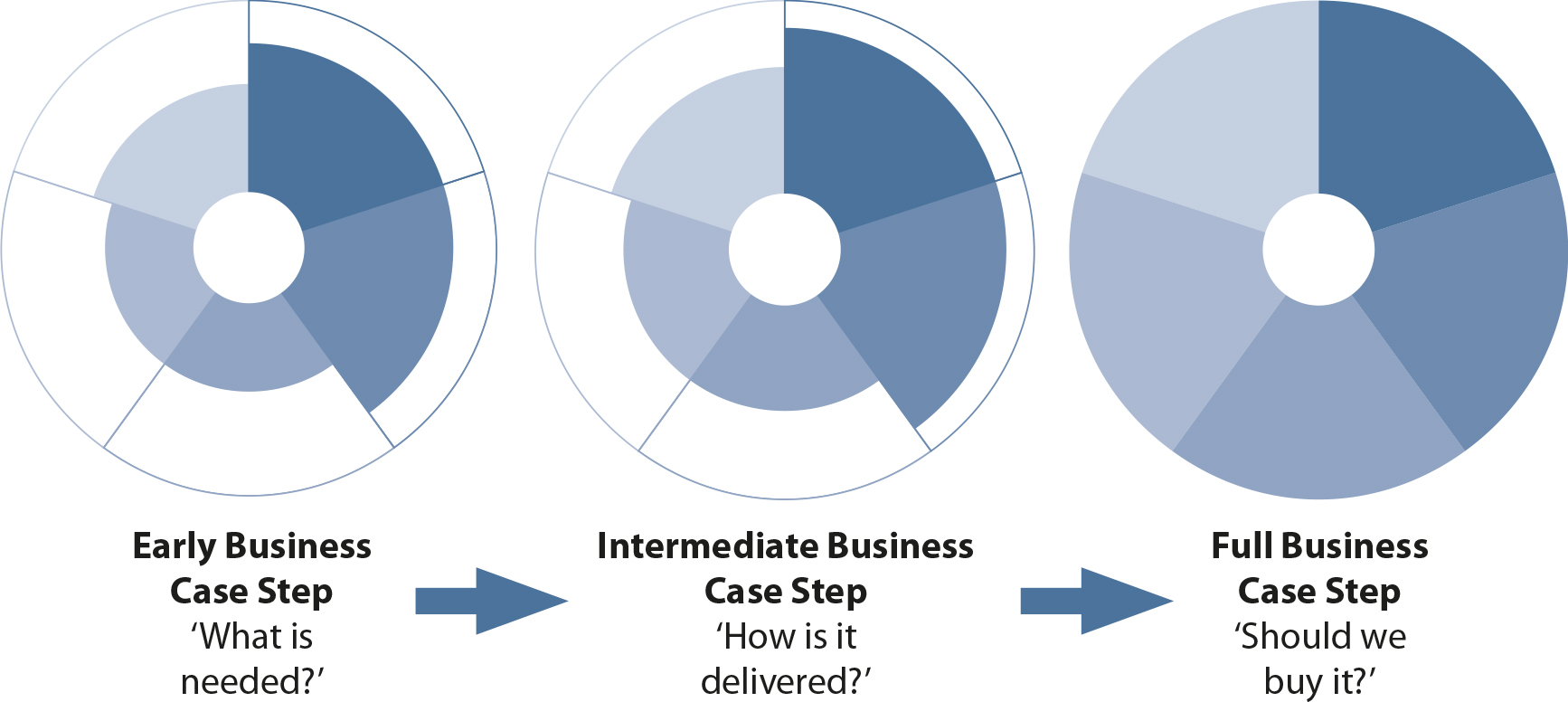
As can be seen in Figure 2, each of the five cases develops at a different pace over the three steps, as the focus changes with each new step in the process. However, at the end of the process, all five cases should be fully developed and mutually reinforcing.
The Five Case Model and Climate Change
The Five Case Model concept originated as an initiative of the government of the United Kingdom, set out in a publication known as The Green Book. In 2022, The Green Book was updated, partly to provide further guidance on how contracting authorities should take climate change into consideration when conducting project appraisals (as well as appraisals of government policies and programmes).
In the 2022 version of The Green Book, climate change considerations are reflected across all five dimensions of the Five Case Model:
- Strategic Case: In assessing the Strategic Case for a project, the contracting authority should have regard to the government’s commitments to net-zero emissions and climate resilience. There should be a clear rationale for intervention, taking into account the long-term impacts of climate change.
- Economic Case: In assessing the Economic Case for a project, the contracting authority should take into consideration all associated GHG emissions, potential climate risks, and the economic implications of climate change mitigation and adaptation strategies.
- Commercial Case: To improve the Commercial Case for a project, the contracting authority should actively seek the selection of partners and suppliers committed to reducing carbon footprints and enhancing climate resilience.
- Financial Case: In assessing the Financial Case for a project, the contracting authority should take into consideration the financial risks associated with climate change. This includes evaluating the costs of implementing low-carbon technologies and improving the resilience of the proposed project.
- Management Case: To improve the Management Case for a project, the contracting authority should ensure that management plans incorporate climate change considerations. This will involve setting up governance structures that monitor climate change impacts and adapt to evolving climate change-related challenges.
In particular, Annex A1 in the 2022 version of The Green Book contains new material on valuation techniques for assessing the impacts of project-related GHG emissions and for evaluating vulnerabilities to climate change.
Subsequently, in May 2024, the UK government issued Accounting for the effects of climate change – Supplementary Green Book guidance, which provides additional guidance in regard to the consideration of climate change issues when undertaking Five Case Model appraisals, particularly in terms of Economic Case assessments.
As a final point in regard to taking climate change into consideration when using a Five Case Model approach, it is noteworthy that, in 2022, Infrastructure Projects Australia proposed that the business cases for major infrastructure projects should include a “carbon base case”, reflecting the forecast carbon emissions associated with the construction of the project (taking into account the quantities of concrete, steel and other construction materials used). This would then allow contracting authorities to compare bids based on the level of ‘embedded carbon’ in the different bid proposals.
8. Implementation evaluation
What is it?
An implementation evaluation of a PPP project or programme, often referred to as an ‘ex-post assessment’, is an analysis of a project’s/programme’s past performance and of its actual results.
The evaluation consists of collecting performance data on the PPP project or programme in order to review its effectiveness, efficiency and economy against the objectives of the project (or programme of PPP projects), and whether value for money has been achieved in the use of public resources. In this respect, it forms part of the ‘backward-looking’ or ‘ex-post’ assessment of value for money (as opposed to the ‘forward-looking’ or ‘ex-ante’ value-for-money assessment – see Value-for-money assessment).
The long-term nature of PPP projects means that an implementation evaluation of an individual PPP project can occur at different stages during the implementation phase of the project, and may reoccur over many years. It should, therefore, be regarded as a continuous process with an evolving focus, depending on the timing of the evaluation and its purpose.
For example, an implementation evaluation of an individual PPP project conducted soon after completion of the construction stage invariably focuses on construction-related activities, such as whether the project asset was delivered on time and within budget. However, an evaluation carried out at the midpoint of the operations stage might focus on whether the services are being delivered to the standard and quality planned, and whether scheduled maintenance activities have taken place.
Why is it important?
Implementation evaluation ensures scrutiny of the use of public resources, and it may be required by law. The European Commission may also require an evaluation of any project involving EC funds.
Evaluating the implementation of a project may not necessarily be the responsibility of a contracting authority, and it is often carried out by an independent third party. However, if a contracting authority understands the basis upon which its PPP project or programme is likely to be evaluated in the future, it is in a better position to take steps at a previous time, such as during the project preparation phase, to help ensure that its project or programme will be evaluated as successful.
Implementation evaluation can be viewed as the ‘check’ phase of the ‘plan – do – check – act’ cycle of good management practice in the continuous improvement of business processes. It is therefore an essential component of the PPP project cycle.
Implementation evaluation also enables lessons to be learnt from projects (or a programme of projects) that have entered the implementation phase, covering both successes and failures. These lessons can improve decisions on how best to identify, prepare, procure and implement future PPP projects.
What does it involve?
The implementation evaluation of a PPP project or programme usually involves two steps:
- defining the institutional framework; and
- developing the analytical framework.
The implementation evaluation is often performed by an independent third-party evaluator, and a lack of adequate, auditable evidence of sufficient quality means that evaluators are frequently unable to be conclusive about the success of a particular PPP project.
Therefore, it is important that the information needed for an implementation evaluation of a PPP project is carefully considered during the project preparation phase, and, where relevant, specified in the PPP contract. This ensures that the project company, with the support of the contracting authority, gathers the right information during the course of the project.
Defining the institutional framework
Implementation evaluation can take place at three different levels (see Figure 10 below), namely:
Level 1: at the individual project level, for example, a school building PPP project;
Level 2: at a programme level (involving a number of related projects), such as a programme of school building PPP projects; and
Level 3: at the policy or institutional level, for example, a decision by the Ministry of Education to use a PPP approach to deliver new school buildings, so as to provide a better learning environment and improve education outcomes.
The purpose of an implementation evaluation at each of these levels often differs, as does how and when it is performed. The resources and skill sets required of the evaluation teams may also differ.
Figure 10 - Levels within a contracting authority at which an implementation evaluation may occur
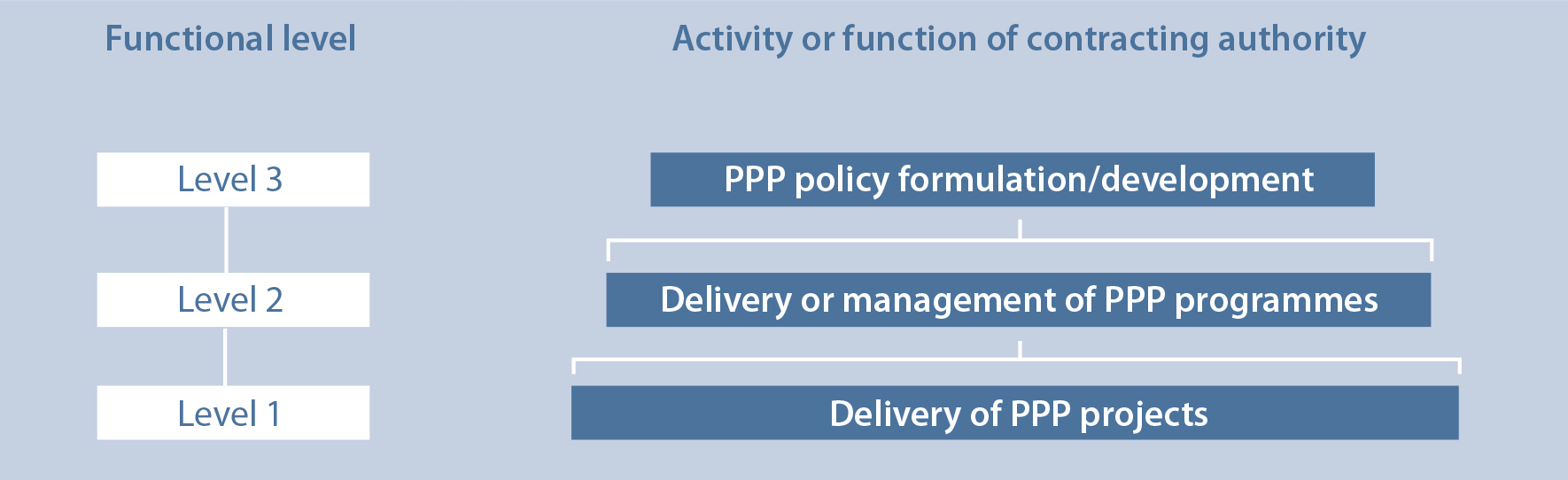
Level 1 – the PPP project
Regular, periodic monitoring of how a PPP project is performing is an integral part of the PPP project cycle. The validation, for example, of deductions and other performance parameters forms a large part of the contract management duties carried out by the contracting authority. This activity is defined as ‘performance measurement’. It is essential that this activity is carried out in strict compliance with the performance management system specified in the PPP contract if the project’s expected value for money is to be protected and delivered. This forms part of the day-to-day contract management activities.
Level 2 – the PPP programme
Implementation evaluation at this level is usually performed by a third party (such as a national audit body) that is functionally separate from the contracting authority. This type of evaluation usually takes the form of a performance audit. It is not usually carried out in the context of managing individual PPP contracts. Instead, it is often a broader and more holistic process of appraisal of performance and, in particular, how the actual outcomes of a programme of PPP projects compare with the intended objectives of the programme.
Level 3 – PPP policy level
Many types of implementation evaluation take place at this level, for different purposes. Such evaluations will generally look for broader insights as to the effectiveness of and efficiencies achieved from PPP projects, such as:
- an understanding of the purpose of the PPP delivery model and the environment in which it operates;
- the goals and objectives of the investments made (such as the PPP policy objectives, the capital assets created and/or the service outcomes sought);
- the core business processes used to achieve the outcomes sought; and
- the benefits realised and the impact achieved.
The findings of a Level 3 implementation evaluation can have a significant impact on decision-making and policy formulation.
Developing an analytical framework
Once the purpose of the implementation evaluation has been established, it is necessary to develop the analytical framework to be used, including defining:
- the expected outcomes of the PPP project or programme (see the following subsection on the preparation of a public sector intervention logic model);
- the evaluation criteria; and
- the appropriate alternative approach (in other words, what would have happened if the project or programme had not been implemented using a PPP delivery model), using a comparator project or programme, and assessing the different outcomes.
The public sector intervention logic model
The intervention logic model identifies the cause-and-effect relationship between the project’s activities and the planned outputs, intermediate impact and longer-term desired outcomes. It produces an analytical framework that translates the contracting authority’s objectives into the intended impacts. It examines the reasons why the contracting authority is making an intervention (in other words, taking an initiative by starting a PPP project or a programme of PPP projects). It also captures the intended inputs necessary for the implementation of a PPP project (or programme of projects).
Figure 11 below describes the intervention logic model for a proposed PPP project. It defines the relationship between the needs to be addressed by the proposed contracting authority intervention/ initiative and the objectives of that intervention/initiative.
Figure 11 - Outline logic model for a typical PPP project
(Source: Figure 11 was developed by EPEC using material in the Performance Audit Manual, published by the European Court of Auditors in 2017, at Page 17: ‘The Programme Logic Model’.)
In order to understand the logic model, it is important to have a precise understanding of the different terms. Having a common understanding of the intervention logic and its terms allows the key stakeholders to decide how best to judge the project’s success, and therefore to establish, in advance, precisely what will be evaluated.
Table 1 - Terms used in logic models
| Need | A problem or difficulty/challenge that affects concerned groups and which the public sector intervention aims to solve or overcome. |
| Objectives | An initial statement of the outcomes intended to be achieved by an intervention, in order to meet a need. |
| Inputs | The resources that are deployed for the implementation of an intervention, which may be financial, human and/or material. |
| Processes | The procedures and activities used to convert inputs into outputs. |
| Outputs | What is produced or accomplished with the resources allocated to an intervention. An output is directly measurable, and it delivers, either singly or collectively with other outputs, the objectives. |
| Outcomes | The actual changes that arise from the implementation of an intervention, which relate to the objectives of the intervention. Outcomes include results and impacts. |
| Project | A non-divisible operation, broken down in terms of schedule and budget, and placed under the responsibility of an organisation which implements, closest to the field, the resources allocated to the intervention. |
Evaluation criteria
Implementation evaluation requires the definition of relevant criteria and data collection methods and ensuring that the evaluator has the requisite skills and resources. In order for this process to be successful, it is important that the evaluator (which may be the contracting authority itself):
- defines the set of questions it would like to have answered;
- decides what information is needed to answer those questions and who is to collect it; and
- chooses a range of appropriate monitoring indicators, using the defined set of questions.
The evaluation process should also recognise that there may be a range of different stakeholders, each of whom will be seeking answers that verify and validate their own expectations as to the impact of the project or programme.
The evaluation criteria most often used to evaluate PPP projects (and programmes) include the following indicators.
- Effectiveness: have the expected results of the project been obtained, in other words, have the objectives been achieved?
- Efficiency: were the results of the project obtained using the optimal relationship between the resources employed and the results achieved?
- Economy: were the resources used made available in due time, in appropriate quantity, quality and at the best price?
- Relevance: do the explicit objectives appropriately address the issue that the project was meant to solve?
- Internal coherence: do the various objectives of the project logically contribute to one another? Are inputs adapted to the overall ambition?
- External coherence: do the objectives of the project correspond to or complement those of other public sector interventions?
- Utility (also called Impacts): were the expected and unexpected (positive and negative) effects satisfactory, from the point of view of the direct and indirect beneficiaries of the project?
Each indicator should have a clear definition, with an established monitoring frequency and a source of information. The baseline situation should be defined in advance, together with a target outcome.
Implementation Evaluations and Climate Change
Modern implementation evaluations may increasingly involve assessments of climate change-related impacts. A good example is the 2024 Special Report of the European Court of Auditors on Climate Adaptation in the EU, which evaluates climate change adaptation projects, programmes and policy frameworks in the European Union. Some of the key recommendations in the report concern the need to improve reporting on climate change adaptation, and the greater use of publicly available tools such as the Copernicus Climate Change Service.
9. Legal framework
What is it?
The PPP legal framework is the system of laws, regulations and policy that determines how PPP projects are prepared, procured and implemented. The legal framework will influence, amongst other matters:
- the scope and use of public-private partnerships in a jurisdiction or a sector (in other words, whether PPP projects are allowed/encouraged/prohibited/discouraged);
- the ability of the parties to enter into a PPP contract (for example, the legal right of the contracting authority to participate in PPP projects; the legal right to have public services provided by non- public entities; and the terms and conditions under which public assets may be transferred to non- public entities);
- the processes by which a PPP project is prepared and procured (such as the rules for public procurements, and the approval of such procurements);
- the commercial structure and terms of the PPP contract (for example, the ability of the government to provide financing, and the government’s rights on termination of the PPP contract);
- the interpretation and implementation of the PPP contract; and
- general industry and commercial activity in the jurisdiction or sector (including tax regimes, sector- specific regulations, legal obligations relating to environmental issues, climate change, etc.).
Why is it important?
A PPP project or programme stands the greatest chance of success when it is prepared, procured and delivered within a legal framework that is clear, stable and supportive of complex, long-term PPP investment arrangements.
On any given PPP project or programme, the contracting authority needs to be aware of the legal framework within which it is working, and understand the impact that the framework has on all aspects of the PPP project preparation, procurement and implementation.
What does it involve?
The shape and form of a PPP legal framework varies from country to country. However, the legal framework must possess certain qualities if a PPP programme is to be successful. The PPP legal framework should:
- establish a clear policy rationale for having PPP projects;
- define the various types of PPP arrangements;
- establish clear and robust institutional roles and procedures for the various phases of the PPP project cycle, including decision-making responsibilities;
- provide for the management of affordability issues, including budgeting and fiscal impact assessment; and
- define the obligations of the PPP contracting parties in respect of international and national commitments to addressing issues such as environmental sustainability, gender equity, climate change, etc.
The impact of the legal framework on the PPP project cycle needs to be ascertained and managed by the contracting authority in conjunction with its legal advisors. This involves consideration of the following issues:
- the existence of any PPP-specific legislation (see below), and how that legislation may influence the project preparation phase (including the preparation of the proposed PPP contract), the procurement phase and the implementation phase of a PPP project;
- the relationship between legislative obligations and obligations created by the PPP contract (in other words, the extent to which the parties to the PPP contract have freedom to contract on terms that differ from existing legislation);
- any legal or policy requirement to use a standard form of PPP contract, and the conditions/ processes to be followed in seeking any amendments to standard terms;
- legal approval processes to be reflected in the project timetable;
- the impact of relevant legislation – including tax laws or regulations – on the affordability, value for money and bankability assessments;
- the influence of the legal framework on the choice of procurement strategy, including procurement negotiations and the procurement timetable.
To go further...
Legal traditions
The design of PPP legal frameworks varies across EU countries, depending on legal traditions and existing laws. Most countries in Europe have a legal tradition based on civil law, meaning that their law is derived from a set of written rules or civil code. By contrast, common law systems (such as those in Ireland and the United Kingdom) place greater emphasis on case law and precedents.
The written codes and laws which exist in civil law jurisdictions contain rights and processes relating to contract and administrative law that apply to PPP projects. Examples (from various jurisdictions) include:
- the ability of a contracting authority to cancel or change a PPP contract unilaterally;
- a project company’s right to compensation for unexpected cost increases;
- mandatory notice periods for early termination of the PPP contract;
- the definition of force majeure, and the consequences of force majeure events; and
- provisions that limit lenders’ ‘step-in rights’.
Some provisions and principles of civil law might not be capable of being amended or overridden by the PPP contract, which can limit the contracting authority’s ability to negotiate bespoke PPP arrangements.
Common law jurisdictions, on the other hand, are less prescriptive as to both the form and substance of contracts. This offers greater flexibility in negotiation, but it also means that PPP contracts in common law countries tend to be more complex than those in civil law jurisdictions, since they need to contain details that are not found in legislation.
PPP-specific legislation
Some civil law countries have introduced legislation that relates specifically to the procurement, contracting and delivery of PPP projects. PPP-specific laws can be found, for example, in Belgium, Italy, Poland, Portugal and Spain. These laws may apply to all PPP projects, or focus only on a particular sector or subsector (such as motorways).
A PPP-specific law is not an essential component of a PPP legal framework. It is possible for PPPs to be delivered successfully within a general legal framework. For example, Australia, Canada and the United Kingdom – all of which have a considerable history of PPP programmes – do not have PPP- specific legislation, although specific laws to confirm the legal powers of health service bodies and local authorities to enter into PPP arrangements were enacted in the United Kingdom after the start of the programme there, to respond to concerns expressed principally by lenders. In common law systems, Government Payment PPPs are often treated as a form of government procurement, although End-User Payment PPPs may need specific legal provisions to allow the project company to charge and collect revenues.
Whilst not essential, PPP-specific laws can be helpful in establishing fundamental principles of PPP arrangements, whether relating to processes (such as the need for value-for-money assessments) or particular provisions in the PPP contract (such as step-in rights). In addition, a PPP-specific law signals to investors that the jurisdiction enacting the legislation is serious about undertaking a programme of PPP projects. Further, a PPP-specific law can help to define the different institutional roles of government entities involved with PPP projects, including contracting authorities, PPP units, the Ministry of Finance, and other ministries and agencies.
An approach which has primary legislation as enabling legislation, backed up (if necessary) by more detailed secondary legislation that is more easily amended, minimises the risk of having a PPP- specific law that is unduly restrictive, subsequently outdated or irrelevant in the implementation of PPP projects.
EU legislation
Whilst there is no EU legislation that specifically governs PPP projects, the procurement and delivery of PPP projects are affected by various EU laws, including those on public procurement and state aid.
Standardisation
As a part of PPP policy, where a reasonable number of PPP projects is contemplated, and some experience has already been established with early projects, a number of countries have developed standardised PPP contracts either at a programme-wide level and/or for specific sectors. This can provide the benefit of ensuring quality, consistency and predictability and reduced costs in the terms of the PPP contract.
Standardisation usually works best in allowing for some flexibility, by distinguishing between recommended and mandatory wording of the different PPP contract clauses. It is also important to ensure that such standardisation is backed up by a suitable approval process, to ensure that the standard documents are used effectively, they are updated from time to time and any departures from standard terms can be considered appropriately. This is usually the role of a central PPP unit.
Standardisation in other areas, such as in the development and format of bidding documents and procurement processes (see Procurement strategy), can also help to ensure quality and predictability for public and private sector stakeholders.
Practice manuals
To complement various laws and regulations, various countries have also benefited from developing guidance for contracting authorities, in the form of practice manuals, on the preparation, procurement and implementation of PPP projects in their specific markets. This helps to reflect the detailed practical issues that are not so easily set out in formal legislation. Examples include how to conduct a value-for- money assessment, reflecting national approaches to this form of assessment. Again, a central PPP unit will usually be responsible for the preparation of such guidance materials.
Obligations arising from international and national climate change commitments and policies
At an early point in the project identification phase, the contracting authority should undertake a mapping of all of the climate-related elements of the legal framework applicable to the proposed project. This will include elements such as climate treaties to which the government is a party (such as the 2015 Paris Climate Accords); regional obligations (such as the EU GHG Emission Reduction Targets); as well as national legislation, regulation, rules and codes (including climate change-related provisions in building and civil engineering codes).
The contracting authority should also be cognisant of international, national and sub-national climate-related policies and strategies – which may not have the force of legislation, but which nevertheless should be taken into consideration in identifying and preparing PPP projects, since such policies and strategies may be significant considerations in terms of the public acceptability and bankability of a proposed project. These may include, for example, sector-specific emission reduction strategies or national preparedness and disaster recovery plans.
In undertaking this mapping exercise, the contracting authority should collaborate with relevant government stakeholders, including other line ministries and agencies – especially ministries and agencies with environmental and climate change responsibilities.
Climate-related legal frameworks may also impact the availability of financing for climate-proof projects, in terms of setting out the eligibility requirements for international green financing instruments. Similarly, legal frameworks may affect the availability of climate risk insurance and reinsurance for particular projects.
Lastly, climate-related legal frameworks may dictate the requirements for the collection of data during the course of contract management by the contracting authority throughout the implementation phase of the PPP Project Cycle, as well as the need for an ex-post implementation evaluation of the climate change-related impacts of the project.
10. Managing the process
What is it?
The management of the PPP process refers to the activities, tools and structures that a contracting authority has to organise in order to prepare and procure a project under a PPP approach. This covers the PPP process up to financial close (see Contract management for management of the PPP project after financial close).
A key feature of sound project management is the governance framework that establishes the roles of the key project management bodies, how they relate to each other, how decisions are made and how responsibilities and accountabilities are managed. Good project governance creates decision-making arrangements whereby those with the requisite knowledge, skills and experience are adequately empowered, so that project management can work effectively and efficiently. For most PPP projects, it is often necessary to use external resources, in the form of appointed advisors, who possess the skills and competences that might not be readily available within the contracting authority. These advisors will also need to be managed as part of the governance arrangements.
Various tried and tested project management approaches, such as the ‘PRINCE2’ methodology, are available to guide the establishment and operation of the governance mechanisms for complex projects.
Why is it important?
The preparation and procurement of a PPP project involves a wide range of activities and stakeholders over an extended period of time. It usually involves considerable levels of time, resources and cost for the contracting authority, all of which need to be managed efficiently and effectively. Management of the process, as with any other public sector activity, is likely to be subject to review and scrutiny by the public administration and other stakeholders. Accordingly, the contracting authority needs to establish an efficient and effective process, with clear lines of responsibility and accountability, including responsibility for decision-making.
Private sector bidders will also pay close attention to the capability of the contracting authority to manage the process properly. For this reason, a well-managed PPP process will encourage and attract strong private sector participants. Conversely, a poorly managed process will typically lead to a combination of:
- delays in moving the PPP project forward;
- poor bidder interest and lack of competitive bidding;
- increased costs for the contracting authority;
- reputational and other risks for the contracting authority; and, ultimately,
- poor value for money.
Project management will also be one of the key areas examined in an implementation evaluation of the project.
Given the need to ensure that all new infrastructure initiatives must now be designed with climate change in mind, the decision-making processes for PPP projects must be systematically inclusive, involving all relevant public sector stakeholders. This means that project management governance procedures must reflect the complex interdependency of infrastructure systems, in terms of both climate change mitigation and climate change adaptation. Traditional siloed decision-making processes may prove to be increasingly unsuitable in dealing with the climate change aspects of new PPP projects.
What does it involve?
Setting up a governance framework
A common approach to implementing effective project governance for a PPP project is to use a system of boards or committees. Different systems can be considered, but they normally include:
- A project steering committee (or project board), led by a senior officer within the contracting authority who has overall responsibility for the steps leading up to financial close. The project steering committee oversees a project management team. It does not engage in the day-to-day operational matters associated with the preparation and procurement of the project, but considers proposals made by the project team that are of key strategic importance, as well as providing high-level support to the project team. The project steering committee is also responsible for making important decisions referred to it by the project management team (for example, decisions affecting spending and budgets).
- A multi-disciplinary project management team that develops the project plan and carries out the various day-to-day project-related preparation and procurement activities (including managing external advisors) in accordance with this plan (see ‘To go further…’). The team is led by a project director, appointed by the contracting authority, who reports to the project steering committee. For most types of PPP projects, this role is a full-time position, and experience in the specific sector and in procuring PPP projects is needed wherever possible. For more complex projects, the project director may be supported by a project manager who is responsible for managing all day- to-day project activities through a project management office. The project manager is, generally, the person who coordinates the inputs from, and gives instructions to, the external advisors. The relationship between the project director and project manager is one of the most important within the project team, and it relies on close coordination and communication.
- A bid evaluation panel(s), responsible for evaluating the bids at the different stages of the procurement process (see Procurement strategy). The contracting authority should identify the members of the bid evaluation panel(s) prior to issuing the bid invitation documents. While these may include members of the project management team, it is generally not good practice to include members of the steering committee on a bid evaluation panel, especially in circumstances where the steering committee is responsible for approving the final evaluation outcome.
The PPP steering committee and project management team should usually be planned for at the end of the project identification phase and set up at the start of the project preparation phase, when the proposed PPP project is considered a potential option by the contracting authority for further detailed assessment and preparation. This is the point when there is usually a step change in the levels of resourcing and range of activities that need to be managed. This may also be the point at which external advisors are appointed, as the budgets for such resources would typically be approved as part of the decision to move to the project preparation phase.
Members of the project management team will usually continue to be responsible for the project up until the award of the PPP contract. Ideally, the team would continue to handle contract management during the implementation phase, but this is often not possible. If this is not feasible, there should be some overlap between the project management team and the contract management team to ensure continuity.
Planning the resources required and establishing the project team
In planning the activities, composition and resourcing of the project team, the contracting authority should:
- determine the resources available within the contracting authority and the services that will need to be obtained externally, by, for example, appointing advisors;
- assess the total cost of the required internal and external activities based on current market prices;
- prepare the terms of reference for appointing advisors and plan for the procurement of such advisors;
- secure the necessary powers for the project team to manage the project preparation and procurement phases;
- if required, define a process and budget to transfer responsibility for managing the PPP project from the project management team to the contract management team, once the PPP project has reached financial close.
The project management team needs to comply with the internal rules that govern the operations of the contracting authority and those established as part of the project’s governance structure. This typically involves operating within delegated limits of authority, seeking approvals as required and keeping an audit trail of all decisions taken. During the procurement process, many of the activities need to comply strictly with national procurement regulations (see Procurement strategy).
Defining decision-making points
An effective governance system involves clearly defined decision-making points. The primary reason for establishing such points is to prevent a project developing too far in a certain direction, when it may no longer be viable. Decision-making points are often coincident with key resourcing decisions. Each decision-making point (or ‘gateway’) normally involves a review of the project’s status, to help the decision-makers make an assessment as to the continuation of the project and allocation of resources for the next phase. Decision-making points may be part of the contracting authority’s existing governance procedures, or they may involve wider government bodies (such as an inter-ministerial approval committee). Key decision-making points include:
- a decision to proceed from the project identification phase to the project preparation phase and, thereafter, to the procurement phase;
- a decision, during the procurement phase, to select a preferred bidder; and
- a decision to sign the PPP contract (commercial close).
Setting up review processes
Independent reviews prior to key decision-making points are a key feature of project governance. These provide independent assurance that the project is proceeding in line with the agreed plan and that the objectives are likely to be delivered, supporting each decision-making point. The scope of such independent reviews may include a consideration of the continuing effectiveness of the project governance arrangements, and the adequacy of resources provided to the project management team.
The process may involve a report to the project director/manager as part of an informed peer review (as is the case for the Gateway Review process used in a number of countries), where the objective is primarily to support the project director/manager. Alternatively (or additionally), an independent review process at key decision-making points may be part of the contracting authority’s usual approval processes.
Managing authorisations
Prior to launching the procurement process, the project management team should assess the status of all of the specific authorisations, permits and approvals that are required. In particular, it should:
- assess the land acquisition, expropriation, environmental, climate change and health and safety approval requirements for the project;
- determine who is responsible for obtaining the required authorisations, permits and approvals (the responsibility will either lie with the contracting authority or with the Project company);
- factor in the costs of obtaining any authorisations within the project preparation budget (in cases where the authorisations need to be obtained by the contracting authority); and
- identify the risks associated with obtaining the required authorisations, and update the risk register accordingly (see Risk management).
Working with the central PPP unit
Central PPP units may play an important role in the governance process, either as a source of support to the steering committees and project management teams, or as part of the approval processes. Central PPP units can bring technically informed views and help to strengthen the credibility of the PPP process.
To go further…
Steering committee
As the core function of the steering committee is to provide oversight and good decision-making, it is important that it is composed of individuals who are both capable and available to interrogate the proposals that are made to it by the project management team. They should have the authority and knowledge to connect the issues which come before the steering committee with the contracting authority’s strategic objectives for the project.
The chair of the steering committee is, in effect, the senior official at the contracting authority in charge of the project. He or she may need to represent the project to other senior decision-makers within the contracting authority or more widely across the public and private sectors. This may be necessary, for example, if the project director/manager requires support from other areas of government, or if there are delays in receiving critical approvals from other public authorities. Similarly, the chair of the steering committee may be called upon to represent the contracting authority at key meetings with potential or actual bidders.
The steering committee should, typically, meet on a monthly basis. More frequent meetings may be needed when key decisions are required such as, for example, during the bidding process.
It is a common mistake to confuse the role of a steering committee with that of a stakeholder engagement board. This can lead to large committees that are difficult to operate and ill-equipped to take decisions and provide oversight and support to the project management team. Stakeholders are usually better managed through specific separate arrangements. (For example, a contracting authority may create a stakeholder subcommittee, which reports to the steering committee).
Project management team
The size and composition of the contracting authority’s project management team will depend on the nature, scope, value, level of risk and complexity of the project. The team should have:
- an appropriate mix of skills and experience including project management, public procurement, familiarity with private business, and practical experience with commercial issues and contract negotiation);
- appropriate technical and functional specialisations (to cover the financial, economic, technical, environmental, social, climate change, market/demand, tax, accounting and insurance aspects of the PPP project); and
- knowledge and experience of the contracting authority’s business, its processes and operational requirements relevant to the project.
Ideally, when appointing a project director/manager, he or she should:
- have previously worked on similar projects (sector, size and technical complexity);
- have previously worked on one or more PPP projects;
- be available to be dedicated full-time to the project; and
- be familiar with private sector perspectives, and have an understanding of how government administration works.
External advisors, once appointed, may become part of the project team.
Bid evaluation panel(s)
A bid evaluation panel evaluates the bids received against criteria set out in the bid invitation document, in order to select a preferred or successful bidder. The panel will usually consist of a minimum of three people, but not more than five.
It is good practice, prior to the start of the procurement process, to identify the bid evaluation panel members and document the process that the panel(s) will follow for receiving the bid submissions, including the bid evaluation criteria (see Procurement strategy).
Each panel member should:
- have the skills, knowledge and expertise required to ensure a robust evaluation;
- be available to participate throughout the evaluation process;
- not have any conflict of interest (and to declare this fact as part of a confidentiality agreement signed by all panel members); and
- not discuss any part of the bid evaluation process with anyone outside the evaluation panel.
For a large and complex PPP project, it is common to use a number of different panels to assess separate attributes of the bids received, especially technical, financial and legal. As a result, each panel will likely include specialists with technical, financial or legal expertise, depending on the nature of the project. Other experts may be used to give the panel members advice on particular aspects of the bids, although such individuals need not be members of the panel.
Additionally, it is good practice to separate the financial evaluation from the other aspects of the bid evaluation process and to keep the deliberations of each of the panels separate until the process has concluded.
Developing a timetable
The project preparation and procurement phases of a PPP project are complex undertakings, with parallel activities feeding into critical paths. It is important that activities on the critical path are initiated at the right time and monitored closely, to ensure that they proceed as planned and do not cause delays to other activities. It is helpful to use project-planning software to create the timeline, usually in the form of a ‘Gantt’ chart. The Gantt chart can then be easily reviewed and updated from time to time.
The project management team should check that the timetable:
- accommodates any required stakeholder engagement processes;
- allows enough time to obtain all required authorisations, permits and approvals (such as land acquisition approvals and environmental clearances);
- allows enough time to obtain approvals for any external funding sources (such as EU grants);
- allows enough time to conduct the procurement process effectively, including raising the financing and satisfying all conditions precedent (see Procurement strategy);
- identifies key milestones in the project preparation and procurement phases and shows the relationships between tasks;
- has been fully accepted and approved by the project steering committee and any other appropriate authorities (by ensuring that expectations are realistic and well managed across the project’s governance structure);
- accommodates planning for the implementation phase, during which responsibility will be transferred to the contract management team;
- has been informed by feedback from market soundings; and
- includes a process for regularly reviewing and updating the project timetable.
11. Market sounding
What is it?
Market sounding refers to the process of consulting with the market in a structured way on the potential terms of a PPP contract prior to the procurement phase. It may cover a range of issues including cost assumptions, risk allocation and potential contract clauses. Market sounding is not part of the formal procurement process – it does not involve an evaluation of bids or of bidders or commitments on either side.
Market sounding is often confused with the process of alerting the market with a view to stimulating market interest, as is done during a ‘road show’ process. It may also be confused with ‘market testing’, which involves the project company periodically rebidding for certain services during the operations stage of the PPP project. Equally, market sounding is not the same as a public consultation, which seeks to determine the general acceptability of the PPP project among affected stakeholders as part of the stakeholder engagement process.
Why is it important?
Gathering feedback from the market helps to ensure that the proposed scope, cost and value-for-money assessment of the prospective PPP project are realistic; and that the terms of the draft PPP contract and the associated risk allocation are likely to be accepted by the market. An effective market sounding process ensures that when the procurement phase is launched, there is strong interest from bidders, that the project is bankable and that the actual costs and timescales are in line with the expectations around affordability and value for money.
A contracting authority should use the market sounding process to test the market’s reaction to new and/or potentially problematic features of the proposed PPP contract, such as proposed climate change mitigation and/or adaptation targets.
If market sounding is not carried out, the contracting authority risks having to cancel the project or significantly amend the PPP contract during the procurement phase, either because the terms of the PPP contract are not commercially viable or bankable, or because the bids that are submitted do not meet the affordability or value for money tests.
What does it involve?
Market sounding normally takes place during the project preparation phase, although some initial market sounding may also take place during the project identification phase to determine, at a high level, the potential market capacity for the project. The level of market sounding varies between projects, and will depend on the nature of the project and the level of the contracting authority’s understanding of the current market.
The key to successful market sounding is to be as precise as possible about the issue on which the contracting authority is seeking to obtain a market viewpoint. This requires the contracting authority to be clear about the reason and context for the particular issue that requires input from the market.
Accordingly, a market sounding should not be carried out too early (before the issue is properly defined) or too late (when it might be difficult to incorporate the results of the market sounding into the draft PPP contract).
A market sounding should be carefully planned. This should involve:
- identifying the key features of the project to be tested with the market (for example, the project’s scale, technical and quality specifications, and risk profile);
- setting out the approach to engaging with all the relevant market players – for instance, the contracting authority may decide to consult with the market through an open meeting, the use of questionnaires, invitations for written submissions on specific topics or the use of meetings with individual companies (to facilitate a more open discussion); and
- making it clear to market participants that the market sounding is not part of the formal procurement process (by, for example, ensuring that the private sector participants at the market sounding are not described as ‘bidders’).
While there are no specific rules governing a market sounding, it should always follow the fundamental principles of non-discrimination, equal treatment and transparency – particularly where individual meetings are envisaged. The contracting authority should, therefore, ensure that effective governance arrangements are in place; that no party is given an advantage through participation in the market sounding exercise; and that the consultation is conducted with an open mind and across a wide range of private sector participants, to avoid any individual participant exerting undue influence in terms of the design of the prospective PPP project. Market sounding consultations should be conducted in a consistent way, and they should be properly documented for transparency, with clear audit trails.
The private sector entities that should be invited to market sounding consultations include lenders and PPP equity shareholders, along with other interested parties such as potential construction and operations contractors. In addition, it may be appropriate to seek the views of independent experts, specialised bodies or business organisations.
External advisors can play a useful role in a market sounding, helping to identify the private sector entities that should be invited to consultations on particular topics. In addition, advisors can assist the contracting authority in managing the market sounding process and in obtaining and interpreting the information received (see Appointing advisors).
Market soundings could be particularly useful for testing the acceptability of the climate change-related features of a proposed PPP project, and the contracting authority should discuss the implications of such features for equity and debt investors. The contracting authority should also clearly communicate the climate change-related considerations associated with the project, and make it clear that innovative approaches to climate change mitigation and climate change adaptation options are welcome.
A contracting authority should also bear in mind that, in conducting a market sounding, it is inevitably exposing itself and the prospective PPP project to potential bidders who will be alert to the quality of the contracting authority’s performance in conducting the consultation. A poorly prepared market sounding will create an unfavourable impression but, conversely, a well-organised market sounding can provide an opportunity for the contracting authority to demonstrate to the market the seriousness of its approach to project preparation and the subsequent procurement phase.
12. PPP contract
What is it?
The PPP contract is the document that lies at the heart of all PPP projects, defining the relationship between the contracting authority and the project company, and their obligations to each other. It is prepared in draft form by the contracting authority during the project preparation phase, negotiated with bidders during the procurement phase, and signed with the preferred bidder once all of its terms are agreed. The time at which the PPP contract is signed is commonly referred to as the ‘commercial close’.
Why is it important?
The PPP contract captures all the commercial, technical and legal aspects of the PPP project from the contracting authority’s perspective, and is the means by which risks are defined and allocated between the contracting authority and the project company.
A comprehensive and clearly drafted PPP contract will be easier to procure, negotiate, manage and enforce. Ambiguity or inconsistency in the PPP contract can lead to delays (in procurement and/or implementation) and disputes. The long-term nature of PPP projects makes it likely that the individuals involved in the PPP project will change over time, which reinforces the need for a clearly worded and thorough PPP contract that can be interpreted and applied consistently when personnel change.
What does it involve?
It is established good practice to include the full draft PPP contract (including the payment mechanisms and technical specifications) in the bid invitation package of documents (see Procurement strategy). The more comprehensive and detailed the draft PPP contract is, the more efficient and effective the procurement process and negotiations with bidders are likely to be.
During the project preparation phase of the project cycle, the contracting authority works with its advisors to prepare the draft PPP contract, building on relevant national and/or international established precedents and best practice. The legal framework (such as a PPP-specific law or policy) might require the contracting authority to use a standard form of PPP contract or incorporate particular principles or provisions in the draft PPP contract. The draft PPP contract issued with the bid invitation package should reflect the risk allocations, the value for money, the affordability, bankability and climate change analyses undertaken during the project preparation phase.
The PPP contract incorporates, as a minimum:
- the contracting authority’s requirements for the project, defined by the contracting authority’s objectives and by measurable construction and service requirements;
- a process for determining successful completion of the construction stage;
- a payment mechanism, including a process for making adjustments to payments in response to various contingencies;
- performance deductions (and, possibly, bonuses) which have financial consequences and/or give rise to warning notifications (which may eventually lead to an early – in other words, a premature – termination of the PPP contract);
- requirements for regular reporting by the project company, and for contract management by the contracting authority during the implementation phase;
- a process for handling potential transfers of staff affected by the project (such as the transfer of staff from the contracting authority to the project company, and back to the contracting authority at the end of the PPP contract);
- a process for proposing and agreeing any variations to the contracting authority’s requirements or other terms of the PPP contract;
- the definition and impact of ‘force majeure’ events, emergencies and changes in law;
- requirements to take out and maintain project insurance;
- a process for agreeing to a refinancing and for sharing any benefits that arise from refinancing;
- security and performance bonds to be provided by the project company to guarantee the delivery of services in accordance with the PPP contract;
- a dispute resolution procedure;
- conditions for the early termination of the PPP contract due to the occurrence of defined events, and the compensation payable on termination (for each category of event);
- ‘step-in rights’ for lenders and for the contracting authority;
- provisions that regulate the transfer of project interests by either party, such as, for example:
- a transfer of the project company’s obligations to a subcontractor;
- an assignment by the project company of its contractual rights to a third party; or
- the sale of equity shares in the project company;
- a process for the handback of the project assets at the end of the PPP contract.
Recently, efforts have been made, by multilateral financial institutions and other entities, to standardise the language used for some key PPP contractual provisions (see the Guidance materials below, and the section on Legal framework).
During the procurement process, and subject to the contracting authority’s procurement strategy, the draft PPP contract will be refined to reflect the position(s) negotiated with the bidders. The contracting authority needs to develop its procurement strategy in consultation with its advisors (for example, will the contracting authority allow negotiation on all or only some aspects of the draft PPP contract? And does the contracting authority try to agree a common position with all bidders or allow for different positions to be agreed with different bidders?).
Concluding bids will ultimately be invited on the basis of a final draft version of the PPP contract. The contracting authority’s chosen negotiation strategy usually involves preparing a single final draft PPP contract for all bidders. Occasionally, a strategy might involve preparing several drafts, allowing for different versions of the draft PPP contract to be negotiated with different bidders. But this latter strategy requires the contracting authority to have a high degree of sophistication.
The contracting authority should continuously review the bankability, affordability and value for money aspects of the PPP contract throughout the procurement phase.
The draft PPP contract is likely to require further refinement after the appointment of a preferred bidder. However, the contracting authority needs to be aware of the limitations in the EU procurement rules in regard to changes to the bid proposals or to the terms of the PPP contract during the procurement phase (see ‘Procurement’ strategy). As a general principle, the contracting authority should be careful not to agree to any changes that risk distorting competition or causing discrimination.
The achievement of financial close (when the financing from lenders becomes available) can occur at the same time or at some point after commercial close, when the PPP contract is signed by the project company and the contracting authority. If these processes cannot take place at the same time, the time allowed for reaching financial close should be kept to a minimum. This is to reduce:
- the risk of having signed a PPP contract that turns out not to be bankable; and
- the practical, legal and political challenges that arise when dealing with significant fluctuations in costs/risks that might occur in the period between commercial close and financial close.
To go further...
Output specifications
In contrast to traditional infrastructure procurement, the PPP delivery option focuses on the provision of infrastructure as an ongoing service, and not simply the construction of physical assets. Effective risk transfer to the project company is achieved by the contracting authority expressing its requirements (both asset and service-related) by way of output specifications, as opposed to input specifications.
As an example, in a light underground railway PPP project, the contracting authority might indicate its service requirements in terms of output specifications such as train capacity (the maximum number of passengers on each train), journey frequency (how many journeys per hour or per day, or even a mandatory timetable), journey times, GHG emission levels and travel comfort (air conditioning/heating, cleanliness) – as opposed to using input specifications which detail how many trains are to be provided and how each train is to be constructed.
The output specifications (relating to the assets and services) form part of the PPP contract. They are often contained in separate technical schedules and negotiated in a separate technical workstream during the procurement phase.
The contracting authority’s output specifications should be expressed in clear, objective and measurable terms. This is particularly true in regard to the output specifications related to climate change mitigation and adaptation – which should set out the minimum acceptable requirements consistent with the government’s climate change policies while inviting the bidders to achieve superior mitigation and adaptation performance. Clear output specifications will allow bidders to make an accurate assessment of the technical solutions and investment needed. Clear specifications are also crucial for subsequent management of the PPP contract and, in due course, any implementation evaluations.
When drafting the output specifications, the contracting authority should give careful consideration to the impact of the provisions on the bankability of the project. In particular, the penalty provisions for a failure to meet the specifications, and the provisions regarding the time for curing such a failure, should be drafted in a manner that adequately protects the rights of the lenders to the project (see also the discussion below regarding “Early termination”.) This may be particularly important when considering the inclusion of any climate change adaptation or mitigation performance specifications.
Payment mechanism
The payment mechanism regulates payments made to the project company during the operations stage of the implementation phase. It is the primary mechanism for allocating risks and incentivising the project company’s performance.
A key principle of a PPP payment mechanism is that it links payment to performance, rather than costs incurred. Under a Government Payment PPP arrangement, the contracting authority makes regular (such as monthly, quarterly or annual) payments to the project company based on a fixed price agreed for each unit of service that is provided to the agreed standards. Typically, these regular payments will be made in arrears. The important point is that the regular payments are not made unless and until the service is provided in accordance with the agreed standards.
Similarly, under an End-User Payment PPP arrangement, end-users will only pay for services that the project company is actually delivering.
The detailed design and calibration of the payment mechanism is a complex task, particularly in the case of Government Payment PPPs. Financial and technical advisors are often used to advise the contracting authority with this (see Appointing advisors). For a Government Payment PPP, the task involves the analysis of a number of factors, including:
- market expectations as to what level of service justifies a full payment, and what justifies a refusal to make any payment;
- the likelihood, frequency and impact of different service failures;
- the relative importance of different elements of the asset/service at different times; and
- bankability considerations.
Other issues to consider in developing the payment mechanism include:
- an indexation mechanism, to compensate for cost increases due to inflation (with consideration given to the costs to be indexed and the index/indices to be applied);
- mechanisms to compensate, in whole or in part, for cost increases due to extreme climate events, arising from climate change risks not allocated to the project company;
- any cost items that are outside the control of the project company and appropriate to deal with on a ‘pass-through’ basis (in other words, costs that are reimbursed by the contracting authority as and when they are incurred by the project company) – on the basis that such pass-through costs should be limited and clearly defined; and
- ensuring that deductions applied for poor performance are proportionate to the degree of failure, on the basis that service quality measures need to be clear, measurable and objective.
In the case of End-User PPPs, the contracting authority should ensure that the payment mechanism should provide strong incentives for the project company to perform but, at the same time, the mechanism should not burden the project company with excessive risk. ‘Excessive’ in this context could mean that the price premium charged by the project company to bear the risk would not be offset by any increased efficiencies. It could also mean that the project company would be too likely to make excess profits or face large losses, which would threaten the viability of the PPP arrangement.
Scenario testing should be carried out by the contracting authority’s advisors to calibrate the parameters of the payment mechanism, and ensure that it performs satisfactorily under various likely performance scenarios. Although poor performance should have a material impact on the equity return of the project company, it would be counterproductive if poor performance were to jeopardise debt service payments too easily (as this could result in the bankruptcy of the project company or adversely affect the bankability of the PPP contract).
Environmental and social benefit provisions
There is increasing recognition that, in addition to providing public infrastructure and services, PPP projects present an opportunity to deliver wider benefits to society, the economy and the environment. A PPP contract can be used to capture long-term commitments to these benefits (by including output specifications that, for example, pertain to environmental standards, or targets for employment and training opportunities, or local supply chain contracts), backed by payment mechanism deductions or other remedies if the project company fails to meet the prescribed output specifications (a system of additional rewards to achieve further benefits might also be used).
Climate change-related PPP contracts
Considerable attention is now being given to the development of innovative approaches to the drafting of climate change-related provisions for PPP contracts, and the ‘state-of-the-art’ is constantly evolving.
In addition, as discussed in the preceding section on Bankability, there is a close relationship between the provisions found in PPP contracts and those set out in the financing agreements for PPP projects, and many lenders are now inserting climate-related KPIs into their loan agreements for major infrastructure projects. Accordingly, contracting authorities should also be aware of ongoing developments in the drafting of climate change-related loan agreements.
Climate-related provisions will be found at various locations in PPP contracts, including the following areas.
- Provisions relating to the technical requirements for the infrastructure facility, in terms of both climate change mitigation and climate change adaptation. These provisions may include requirements to ensure that the project design complies with climate standards included in national or international codes and guidelines, such as the International Green Construction Code.
- Provisions relating to performance requirements, which should include KPIs in line with national and EU law, as well as the EU Taxonomy Technical Screening Criteria (TSC). The KPIs may pertain, for example, to emission targets or to the continued availability of the facility during both acute and chronic weather events (see the examples provided in the 2024 United Nations Economic Commission for Europe Guidelines on green and sustainable procurement of Public-Private Partnerships for the Sustainable Development Goals, referenced in the Guidance materials set out at the end of this section). Contracting authorities may also wish to consider adding penalty provisions to deal with non-compliance in terms of the delivery of mitigation and/or adaptation works and climate change-related disaster recovery times – but careful attention should be given to setting the amounts of such penalties, and to the provisions allowing the project company time to remedy deficiencies, so as not to jeopardise the bankability of the project. The PPP contract may also include provisions requiring the project to achieve a specified level of compliance within sustainability rating frameworks, such as the Building Research Establishment Environmental Assessment Method (BREEAM) rating system – but, again, contracting authorities will need to carefully consider the contract management arrangements necessary to monitor and enforce such provisions. The PPP contract may also require the project company to deal with climate change risks in its Environmental and Social Plan (ESP), as well as in its emergency response plans.
- Provisions related to the allocation and sharing of climate change-related risks (see the section on Risk management), and climate change aspects of force majeure.
- Provisions related to the use of green funding and financing.
As discussed in the section on Risk management, one of the defining characteristics of climate change is the uncertainty associated with future climatic conditions – which introduces a particular challenge in drafting a long-term PPP contract. As an example of an innovative approach to dealing with such uncertainty, the Guidance materials include a case study of the Tłı̨chǫ All Season Road project in northern Canada. The PPP contract for that project incorporates a Climate Change Risk-Sharing Regime, to deal with the extremely wide range of potential future maintenance costs attributable to the impact of possible temperature increases – which might either be higher or lower than expected – on the permafrost underneath the highway.
As was noted in the section on Defining the project, contracting authorities may wish to consider inserting ‘adaptive planning’ provisions in the PPP contract, setting out contingent plans for adaptive measures to be taken, during the operations stage of the project, if necessitated by changing climatic conditions. Although not specifically related to climate change, the so-called ‘augmentation’ provisions found in recent Australian and New Zealand PPP contracts may provide guidance on the wording of such adaptive planning provisions. These augmentation provisions allow for the contracting authority to have the project company undertake, on a sole-source basis, major expansions/augmentations to the initially-designed project. Such provisions may include, for example, a cap on the project company’s equity return on the augmentation work and provisions designed to protect the interests of lenders, including both the initial lenders to the project and the lenders financing the augmentation work. Of course, such provisions must be consistent with applicable procurement rules (as discussed in the section on Procurement strategy). Within the European context, it would also be necessary to consider the Eurostat implications of such arrangements (see the section on Statistical treatment).
Insurance
The project company is incentivised (based on the risk allocation in the PPP contract) to protect itself against certain risks through the purchase of insurance. The project company is unlikely to be able to self-insure to any meaningful extent. This is because its financing structure typically has limited levels of risk-bearing equity financing and also has limited recourse to shareholder guarantees. In addition, the lenders to the project company impose specific insurance requirements, in order to protect the repayment of their loans. Although the contracting authority can rely on this incentivisation and on the lenders’ requirements, it is nevertheless prudent for the contracting authority to specify minimum insurance requirements in the PPP contract. Doing so gives the contracting authority a degree of comfort that the project will be adequately protected against the impact of insurable risks.
The main categories of insurance required by the contracting authority usually include:
- Property damage insurance: this is often referred to as ‘contractors all risks insurance’ during the construction stage (covering physical loss or damage to the works and equipment on the construction site) and ‘all risks insurance’ during the operations stage (covering physical damage to the assets);
- Public liability insurance: insurance coverage which applies during both the construction and operational stages, covering liabilities that may arise towards third parties.
- Insurance for loss of revenue/profit: this is often referred to as ‘delay in start-up insurance’ during the construction stage (covering loss of revenue or profit due to a delay to construction completion) and ‘business interruption insurance’ during the operations phase (covering loss of revenue or profit due to an interruption to service delivery with a corresponding impact on revenue/profit); and
- Professional indemnity insurance: taken out by the project company’s construction contractor(s), this insurance gives the contracting authority comfort as to the contractor’s resources to deal with construction defects.
Other specific types of insurance policies (such as policies covering particular environmental risks) or additional ‘force majeure’ insurance may also be required, depending on the project.
For each category of insurance, the PPP contract should set out the key features of the policy, the minimum level of coverage, the principal exclusions and the maximum deductibles (in other words, the thresholds below which the insurance company does not need to make a payment). The contracting authority (and the lenders to the project company) usually require that insurance policies are issued by insurers with a prescribed minimum financial standing. The lenders also typically insist upon specific requirements in the insurance policies, such as being named as additional or co-insured parties; their consent to any changes in policy terms; and waivers of subrogation (in other words, waivers of an insurer’s claim to any share in a later recovery of monies against any third parties which caused a loss) until the lenders are fully repaid.
Another important matter to address in the PPP contract is the impact of a risk becoming ‘uninsurable’. ‘Uninsurable’ means that insurance is unavailable on the international insurance market from reputable insurers of good standing and/or that insurance premiums are prohibitively high (not merely more expensive), that is, that the premiums are at a level such that the risk is not generally being insured against in the worldwide insurance market with reputable insurers of good standing by contractors in the same country.
As indicated in the IDB’s Climate Resistant Public Private Partnerships: A Toolkit for Decision Makers (included in the list of Guidance materials at the end of this section), including an ‘uninsurability’ clause in the PPP contract may help make a PPP project inherently more climate-resilient, since this acknowledges the uncertainty around climate change risks and the difficulty in insuring them.
Various types of climate change risks – notably those risks associated with extreme weather conditions – may fall into the ‘uninsurable’ category. For the contracting authority, this gives rise to public policy concerns (if the project company is carrying on business without adequate insurance), as well as value for money and affordability considerations (caused by the project company having to increase its bid price to pay for extremely high insurance costs). It is widely established practice, therefore, that the contracting authority take or share the impact of ‘uninsurable’ risks, plus risks that can only be insured under prohibitively expensive insurance policies. This may involve the contracting authority agreeing to self-insure against these risks and/or treating uninsurable risks as ‘force majeure’ events.
The interests of the contracting authority of the lenders to the project company are largely aligned when it comes to insurance matters, and their respective requirements are usually consistent with each other.
Insurance for PPP projects is a highly specialised area and, accordingly, the contracting authority’s insurance requirements should be developed and negotiated with the support of insurance advisors.
Early termination
The PPP contract should include provisions that deal with the following issues:
- the circumstances under which the PPP contract may be terminated by a party ahead of its scheduled expiry date;
- the process, rights and obligations of the parties in an early termination scenario;
- the payments due as a consequence of early termination; and
- requirements for the transfer of project assets back to the contracting authority following an early termination of the PPP contract.
Prospective lenders to and the equity shareholders of the project company will carefully review the terms of the PPP contract regarding early termination, which represent a major risk to such lenders and shareholders.
A failure to address those matters properly in the PPP contract might result in a PPP project that is not bankable (in that it is too risky for lenders), or that does not meet the tests of affordability and value for money (due to high financing costs).
The contracting authority must have a detailed understanding of the rights and obligations of each contracting party in a situation of premature termination of the PPP contract. Those rights and obligations could be financial in nature (such as an obligation on the contracting authority to make a substantial payment in the event of an early termination) or non-financial (for example, handback provisions that come into effect if the PPP contract is prematurely terminated). In addition, from the contracting authority’s perspective, early termination of the PPP contract may also have an impact on the statistical treatment of the PPP project.
From the contracting authority’s point of view, dealing with the possibility of an early termination of the PPP contract includes the following actions:
- Reviewing the potential scenarios leading to an early termination and the options available to mitigate its impact, for example, the ability of the contracting authority under the PPP contract to exercise any available ‘step-in rights’. This review should be carried out with the support of legal advisors in order to understand the legal implications of each scenario.
- Reviewing the rights and obligations of the various project stakeholders, particularly the rights and obligations of lenders in anticipation of early termination, including the ability of lenders to exercise their ‘step-in rights’.
- Working with financial advisors to calculate the termination payments under each option.
- Undertaking a fresh value-for-money assessment to rank the options and potentially justify a decision to terminate the PPP contract prematurely.
- Assessing the impact of early termination of the PPP contract on the statistical treatment of the PPP project.
- Checking that the condition of the assets is in line with the requirements of the PPP contract and, if not, making appropriate adjustments to the prescribed termination payments (to the extent permitted by the PPP contract).
- If applicable, obtaining the relevant authorisations and taking the other steps necessary to implement the post-contractual arrangements ensuring the continuation of the infrastructure services provided by the PPP project.
Additional information on these issues is provided below.
Circumstances allowing for early termination
The typical grounds for early termination are:
- default by the project company;
- default by the contracting authority;
- voluntary decision by the contracting authority; and
- prolonged occurrence of a ‘force majeure’ event.
The PPP contract should describe in detail the circumstances in which a party can trigger early termination. The defaults by either party that could lead to early termination should be extremely significant, and (for defaults that it is possible to remedy) subject to a ‘cure period’ (in other words, the defaulting party should be given a specified period of time to remedy the default). It is good practice for the PPP contract to include defined lists of defaults, rather than rely on general concepts of so- called ‘material’ or ‘fundamental’ breach of contract. Contractual certainty and a balanced approach to early termination are key bankability issues.
In most PPP contracts, the contracting authority has the right to terminate the contract prematurely if the project company fails to complete construction, persistently fails to meet performance standards, becomes insolvent, or if corruption is involved.
Particular attention should be given to the issue of so-called ‘persistent breaches’ by the project company (in other words, situations where the project company has committed a significant number of breaches of the PPP contract which, individually, are not sufficiently serious to trigger early termination but which collectively constitute non-performance of the PPP contract). The test for determining if ‘persistent breaches’ have occurred should be as objective as possible. This can be achieved by reference to the accumulation of penalties, deductions, performance points or warning notices over a specified period. Beyond a certain threshold, the contracting authority should have the right to terminate the PPP contract prematurely for such persistent breaches.
In most PPP contracts, the project company has the right to terminate the contract prematurely if the contracting authority fails to make payments of amounts due to the project company, or commits other breaches of the PPP contract that have a material adverse impact on the project company’s ability to perform the services (for example, restricting access to the project site).
The process, rights and obligations in an early termination scenario
The path to early termination for project company default often involves interactions with subcontractors and lenders. Where the default is caused by a subcontractor failure (for example, the insolvency of a subcontractor or the prolonged poor performance of a subcontractor) the PPP contract and other agreements (such as the subcontractor agreements and the loan agreements) usually give the project company some ability to replace the non-performing subcontractor. The project company usually has the right to damages from the subcontractor (backed up by performance bonds or guarantees) that should cover the costs of replacement.
For most types of project company default, the lenders to the project company have the right to step in and take control of the project from the project company. Ideally, the lenders’ step-in rights should benefit all parties, giving lenders the opportunity to protect their investment and preserving continuity of service for the contracting authority and end-users. The lenders and the contracting authority typically enter into a separate ‘direct agreement’, which regulates their relationship before, during and after step-in.
Similarly, the PPP contract also contains provisions whereby the contracting authority has the right to step in and take control of the project in the event of certain types of project company default.
Payments due on early termination
The PPP contract typically obliges the contracting authority to make an early termination compensation payment to the project company. This is in recognition of the fact that the PPP assets typically revert to the contracting authority on termination.
The amount of compensation payable by the contracting authority varies, depending on the circumstances giving rise to early termination, on the following basis.
project company default termination: the most common compensation arrangement in the event of an early termination caused by a project company default involves the contracting authority making a payment based on one of the following calculations (which are discussed in detail in the World Bank’s Guidance on PPP Contractual Provisions, and EPEC’s Termination and Force Majeure Provisions in PPP Contracts (2013), both referenced in the list of guidance materials):
- the auction/market value of the PPP contract if it were to be rebid;
- a percentage (usually around 90%) of the project company’s outstanding debt; or
- a valuation of the project assets.
Contracting authority default/voluntary termination: the general principle is that the project company should be compensated in full for its costs/losses arising from early termination of the PPP contract (in other words, the compensation payable by the contracting authority should cover outstanding debt repayments, loss of profit, and subcontractor ‘breakage’ costs).
A ‘force majeure’ termination: reflecting the ‘no fault’ nature of ‘force majeure’ events, the financial consequences of early termination for ‘force majeure’ are usually shared. Compensation payable by the contracting authority is usually limited to cover the outstanding debt plus subcontractor ‘breakage costs’ (in other words, there is no compensation for the project company equity shareholders’ loss of profit).
The approach to calculating early termination compensation is fundamental to the assessments of bankability and value for money and the statistical treatment of the PPP project. When preparing the draft PPP contract, considerable care needs to be taken to avoid perverse incentives to trigger early termination, such as:
- arrangements where a contracting authority is incentivised to terminate a PPP contract prematurely, instead of allowing a well-performing project to continue; or
- arrangements where lenders are incentivised to allow early termination to take place, instead of exercising their ‘step-in rights’ to rescue a poorly performing project.
Requirement for the transfer of project assets to the contracting authority on early termination
The PPP contract should contain provisions to ensure that all of the assets are transferred back to the contracting authority in the event of an early termination of the PPP contract, and that the project company cooperates in this transition process (by, for example, handing over relevant information and records, and cooperating with the contracting authority in regard to the re-transfer of staff).
13. Procurement strategy
What is it?
PPP arrangements are a type of public procurement and, accordingly, PPP projects are subject to public procurement rules and policies. In EU countries, these rules and policies are determined and influenced by EU legislation on public procurement, principally Directive 2014/23/EU on the award of concession contracts, and Directive 2014/24/EU on public procurement.
A contracting authority’s procurement strategy defines how the contracting authority selects a project company for a PPP project, in terms of process and timetable, in compliance with the applicable procurement rules and policies.
In developing a procurement strategy, it is helpful to consider, at the same time, the various activities to be undertaken during the procurement phase of the PPP project cycle.
Why is it important?
Fundamentally, the procurement strategy seeks to ensure strong competition between high-quality bidders (as a key driver of value for money), through an efficient and effective process, while at the same time ensuring strict compliance with procurement legislation to minimise the risk of challenges to the process being made by unsuccessful bidders.
Whilst procurement rules and policies will specify certain requirements and constraints that apply to the procurement of a PPP project, a contracting authority will need to make many decisions to determine the exact details of a procurement process that is optimal for its project: for example, decisions as to the specific procedures to be used, and the timing of the steps in the process.
A well-developed procurement strategy is essential to ensure:
- a high level of market interest;
- the quality of engagement with bidders and the bids received; and
- the value for money of the proposed project.
On the other hand, a poorly conceived procurement strategy (such as a strategy that sets an unrealistic timetable for bidders to prepare and submit their proposals, or that conflicts with a fundamental principle such as transparency) risks damaging the contracting authority’s credibility and exposes it to potential delays, cancellation and legal challenges.
What does it involve?
Complying with EU directives
The European Union regulates public procurement activity in EU Member States through the use of directives, transposed into national laws, which implement and expand upon the principles and freedoms established by the EU treaties. These directives aim to make the procedures for awarding public procurement contracts transparent and open to all suppliers across the European Union, which can thus offer their services and products to public authorities throughout the EU single market.
In March 2014 two directives of relevance to PPPs were adopted by the European Union in the area of procurement: specifically, the Public Procurement Directive (2014/24/EU) and the Concessions Directive (2014/23/EU). Both directives also cover limits to permitted contractual modifications after signature of the PPP contract.
End-User Payment PPPs are procured under the Concessions Directive, whereas most Government Payment PPPs are likely to be procured under the provisions of the Public Procurement Directive. The Public Procurement Directive is quite prescriptive, laying out in some detail the required procedures by which contracts should be procured and awarded, while the Concessions Directive is less prescriptive in the required procedures. There is some debate as to whether Government Payment PPPs may also be procured under the less prescriptive Concessions Directive. However, if the Concessions Directive is found not to be applicable, the contracting authority may find itself having to rerun the procurement process or return any EU grant funding. These risks may be reduced if the award procedure complies with the requirements of the Public Procurement Directive, as this is the higher, more prescriptive, standard.
Selecting the procurement procedure
The contracting authority will need to select a competitive procurement procedure which, in an EU context, will be one of the following options:
- the ‘open procedure’;
- the ‘restricted procedure’;
- the ‘competitive dialogue procedure’ (‘CD’); or
- the ‘competitive procedure with negotiation’ (‘CPN’) process.
Table 2, below, summarises the features of each of these four alternative procedural options.
The options may be more limited under the national legal framework. The choice and suitability of a procedure for a PPP project is strongly influenced by how the procedure deals with the following:
- restricting the number of bidders by pre-qualifying applicants: namely, whether the procedure allows the contracting authority to limit the number of organisations that participate in the bidding process;
- the level of engagement with bidders: namely, whether the procedure allows the contracting authority to have discussions with bidders about the PPP project and their proposals for delivering it prior to final bid submission; and
- the relationship between price and quality in evaluating proposals: namely, the extent to which the procedure allows the contracting authority to consider the qualitative aspects of bids, and not just the bid price, and to what degree.
The size and complexity of PPP projects means that the contracting authority is usually interested in using a procedure that allows it to restrict the number of bidders, engage in discussions with those bidders on the details of the project, and take account of the quality of proposals as well as the price. Given the time and cost involved for bidders and for the contracting authority, this can help to ensure that bids are prepared to a high standard by a limited number of high-quality bidders, each of which stands a reasonable chance of success. It can also help to ensure that:
- bidders fully understand the contracting authority’s requirements;
- the contracting authority is confident that the project can be delivered by bidders on time;
- the project is feasible and affordable; and
- the process is manageable for the contracting authority.
Accordingly, the ‘open procedure’ is not recommended for procuring PPP projects and is very rarely used for that purpose. The ‘restricted procedure’ is also not commonly adopted for PPP projects, and it has only been used for such projects in a limited number of jurisdictions, typically under a legal framework with a well-developed civil code governing public procurement and contract law and/or where the nature of the project is such that there are limited benefits from engaging with bidders. The restricted procedure requires the contracting authority to be highly confident, at the beginning of the procurement process, as to the conditions and specifications of the PPP contract (both in terms of what it wants and what the market can deliver), as there is no scope to amend these during the bidding process.
The common practice within the European Union for PPP projects is, therefore, to use either the ‘competitive dialogue procedure’ or the ‘competitive procedure with negotiation’.
Both of these procedures have two stages. The first stage is used to pre-qualify a limited number of bidders, while the second stage is used to conduct dialogue/negotiations with those bidders in a disciplined competitive environment.
Planning the procurement process
The contracting authority’s chosen procurement procedure provides a framework for the procurement process. However, the contracting authority’s overall procurement strategy will also need to consider issues such as:
- when to procure: the benefit of launching the procurement process at a time that maximises market interest and participation (for example, taking into account other projects that may also be entering the procurement phase in a limited market);
- the procurement timetable: ensuring sufficient time for each stage in the procurement to be effective (by, for example, allowing sufficient time for internal contracting authority approvals, an appropriate number of negotiation meetings, and quality bid preparation) while at the same time being efficient (since an excessively long timetable can deter bidders);
- interactions with bidders: the frequency with which the contracting authority expects to engage in dialogue/negotiation with bidders and the issues on which any dialogue/negotiations will focus;
- resourcing: how the contracting authority plans to resource the various procurement activities (for example, attendance at dialogue/negotiation meetings; and bid evaluation – see Managing the process);
- evaluation: the criteria that the contracting authority intends to use to limit the number of bidders, and to select a final bid; and
- bid costs: in some jurisdictions (such as, for example, a new/relaunched PPP market or a PPP market with a history of failed procurements), the contracting authority may consider offering to reimburse some portion of the costs incurred by shortlisted bidders in preparing their proposals. This offer might be unconditional (as might be the case where, due to the complexity of the project, the cost of bidding is expected to be particularly high) or reimbursement might be offered only if the procurement process is prematurely terminated by the contracting authority.
To go further...
| Open Procedure | Restricted Procedure | Competitive Dialogue | Competitive Procedure with Negotiation | |
| Possibility to limit number of bidders | No pre-qualification or pre-selection is permitted. Any interested company may submit a bid. | The number of bidders may be limited to no less than five, in accordance with criteria specified in the contract notice (pre-qualification and shortlisting permitted). | The number of bidders may be limited to no less than three, in accordance with criteria specified in the contract notice (pre-qualification and shortlisting permitted). | The number of bidders may be limited to no less than three, in accordance with criteria specified in the contract notice (pre-qualification and shortlisting permitted). |
| Discussions during process | The specifications may not be changed during the bidding process, and no negotiations or dialogue may take place with bidders. Clarification is permitted. | The specifications may not be changed during the bidding process, and no negotiations or dialogue may take place with bidders. Clarification is permitted. | The specifications may not be changed during the bidding process, and no negotiations or dialogue may take place with bidders. Clarification is permitted. | The specifications and minimum requirements may not be changed during the bidding process. Negotiation with the bidders is permitted in terms of initial and all subsequent proposals. When negotiations are concluded, final proposals need to be in conformity with minimum requirements. |
| Discussions after final bid is submitted | No scope for negotiations with a bidder after final bids are submitted. | No scope for negotiations with a bidder after final bids are submitted. | Only permitted to clarify, fine-tune or specify a bid. No changes are permitted to the basic features. | No scope for negotiations with a bidder after final bids are submitted. |
| Basis for award | Lowest price or most economically advantageous proposal. | Lowest price or most economically advantageous proposal. | Most economically advantageous proposal. | Most economically advantageous proposal. |
| Possibility to limit number of bidders | No pre-qualification or pre-selection is permitted. Any interested company may submit a bid. | The number of bidders may be limited to no less than five, in accordance with criteria specified in the contract notice (pre-qualification and shortlisting permitted). | The number of bidders may be limited to no less than five, in accordance with criteria specified in the contract notice (pre-qualification and shortlisting permitted). | The number of bidders may be limited to no less than three, in accordance with criteria specified in the contract notice (pre-qualification and shortlisting permitted). |
| Discussions during process | The specifications may not be changed during the bidding process, and no negotiations or dialogue may take place with bidders. Clarification is permitted. | The specifications may not be changed during the bidding process, and no negotiations or dialogue may take place with bidders. Clarification is permitted. | A dialogue with the bidders is permitted on all aspects (including further shortlisting). When the dialogue is concluded, final complete bids must be requested based on the solution(s) presented during the dialogue phase. | The number of bidders may be limited to no less than three, in accordance with criteria specified in the contract notice (pre-qualification and shortlisting permitted). |
| Discussions after final bid is submitted | No scope for negotiations with a bidder after final bids are submitted. | No scope for negotiations with a bidder after final bids are submitted. | Only permitted to clarify, fine-tune or specify a bid. No changes are permitted to the basic features. | No scope for negotiations with a bidder after final bids are submitted. |
| Basis for award | Lowest price or most economically advantageous proposal. | Lowest price or most economically advantageous proposal. | Most economically advantageous proposal. | Most economically advantageous proposal. |
Competitive dialogue or competitive procedure with negotiation?
The EU Public Procurement Directive sets out four grounds on which the Competitive Dialogue or the Competitive Procedure with Negotiation options may be used:
- the absence of readily available solutions that do not require adaptation;
- the need for design or innovative solutions;
- the complex legal and financial make-up of solutions; and
- technical specifications cannot be established with sufficient precision.
The Competitive Procedure with Negotiation can be useful in situations where the contracting authority is relatively confident about the project’s requirements, and the ability of the market to respond appropriately to these, but believes that there would be a benefit in having some negotiation with the pre-qualified bidders to improve their bids prior to final bid submissions.
The more common Competitive Dialogue procedure is appropriate for relatively complex projects where the contracting authority is less sure what is available in the market to meet its needs and is seeking to maximise the experience available in the market. This procedure has the added flexibility of allowing the contracting authority to confirm and optimise final details and other terms after the selection of a preferred bidder. For this reason, the competitive dialogue procedure is particularly well-suited for climate-proof projects, as it provides an opportunity to discuss and refine climate change mitigation and climate change adaptation objectives which may have multiple solutions.
Procurement steps under the Public Procurement Directive (2014/24/EU)
The following summarises the expected steps to be taken if a PPP contract is procured using the Competitive Dialogue (or the Competitive Procedure with Negotiation) provisions of the EU Public Procurement Directive.
Contract Notice publication
Within the European Union, the publication of a Contract Notice usually marks the formal start of the procurement process. EU legislation (EU Directive 2014/24/EU) provides a standard format of Contract Notice that the contracting authority must publish in the Official Journal of the European Union (OJEU). It may also publish the Contract Notice elsewhere, in a way that might target certain market sectors or jurisdictions (such as, for example, on a national procurement portal). The Contract Notice needs to provide sufficiently detailed information about the PPP project to attract interest, and allow interested parties to make an informed decision as to whether to participate.
The contracting authority has the option to precede the publication of a Contract Notice with a Prior Information Notice (PIN) in the OJEU. The advantage of publishing a PIN is that it gives interested private sector entities advance notice of the formal launch of the procurement process, thereby giving those entities additional time to identify and engage with potential partners with whom they may form bidding consortia.
Pre-qualification
The pre-qualification step involves issuing a pre-qualification questionnaire to all interested parties. This comprises a list of questions aimed at determining if the interested parties have sufficient experience, capacity and financial standing to undertake a PPP project of the nature, scope and scale that is being proposed by the contracting authority. The questionnaire includes, for example, questions relating to candidate experience and capacity in:
- the relevant sector;
- the individual components of the project (construction, operation, and the raising of finance); and
- the successful delivery of projects using the PPP approach.
The contracting authority might also use the pre-qualification questionnaire to screen interested parties’ environmental and social credentials relevant to the PPP project in question (such as a consortium’s experience of achieving low-carbon and sustainable design, community engagement, training, and employment for disadvantaged groups).
In line with EU public procurement legislation, individual private sector entities may choose to form a collective bidding consortium, whereby they can jointly demonstrate the ability of the consortium to meet the pre-qualification criteria.
In regard to bids submitted by a consortium, it would be unusual for a contracting authority to require the consortium members to establish, at this stage, a particular legal form in order to participate (such as a joint venture company or a partnership). Such a requirement would impose an unnecessary administrative burden. However, the pre-qualification questionnaire should ask for relevant information about the proposed structure of any bidding consortium.
In parallel with developing the pre-qualification questionnaire, the contracting authority needs to define the criteria and methodology that it will use to assess the pre-qualification responses and select a shortlist of candidates. In the interests of transparency, this information must be disclosed to all interested parties. The selection criteria must be non-discriminatory, and proportionate in the context of the specific project. The criteria should also reflect the potential credit requirements of the likely lenders to the project to avoid the risk that selected parties are unable to raise the necessary financing or to access finance on reasonable and affordable terms.
Pre-qualification and shortlisting usually depend on candidates meeting clear and objective thresholds in all relevant respects (normally on the basis of pass/fail tests). If this analysis results in a large number of consortia that exceed the maximum number pre-specified for the shortlist, then a systematic and predetermined process for scoring or ranking should be used to narrow down the list.
As a general rule, the shortlisting process should try to reduce the number of candidates that take part in dialogue/negotiations, with the aim of having approximately three to five bidders submitting bids for the PPP project. Bidding for a PPP project, especially a complex one, is a costly undertaking for bidders, and evaluating bids is also a time-consuming exercise for the contracting authority and its advisors. The presence of too many bidders on the shortlist may reduce the interest of some of them, and cause potentially good bidders to drop out of the process.
It is good practice to advise the shortlisted bidders that their continuing compliance with the pre-qualification questionnaire may be reassessed at key points in the procurement process (for example, before inviting final bids), or if there is a change in circumstances (such as a consortium member becoming financially distressed). It is also common to allow a consortium to replace one of its members during the procurement process, provided that the consortium is still able to satisfy the pre-qualification conditions.
At the end of the pre-qualification process, a well-substantiated pre-qualification report should be prepared, to provide an audit trail. Unsuccessful candidates should be debriefed.
Invitation documents
The pre-qualified candidates are then invited to participate in the next phases of the procurement process. Where the ‘competitive dialogue’ option is being used, pre-qualified candidates are invited ‘to participate in competitive dialogue’, as prescribed in EU procurement legislation.
The objective of this dialogue is to improve the quality of the proposals by:
- fostering innovative solutions from different bidders;
- clarifying any technical, financial and commercial issues; and
- providing timely, direct and specific feedback to all bidders on key aspects of the bids. The invitation documents therefore usually contain:
- detailed information on the project and the requirements of the contracting authority, including information on the project data room (where a virtual data room is being used, this would include details on access to a secure web-enabled information platform by which bidders are granted access to electronic copies of the data);
- a description of the procurement process (including communication and meeting arrangements) and the timetable of the procurement process;
- assuming the ‘competitive dialogue’ option is being used, an indicative schedule of the separate dialogue meetings with each bidder, giving fixed dates and suggested topics for each meeting;
- factual data and survey information that can be used to prepare the bids;
- instructions for bids (format, content) and their submission (such as where and when bids must be submitted);
- the bid evaluation criteria; and
- the draft PPP contract, including technical and financial schedules.
Competitive Dialogue
The first phase of dialogue under the competitive dialogue option is usually to ensure a common understanding of the bid invitation document. Clarification of the contracting authority’s requirements for the project will allow the process to be optimised for all bidders in the same manner (under the competitive procedure with negotiation option, ‘negotiations’ are on the basis of initial and subsequent bids, with a view to improving the content of the bids).
In the second phase of the dialogue under the competitive dialogue procedure, the contracting authority meets with bidders and agrees with them the final version of the draft PPP contract on which the final bid is based. This helps to ensure that the contracting authority’s requirements are matched to the capabilities of the candidates. It also ensures that, when bids are submitted at the end of the dialogue process, they are based on a clear understanding by bidders of the contracting authority’s requirements and form a firm commitment by the bidders as to what will be delivered. This phase of the dialogue process may involve a series of iterations in the development of the draft PPP contract. This phase can also include one or more stages of de-selection of bidders at the end of each dialogue.
Each dialogue session generally involves detailed discussions between the parties on the technical, financial and legal/commercial aspects of the PPP project. The contracting authority may update the affordability, value for money, bankability and risk management assessments with the information and feedback provided by the bidders during the dialogue sessions. There is no limit under the EU Procurement Directive on the number of dialogue sessions that the contracting authority may have.
During the dialogue sessions, the contracting authority should provide updates, as part of the stakeholder engagement process, to relevant stakeholders in order to inform them of any changes to the project’s definition, to test selected proposals made by bidders and, when required by the project’s governance structure, to obtain approvals for the negotiation of changes to the draft PPP contract. In this context, the contracting authority should always refer to the strategic objectives of the investment identified in the early stages of the project cycle, as it is possible for the project to ‘drift away’ from those initial objectives as a result of the accumulation of changes over the project preparation and procurement phases.
The dialogue process ends when the contracting authority issues an invitation to tender under the competitive dialogue procedure (or requests the remaining bidders to submit a best and final offer (BAFO) under the competitive procedure with negotiation procedure). The bidding process itself ends when bidders put forward their proposals in the form of final submissions.
Bid evaluation
Once the final bids are submitted, they must be evaluated to select the preferred bidder.
In the European Union, the preferred bidder must be selected on the basis of the most economically advantageous bid from the contracting authority’s perspective. On a PPP project, this typically involves a combined assessment of the price and non-price elements of the bid:
- The price element is usually taken as the net present value of the annual payments that will be made over the life of the PPP contract. To ensure a ‘level playing field’ in making this assessment, the contracting authority will need to specify certain mandatory assumptions for use in the bidders’ financial models.
- The non-price assessment typically includes the quality and robustness of technical aspects of the project, such as the proposed design, the construction programme and the service standards, as well as commercial aspects such as the financing solution, the draft PPP contract terms, and the risk management arrangements.
The contracting authority’s detailed criteria and methodology for scoring and ranking bids should reflect its needs and priorities for implementing the project (for example, the contracting authority’s objectives in regard to the functionality, price and aesthetics of the project). The evaluation methodology should also allow the contracting authority to make a fair comparison of the bids received. In defining the evaluation criteria, the contracting authority needs to consider the relevant technical, financial and legal aspects areas to be assessed; the basis on which they will be assessed (such as pass/fail, scoring); and the relative weightings of the individual criteria. Given the increasing emphasis on environmental and social sustainability in public procurement, as well as the critical importance of climate change mitigation and climate change adaptation considerations, the contracting authority should also consider how to evaluate these aspects of bidders’ proposals. The tender documentation might specify that designs should take into consideration climate change projections of applicable national and regional emission reduction targets and adaptation plans, and the need to comply with or surpass relevant legal requirements. The contracting authority may also wish to assess bidders’ previous experience in dealing with climate change issues as an award criterion (and, possibly, as a pre-selection criterion).
Bid evaluation criteria and methodologies are frequently the basis of challenges from unsuccessful bidders, which is particularly common in some countries. The contracting authority should, therefore, take appropriate expert advice to ensure that its criteria and methodology are fair and transparent.
Before the evaluation process starts, the bid submissions should be checked to ensure that they are complete (meaning that no parts of the bid submission documents are missing) and that the format of the bid submission complies with the rules of the bid invitation document. The contracting authority, in accordance with the rules described in the bid invitation document, may reject at this stage any bid submission that is either incomplete or does not comply with predefined requirements.
In some instances, the contracting authority may accept bids that offer an alternative solution to that prescribed in the bidding documents. These alternatives are known as ‘variant tenders’ or ‘variant bids’. When the contracting authority explicitly allows the development of variant bids, it must evaluate them to assess their potential for providing superior value for money. The invitation to tender document identifies if an option to propose variants is available to bidders, indicating that the same criteria will be used to evaluate variant and conventional bids.
As a general rule, compliant bids are usually first assessed on the basis of any pass/fail criteria prescribed by the contracting authority, before a more detailed evaluation is undertaken. For example, a contracting authority may prescribe that all bids must meet the minimum technical requirements.
Once these initial checks and assessments are complete, the bid evaluation panel (appointed under the project’s governance structure) should consider, with the active help of external advisors, the compliant bids, in accordance with the criteria and the weightings set out in the bid invitation document. Advisors may play a particularly important role here in assisting the contracting authority to fully understand and assess the quality of the bids, such as in terms of their commercial viability.
It is good practice to separate the evaluation on the financial and non-financial components of the bids, and to maintain confidentiality between the evaluation panels dealing with these two components – even though all of the individuals on the two panels will be members of the project team. This avoids the perception that the evaluation of the non-price elements is in some way influenced by price.
The application of the evaluation criteria and the respective weight of each criterion determines the ranking of the bids, thus identifying the preferred bidder. Based on the bid evaluation panel recommendation, the contracting authority should arrange for the necessary internal procedures, under the project’s governance structure, to finalise the official award decision (see Managing the process). The contracting authority must then communicate the result of the evaluation to all bidders, once the award decision has been made.
Occasionally, only one bidder will submit a bid, despite the contracting authority having issued the invitation to bid to several shortlisted candidates. Should that happen, the question of how to proceed should be considered on a case-by-case basis, taking into account the following:
- If it appears that bidder interest was low because of deficiencies in the contracting authority’s bid documents (including the project specifications or the draft PPP contract) and these can realistically be remedied, then the best solution might be to repeat the procurement process, after making appropriate changes to the bid documents.
- Alternatively, if it appears that the bid was made in the bidder’s belief that there would be a substantial level of competition, then the best solution might be to continue with the procurement, and consider the sole bidder to be the winner, provided that the bid is fully compliant and meets all pass/fail evaluation criteria. However, this approach should be supported by the contracting authority’s advisors carrying out benchmarking of the cost estimates set out in the bid and, in some cases, by insisting on actual market testing of the costs of the major subcontracts.
Under the EU Remedies Directive (2007/66/EC), the contracting authority must notify the unsuccessful bidders of its intention to award the PPP project to the identified preferred bidder. The issuance of this notice is followed by a ‘standstill period’ of at least ten business days between the notification of the award decision and the commercial close of the PPP contract (subject to any additional national requirements). The rationale for this delay is to give unsuccessful bidders the opportunity to request a review of the award decision, if they are dissatisfied with it and have a basis for complaint.
An unsuccessful bidder might initiate a challenge to the decision if the bidder considers that the contracting authority contravened EU procurement rules in a serious manner. The various rights and obligations of the parties under these circumstances are determined by national law.
Once the minimum ‘standstill period’ has elapsed (and subject to any challenge of the decision), the contracting authority can move to the next step.
Commercial and financial close
The nature of a PPP contract is such that it is generally not possible to sign the contract immediately after identifying a preferred bidder. The finalisation of the PPP contract, leading to the signing of the contract by the contracting authority and the project company (‘commercial close’) and the finalisation of the financing arrangement (‘financial close’) involves a series of steps, described below. The activities involved in these steps often deal with detailed 'fine-tuning' issues. If the ‘competitive dialogue’ or ‘competitive procedure with negotiation’ option is used, the processes for completing these steps are typically discussed in the final rounds of the dialogue process, so that the processes are well understood by both the contracting authority and the project company.
Normally, the time between the selection of a preferred bidder and the achievement of financial close is in the order of three months.
Finalisation of the PPP contract
Under the competitive dialogue option, once final bids have been received and a preferred bidder has been selected, further discussions are only permitted to clarify, fine-tune or specify a bid. No changes are permitted to the basic features of the bid. Under the competitive procedure with negotiation option, there is no scope for further negotiation after the bids have been submitted.
Finalisation of the contracting authority’s strategy for administering the PPP contract
Prior to the signing of the PPP contract, the contracting authority should have identified a contract management team, with a plan to transition from the project management team to the contract management team (see Contract management). To assist with this transition, the contract management team should, ideally, be involved in the final stages of the procurement phase, particularly to ensure that the PPP contract sets out clearly all the information that the project company must provide during the implementation phase to ensure effective management of the PPP contract by the contracting authority.
Confirmation that the proposed PPP contract still delivers value for money
Depending on any national value for money methodologies, this step may involve a qualitative assessment of the procurement process, with a particular focus on the quality of competition. It may also involve a final quantitative comparison with the Public Sector Comparator (PSC) to ensure that the risk-adjusted discounted value of payments under the proposed PPP contract is lower than the value of the payments that would be made under a PSC. Depending on national requirements, if the proposed PPP contract does not meet this particular value for money test, the assessment of qualitative factors may still indicate that, overall, the proposed PPP contract nevertheless represents value for money.
Confirmation that the PPP project remains affordable for the contracting authority
The affordability assessment that takes place following the selection of the preferred bidder is usually based on the financial model provided by the preferred bidder as part of its final bid proposals. Whilst most of the cost estimates to calculate the bidder’s financial proposal would have been based on firm commitments given to the bidder by its suppliers, and therefore fixed in the bidder’s financial model, some costs may still vary until financial close is actually reached.
This is typically the case for financing costs, for which the contracting authority usually retains, until financial close, the risk associated with the fluctuation of the reference market rate (used to calculate the interest rate of the loans which will be made to the project company). The preferred bidder might also be allowed to make inflation adjustments to other costs, if there is a significant delay in reaching financial close. In announcing the selection of the preferred bidder, the contracting authority should specify the circumstances under which any of the estimated costs may be adjusted, as well as the process to update the bidder’s financial model to reflect those adjustments.
Because of these potential variations in costs after the selection of a preferred bidder, it is important that the contracting authority, with the assistance of its financial advisor, recheck the affordability of the PPP project. If the affordability limits are exceeded, the project may need to be rescoped, or abandoned.
The conclusion of the financing arrangements
The preferred bidder is the party that is primarily responsible for finalising the financing arrangements, and the contracting authority should recognise that the lenders will impose a number of requirements on the preferred bidder. The role of the contracting authority consists of assisting, to the extent possible, the preferred bidder in securing the financing on optimal terms from its lenders. To this end, the contracting authority will be required to fulfil, where applicable, the relevant ‘conditions precedent’ to the effectiveness of the draft financing agreements and other documentation produced during the financial close process. The contracting authority also reviews the relevant financing documents, verifies that they are consistent with the commercial terms of the PPP contract and oversees the process to set the interest rate of the loans based on the actual fixed rates of the market at the time of financial close.
Publishing the Contract Award Notice
Following the conclusion of the PPP contract (or as soon as practicable), the contracting authority must publish a contract award notice in the OJEU, giving details of the contract award and the successful bidder.
Modification of contracts during their term
The EU Public Procurement Directive sets out, in Article 72, the circumstances under which a contract may be modified during the course of its term, without the need for a new procurement procedure. As discussed in the section herein on the PPP contract, such modifications may, in particular, be necessitated due to the uncertainties associated with climate change.
The list of circumstances under which such modifications may occur includes the following situations:
- where the proposed modification was provided for in the original procurement documents;
- where the additional works or services have become necessary and where a change of contractor is impractical, provided that the price increase does not exceed 50% of the value of the original contract; and
- where the proposed modification arises due to a change in conditions which was not foreseeable by the contracting authority but the modification does not alter the overall nature of the contract, and the price increase does not exceed 50% of the value of the original contract.
14. Risk management
What is it?
There is no international consensus on the meaning of ‘risk’, and the use of the term varies depending on the context. However, in respect of PPP projects, risk can be defined as the ‘unexpected variation in value’. It includes the possibility of an unexpectedly negative (as well as an unexpectedly positive) change in value.
All projects are bundles of risks. Risk management involves identifying the risks, assessing their likely impacts, usually in value or cost terms, and deciding how best to deal with them – with a particular emphasis, in PPP projects, on the allocation of risks between the contracting authority and the project company. As a project evolves and the environment changes, new risks emerge and assessments of existing risks may change. Accordingly, risks need to be actively monitored and managed throughout the project cycle.
Why is it important?
In terms of value for money, the management of risks – which includes the processes of identifying, assessing/valuing, allocating, mitigating and monitoring all of the various project risks – goes to the heart of delivering a PPP project in the most economically efficient way. In project delivery terms, understanding, valuing and allocating risks determines whether, and on what basis and cost, the different stakeholders are prepared to support the delivery of the project.
Consequently, the process of risk management forms a part of almost every facet of PPP arrangements. This includes:
- the assessment of value for money and, therefore, the choice of whether or not to use a PPP delivery model;
- the preparation and terms of the PPP contract, including the development of the payment mechanism, early termination and variation provisions;
- the assessment of expected life-cycle costs and, therefore, affordability and budgeting for the PPP project (including the costs of further forms of government support, such as guarantees);
- the assessment of the bankability of the PPP project and the capacity of the private sector to deliver the project;
- the statistical treatment of a PPP project in line with Eurostat guidelines.
The management of risks forms a key activity for the contracting authority, in terms of both:
- managing the process, during the project preparation and procurement phases; and
- contract management, during the implementation phase.
Risk management is also a key consideration for all the other stakeholders in the PPP project, including the lenders (which is why the subject is relevant to the issue of bankability); equity shareholders; and construction, operation and maintenance subcontractors. Risk considerations drive the ability and willingness of all of these entities to participate in the PPP project, and the terms upon which they are prepared to do so.
What does it involve?
Risk management involves five key activities, as follows.
Risk identification and categorisation
Risk identification and categorisation is the process of identifying all the risks relevant to the project, and putting them into different categories. By way of example, the risks that arise during the implementation phase can be categorised as either ‘construction stage risks’, ‘operations stage risks’ or ‘handback stage risks’. Tools that can help identify and categorise the relevant risks include risk workshops; standardised lists of typical PPP project risks; experience from similar projects; and other guidance materials (such as material on standardised provisions in PPP contracts, and the EPEC guidance material describing the risks that are particularly significant in terms of the statistical treatment of a PPP project). Risk identification takes place at the start of the project cycle and continues as more information becomes available.
Risk assessment and valuation
This is the process of analysing the identified risks and determining both the likelihood of them materialising, and the magnitude of their consequences/impact if they do materialise.
Risk assessment can be qualitative and/or quantitative in nature, and different methodologies exist for valuing risks, ranging from simple (but basic) deterministic calculations to more sophisticated probabilistic approaches.
For example, a deterministic approach might involve simply assuming a fixed possibility of the occurrence of a particular risk (such as 10%) and then multiplying that probability by the assumed fixed cost of the impact of the risk materialising (using a single damage figure, such as €200 000), thereby yielding a single number for the ‘value of the risk’ (in this example, the ‘value of the risk’ would be 10% of €200 000, or €20 000). In contrast, a more sophisticated approach to risk valuation might involve extensive data inputs, and the use of distribution curves of probabilities and outcomes.
It may also be possible, in some circumstances, to use insurance costs as a proxy for risk values – if the risk under consideration is insurable.
Valuing risks plays an important part in determining the expected project costs and, accordingly, the assessments of affordability and value for money.
The valuation of risks is only as good as the data available and, ultimately, the process depends on assumptions about the future. A contracting authority should be mindful that sophisticated risk valuation tools may give a false impression of accuracy, even if the underlying data are not reliable.
Finally, as is the case with risk identification, the risk assessment process should begin at an early stage, as one of the key project identification activities; and the process should continue thereafter, in increasing detail, over the subsequent phases of the project cycle.
Risk allocation
This is the process of allocating responsibility for dealing with the consequences of each risk, either directly or indirectly, to one or both of the parties to the PPP contract (namely the project company and/or the contracting authority). Risk allocation takes place primarily during the project preparation phase.
Risk allocation is informed by assessing which party is best able to control or influence the likelihood of a risk occurring, or its impact, or is best able to absorb the risk for the least cost. Risk allocation also requires the relevant party to understand the risk – for example, a party may believe it is better placed to manage a risk, but less aware of its ability to bear the consequences of the risk should it materialise.
In some instances, risk allocation may involve the different parties ‘sharing’ the consequences of a particular risk, perhaps to different degrees.
Risk allocation guides, standardised contractual provisions and market soundings are all tools that can help to inform risk allocation. In general, the private sector is better placed to assume project-related risks such as construction and operation risks, while the public sector is better placed to assume certain external risks, such as political risks.
Risk allocation (and the costs of risks) is an important reason for, and an outcome of, the market sounding process. The PPP contract is then the main tool for allocating risks between the contracting authority and the project company. Risk allocation is, therefore, central to the preparation of the PPP contract.
In addition to allocating risks between the contracting authority and the project company, risks are also further allocated across the different private sector parties through the web of subcontracts between the project company and the various subcontractors (in effect, the project company serves as a form of ‘traffic manager’ of risks across the different private sector parties).
Similarly, certain risks can be transferred by the project company (and its subcontractors) to an insurer, so as to reduce or eliminate the financial impact of a risk materialising in exchange for payment of an insurance premium (or fee). It may also be possible for a contracting authority to purchase insurance for certain risks that it has retained.
Risk allocation also has an important impact on value-for-money assessment and on the Eurostat statistical treatment of PPP projects.
Risk mitigation
Risk mitigation is a process which seeks to reduce the probability of a risk occurring, or to reduce the consequences of a risk should it materialise. Risk mitigation takes place throughout the project cycle, as new risks emerge.
For example, a contracting authority could seek to reduce the probability of a risk occurring by undertaking detailed geological, environmental and social studies during project preparation, or by adopting a staged approach to development of the project (without prejudicing the underlying objectives for the project). Similarly, a contracting authority might seek to minimise the consequences of the materialisation of a risk (that it had retained) by taking immediate steps to limit those consequences in a proactive manner during the contract management process.
For its part, the project company will also seek to mitigate the risks it has retained by, for instance, designing the project so as to reduce the likelihood and/or the impact of particular risks. For example, an ingenious design might reduce the project’s exposure to the risks associated with severe weather events (see the discussion below on Climate Change Risks).
Risk monitoring and review
Risk monitoring and review involves the constant monitoring and review of risks as the PPP project develops and its environment changes. This process may start during the project identification phase and continue throughout the life of the project, updating the information on all the identified risks and adding new risks as necessary.
This can involve the use of a ‘risk register’ to log and keep track of all the risks associated with the project, their expected impact and how they are expected to be managed from the perspective of the contracting authority. The term ‘risk matrix’ often refers to a large subset of the items listed in the risk register, namely the subset consisting of the risks that are allocated between the contracting authority and the project company under the PPP contract.
As an overall risk management tool for the contracting authority, the risk register is used to manage all relevant risks for the contracting authority, including those risks which are internal to the contracting authority’s operations throughout the project cycle.
To go further...
Format of a Risk Register and Risk-Relation Map
A typical project risk register, often in the format of a spreadsheet, might contain the following headings for each risk:
- the name and identification number of the specific risk;
- a description of the nature of the risk;
- the expected cause of the risk;
- the project stage(s) where the risk is most likely to arise (for example, the construction stage or the operations stage);
- the expected probability of occurrence (quantitative or qualitative);
- the expected impact value of the risk (quantitative or qualitative);
- an identification of which party is expected to be responsible for the risk (this might also include how the risk is handled in the PPP contract, where relevant); and
- an outline of any risk mitigation and reduction strategy in relation to the risk.
Using a colour code can help to highlight and prioritise risks that need particular attention, due to their impact/likelihood of occurrence or timing.
A risk-relation map is another useful tool to help visualise the relationship between one risk and another risk to which it is causally related. For example, the risk of a cost overrun during the construction stage may materialise due to the risk of a labour dispute materialising. The risk-relation map also helps to categorise and list the risks in the risk register in a rational order.
Mismatching risks
For those risks that are allocated from the contracting authority to the project company and then to the various subcontractors, it is important that the definition and consequences of the risk are consistent. Otherwise, one party may assume a risk has been transferred when, in reality, this may not have happened, or not happened to the extent anticipated.
It should also be noted that the contracting authority always retains the risk of not properly specifying the project requirements, and therefore having to pay for a service that does not meet its needs. This highlights the importance of developing the output specifications carefully, as subsequent changes to rectify inappropriate specifications may be expensive.
Risk allocation template
Table 3 below shows a typical high-level risk allocation matrix for a Government Payment PPP project, where the contracting authority makes regular periodic payments to the project company based on the availability of the project.
Table 3 - High-level risk allocation matrix for a Government Payment PPP project
| Risk category | Descriptive summary | Public | Private | Shared |
| Land/site | Purchase and provide free access | ✓ | ||
| Permitting | Statutory licences and approvals | ✓ | ||
| Archaeology | Finds; disruption, delay and costs | ✓ | ||
| Design | Compliance with standards | ✓ | ||
| Construction | Fitness for purpose, liability for defects | ✓ | ||
| Completion | On time and within cost | ✓ | ||
| Maintenance | Residual design life protected | ✓ | ||
| Residual condition | Compliance with minimum standard | ✓ | ||
| Performance | Services comply with standards | ✓ | ||
| Inflation | Costs increase more than expected | ✓ | ||
| Force Majeure | Delays/prevents performance | ✓ | ||
| Insurance | No longer available in market | ✓ | ||
| Regulatory/law | Changes affecting PPP projects only | ✓ | ||
| Environmental | Pollution, ground contamination, hazardous materials | ✓ | ||
| Social/Protester | Third party interference | ✓ | ||
| Availability | Asset can be used freely and safely | ✓ | ||
| Demand | Quantity of demand | ✓ | ||
| Early termination | Monetary consequences | ✓ | ||
| Revenue/income | Third party income, refinancing gain | ✓ | ||
| New technology | Disruptive to established practice, cost | ✓ |
Climate change risks
The risks associated with climate change have become an increasingly important consideration for all major infrastructure projects, including PPP projects, as discussed in the section in this chapter on Climate-proofing. Managing climate change risk is, however, particularly challenging, given the uncertainty associated with future climate conditions. In addition, climate change risks are especially complex, in that consideration must be given to both direct climate change risks (that is, risks that directly affect the project) as well as indirect climate change risks (risks such as the failure of interconnected infrastructure caused by climate change).1
In terms of direct risks, consideration should be given to the project’s exposure to all types of physical risks, including both acute climate changes (such as increasingly severe storms) and chronic changes (such as gradual temperature increases). In terms of indirect risks, it is necessary to evaluate not only dependencies on associated infrastructure but also to examine the potential impacts of transitional risks, such as technological, policy and market developments driven by climate change.
The challenge of uncertainty means that the parties to a long-term PPP contract need to consider the possible impacts on the project under a variety of different climate scenarios. To help manage this uncertainty, the contracting authority should develop climate risk scenarios, using global and regional climate models (such as the Copernicus Climate Change Service in Europe), to identify the potential trends of climatic stressors that may affect the project.
The uncertainty associated with climate change risks, and the potentially catastrophic impacts of climate change events, may mean that certain climate change-related risks will become uninsurable (as discussed in the section on PPP contracts).
Due to this uncertainty and the scope of impact, climate change-related PPP contracts may incorporate more detailed definitions of different forms of climate risk, and a greater degree of risk sharing between the contracting authority and the project company, instead of a blanket allocation of climate change risks to one or other of the parties. Although Table 3 above does not deal with the subject of incorporating climate change risks into a PPP risk matrix, guidance on this specific topic can be found at pp. 213-222 of the World Bank’s High-level Climate Toolkit for Infrastructure PPPs, cited in the list of Guidance materials set out below. In addition, the IDB’s Climate Resistant Public Private Partnerships: A Toolkit for Decision Makers (also included in the list of Guidance materials at the end of this section) provides further guidance, at pp. 146-148, on the treatment of ‘uninsurable’ climate change risks.
1. In the World Bank’s High-level Climate Toolkit for Infrastructure PPPs (which is included in the list of Guidance materials at the end of this section), direct climate change risks are characterised as “internal risks”, while indirect climate change risks are characterised as “external risks”.
15. Stakeholder engagement
What is it?
Stakeholder engagement in the context of a PPP project involves the identification and management of all relevant stakeholders over the life of the project. Communicating with stakeholders forms an important part of the stakeholder engagement process.
Of course, stakeholder management is important from an early stage in the preparation of any public infrastructure project, whether delivered as a PPP or not. For a PPP project, stakeholder engagement can present special challenges, and the process must be carefully managed.
Why is it important?
PPP projects usually involve a wide range of stakeholders and relationships, as well as technically complex issues and processes (such as, for example, dealing with the false belief – which exists in the minds of many members of the public – that PPP arrangements are the same as privatisation).
Contracting authorities often have multiple objectives when developing a PPP project (such as efficient service delivery, as well as mobilising finance) which can create confusion if these are not well explained to all of the key stakeholders.
PPP projects are sometimes used to promote public policy change and reform, and thus become the target of criticism, as they are seen as the source of reform rather than the instrument. For example, a contracting authority may wish to change to a user-pay approach for certain types of infrastructure services, and may simultaneously decide to introduce this concept with a PPP project.
Also, a PPP arrangement might be used by a contracting authority to deal with a politically difficult social problem, such as a problem with healthcare, education, prison facilities or water supply. In such circumstances, the public is likely to link the success or failure of the project with the PPP process. Accordingly, if the project itself turns out to be the wrong solution to the social problem, the public may form a negative view of the PPP arrangements, even if those arrangements were not the actual cause of the failure.
In addition, because the PPP approach is, in most countries, less common than traditional infrastructure procurement, PPP projects tend to be subject to greater scrutiny by the public and by other key stakeholders, such as senior government officials.
A PPP project is a long-term arrangement, and stakeholder management is relevant throughout the PPP project cycle.
All of this means that stakeholder engagement issues are particularly important in a PPP project. If stakeholders are not properly engaged, they can adversely affect the ability of the project to be successful. Equally importantly, stakeholder engagement can be used to provide valuable information to a contracting authority, particularly in terms of defining the project. By using this information, a contracting authority can improve the project and, in turn, increase stakeholder support for it.
What does it involve?
Engagement
Stakeholder engagement should be seen as a strategic activity throughout the PPP project cycle. It comprises numerous activities and interactions, as follows:
- stakeholder identification and analysis: identifying and prioritising stakeholders, and assessing their interests and concerns;
- information disclosure: disclosing relevant information as early as possible and on an ongoing basis throughout the life of the project, in a way that is meaningful and accessible to the recipient stakeholders;
- stakeholder consultation: taking an approach that is planned, inclusive, well-documented and includes a follow-up process;
- negotiation: for complex issues and particular types of stakeholders, entering into good faith negotiations to seek to satisfy the interests of all of the concerned entities;
- grievance management: providing an accessible and responsive means to enable stakeholders to raise concerns;
- stakeholder involvement in project monitoring: involving directly affected stakeholders in the project monitoring process, and also using external monitors to enhance transparency and credibility;
- reporting to stakeholders: reporting back to stakeholders on project performance, as appropriate; and
- management functions: building and maintaining capacity to support stakeholder engagement, track commitments and report to senior officials within the contracting authority.
It is important that stakeholder engagement is not seen to be only about ‘selling your message’. It is also about listening – and reacting – to stakeholder concerns. Market sounding is, for example, an important component of stakeholder engagement, which seeks to ensure that market views and issues are taken into consideration in the preparation of the PPP project.
Tips for successful stakeholder engagement include the following recommendations.
- Start early. Stakeholder engagement should start during the project identification phase and continue throughout the life of the project. By engaging key stakeholders at an early point, a contracting authority can take into consideration the comments and suggestions of those stakeholders at a time when it is relatively easy to make adjustments to the design of the proposed project. This, in turn, will send a message to stakeholders that their views are being taken into account by the contracting authority, which helps engender stakeholder support for the project. It also enables the narrative around the project to be controlled by the contracting authority before a negative impression has been created by those who are opposed to the project. In addition, a contracting authority will be in a better position to deal with any problems that may arise with the project if it has already established strong channels of communication with key stakeholders.
- Take an active (as opposed to reactive) approach to communicating with stakeholders. This entails issuing regular reports and information to key stakeholders, in a manner that is regarded as reliable – rather than reacting only when criticisms arise. Be transparent as to both the benefits and costs of the project.
- Take care as to how messages to stakeholders are articulated, transmitted and targeted. For example, the priority of key points made in communications with future end users of the project may be different to the priority of the key points made in communications tailored for prospective bidders.
- Take a long-term view and build lasting relationships with key stakeholders. The contracting authority should not focus on short-term interests.
- Manage the process as a business function. The contracting authority should develop a clear set of objectives for the stakeholder engagement process, along with an appropriate budget, timetable and allocation of responsibilities.
- Do not confuse stakeholder engagement with project decision-making. Stakeholder engagement should inform decision-making, but it is a mistake to design a governance structure for managing the process on the basis that it will be a mechanism for stakeholder engagement. By way of illustration, the contracting authority’s project steering committee is unlikely to function effectively as a decision-making body if it is used as a body that consists of a large number of stakeholders and is focused primarily on the management of stakeholder issues.
- The project company will have an important role to play in stakeholder engagement. For this reason, the contracting authority may wish to assess bidders’ previous experience with community engagement as a pre-selection and award criterion.
Communications
Stakeholder engagement in the context of a PPP programme or project also requires a proactive communication strategy (and may require some culture change within a contracting authority that has previously only dealt with traditional infrastructure procurement projects). This is even more important when misinformation can quickly escalate into stories that are difficult to control – through, for example, social media channels. A communication strategy should therefore address the need for both the active promotion of the contracting authority’s key messages in respect of the PPP programme or project, plus the need for a plan to deal with a project-related or programme-related unexpected event or crisis.
As indicated, a communication strategy should exist at both the programme level and at the individual project level, with coordination and consistency between these levels.
At a programme level, the communication strategy should set out a plan for dealing with three key groups of stakeholders, as follows.
- In terms of the general public, the strategy should include a plan to explain clearly to the public what a PPP arrangement is, and also explain how the contracting authority proposes to identify projects as suitable candidates for a PPP arrangement. This will help to counter misperceptions about PPP projects and help to reassure the public that the PPP process is a well-governed one, with accountability and transparency. In this regard, it is important to ensure that messages are consistent both across government and with other policies such as a national infrastructure plan, setting out the rationale for the role played by PPP projects. For example, there may be a specific policy commitment as to the role of the private sector in helping to deliver part of the national infrastructure plan.
- In terms of potential investors in PPP projects, a clear message in regard to the contracting authority’s PPP programme sends a strong signal that the contracting authority is committed to the PPP process, encouraging participation and competition. This is critically important, in that investors will be much more interested in devoting time and effort to familiarise themselves with a particular jurisdiction if they are confident that the jurisdiction is likely to offer a ‘pipeline’ of future PPP projects.
- In terms of the public sector, the strategy should seek to ensure consistency in the understanding of the PPP approach and the rationale for using it. High-level support is also vital to ensure public officials are confident to engage with the PPP process.
Similarly, at the project level, the communication strategy should set out a plan for dealing with the following key stakeholders:
- Potential investors in the PPP project: the communication strategy should be designed to address issues of importance to prospective bidders and other investors, including lenders.
- ‘Project-Affected Persons’ (PAP): namely the individuals who will be directly affected by the proposed project, such as workers at a state-owned enterprise who may need to be transferred to the project company, or families that might need to be relocated, as well as the public officials tasked with helping to deliver a PPP project – the communication strategy should clearly set out how their concerns will be addressed.
- The general public: the communication strategy should explain the project-specific objectives of the contracting authority in regard to improvements to the delivery of public infrastructure. The strategy should also provide the public with easily accessible information regarding the details of every PPP project, in a form that is understandable. For example, many jurisdictions place summary descriptions of each PPP project on the website of the relevant contracting authority and/or central PPP unit.
Contracting authorities should also give consideration as to the nature and extent of public disclosure of information that is provided in regard to PPP projects – such as, for example, the question of whether to disclose, as a number of countries currently do, the contents of each PPP contract, either in their entirety or on a redacted basis (by removing certain commercially sensitive items of information). In this regard, the contracting authority must, of course, take into account any applicable Freedom of Information legislation which exists in the country.
Once the project has entered the operations stage, communications should demonstrate how the project is making a difference, collecting and using positive testimony where this is valid, and focusing on those areas of impact that are relevant to the stakeholders (such as job/skills creation, improvement/ upgrade of services, and reduced costs through competition), as well as ensuring that any legitimate concerns during the operations stage are properly addressed.
In communicating with the media, the contracting authority should seek to develop a proactive regular channel of communication, to establish the factual basis of the PPP programme or project with key journalists. The contracting authority should seek to meet the journalists’ needs and demands, whenever possible, such as providing fact-checking facilities for quotes and explanations of technical details. In building trust with the media, it is vital that all communication material is accurate, in addition to being interesting and newsworthy.
Internally, the contracting authority should establish regular interactions between the contracting authority’s communications team and the programme and project teams. These interactions should happen frequently – not just when a problem arises.
A central PPP unit can be a useful central source of information and advice on wider stakeholder issues and sensitivities. For example, it can be a source of effective ‘myth busting’ explanations (such as providing a central repository of clear and accurate answers to frequently asked questions and criticisms). A central PPP unit can also play an important role in providing up-to-date information to citizens on the overall performance of the PPP programme, including data on the fiscal commitments involved and the current status of individual PPP projects (by means of, for example, a publicly accessible and actively managed PPP database).
At the senior decision-making level, careful consideration should also be given to whether to give a label to the PPP programme. Such a label could reflect policy objectives (although these can change over time) or it might reflect more technocratic objectives (such as ‘performance-based contracting’). Another possibility is to avoid creating a label for the programme, thereby avoiding the creation of a focal point for opposition (but at the risk that some stakeholders may provide their own label, and use it to control the narrative of the programme).
To go further...
Identifying stakeholders
Simple stakeholder mapping tools are widely available, and they can help identify the main stakeholders who have an interest in a PPP programme or project.
A mapping process helps to prioritise the focus of the contracting authority on those groups and individuals who have a high interest and high influence, and it also helps the contracting authority make more nuanced decisions with regard to those stakeholders who are interested in a PPP programme or project but who have less impact. Figure 12 below illustrates, on a high-level basis, this approach to stakeholder prioritisation and management, and provides some examples of the different stakeholders and how they might have an impact on a programme or project.
Figure 12 - A sample high-level stakeholder map
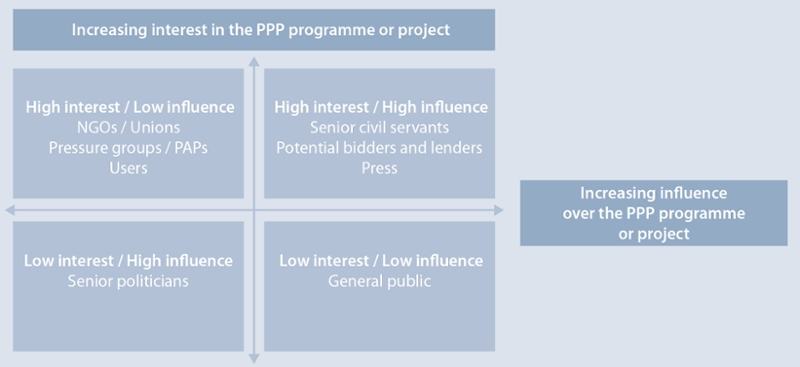
Key stakeholders in a PPP programme and/or project and their areas of interest/concern are likely to include the following groups:
- Senior politicians, who may be concerned with the relevance of PPP projects to the government’s overall policy agenda. The contracting authority should ensure that there is a political champion for the PPP programme or project. Senior political figures who can influence project implementation and the overall PPP programme are usually placed in the ‘High interest/High influence’ category of stakeholders.
- The general public, who may have limited interest in a PPP programme or in PPP projects. The contracting authority should consider the level of public knowledge and awareness of a PPP programme or individual PPP projects, and the levels of acceptance, trust or scepticism in the programme or project.
- End users, who may have specific requirements, concerns or expectations in regard to a PPP project. If an End-User Payment PPP project is being considered, the contracting authority’s communication plan should be concerned with assessing the willingness and ability of end-users to pay for the proposed infrastructure service (see Affordability).
- Project-Affected Persons (PAP), such as affected employees and local residents, who will, as noted, be concerned with the impact that a particular PPP project will have on them. Different types of PAPs will normally be found in one or other of the ‘High interest’ categories.
- Senior civil servants, who may be concerned with the track record for PPP projects in the sector or in similar projects. The contracting authority should also consider the key policy drivers for this group of stakeholders.
- Potential bidders and lenders, who may be concerned with the credibility of the contracting authority’s commitment to the PPP programme or project. Bidders and lenders may wish to limit what they are prepared to say in public in regard to their concerns, but industry associations can be a useful source of informed feedback on such issues (see Market sounding).
- NGOs/unions/pressure groups/press, who may have predetermined views on a PPP programme or a particular PPP project. The contracting authority should carefully assess the likely issues to be raised by such groups (such as, for example, environmental issues or taxpayer protection issues), and the potential impact that these important stakeholders may have.
Stakeholder engagement and climate change
The consideration of climate change issues increases the number of stakeholders concerned with PPP projects, in that the stakeholder group should now include:
- government entities dealing with climate science and policy (both in terms of mitigation and resilience);
- academic and research organisations dealing with climate change issues; and
- community-based organisations focused on climate change impacts.
These additional stakeholders should be engaged throughout the PPP Project Cycle, as discussed in the Inter-American Development Bank’s Climate Resistant Public Private Partnerships: A Toolkit for Decision Makers, cited in the list of Guidance materials at the end of this section of the PPP Guide.
16. Statistical treatment
What is it?
The ‘statistical treatment’ of a PPP project concerns the assessment of the project’s impact on a country’s national debt and deficit indicators. For EU Member States, this involves the consideration of special rules applicable to the economic convergence criteria in the Stability and Growth Pact and the Excessive Deficit Procedure (defined by the Maastricht Treaty). These require that the debt and deficit treatment of PPP projects follow the European System of Accounts (‘ESA’).
The European Commission, through its statistical agency, Eurostat, endeavours to ensure the proper application of the ESA in order to gather reliable and comparable statistics on the debt and deficit position of EU Member States. Since September 2014, Eurostat’s ESA 2010 publication (ESA 2010) has been the reference framework for the collection of these statistics. Eurostat’s interpretation of ESA 2010 is set out in the Eurostat Manual on Government Deficit and Debt (MGDD), the current version of which is the MGDD 2022 edition.
Eurostat’s rules on the statistical treatment of PPP projects are drawn from ESA 2010 and MGDD 2022, as well as official opinions produced by Eurostat on specific PPP projects.
Eurostat also publishes, from time to time, updates on relevant issues, such as issues in relation to the sharing of construction pricing risk variations.
The purpose of the Eurostat rules is to allocate the debt associated with a PPP project to the economic owner of the PPP asset, with the economic owner being the party that bears most of the risks and has the right to most of the rewards associated with the PPP asset. In practical terms, this means that the impact of the PPP project’s debt on the Eurostat national debt and deficit indicators will be determined by examining the economic ownership arrangements as they stand at financial close against the Eurostat rules in force at financial close.
The statistical treatment of a PPP project according to Eurostat rules is distinct from, and must not be confused with, the arrangements pertaining to the budgeting for, and accounting of, such projects from the perspective of the contracting authority. Budgeting for a PPP project involves the allocation of government funds to allow the contracting authority to meet its payment obligations in respect of the project, and the accounting treatment of the project involves applying national accounting rules for reflecting the financial aspects of the project in the contracting authority’s financial statements. The budgeting and accounting arrangements for a PPP project involve complex issues (see the section on Affordability in this chapter ) – but, again, those issues are different from the issues applicable to the statistical treatment of the project.
Why is it important?
The statistical treatment of a PPP project is likely to be an important issue for the contracting authority if the country is a Member State of the European Union, and therefore subject to ESA 2010 rules.
ESA 2010 requires the national debt and deficit indicators to be determined using a ‘binary’ reporting system. This means that a PPP project asset must be recorded, for the purpose of the indicators, as being either a government asset or a non-government asset. In other words, economic ownership cannot be split between the government (namely, the contracting authority) and the private sector (namely, the project company). It must be one or the other.
As a result, when a PPP project asset is determined to be a government asset, the full, aggregate value of the asset – and any associated liabilities – must be included in the national debt and deficit indicators. Because the liabilities associated with the PPP project constitute government debt in this instance, this statistical treatment can be a significant hurdle for countries constrained by their existing level of national debt.
What does it involve?
The preliminary assessment
The contracting authority should determine, during the project identification phase of the PPP project cycle, whether it needs to view the statistical treatment of the PPP project as an important issue. For example, the contracting authority should determine whether a final decision on proceeding with a proposed PPP project is conditional on it being treated as being ‘off-balance sheet’, in the sense of being excluded from the Eurostat statistical treatment of debt and deficit indicators.
If the project will only be approved if it is ‘off-balance sheet’, the contracting authority should undertake a preliminary assessment of the statistical treatment of the project based on its initial design, and update that assessment as the PPP contract terms are developed and refined.
To assist with this assessment, EPEC and Eurostat have produced guidance material, namely the 2016 Guide to the Statistical Treatment of PPPs, which outlines how the Eurostat rules should be interpreted and applied to PPP projects where the majority of the project company’s revenues will come from the contracting authority (as opposed to coming from end users).
The EPEC guidance document also explains Eurostat’s approach to determining the statistical treatment of a PPP project, describing the extent to which different PPP contract provisions influence the determination, and the provisions – or combinations of provisions – that would bring a project ‘on-balance sheet’ when calculating the national debt and deficit indicators. The EPEC guidance is fully endorsed by Eurostat and, as such, it constitutes official Eurostat guidance and applies to all PPP projects that reach financial close after 29 September 2016.
In essence, the approach is to determine:
- whether or not the features of the partnership arrangement mean that it falls within the Eurostat definition of a ‘PPP’ and, therefore, the applicability of the Eurostat PPP rules (or whether the rules related to Concessions or Energy Performance Contracts – as mentioned further below – apply);
- the classification of the parties to the PPP arrangement in terms of whether they are classified inside or outside government; and
- the features of the underlying asset and scope of services proposed.
Features of the proposed PPP contract are then examined under various themes, and classified in accordance with their impact on the statistical classification of the PPP. A scoring mechanism is used to determine the overall impact of the different PPP contract features (‘automatically on-balance sheet’, ‘very high’, ‘high’, ‘moderate importance’), so as to determine the overall classification of the PPP.
There is a core focus on risk allocation, and the consequences of that risk allocation on the parties, to determine the statistical classification of the PPP. For example, the approach requires that force majeure events (see Theme 7 in the Guide to the Statistical Treatment of PPPs) must be finite and well-defined and not ‘reasonably foreseeable or estimable’ nor ‘fundamentally uncertain’, if the provisions of the proposed PPP contract are not to influence the statistical treatment of the PPP. The impact of climate change-related events may require very careful analysis, especially as they can involve a mix of predictable and unpredictable elements and, therefore, their treatment as force majeure events or non-force majeure events.
The Guide to the Statistical Treatment of PPPs is intended to be a tool for contracting authorities within the European Union as they prepare and procure PPP projects, helping them to anticipate the likely statistical treatment of a PPP project with a high degree of clarity and certainty.
It is good practice for a contracting authority to undertake the preliminary assessment of the statistical treatment of each PPP project with the support of advisors and/or directly with the country’s national statistical office.
The final assessment
Final decisions on the statistical treatment of PPP projects rest with national statistical authorities and, ultimately, Eurostat. The extent of consultation with national statistical authorities and Eurostat is a matter of national policy and practice. Early consultation with national statistical authorities is recommended if the statistical treatment of a project is likely to be a determining factor in the contracting authority’s decision to begin the procurement phase or enter into a PPP contract, or in any other situation where greater certainty on the statistical treatment is required. If there is doubt as to the appropriate statistical treatment for a PPP contract (signed or under preparation), a national statistical authority has the ability to ask Eurostat for its assessment.
It is important to stress that the Guide to Statistical Treatment of PPPs does not deal with PPP contracts where the majority of the project company’s revenues are to come from end users. These End-User Payment PPPs (referred to by Eurostat as ‘concessions’) are assessed under separate rules, set out in Chapter 6.3.1.5 of MGDD 2019.
It should also be noted that, in 2022, Eurostat issued further guidance in regard to a contracting authority using EU grant funds to make payments to a project company during the construction and operational stages of a PPP project. The guidance indicated that the use of such EU funding (which could include grants related to climate change mitigation or climate change adaptation) will not be treated as government financing – and, accordingly, this will have no influence on the project's statistical treatment.
In addition, Eurostat and the EIB issued, in 2018, the Guide to the Statistical Treatment of Energy Performance Contracts, also covered under Chapter 6.3.1.6 of MGDD 2022. Energy Performance Contracts (EPC) – which may, under certain circumstances, be interpreted as being PPPs – are used to transfer the performance risk of energy efficiency investments, from contracting authorities to private sector project companies. In the 2018 guidance document, Eurostat and the EIB advised that, where the amount of capital expenditure in the refurbishment of an existing asset represents 50% or more of the value of the asset after completion of the works, then the following rules shall apply:
- if the project company is remunerated on the basis of the availability of and/or demand for the existing infrastructure (as refurbished, renovated or upgraded), then the arrangement should be treated as a PPP and assessed according to the Eurostat rules on PPPs (see the 2016 Guide to the Statistical Treatment of PPPs); and
- if the project company is remunerated on the basis of energy consumption and/or cost savings associated with the existing infrastructure, then (assuming it has the other features of an EPC as defined by Eurostat) the arrangement will be considered to be an EPC, and its statistical treatment will be assessed according to the Eurostat rules on EPCs (as set out elsewhere in the 2018 Guide to the Statistical Treatment of Energy Performance Contracts).
Finally, it should be noted that changes to a PPP contract after it has been signed may result in a change in its statistical treatment. The statistical treatment implications are, therefore, also a factor for the contracting authority to consider in the process of negotiating and agreeing any requested variations to the PPP contract.
17. Value-for-money assessment
What is it?
Value for money is a concept that aims to take into account the balance between cost and quality, highlighting that both elements should be considered when making a spending decision. A value-for-money assessment, in a PPP context, usually seeks to capture the balance, from the perspective of a contracting authority, between the value (benefit) and the cost of a PPP delivery option compared with other project delivery options, such as a traditional infrastructure procurement option.
The process of assessing value for money seeks to counter ingrained problems with public procurement decision-making, including the notion that the least expensive option is always the best. A value for money analysis also forces contracting authorities to recognise risk-adjusted costs over the entire life of a project. It is important to note that value for money is a relative concept – in other words, a value-for-money assessment compares one project delivery option with another (although value-for-money assessments usually also involve assessing the suitability of the PPP approach to a project, so as to deliver value for money).
A value-for-money assessment is often carried out to help inform and justify the decision about whether to use a PPP delivery option, sometimes described as an ‘ex ante’ value-for-money assessment.
Unfortunately, there is no ‘one best way’ of carrying out a value-for-money assessment. This is because the assessment usually reflects differences in policy and other practical considerations between countries, such as the use of discount rates, the availability of data and the decision-making and oversight processes used by different administrations.
However, value for money can also form the basis of evaluating a project after it has been implemented, to determine how well public resources have been used, sometimes described as an ‘ex post’ value-for-money assessment (see Implementation evaluation). In fact, the concept of value for money was originally developed in this ‘looking backwards’ context by performance auditors, to assess the efficiency, effectiveness and economy (sometimes described as the ‘3 Es’) of how the public sector has spent taxpayer money.
It is important to remember that assessing value for money on a forward-looking basis is not the same as achieving value for money. Just because value for money has been assessed at a particular point in time does not mean that it will actually be achieved. Assessing value for money is an important activity in the project cycle process, but achieving value for money depends on carefully undertaking a wide range of other activities, such as ensuring effective competition during the bidding process, or ensuring effective contract management during the implementation phase. In other words, unless there is a genuine desire to achieve value for money (as opposed, for example, to using a PPP approach solely to classify a project as being ‘off-balance sheet’ for statistical treatment purposes), a value-for-money assessment may be no more than an expensive – but pointless – exercise.
The rest of this section focuses on the forward-looking use of value-for-money assessment and how it is used to inform and justify the decision to deliver a project as a PPP during the initial phases of the project cycle.
Why is it important?
A forward-looking value-for-money assessment is used by a contracting authority to inform public sector decision-making and to verify that decisions have been taken in a rational and systematic way. In some jurisdictions, value-for-money assessment is a requirement of the policy framework for PPP projects, reflecting the fact that maximising value for money is a key objective when using a PPP project delivery option.
Value-for-money assessments are ideally used at all the key decision-making stages in the PPP project cycle, including the initial decision to consider a PPP delivery approach during the project identification phase; deciding on risk allocation during the project preparation phase; deciding to proceed to the procurement phase with the PPP delivery option; and deciding on which bid, if any, to accept during the procurement phase.
What does it involve?
Approaches to assessing value for money
Assessing value for money usually involves a combination of both quantitative and qualitative assessments.
Quantitative value-for-money assessment
A quantitative value-for-money assessment usually involves estimating and comparing the risk-adjusted life-cycle costs of a project delivered using a PPP arrangement with the corresponding costs using a traditional infrastructure procurement approach. This comparison of these two different delivery options should be on the basis of the same level and quantity of public service over the same period of time.
At its core, a quantitative value-for-money assessment seeks to determine if the value of the risks to be transferred to the project company, together with the value of any assumed efficiencies under the PPP option, are outweighed by the lower cost of finance under the traditional infrastructure procurement route. If the benefits of the risk transfer and the increased efficiencies are, collectively, greater than the savings that can be achieved using public sector financing, then the PPP option is the superior choice in value for money terms.
The traditional infrastructure procurement delivery option is usually referred to as the Public Sector Comparator (PSC) or Public Sector Benchmark (PSB).
When assessing value for money prior to the procurement phase, the PPP option is based on an assumed model of the project delivered using a PPP approach (sometimes referred to as the ‘shadow bid model’).
During the procurement phase, the PPP option is assessed for value for money based on the net present value of the payments in the bids tendered by the private sector.
As noted, a quantitative value-for-money assessment may be used during both the project preparation phase and the procurement phase of a PPP project. The following key considerations are applicable to quantitative value-for-money assessments at different points in time:
- during the project preparation phase, a quantitative value-for-money assessment may be used to make a comparative assessment of the estimated costs of a PPP delivery option with a traditional infrastructure procurement (the Public Sector Comparator), to decide whether to proceed to launch the procurement using a PPP approach;
- during the procurement phase, a quantitative value-for-money assessment may be used to compare the relative value for money of different PPP bids that have been received, to help inform the decision as to which bid to select; and
- prior to signing the PPP contract, a quantitative value-for-money assessment may be used to compare the costs of actual PPP bids with the Public Sector Comparator, to help inform the decision whether to proceed to commercial close.
In addition, a quantitative value-for-money assessment may occasionally be used during the implementation phase, to inform an implementation evaluation, or to justify a contract variation.
Qualitative value-for-money assessment
A qualitative value-for-money assessment can involve two different types of analysis. One seeks to test the ‘suitability’ of the PPP approach based on the specific characteristics of the project. The second type seeks to identify the relative benefits and costs of a PPP approach (as compared with a traditional infrastructure procurement) in qualitative terms, including those that cannot be easily reflected in numerical terms under the quantitative value-for-money assessment – for example, environmental and social benefits and costs, as well as the benefits and costs associated with climate-proof PPPs. These are sometimes described as ’non-financial’ benefits and costs.
Assessing suitability
Suitability tests do not conclusively answer the question about the relative benefits of a PPP approach. They mainly seek to identify whether or not a PPP approach is likely to deliver value for money, given the nature of the project. Using a checklist, the analysis identifies those conditions or project characteristics that enable a PPP approach to be effective, or which may prevent it from delivering value for money. For example, PPP projects where they involve long-term contracts that do not easily accommodate significant changes, are known to be less effective where the service requirement is expected to change significantly over the life of the project, so this would normally be one of the checklist questions.
Table 4 below provides a list of the broad categories of such suitability questions. It might be difficult to assess certain suitability criteria at the early stages of PPP project assessment, but it may be easier to do so at a later point, as more information on the project becomes available. Accordingly, the suitability checklist should be revisited several times over the project preparation phase and the procurement phase, both to complete the categories where information was not previously available and to reaffirm if previous answers remain valid. By the time of launch of the procurement phase, all of the suitability criteria questions should have been answered positively, if the project is to proceed as a PPP.
Table 4 - List of categories of ‘suitability’ questions in a qualitative value-for-money assessment
| Categories for PPP suitability questions |
| The PPP legal and regulatory framework |
| Public sector capacity and readiness to deliver the project using a PPP approach |
| Private sector capacity and interest to deliver the project using a PPP approach |
| Project structure and size |
| Risk identification, valuation and allocation Service requirements |
| Public and political support for a PPP approach for the project |
Arguably, the most important driver of value for money in a project is a strong competitive bidding process. Accordingly, many of the suitability criteria seek to assess not only the potential market interest in a PPP project but also the conditions that are likely to ensure competition. This includes assessing whether a contracting authority has the capacity and ability to manage the PPP project preparation and procurement process, and develop an appropriate PPP contract that is bankable.
Assessing relative qualitative benefits and costs
Assessing the relative benefits and costs is a process which recognises that there may be important advantages or disadvantages in using a PPP approach as opposed to a traditional infrastructure procurement approach – but that these advantages/disadvantages may be difficult to quantify.
The first step is to identify and prioritise the key problems that the contracting authority is seeking to address when considering whether to use a PPP approach. Examples of such priorities could include improved delivery on time and within budget; improved long-term maintenance; improved quality and consistency of service delivery; and improved opportunities to mobilise innovation in design, construction and service delivery. Conversely, there may be other objectives that the PPP delivery mode is not well equipped to deliver. Identifying these priorities or motivations clearly at the start of the project cycle also serves as a benchmark when an implementation evaluation assesses the value for money of a project later on.
Because they can help quickly to filter out projects that are unsuitable to be delivered as a PPP, qualitative value-for-money assessments are frequently used during the project identification phase of the project cycle, before a more complex quantitative value-for-money assessment is carried out. However, qualitative value-for-money assessments are also used throughout the project cycle before various key decisions are made, such as:
- during the project preparation phase, where qualitative value-for-money assessments are usually applied progressively and with increasing level of detail;
- during the procurement phase, when considering which of the final bids offers the best value for money; and
- during the implementation phase, to inform decisions that may arise during contract management.
Different approaches to value-for-money assessment arise from differences in (i) the emphasis placed on both the qualitative and quantitative assessments; and (ii) when they are used at the different stages in the identification, preparation and procurement phases of the project cycle.
Implementing the value-for-money assessment
In most cases, the project management team is responsible for carrying out the value-for-money assessment. It is important that the contracting authority ‘owns’ the value-for-money assessment, even if (as is the case in many jurisdictions) the contracting authority must present its value-for- money assessment to a separate set of decision-makers as part of the project approval process. Similarly, advisors, particularly financial advisors, often assist with the value-for-money assessment but, ultimately, the contracting authority must take responsibility for it.
Where a central PPP unit exists, it may assist the contracting authority with the value-for-money assessment, or assist a higher decision-making authority in its review of the value-for-money assessment. Alternatively, the PPP unit may conduct most of the value-for-money assessment itself, making use of a specialist team to do so in line with an agreed methodology (as is done, for example, in Ireland). It is important to have an agreed national methodology for value-for-money assessment, and a central PPP unit usually plays a key role in developing such methodologies.
To go further...
Value for money and cost-benefit analysis
In many respects, a value-for-money assessment is effectively a form of cost-benefit analysis, applied to assessing the relative merits of different project delivery options – just as a CBA assesses the benefits and costs of the project itself. Like a CBA, a value-for-money assessment can involve qualitative and quantitative forms of assessment, the use of discounted cash flows and the application of discount rates. Forward-looking value-for-money assessments necessarily involve assumptions as to future benefits (or value) and future costs. Therefore, like a CBA, a value-for-money assessment involves a fair amount of judgement. This can expose value-for-money assessments to manipulation, debate and criticism (see ‘Limitations of a value-for-money assessment’ below). Unlike CBA, however, value-for- money assessments also consider the impact of financing structures and terms of finance (given that these are important components of a PPP delivery option).
Calculating net present value in a quantitative value-for-money assessment
Quantitative value-for-money assessment involves calculating the costs of each delivery option on a present value basis. This is because the time profile of the individual costs is fundamentally different under a PPP delivery option as opposed to a traditional infrastructure procurement process.
The discount rate used to calculate the present value of the costs strongly influences the results of the comparative analysis. The choice of the level and nature of discount rate is, therefore, important and is frequently subject to much debate. Any choice should be consistent with the policy perspective applicable to making infrastructure investment decisions. For example:
- if the decision is made from a public financing perspective, a government’s cost of borrowing rate is usually used;
- if the decision is made from a public spending perspective, an economically derived social discount rate might be used; and
- if the decision is made from a public investment perspective, a risk-adjusted investment rate, such as the weighted average cost of capital (WACC), might be used.
In all cases, risks are mostly reflected in adjustments to the cash flows, but some types of risks might be reflected in the level of the discount rate (such as, for example, systemic risks).
Additional information in regard to these calculations can be found in the Guidance material listed below, including the publication Public-Private Partnerships for Infrastructure: Principles of Policy and Finance, Second Edition.
Value for money is not affordability
Value for money and affordability are sometimes confused as being identical concepts. This can arise because the approach to making a quantitative value-for-money assessment has strong similarities to that for an affordability assessment (for example, each may involve use of a spreadsheet model). However, each assessment has a different output:
- a value-for-money assessment seeks to determine whether a project should proceed using a PPP approach; while
- an affordability assessment seeks to determine whether the project is affordable for the contracting authority and/or end users.
A project that is affordable may still be poor value for money.
Value for money and climate change
The detailed climate change mitigation and climate change adaptation analyses undertaken during the project preparation phase of the PPP project cycle will often have particularly significant impacts upon the project’s value for money. Accordingly, when a contracting authority is developing climate-proof PPP projects, it is especially important to revisit the initial value-for-money assessment that was undertaken during the project identification phase, to ensure that the previous assessment is still valid. Climate change-related risks identified during project preparation that might significantly alter the value-for-money assessment include the following:
- risks which may be uninsurable;
- risks which may necessitate a greater degree of risk sharing between the contracting authority and the project company;
- risks which necessitate the use of additional government guarantees; and
- risks which may reduce the level of private sector interest in the procurement process.
At the same time, it is important to note that, when a contracting authority undertakes a value-for-money assessment involving a Public Sector Comparator, it should ensure that the same climate change mitigation and climate change adaptation objectives are imposed upon the hypothetical public sector project. It is also important to take into consideration the ability of the private sector to offer innovative climate-proof technical solutions, which may not be achievable under a traditional infrastructure procurement approach.
It is also important to remember that the value-for-money assessment should be based on the best available information at the time of the assessment. This may be particularly relevant in the context of climate change, as future climate events may have a significant impact on the actual performance of the project. This does not mean that the value-for-money assessment was incorrect, but it does underline the importance of keeping a record of the assumptions used at the time of the assessment.
Particular constraints applicable to quantitative value-for-money assessments
It is important to be aware of the limitations in both the methodology and application of a value-for- money assessment.
The complexity of the assessment process
A value-for-money assessment requires building long-term cash flow models for the Public Sector Comparator (PSC) and for the expected PPP project (if used for making the initial decision as to the use of a PPP delivery option). This, in turn, necessitates:
- making reliable long-term cost and revenue assumptions, for example, assumptions as to the expected construction, operating and maintenance costs and assumptions as to revenues from end users (if applicable) over the duration of the PPP contract;
- making reliable assumptions regarding adjustments to the costs in the PSC and PPP options for risks transferred to the project company, and regarding the financial structuring and terms of the PPP option; and
- making decisions regarding the discount rate to be used when calculating the net present values of each delivery option.
The potential for manipulation
Given the range of assumptions and estimates that need to be made by the contracting authority in a value-for-money assessment, the process may be open to manipulation to achieve a preferred result, if it is not carried out within a well-defined and managed institutional framework.
A false sense of accuracy
Because a quantitative value for money analysis is performed using a relatively complex spreadsheet model, this may give decision-makers an impression of accuracy that is misleading. The complexity of the assessment process and the reliance on a large number of assumptions and estimates may give users of the results false comfort as to the reliability of the model output. The output is only as reliable and robust as the inputs used.
Furthermore, differences in results may be outweighed by variations in the accuracy of the inputs. Accordingly, a quantitative value-for-money assessment which shows that the PPP delivery option is a fraction of a percent less expensive than a traditional infrastructure procurement should not be the sole basis of a decision in favour of using a PPP delivery option.
Some delivery options may not really be available
A value-for-money assessment is often based on an assumption that, in the case of a traditional infrastructure procurement, the contracting authority will maintain the infrastructure asset to a consistent standard over the same long-term period as in the PPP option – even though such an assumption may be inconsistent with the reality of the contracting authority’s past practice. In such a situation, the assessment may be misleading, since it may be based on a comparator that is not actually available.
Particular constraints applicable to qualitative value-for-money assessments
A qualitative value-for-money assessment does not involve the same complexity and need for data as a quantitative assessment. Nevertheless, the following considerations should be kept in mind.
- The need to apply significant professional judgement when applying qualitative criteria, which may be open to manipulation to achieve a preferred result if the evidence base is weak or non-existent.
- The robustness of the criteria, and the availability of evidence to underpin their relevance.
- The relative importance of different criteria, where some criteria may be more relevant and, therefore, more important than others. The assessment might choose to give significant weight to certain criteria, which may subsequently prove to be less relevant.
General considerations applicable to both types of value-for-money assessments
The following considerations apply to both qualitative and quantitative value-for-money assessments:
- Timing of the value-for-money assessments. If a value-for-money assessment is carried out too late in a given phase of the project cycle, then the output is unlikely to have the required influence, as key decisions may have already been made.
- The proportionality of the approach used. Requiring an overly complex assessment to be made for a relatively small project, or for a project where the level of information required is unlikely to be available. The challenges involved – in undertaking a value-for-money assessment so as to justify using a PPP approach – may dissuade a contracting authority from even considering a PPP option.
- A mechanistic (unthinking) approach to value-for-money assessment. Some contracting authorities may regard a value-for-money assessment as an annoying ritual duty, with the result being that proper consideration is not given to steps that could be taken, during the project preparation, procurement and implementation phases, to improve the value for money of the project.
Addressing the constraints of value-for-money assessment
The process of assessing value for money is arguably as important as the result of the assessment – since a proper value for money process forces the contracting authority to consider long-term costs and risks in its decision-making.
To address the constraints identified above, it is common practice to use a combination of both quantitative and qualitative value-for-money assessments. In the past, quantitative assessments were the main determinant of value for money, but many contracting authorities now attach increasing importance to the use of qualitative assessments.
In practical terms, the use of a qualitative assessment as early as possible may be more effective in actually influencing the project delivery decision, since the broad direction of the project is easier to change in the early stages. This is in contrast to the impact of a value-for-money assessment later on, even if it is more thorough, as the political momentum behind the PPP project delivery option may have already become well-established and therefore less easy to change.
To simplify and improve the value-for-money assessment process, a contracting authority might also consider the following recommendations:
- Using standardised spreadsheet models for the quantitative assessment. This can help to address the risk of manipulation (as well as reduce the time and cost). However, such standardised models do not easily allow for the widely varying complexities and scale of different types of projects, and can encourage a mechanistic mindset to value-for-money assessment and reduce the need to think through the value for money drivers.
- Using standardised adjustment factors. Examples of this include the use of standardised project cost/duration adjustment factors based on studies of ‘optimism bias’ (namely the demonstrated, systematic tendency for project appraisers to be overly optimistic with regard to a project’s costs, benefits and duration).
- Using standardised PPP contract terms. The development and use of standardised PPP contract terms, combined with effective enforcement and derogation rules (which allow for departures from the standard terms, based on informed decisions), can help to ensure that projects are developed in line with a pre-agreed basis for risk management.
- Establishing a specialised team to conduct value-for-money assessments. This could be a designated team within a central PPP unit (see Managing the process).
- Strengthening the overall PPP project quality control and approval processes. This is to ensure that the findings of the value-for-money assessment are properly taken into consideration in the decision-making processes.
18. Variations and dispute resolution
What is it?
The long-term nature of a PPP project means that variations to the PPP contract are likely to be sought by the parties from time to time. The contracting authority, for example, might require changes to the infrastructure assets or services, to reflect changes in the public’s use of the assets; or the project company might propose new methodologies or technologies to deal with unanticipated impacts due to climate change. It is recommended that the PPP contract include a framework for the parties to propose, negotiate and agree such changes.
In addition, the PPP contract should provide a clear framework for the resolution of any disputes between the parties that arise during the implementation phase of the PPP project.
Why is it important?
Variations and disputes are significant risks to the successful delivery of a PPP project.
The inability or failure to implement necessary changes could jeopardise the PPP project. At the same time, implementing a change should not be to the detriment of the value for money, affordability or bankability of the project. A process that sets parameters for introducing and negotiating changes (including cost and compensation parameters) will improve the flexibility, efficiency and effectiveness of the PPP project over the long term.
Disputes during the implementation phase have the potential to undermine the ‘partnership relationship’ between the contracting authority and the project company, and the PPP contract therefore needs to provide a clear process for the quick and effective resolution of such disputes.
The risks around variations and disputes also influence how investors approach a prospective PPP project during the procurement phase. A lack of clarity on these risks in the draft PPP contract (as included with the bid documents) may cause bidders to increase their prices to deal with the uncertainties, or it may significantly reduce the number of bidders participating in the procurement process.
A poorly run procurement strategy and/or poorly prepared PPP contracts and unrealistic risk allocations (for example, misallocation of demand risk) are usually associated with higher requirements for subsequent variations to PPP contracts, with the attendant problems this can lead to. This also underlines the importance of clearly defining and scoping the project in the first place and developing realistic commercial terms and risk allocation (using market sounding, if necessary) to reduce the need for changes later on.
What does it involve?
Before commercial close
Processes for variations and dispute resolution should be developed by the contracting authority and appropriate provisions in regard to those processes should be included in the draft PPP contract issued with the bid documents.
Provisions dealing with the variation process for generic and undefined changes could, for example, include:
- limitations on the impact of changes (for example, a restriction that there must not be a material change to the risk allocation arrangements);
- provisions setting out the timeframes for the parties to respond and provide information; and
- parameters for agreeing any cost savings or increases, and managing their impact.
The contracting authority might also consider including provisions dealing with specific variations that are likely to happen over the life of the PPP contract (such as minor reconfigurations of the infrastructure assets).
The variation mechanism is frequently used for addressing changes to the PPP infrastructure assets or services. In addition, other changes that might arise and that are typically addressed through separate provisions in the PPP contract include:
- changes to the financing structure (referred to as ‘refinancing’ – see ‘To go further…’);
- changes to the project company’s corporate structure (such as changes to the mix of shareholdings); and
- unplanned or unexpected events that threaten the delivery of the infrastructure services, such as a pandemic (which the PPP contract might address through provisions on disaster/contingency planning and/or provisions regarding the contracting authority’s ‘step-in rights’).
The contracting authority’s legal advisors should also provide advice on the design of a dispute resolution process which is in conformity with the national legal framework. The dispute resolution process typically takes a ‘tiered’ approach, with attempts to reach a resolution only being escalated if they need to be. Typical tiered dispute resolution mechanisms include:
- referral of the dispute to a meeting of the senior officers of the contracting authority and the project company;
- mediation or conciliation, where a third party helps the parties to reach agreement, occasionally by issuing a non-binding recommendation as to how the dispute should be resolved;
- expert determination by an individual expert, frequently used for specific technical or financial issues, but often on the basis that the expert’s decision can be appealed;
- the use of a standing ‘dispute board’, usually composed of three independent individuals appointed at the outset of the implementation phase, who have an ongoing relationship with the PPP project and who can issue either recommendations or binding decisions;
- determination by a sector-specific regulatory tribunal, where applicable;
- arbitration (national or international); and
Before commercial close, the contracting authority needs to establish its internal arrangements for handling variations and disputes. These need to be clear within its contract management structure.
After commercial close
Once the PPP contract is signed, variations and disputes will be handled as part of the contracting authority’s established contract management processes. In relation to variation requests, this normally involves:
- liaising with the contract management technical team (and its advisors) to review the scope/ costing/timing of variations and the potential impact on the delivery of the infrastructure services;
- liaising with the financial team (and its advisors) to assess the financial impact of variations, in terms of affordability and value for money;
- liaising with its advisors to assess the impact of the variation on the statistical treatment of the PPP project;
- liaising with the legal and procurement team (and its advisors) to check compliance with the legal framework and EU procurement rules (if applicable);
- liaising – if relevant – with the providers of grant funding (such as the providers of concessional funds available for climate-proof PPPs) to report on variations/disputes, as required;
- managing the process of liaising with the project company;
- obtaining the relevant internal approvals.
The risks associated with the negotiation of variations need to be acknowledged and mitigated, taking the following points into consideration:
- The contracting authority needs to find a balance between, on the one hand, requiring the project company to take on and manage the risks it agreed to accept when it signed the PPP contract, and, on the other hand, ensuring that the infrastructure services are being provided to the public in a satisfactory manner.
- Value for money is at risk when the project company is pricing the cost of variations in an environment where there is no competitive pressure (given that the procurement phase has ended). This problem can be addressed, to some extent, by specifying, in the PPP contract, the cost parameters for variations, using cost benchmarks or expert facilitators.
- EU procurement law limits the scope for changes to the PPP contract after commercial close (see the discussion, in the section on Procurement strategy, of “Modification of contracts during their term” and the discussion, in the section on PPP contracts, of ‘augmentation’ in the context of “Climate change-related PPP contracts”).
- A variation may result in a change to the statistical treatment of the PPP project.
- The lenders to the project company may have the right to prevent it from agreeing to particular variations of the PPP contract.
To go further...
Sharing the gains from a refinancing
Refinancing is commonly understood as the replacement or renegotiation of the original capital structure, debt and/or equity of the project company on more favourable terms. Refinancings are attractive to the project company when interest rates fall (if the project company can benefit from such a fall under its hedging policy) or when the risk profile of the project company has improved. A refinancing might involve:
- a reduction in the debt pricing;
- an extension of the debt maturity;
- an increase in the ‘gearing’ (the amount of debt relative to equity), that becomes possible when lenders are prepared to relinquish some of the contractual restrictions on gearing levels contained in the financing agreements, as the perceived project risks are reduced;
- lighter ‘reserve account’ requirements imposed in the financing agreements; and
- the release of guarantees to lenders provided by the project company’s shareholders or by other parties.
A refinancing will often result in financial gains for the project company’s shareholders. Some of these gains may be attributed to good performance by the project company, but some may arise from macroeconomic factors or lenders’ greater confidence in a specific market (in other words, factors not attributable to the project company). In the latter instance, financial gains for the project company’s shareholders may appear undeserved, and give rise to public opposition to the PPP project. As a result, it is now established practice for the PPP contract to include a mechanism for calculating the gains that arise from any refinancing, and for the project company to share those gains with the contracting authority.
The refinancing provisions in the PPP contract are critical factors in the statistical treatment assessment.
The refinancing provisions in the PPP contract should be developed with support from the contracting authority’s financial and legal advisors. The provisions need to address the following considerations:
- calculating the expected refinancing gain to the project company’s shareholders (by, for example, using net present value techniques);
- determining the portion of the gain to be allocated to each party to the PPP contract; and
- deciding how the gains should be processed (by, for example, a lump sum payment to the contracting authority and/or a reduction in the future availability payments made by the contracting authority to the project company).
Many other points of detail (such as the discount and interest rates to be used in the calculations, and the treatment of a refinancing on a future early termination payment) should also be addressed in the PPP contract.
Compensation
Where the variation is required by the contracting authority, the general principle is that the contracting authority should compensate the project company to be put in a position no better or worse than if the change had not been required – this is often referred to as ensuring ‘economic balance’. Under an End-User Payment PPP, the cost changes may sometimes be passed on to end users (otherwise they should be met by the contracting authority). Variations that require capital expenditure could be met by the contracting authority paying for any increased costs directly (if it has the budget), or by requiring the project company to meet these in return for an increase in the availability fee and/or by extending the term of the PPP contract if the project company agrees to do so (although determining the required increase in the fee or extension can be a complex issue).
The contracting authority should also be mindful that variations above certain limits may not be permitted without contravening procurement regulations (see Procurement strategy). Specifically, the EU procurement directives permit, in ordinary circumstances, cumulative changes of no more than 10% of the contract value, without the requirement for rebidding. However, the EU directives also permit, in certain specific cases (such as, for example, unforeseen changes), changes up to 50% of the contract value, without the requirement for rebidding (again, see the discussion, in the section on Procurement strategy, of “Modification of contracts during their term” and the discussion, in the section on PPP contracts, of ‘augmentation’ in the context of “Climate change-related PPP contracts”).
Managing small variations
The most frequent variations are usually small changes to the service or asset required by the contracting authority to meet changes in public needs. These are to be expected and are best handled by agreeing, in the PPP contract, upon a set of general time and cost-plus rates applicable to small changes, and the procedure or ‘protocol’ to manage such changes.
It is also important to note that lenders often require that they are given the right to approve any changes to the PPP contract. To avoid the need to have small changes approved by all of the lenders (which can be costly and time-consuming), the right of approval, for changes below an agreed threshold, may be delegated to the lenders’ technical advisor or an agent bank. It is also better to group the request for small changes together where possible, to minimise processing costs and to simplify any required changes to the availability or end-user fees.