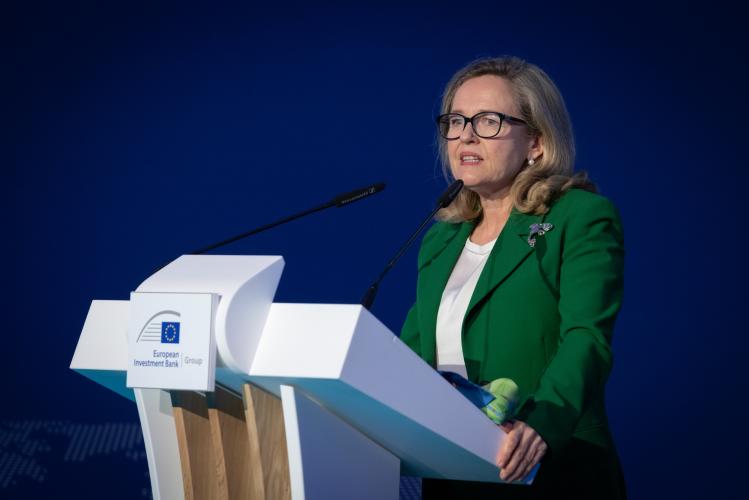
Nadia Calviño, présidente du Groupe BEI, donne le coup d’envoi des Journées BEI Monde dans le cadre de l’édition 2026 du Forum du Groupe BEI.
Eh bien, quelle magnifique vidéo qui nous montre que tout est interconnecté et que nous vivons dans un seul et même monde. Une seule population, un seul monde. C’est une belle image pour ouvrir la partie de notre forum annuel consacrée à BEI Monde.
Mesdames et Messieurs les Commissaires, les Ministres, leurs collègues et amis, mes sœurs Ngozi de l’Organisation mondiale du commerce, Sanya de Gavi, mon cher Ethiopis. Il y a longtemps que nous travaillons ensemble en occupant de nombreuses autres fonctions. Chers collègues de la Banque européenne pour la reconstruction et le développement, des Nations unies, des agences nationales de développement, votre Éminence, représentantes et représentants du secteur privé, de la société civile, partenaires et alliés, de l’Ukraine à l’Afrique, de l’Amérique latine à l’Asie du Sud-Est. Bienvenue à la deuxième édition des Journées BEI Monde, cette partie du Forum du Groupe BEI consacrée à la coopération internationale et à des partenariats mondiaux mutuellement bénéfiques, une expression que, je pense, vous entendrez beaucoup dans les tables rondes qui vont suivre.
Au vu des événements dramatiques que nous vivons et de l’intensification du conflit au Moyen-Orient ces derniers jours, mais aussi des conflits qui ont éclaté ces dernières semaines et ces derniers mois, et les nouvelles réalités qui s’imposent à notre monde, je crois que s’il y a bien un moment où un tel engagement est urgent, nécessaire et essentiel, c’est maintenant. Le monde a besoin de voir qu’une autre voie est possible et le travail que nous accomplissons ensemble, avec vous toutes et tous, les projets que nous faisons naître, montrent qu’il existe effectivement une autre voie. Par exemple, l’engagement d’un milliard d’euros en faveur de l’initiative Mission 300 visant à fournir une énergie propre et abordable à 300 millions de personnes sur le continent africain d’ici à 2030. Nous nous associons à nos partenaires de la Banque africaine de développement – dont le président est également avec nous aujourd’hui, je crois, je ne le vois pas, mais il doit être quelque part dans la salle – et du Groupe de la Banque mondiale, représenté par le vice‑président de la Société financière internationale. Nous unissons nos forces à celles de ces institutions multilatérales pour nous assurer que nous pouvons améliorer les conditions de vie, les moyens de subsistance et les perspectives de 300 millions de personnes.
Et le premier message que je voulais partager avec vous aujourd’hui, c’est que dans un monde où les défis sont nombreux, l’Europe a quelque chose de très concret à offrir. Un modèle, un historique, une preuve de concept, des leçons apprises. J’y pense parfois quand on me demande pourquoi l’Europe est si attachée à l’idée de coopération, de partenariats mondiaux. Pourquoi insistons-nous sur des règles, le droit international, les institutions, des résultats mutuellement bénéfiques ? La réponse est très simple : parce que nous connaissons l’alternative. Nous en avons fait l’expérience. La guerre a été une constante dans l’histoire de l’Europe. Et notre Union européenne est en fait la preuve qu’il existe une porte de sortie face à ces réalités. L’Union européenne et la Banque européenne d’investissement sont nées des cendres de la Seconde Guerre mondiale.
Je suis moi‑même née sous une dictature, dans mon pays, l’Espagne. J’avais 12 ans lorsque des hommes armés sont entrés dans notre Parlement et ont tenté d’imposer à nouveau un régime militaire. Il y a quelques jours à peine, et c’est pour cela que je l’évoque, nous avons commémoré le 45e anniversaire de cette nuit‑là. Le régime militaire est aussi un souvenir bien présent au Portugal et en Grèce. Beaucoup de mes collègues à la Banque européenne d’investissement sont nés derrière le rideau de fer, sous le régime de l’URSS. Et la guerre est un souvenir bien présent pour nos États membres et les pays candidats des Balkans. La guerre en Ukraine est désormais entrée dans sa cinquième année.
Ainsi, l’Europe n’est pas une tour d’ivoire isolée des problèmes du monde. Bien au contraire, nous formons une communauté où la prospérité, la liberté et la paix n’allaient pas de soi, mais restaient à conquérir, à défendre, avec des revers et des tragédies en cours de route. C’est pourquoi l’engagement de l’Europe en faveur de la coopération et de la prospérité partagée est le fruit de notre histoire et de notre expérience, et cet engagement est solide.
Mon deuxième point, c’est que ce que nous faisons chaque jour compte. L’avenir n’est pas écrit. Il n’existe pas de baguette magique pour bâtir un monde meilleur. Ce que nous pouvons faire, c’est apporter notre pierre à l’édifice, comme nous l’avons vu dans la vidéo, jouer notre rôle au quotidien, par nos actions. Comme l’a dit Robert Schuman – pour celles et ceux d’entre vous qui ne sont pas européens, Robert Schuman est l’un des pères fondateurs de l’Union européenne – à propos de l’unification de l’Europe : « L’Europe ne se fera pas d’un coup, ni dans une construction d’ensemble : elle se fera par des réalisations concrètes créant d’abord une solidarité de fait. » Je vois ces mots tous les jours en venant ici à pied, parce qu’ils sont gravés sur le monument de l’autre côté du pont.
Et cette même logique peut s’appliquer au monde. C’est pourquoi le Groupe Banque européenne d’investissement joue un rôle très important au sein de l’Union européenne et à l’échelle mondiale, parce qu’avec chaque école que nous finançons en Ukraine, chaque fillette que nous contribuons à faire vacciner en Angola, chaque nouvelle ligne de métro au Viêt Nam et en Inde, chaque projet qui apporte de l’énergie propre en Égypte ou dans des pays d’Amérique centrale, chaque accord qui facilite l’accès aux financements pour des agricultrices et des agriculteurs en Côte d’Ivoire ou en Sierra Leone, qui relie des régions isolées du Cameroun et qui donne des moyens d’action aux entrepreneuses en Mauritanie, chacun de ces projets, sans exception, contribue à créer le tissu d’une société où les personnes ont le sentiment que le système répond à leurs besoins. Elles peuvent avoir confiance en l’avenir, pour elles‑mêmes et pour leurs enfants. Et c’est une contribution tangible à la paix, à la croissance économique, à la stabilité mondiale.
En 2025, le Groupe BEI a atteint un niveau historique de 100 milliards d’euros de financements au total. Sur ce montant, plus de 9 milliards d’euros ont été déployés à l’extérieur de l’UE par l’intermédiaire de BEI Monde. Et permettez-moi de préciser ce que cela signifie. L’Ukraine est notre priorité absolue. L’année dernière, nous avons déployé un volume de financement record avec un nouveau projet signé ou inauguré toutes les deux semaines. La sécurité de l’Ukraine et la sécurité de l’Europe vont de pair, et la cause de la population ukrainienne est aussi la nôtre. Depuis le début de l’invasion, nous avons décaissé plus de 4 milliards d’euros pour rétablir les réseaux de distribution d’eau, réparer les réseaux d’énergie et reconstruire des écoles, des jardins d’enfants et des hôpitaux. Et nous nous tiendrons aux côtés de l’Ukraine sur la voie d’une paix juste et durable, que, dans cette salle, nous appelons toutes et tous de nos vœux rapidement.
Dans les Balkans, nous avons mobilisé l’année dernière 1,5 milliard d’euros de nouveaux investissements pour accompagner les pays de la région sur la voie de l’adhésion à l’UE, y compris d’importants financements pour la modernisation stratégique des chemins de fer en Albanie et au Monténégro, l’énergie éolienne en Bosnie-Herzégovine et l’amélioration des services de santé en Serbie.
L’an dernier, le Groupe BEI a investi plus de 3 milliards d’euros en Afrique, notamment pour soutenir la production de vaccins au Rwanda, une campagne de vaccination de masse contre le cancer du col de l’utérus en Angola et des mises à niveau essentielles des réseaux de transport d’eau au Maroc. Cette semaine, nous discutons beaucoup d’un nouveau projet en faveur de capacités de production de vaccins en Afrique du Sud. C’est pourquoi notre partenariat avec Gavi est si important. Je discutais à l’instant avec sa directrice générale, Madame Nishtar, de la façon dont nous pouvons continuer à renforcer ce partenariat crucial, qui change la donne pour le monde.
Pour ce qui est de l’eau, la Banque européenne d’investissement compte en fait parmi les plus grands bailleurs de fonds au monde pour les projets dans le domaine hydrique, qu’il s’agisse de l’eau potable qui coule de nos robinets, du traitement des eaux usées ou de l’irrigation agricole. Nous avons mis à disposition plus de 5 milliards d’euros de financements pour des projets liés à l’eau l’an dernier, améliorant ainsi l’assainissement et l’accès à l’eau potable pour 32 millions de personnes dans l’UE et au-delà, y compris au Moyen‑Orient et en Asie.
Citons par exemple, la remise en état et la construction de stations d’épuration des eaux à Karachi. Le projet d’approvisionnement en eau que nous avons signé l’année dernière à Dhaka, l’un des projets présentés dans la vidéo, devrait bénéficier à plus de 10 millions de personnes dans la capitale du Bangladesh. Enfin, le Groupe BEI a mis à disposition près de 2 milliards d’euros de nouveaux financements pour des projets en Amérique latine et dans les Caraïbes, notamment pour la construction du premier réseau de trains électriques du Costa Rica et pour l’amélioration des réseaux d’assainissement en Équateur.
Ainsi, le message que je souhaite vous laisser – mon deuxième message aujourd’hui –, je veux qu’il soit très clair : là où certains reculent, l’Europe, elle, intensifie son action.
Et mon troisième et dernier point, c’est que le périmètre et le niveau d’ambition des opérations du Groupe BEI vont s’amplifier, à l’image de l’empreinte de l’Europe dans le monde. Quelles sont nos principales priorités ? Nos actionnaires, les 27 États membres de l’Union européenne, ont approuvé à l’unanimité notre nouvelle orientation stratégique pour nos opérations à l’échelle mondiale, en parfaite adéquation avec l’objectif de l’UE de renforcer la voix de l’Europe grâce à des partenariats mutuellement bénéfiques. Le Groupe BEI joint le geste à la parole, en ayant déjà mobilisé 100 milliards d’euros d’investissements alignés sur la stratégie « Global Gateway » de l’Union européenne – avec deux années d’avance sur l’échéance.
Et ce travail va se poursuivre. Notre priorité géographique restera l’Ukraine, les pays de l’élargissement et du voisinage, tout en adoptant une approche différenciée, qui adapte notre offre aux besoins locaux de l’Afrique et de l’Amérique latine. Le Groupe BEI s’engage dans une véritable approche mutuellement bénéfique. C’est la troisième fois que je le dis dans mon discours. Je voulais vraiment en faire l’élément central de mon intervention, car c’est l’idée clé, et c’est l’approche européenne. Il s’agit de conclure des accords et de nouer des partenariats bénéfiques à toutes les parties. Une voie à rebours de la logique qui voudrait que, pour que certains gagnent, d’autres doivent échouer. Soutenir le développement mondial et répondre à des priorités communes, de la santé mondiale au climat, tout en offrant de nouvelles possibilités d’affaires aux entreprises européennes et en contribuant à diversifier les chaînes d’approvisionnement européennes. Les accords que nous avons signés le mois dernier pour soutenir des projets en matière de graphite et de lithium à un stade précoce en Tanzanie et en Namibie illustrent cette approche.
Et le Groupe Banque européenne d’investissement échange aussi intensément avec des économies développées, notamment l’Australie et le Canada, dans ce domaine. Je ne savais pas, d’ailleurs, que notre vice‑présidente venait tout juste de rentrer du Canada. Je ne savais pas que tu serais déjà parmi nous ici, chère Nicola.
Si nous regardons plus loin, l’année prochaine, nous assurerons la présidence du groupe des banques multilatérales de développement, un rôle qui montre que, dans cette institution, nous prenons cela très au sérieux. La collaboration, les synergies et la complémentarité du Groupe BEI avec les partenaires régionaux et multilatéraux, avec les institutions européennes de promotion économique et de développement, avec le secteur privé, l’Organisation mondiale du commerce, des organisations et fondations comme Gavi et, bien sûr, la Commission européenne, institution sœur de la nôtre, maximisent l’impact et illustrent la valeur du multilatéralisme et d’un ordre mondial fondé sur des règles. Comme le partenariat que nous signerons un peu plus tard dans la journée avec mon amie, Ngozi Okonjo‑Iweala, entre la BEI et l’Organisation mondiale du commerce, pour soutenir des réformes et des possibilités d’investissement avec l’Afrique. Cet accord encouragera des échanges commerciaux ouverts, renforcera les chaînes d’approvisionnement, ouvrira de nouveaux marchés et de nouvelles possibilités aussi bien pour nos pays partenaires que pour les entreprises européennes.
Et avec le Groupe de la Banque mondiale, nous codirigeons la base de données mondiale sur les risques des marchés émergents, connue sous l’acronyme de GEMS, qui est la plus vaste base de données au monde sur le risque de crédit dans les économies émergentes, constituée à partir des immenses ensembles de données des banques multilatérales de développement et de 40 ans d’expérience en matière d’investissement. En octobre dernier, nous avons publié de nouvelles statistiques qui ont confirmé un point très important pour mobiliser l’investissement privé : les taux de défaut pour les prêts au secteur privé sur les marchés émergents sont comparables à ceux des économies avancées. Et les taux de recouvrement sont même supérieurs aux valeurs de référence mondiales. Selon l’OCDE, les marchés émergents pourraient être confrontés à un déficit de financement de plus de 10 000 milliards de dollars d’ici à 2050. Or, les données de GEMS sont très pertinentes, parce qu’elles montrent que cet écart n’est pas une question de risque. C’est une question de perception, et aussi d’opportunité. Ainsi, combler cet écart de perception est l’un des leviers les plus utiles dont nous disposions pour mobiliser des capitaux privés là où les besoins sont les plus pressants.
Pour conclure, l’Union européenne et le Groupe Banque européenne d’investissement continueront de jeter des ponts dans un monde où l’on érige des murs, afin d’encourager des échanges commerciaux ouverts, une croissance durable et des sociétés inclusives et en bonne santé. C’est non seulement juste, mais aussi judicieux, parce que, lorsque nous investissons dans ces domaines, nous diversifions également les chaînes d’approvisionnement européennes. Nous renforçons aussi notre propre sécurité. Nous assurons une planète vivable pour nos enfants. Quand nous ouvrons des marchés pour les exportateurs européens et que nous appuyons le secteur privé en Asie ou en Amérique latine, nous créons des occasions de part et d’autre. Quand nous investissons dans la production mondiale de vaccins, nous protégeons aussi notre propre santé. Et quand nous soutenons l’autonomisation économique des femmes, ce sont des communautés entières, le monde entier, qui en profitent.
Et tout cela coule vraiment de source, même si, de nos jours, cela peut sembler presque révolutionnaire dans certains cercles. Dans cette révolution de la raison et du bon sens, le Groupe BEI maintient le cap. Et je suis extrêmement heureuse et reconnaissante de voir que nous sommes rejoints par autant d’alliés ici aujourd’hui. Merci d’être là. Un grand merci aux équipes du Groupe BEI sur le terrain et à vous toutes et tous qui les rejoignez pour vraiment changer la donne.
Je vous remercie pour votre attention.