
Executive summary
This seventh annual report presents an overview of project‑related procurement complaints handled by the European Investment Bank’s Procurement Complaints Committee (PCC) in 2025. The PCC is an independent and impartial Committee responsible for reviewing procurement complaints concerning EIB‑financed projects outside the European Union. In 2025, the Committee received 25 procurement complaints, representing a moderate increase compared with previous years (against approximately 500 non-objections processed in a year). Eighteen complaints were submitted before the Bank’s non‑objection decision and were redirected to the relevant EIB services for follow‑up. Seven complaints were lodged after the Bank’s non‑objection to contract award, of which four were reviewed and decided upon by the PCC. In these four cases, the PCC upheld the Bank’s non‑objection three times and withdrew it once. While complaints do not typically revolve around a specific issue, the allegations concerned lack of transparency, insufficient feedback to bidders, and failures to notify results.
1. Introduction
This report was prepared by the Secretariat of the Procurement Complaints Committee (PCC or "the Committee") of the European Investment Bank ("EIB" or "the Bank"). It provides an overview of the project-related procurement complaints that were received and handled by the EIB over the course of 2025 and outlines the work of the Committee and its Secretariat. This is the seventh annual report to have been compiled and published on the Committee’s activity since it was set up in late 2018.
In line with good practices followed by other international financial institutions, when project-related procurement complaints are submitted to the EIB, they are handled by the PCC. The PCC is a specialised, independent and impartial committee mandated to handle procurement complaints that challenge the Bank’s decisions on project procurement procedures for EIB-financed projects outside the European Union. This system ensures that project procurement complaints regarding EIB-financed projects are handled effectively and independently. If a complainant is not satisfied with the Bank’s outcome or response, they are entitled to escalate their complaint to the European Ombudsman alleging maladministration by the Bank.
2. Brief overview of the EIB’s procurement complaints system
PCC’s remit, work and composition
The Procurement Complaints Committee is an independent Bank committee with four voting and two non-voting members, consisting of senior representatives of different directorates of the Bank.
It is chaired by the EIB’s Inspector General and assisted by a Secretariat. The chairperson decides upon the admissibility of procurement complaints, is in charge of directing and facilitating the work of the Committee, and oversees the Secretariat.
Promoters of projects that are financed by the EIB are required to follow the Bank’s Guide to Procurement (March 2024). This guide also sets out the EIB’s processes for handling procurement complaints. Promoters are fully responsible for implementing projects financed by the Bank, in particular for all aspects of the procurement process, from drafting tender documents to awarding and implementing contracts. The Bank’s involvement is confined solely to verifying whether the conditions attached to its financing are being met.
For projects in the European Union that are financed by the Bank, the relevant national remedy mechanisms provide appropriate safeguards. This is done through the transposition of EU procurement law by EU Member States, in particular the Remedies Directives, which set minimum national review standards.
For projects financed by the Bank in non-EU countries [1], the Bank uses a "non-objection" mechanism for approving procurement methods and outcomes. An important feature of the procurement complaints system is that the Bank requires its promoters to observe a standstill period, which is the intervening period of time between the decision to issue a non-objection to the award of a procurement contract and the signature of the contract.
Complainants may call into question a decision taken by the Bank (usually, but not limited to, a non-objection given by the Bank) for project procurement procedures financed under an EIB project. The Committee may decide to either confirm or withdraw the non-objection already issued by the Bank. If it decides to withdraw the non-objection, it may also recommend that the relevant project component be excluded from the Bank’s financing and/or that any other contractual remedies be undertaken.
Complainants lodging procurement complaints may be "any party having or having had an interest in obtaining a particular contract and who has been or risks being harmed by an alleged infringement of the EIB’s Guide to Procurement." [2]
[1] In countries outside the European Union, the Bank requires that the main mechanisms of the EU directives on procurement be followed with the necessary procedural adaptations (Section 1.1 of the Guide to Procurement for projects financed by the EIB, March 2024).
[2] Id. at Annex 7.
3. PCC complaints in 2025
Taxonomy of admissible procurement complaints and corresponding processes
As described in the Guide to Procurement, procurement complaints that challenge the Bank’s decision on project procurement procedures under an EIB-financed project are classified and handled as follows:
Procurement complaints lodged prior to the Bank’s decision (objection or non-objection) are redirected by the PCC’s Secretariat to the Bank’s services in charge of the respective projects for further follow-up. The substance of such complaints is considered when the Bank decides on the non-objection to the contract award.
Procurement complaints lodged after the Bank’s non-objection to contract award and prior to the signature of contracts – that is, during the standstill period – are reviewed by the Committee, which examines the case to enable the Bank to take a final position on whether to confirm or withdraw its non-objection. The submission of this type of complaint triggers the suspension of the Bank’s non-objection until the Committee has completed its review. Considering that the Bank is not a party to the procurement contract, it can only take decisions concerning the financing it provides to a given project or project component.
For procurement complaints lodged following the Bank’s non-objection to contract award and after the signature of contracts – that is, after the standstill period has expired – the Committee can no longer redress the procurement procedure. However, it examines such admissible complaints to decide whether the Bank should confirm or withdraw its financing of the contract.
According to the Guide to Procurement, the Bank’s decision is taken in less than 30 calendar days from the submission of the complaint. In complex cases, this deadline may be extended up to 60 calendar days.
In 2025, the Committee received 25 procurement complaints. Of these complaints, 18 were submitted prior to the Bank’s decision/non-objection and hence redirected by the PCC Secretariat to the Bank’s services that are responsible for the relevant projects for further follow-up, as per the Guide to Procurement.
The remaining seven procurement complaints were submitted to the PCC following the Bank’s non-objection to contract award (including one submitted after contract signature). Of these seven, one complainant withdrew its submission, one procurement procedure was cancelled by the promoter, and one complaint was overtaken by subsequent events and therefore not reviewed. The Committee thus reviewed and decided on four procurement complaints. It upheld the Bank’s non‑objection in three cases and withdrew the Bank’s non‑objection in one case.
More details on all 25 procurement complaints are provided in the table below and in the following section.
i. PCC complaints by nature of allegation (Table 1)
|
Procurement complaints lodged prior to the Bank’s decision |
||
|
Country of project concerned |
Nature of allegations |
|
|
PCC/2025/01 |
Angola |
Assigned scores and candidates’ qualifications and experience; evaluation matrix, and clear justification for the assigned scores |
|
PCC/2025/02 |
Ukraine |
Issues related to a sanctioned component |
|
PCC/2025/03 |
Ukraine |
Issues related to a sanctioned component |
|
PCC/2025/05 |
Bolivia |
Discriminatory specifications |
|
PCC/2025/06 |
Ecuador |
Absence of feedback/clarifications following the opening of tenders; procedure not in line with the principle of transparency |
|
PCC/2025/08 |
Ecuador |
Lack of transparency in the opening of tenders and alleged substantial omission of competitor's tender |
|
PCC/2025/10 |
Egypt |
Delay in delivery is causing significant issues for the project's progress |
|
PCC/2025/11 |
Ukraine |
Lack of transparency in the evaluation |
|
PCC/2025/12 |
India |
Unjustified disqualification: complainant’s price more competitive than the lowest technically qualified bidder |
|
PCC/2025/15 |
Ecuador |
Lack of access to public information |
|
PCC/2025/16 |
Kosovo |
Evaluation of technical proposal; failure to assess methodology, key experts’ qualifications; inconsistent scoring |
|
PCC/2025/17 |
Ecuador |
Non-compliance with deadlines; lack of transparency in the opening of tenders |
|
PCC/2025/18 |
Moldova |
Artificially narrowed qualification requirements |
|
PCC/2025/20 |
Georgia |
Technical specifications favour a single vendor; restrictive requirements |
|
PCC/2025/22 |
Georgia |
Mandatory requirements for eligibility |
|
PCC/2025/23 |
Ukraine |
Requests for clarifications; insufficient time to prepare a bid |
|
PCC/2025/24 |
Senegal |
Public opening; applicable rules and timelines for submitting an appeal |
|
PCC/2025/25 |
Egypt |
Material responsiveness; technical scores
|
|
|
||
|
Procurement complaints lodged after the Bank’s non-objection |
|
Complaint reference |
Country of project concerned |
Nature of allegations |
|
PCC/2025/04 |
North Macedonia |
The promoter’s assessment is incorrect; the complainant’s technical proposal complies with the eligibility and qualification criteria requirements |
|
PCC/2025/07 |
Kosovo |
The promoter’s rejection of the complainant’s tender is based on a minor/non-material submission deviation which should be waived |
|
PCC/2025/09 |
Sri Lanka |
The promoter has introduced a material change in the tender specifications without the required approvals; re-tendering could yield benefits and savings thanks to technological innovations |
|
PCC/2025/13 |
Albania |
Abnormally low bid; missing mandatory documentation; breach of fundamental procurement principle; risk of improper contract execution and claims; contractual risks under International Federation of Consulting Engineers (FIDIC) conditions |
|
PCC/2025/14 |
Kenya |
Failure to notify results to bidders |
|
PCC/2025/19 |
Tunisia |
Conflict of interest; subjective advantage given to the winning tender in the context of the promoter’s technical evaluation; insignificant difference in the final scores |
|
PCC/2025/21 |
Ukraine |
Lack of transparency (the award notification did not specify the brand, model, or manufacturer of the winning tender’s trolleybuses) and potential use of sanctioned components |
4. Observations
i. PCC complaints by sector
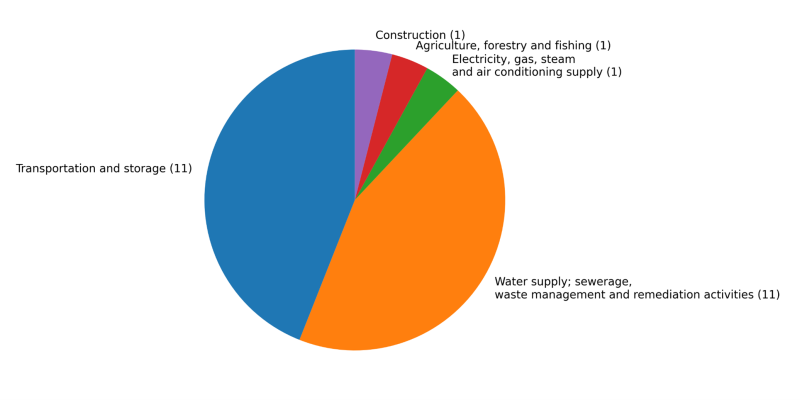
The following table gives a breakdown of the 25 procurement complaints that were received, by project sector:
ii. PCC complaints by region of operation
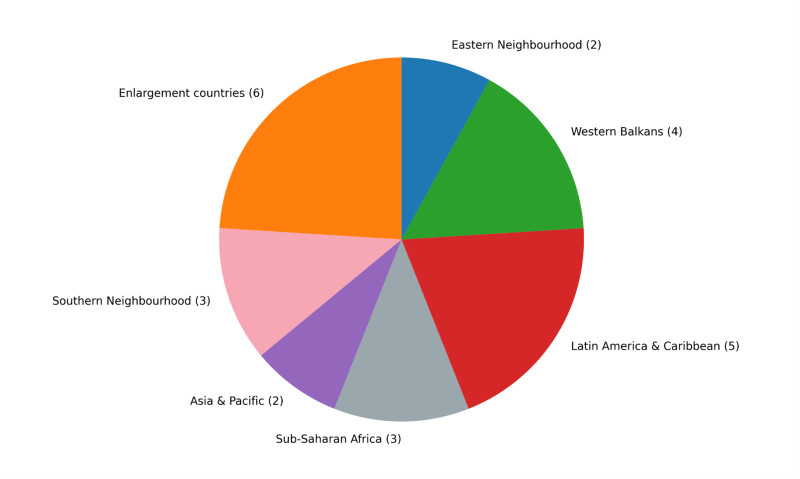
The following table gives a breakdown of the 25 procurement complaints that were received, by region of operation:
The Bank received a total number of 25 complaints in 2025, a moderate increase from the three previous years (21 complaints in 2024, 15 in 2023, and 18 in 2022). By way of comparison, this figure should be read against approximately 500 non objections processed in a year.
The majority, 18 of the 25 procurement complaints, were submitted prior to the Bank’s non objection, while seven were lodged after the Bank’s non-objection to the contract award. Of these seven, four were reviewed and decided upon by the PCC (compared with nine out of 21 in 2024, three out of 15 in 2023, and five out of 18 complaints submitted in 2022).
In terms of sectors, most complaints continue to concern projects related to transportation and storage; and water supply, sewerage, waste management and remediation activities. The breakdown of procurement complaints by sector does not raise concerns for any sector.
In terms of regions of operation, most procurement complaints concerned projects in the Enlargement countries, Latin America and Caribbean, and the Western Balkans.
In terms of subject matter, no specific issue stood out. However, the most common allegations related to lack of transparency in the opening of tenders, absence of feedback/clarifications and failure to notify results to bidders.
For the seven complaints submitted to the Committee following the Bank’s non-objection to contract award, four of the complainants were based in the countries where the projects were located.
The response time for the four procurement complaints that were lodged after the Bank’s non-objection to contract award and prior to the signature of contracts ranged from 61 to 107 days, with an average of 76 days. The longer review process vs. the timing prescribed by the Bank’s policy (Annex 7 to the Guide to Procurement for projects financed by the EIB provides for 30 days, with the possibility of that period being extended to 60 days) reflects the complexity of certain complaints.
The PCC Secretariat consistently informs complainants that they are entitled to escalate their complaint to the European Ombudsman alleging maladministration by the Bank if they are not satisfied with the Bank’s response. No complaint was escalated to the Ombudsman in the course of 2025.
Most complaints were submitted via the dedicated mailbox (procurementcomplaints@eib.org). The Committee’s webpage serves to ensure awareness of this email address as the main entry point for potential procurement complainants, with a privacy statement clarifying the handling of personal data.
As in previous years, the PCC Secretariat received emails that were not necessarily related to project procurement at the EIB but may present issues that fall within the accountability functions of the Inspectorate General. The Secretariat’s position within the Inspectorate General facilitates communication, cooperation, and the transfer of complaints to the Investigations Division concerning allegations of prohibited conduct, and to the Complaints Mechanism for complaints that are unrelated to procurement.
Building on lessons learnt, the PCC Secretariat revisited the Committee’s internal procedures to ensure that all procurement complaints are administered in an efficient manner throughout the process life cycle, and that complainants receive timely answers from the PCC. This initiative incorporates clarifications and updates building on lessons learnt, insights and good practices of the PCC. The Secretariat also monitors whether the relevant EIB services take the necessary follow-up action in the case of procurement complaints lodged prior to the Bank’s decision.