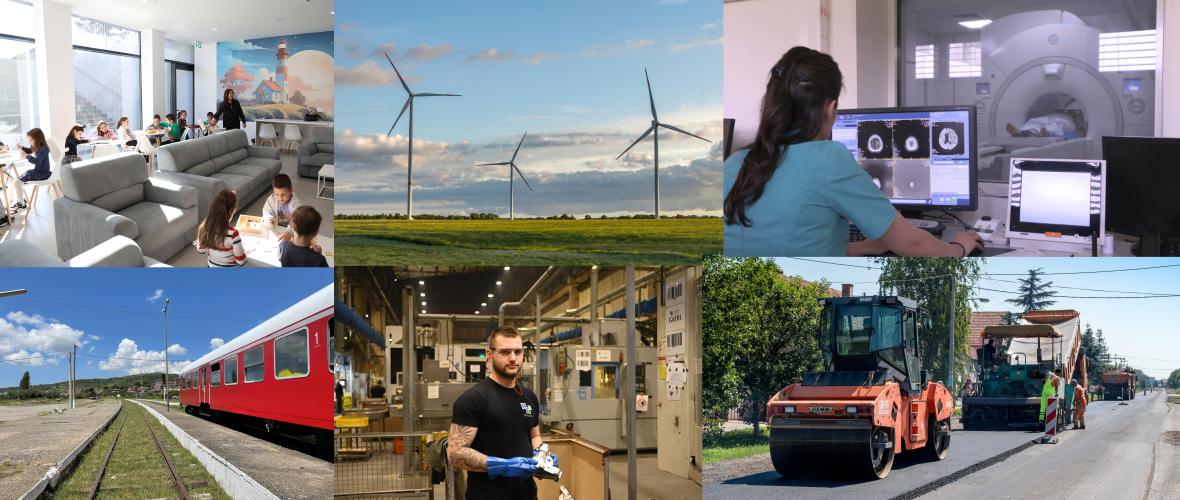
- Le Groupe BEI a investi 822 millions d’euros sous forme de prêts, de garanties et de subventions à l’appui de nouveaux projets, mobilisant au total 1,5 milliard d’euros de nouveaux investissements.
- Ces financements soutiendront des projets dans les secteurs des transports, de la santé, de l’éducation et de l’énergie, ainsi que des petites et moyennes entreprises (PME), contribuant ainsi à rendre les routes et les voies ferrées plus sûres, à renforcer la sécurité énergétique, à améliorer les services médicaux et à rendre les entreprises et les infrastructures plus résilientes face aux changements climatiques.
Le Groupe Banque européenne d’investissement (Groupe BEI) a continué de jouer un rôle clé dans la promotion de l’intégration des marchés, de la connectivité et de la transition verte dans les Balkans occidentaux. En 2025, il a engagé 822 millions d’euros à l’appui de la connectivité durable et de l’action en faveur du climat, dans le droit fil des efforts déployés par la région pour adhérer à l’UE. Sur ce montant, 664 millions d’euros ont été accordés sous forme de prêts et de garanties, auxquels se sont ajoutés 6,5 millions d’euros de subventions à l’investissement au titre de l’initiative Résilience économique de la BEI. En outre, 151,1 millions d’euros de subventions de l’UE ont été signés par l’intermédiaire du Cadre d’investissement en faveur des Balkans occidentaux (CIBO), confirmant ainsi le rôle central joué par l’Équipe Europe dans la mobilisation de ressources importantes à l’appui de la croissance économique et de la convergence dans la région.
Les transports durables ont représenté 58 % du total des investissements, suivis par les secteurs de la santé (20 %), des énergies renouvelables (13 %) et de l’éducation (4 %). Ces financements devraient mobiliser près de 1,5 milliard d’euros de nouveaux investissements. Au total, 58 % de l’appui du Groupe BEI contribuera directement à l’action en faveur du climat et à la durabilité environnementale, conformément à l’ambition de la Banque de soutenir au moins 1 000 milliards d’euros d’investissements verts d’ici à 2030. L’année dernière, 1,4 milliard d’euros ont été approuvés pour de nouveaux projets dans la région et 610 millions d’euros ont été décaissés.
« En 2025, nous avons observé des avancées notables en ce qui concerne l’adhésion à l’UE et l’intégration des marchés dans le cadre du plan de croissance de l’Union européenne. Nos investissements vont de pair avec ces efforts en améliorant la connectivité des transports, en renforçant la sécurité énergétique grâce à la décarbonation et à la diversification, en développant les compétences et en soutenant la résilience face aux changements climatiques. Nous avons également ouvert un nouveau bureau de représentation au Monténégro, renforçant ainsi notre soutien étroit à ce pays sur la voie de l’adhésion. En outre, au cours de l’année qui vient, nous sommes prêts à intensifier notre soutien, notamment à des projets transfrontaliers », a déclaré Robert de Groot, vice-président de la BEI.
La BEI a renforcé son rôle en tant que l’un des principaux bailleurs de fonds pour les infrastructures de transport durable dans les Balkans occidentaux. Dans le cadre de l’approche de l’Équipe Europe, la Banque a mis en place d’importantes enveloppes de financement destinées à des modernisations ferroviaires stratégiques, dont 90,5 millions d’euros pour la ligne Durrës-Rrogozhina en Albanie, 134 millions d’euros pour la ligne Niš-Dimitrovgrad en Serbie et 175 millions d’euros pour le tronçon Bar-Golubovci au Monténégro. Faisant partie du réseau central étendu du RTE-T, ces projets bénéficieront de 207 millions d’euros de subventions de l’UE au titre du CIBO. Par ailleurs, un prêt de 150 millions d’euros de la BEI soutiendra la modernisation de 540 km de routes régionales en Serbie, améliorant la sécurité et renforçant la résilience des infrastructures de transport face aux changements climatiques. Le soutien au corridor Vc en Bosnie‑Herzégovine s’est poursuivi, tandis que les modernisations des voies navigables intérieures en Serbie appuyées par la BEI améliorent les conditions de navigation sur le Danube, facilitent les échanges commerciaux et renforcent l’intégration régionale.
La sécurité et la diversification énergétiques comme priorité
Le renforcement de la sécurité et de la diversification énergétiques est resté une priorité en 2025. La BEI a signé un prêt de 103 millions d’euros pour le parc éolien de Poklečani, d’une capacité de 132 MW, en Bosnie‑Herzégovine. Une fois opérationnel, ce projet produira 437 GWh d’électricité par an, soit suffisamment pour alimenter environ 72 700 ménages et réduire les émissions de CO₂ de 446 900 tonnes par an. Bénéficiant du soutien de subventions et d’une assistance technique de l’UE, ce parc éolien de Poklečani vient compléter d’autres projets financés par la BEI dans la région, notamment le parc éolien de Vlašić, une centrale solaire près de Priština et des projets de réhabilitation de centrales hydroélectriques en Serbie, ainsi que des investissements à venir dans l’agrandissement de réseaux électriques en Serbie et en Bosnie‑Herzégovine. Ensemble, ces initiatives renforceront la capacité énergétique de la région, amélioreront l’efficacité du système et consolideront la sécurité énergétique à long terme.
« Nous saluons la forte dynamique de décarbonation du secteur de l’énergie et de modernisation des infrastructures dans toute la région, qui renforcent la sécurité énergétique, diversifient l’approvisionnement et approfondissent l’intégration des marchés. Pour accélérer la transition écologique, nous avons également lancé plusieurs initiatives liées au climat afin d’aider les économies régionales, et les entreprises en particulier, à se décarboner, à s’adapter aux changements climatiques et à rester compétitives », a déclaré le vice-président De Groot.
Encourager l’innovation verte parmi les PME de la région
Les entreprises de la région intensifient leurs efforts pour réduire leurs émissions, avec l’appui de lignes de crédit vertes de la BEI. Rien qu’en Macédoine du Nord, plus de 50 entreprises ont renforcé de 105 MW leurs capacités en matière d’énergie renouvelable. En Serbie, l’initiative « EU for Green Agenda in Serbia » a introduit un modèle de financement innovant qui combine des subventions de donateurs et des prêts à faible taux d’intérêt. Mise en œuvre par le Programme des Nations unies pour le développement (PNUD) en coopération avec la BEI, depuis 2022, cette initiative a soutenu 94 innovations vertes représentant 52 millions d’euros. En 2025, la BEI a également lancé le mécanisme pour l’innovation et la transformation verte, en accordant 187 millions d’euros sous forme de prêts et de subventions de l’UE afin de soutenir les investissements des PME dans la transition numérique, l’agriculture durable et les technologies résilientes face aux changements climatiques.
Pour promouvoir l’emploi inclusif, la Banque a élargi sa ligne de crédit incitative d’impact, qui a été primée, avec des partenaires en Serbie et en Bosnie-Herzégovine, en ciblant les entreprises qui emploient des femmes, des jeunes et des personnes en situation de handicap. Dans le cadre de l’initiative de garantie à l’appui de la résilience des PME mise en place par l’UE, le Fonds européen d’investissement (FEI) a signé en 2025 des garanties d’un montant de 7,9 millions d’euros, qui devraient mobiliser 105 millions d’euros de financements en faveur des PME, soutenir environ 375 projets et préserver 5 750 emplois.
Faire progresser les compétences, la santé et l’assainissement
Alors que les Balkans occidentaux progressent sur la voie de l’adhésion à l’UE, la modernisation des infrastructures sociales reste essentielle à l’amélioration du niveau de vie. En 2025, la BEI a investi 20 millions d’euros pour faire progresser la transformation numérique du système éducatif du Monténégro et a lancé, avec le Bureau des Nations unies pour les services d’appui aux projets (UNOPS), un exercice de cartographie visant à évaluer la sécurité, l’accessibilité et la performance énergétique de plus de 800 écoles. Avec le soutien de fonds de l’UE, la nouvelle école Vladimir Nazor de Podgorica, qui a ouvert ses portes l’année dernière, propose désormais des installations de pointe à 1 200 élèves.
En Serbie, la BEI a engagé 157 millions d’euros pour moderniser d’importants centres cliniques à Belgrade, Kragujevac, Niš et Novi Sad, améliorant ainsi les capacités du système de santé et l’accès à des services médicaux avancés. Une subvention supplémentaire de l’UE de 35,5 millions d’euros financera un nouveau réseau d’égouts dans la municipalité de Palilula, à Belgrade, afin d’améliorer l’assainissement pour 86 000 habitants et de renforcer la protection de l’environnement. En Bosnie‑Herzégovine, la BEI a continué de soutenir l’agrandissement du centre clinique de Banja Luka.
Les services de conseil, un levier essentiel pour mobiliser des fonds et accélérer la mise en œuvre
En 2025, les services de conseil de la BEI, et en particulier Jaspers, ont continué de soutenir la transformation numérique et la connectivité durable dans l’ensemble de la région. Des spécialistes ont apporté une assistance technique à 48 projets en cours et lancé 20 nouvelles missions. Dans le cadre du programme Écologisation des systèmes financiers, l’appui consultatif aide les banques centrales de Macédoine du Nord, d’Albanie et de Bosnie‑Herzégovine à élaborer des cadres d’évaluation des risques climatiques et des taxinomies vertes, ce qui permet aux banques locales de mieux orienter les PME vers des investissements verts.
En partenariat avec la délégation de l’UE et la chambre économique de Macédoine du Nord, la Banque a lancé le premier guide de décarbonation du pays, un outil en ligne gratuit qui aide les entreprises à mesurer leurs émissions et à planifier leurs trajectoires de décarbonation. En outre, le Green Eligibility Checker – l’outil qui permet de vérifier l’admissibilité des projets à des financements verts – est désormais disponible pour les entreprises et les banques commerciales des Balkans occidentaux, pour simplifier le processus d’évaluation de la conformité des investissements aux critères de financement de la BEI.
Informations générales
À propos de la BEI et de BEI Monde
La Banque européenne d’investissement, qui a pour actionnaires les États membres de l’Union européenne (UE), est l’institution de financement à long terme de l’UE. Elle met à disposition des financements qui contribuent à la réalisation des grands objectifs de l’UE. Les projets appuyés par la BEI renforcent la compétitivité, stimulent l’innovation, encouragent le développement durable, améliorent la cohésion sociale et territoriale, et soutiennent une transition juste et rapide vers la neutralité climatique.
BEI Monde est la branche spécialisée du Groupe BEI dont l’activité est destinée à accroître l’impact des partenariats internationaux et du financement du développement, et un partenaire clé de la stratégie Global Gateway. Elle vise à soutenir 100 milliards d’euros d’investissements d’ici à la fin de 2027, soit environ un tiers de l’objectif global de cette initiative de l’UE. Au sein de l’Équipe Europe, BEI Monde favorise des partenariats forts et ciblés, aux côtés d’autres institutions de financement du développement et de la société civile. BEI Monde rapproche le Groupe BEI des populations, des entreprises et des institutions locales par l’intermédiaire de ses bureaux répartis dans le monde.
La BEI est l’un des principaux bailleurs de fonds internationaux dans les Balkans occidentaux. Pour de plus amples informations sur les activités de la BEI dans cette région, veuillez consulter la page suivante : www.eib.org/publications/the-eib-in-the-western-balkans.
À propos du FEI
Le Fonds européen d’investissement (FEI) fait partie du Groupe Banque européenne d’investissement. Sa mission première est d’aider les très petites, petites et moyennes entreprises européennes à accéder aux financements. Le FEI conçoit et déploie des instruments de capital-risque, de capital de croissance, de garantie et de microfinance destinés spécifiquement à ce segment du marché. Dans ce rôle, il appuie la réalisation des objectifs de l’UE en faveur de l’innovation, de la recherche-développement, de l’entrepreneuriat, de la croissance et de l’emploi. Pour en savoir plus, veuillez consulter le site https://www.eif.org.
Pour de plus amples informations sur les activités de la BEI dans les Balkans occidentaux, consultez la page suivante : www.eib.org/publications/the-eib-in-the-western-balkans.