
Kreditnehmer und Projektträger übernehmen die volle Verantwortung für die Umsetzung der von der Bank finanzierten Projekte – einschließlich der gesamten Beschaffung von der Erstellung der Ausschreibungsunterlagen bis zur Vergabe und Durchführung der Aufträge.
Die Bank überprüft in diesem Zusammenhang lediglich, ob die für ihren Finanzierungsbeitrag geltenden Bedingungen eingehalten werden. Wir beraten und unterstützen Projektträger auf Wunsch im Vergabeprozess, sind jedoch nicht als Vertragspartner an der Auftragsvergabe beteiligt.
Der Leitfaden zur Auftragsvergabe beschreibt die Vergabepolitik der EIB. Er richtet sich an Kreditnehmer und Projektträger, deren Aufträge von der Bank finanziert werden. Ziel ist es, sie darüber zu informieren, wie die benötigten Leistungen für ihre Projekte beschafft werden müssen.
Neueste Entwicklungen
Hydropower sector market outreach webinar: we want to know your opinion
The European Investment Bank was pleased to invite industry stakeholders to a dedicated hydropower sector market outreach webinar on 16th April. The event presented upcoming EIB‑financed hydropower projects across Africa, the Eastern Neighbourhood, the Western Balkans and Asia.
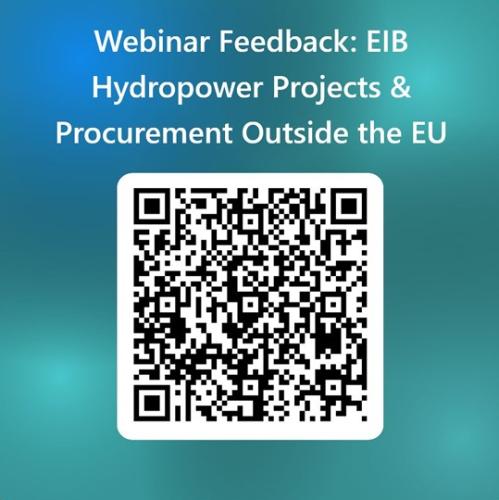
Your opinion matters to us! The EIB has prepared a questionnaire is to better understand market perspectives on hydropower procurement outside the EU, including key barriers, risks and incentives to participation. The feedback received will directly inform how the EIB structures future market engagement activities in this sector.
Strategic procurement talks: EIB meets EU industry associations
EIB’s Procurement Office recently hosted representatives from the European International Contractors (EIC) and the European Federation of Engineering Consultancy Associations (EFCA) for an information session on Strategic Procurement.
The meeting was part of the EIB’s Strategic Procurement initiative, which aims to strengthen targeted market outreach. In a context of growing geopolitical complexity and evolving procurement requirements, the objective was to ensure that EU industry associations and other key stakeholders are consulted early and in a structured way.
Discussions were organised around three main topics:
- The EIB’s Strategic Procurement initiative, including planned updates to the Guide to Procurement;
- Collaborative Delivery Models, a procurement approach presented by EIC;
- EU eligibility restrictions, an overview of recent regulatory developments affecting participation in EU funded projects.

Key points from the discussion
EIB invited feedback from industry representatives on a range of procurement topics, including procurement strategy, concessions, innovation, evaluation criteria, abnormally low tenders, and national remedy mechanisms.
The EIB also presented new tools currently under development to support promoters in meeting Strategic Procurement objectives. These include a social procurement criteria library, a procurement strategy toolkit for buildings, as well as guidance notes on circular economy and gender responsive procurement.
Industry representatives welcomed the planned procurement strategy tool, noting that earlier access to information would help companies decide whether to bid and better prepare their tenders. They also acknowledged the proposal to allow unsolicited proposals in project concessions of EU interest, while highlighting that its impact may be limited where the applicable legal framework is not fully clear.
EIC and EFCA shared plans for an upcoming paper on Collaborative Delivery Models, which aims to promote innovative practices among national authorities, including in countries outside the EU where EIB financing may be involved.
On eligibility restrictions, EU industry associations expressed a preference for tied aid with clear eligibility rules. The EIB, in turn, referred to the European Commission’s move towards imposed eligibility restrictions under instruments such as Global Europe, the Ukraine Facility, the Western Balkans Facility, and the Moldova Facility.
Participants also underlined the value of early EIB engagement and technical assistance during project preparation, timely access to procurement information for the private sector, and better recognition of quality and innovation in tender evaluation. There was strong interest in EIB led webinars and events to promote procurement opportunities and support sector specific matchmaking.
EIB exploring innovative procurement practices: early contractor involvement
The EIB organised a knowledge-sharing session on Friday, 28 November 2025 with Rijkswaterstaat - the executive agency of the Dutch Ministry of Infrastructure and Water Management- to discuss how procurement can become a strategic driver of innovation and resilience in Europe’s infrastructure delivery.
The world around us is changing fast. Climate pressures, geopolitical uncertainty, technological developments and economic shifts demand that Europe acts with greater agility and creativity. Innovation is needed not only in what we build, but in how we deliver it. And procurement is no longer just an administrative process with static roles of the parties involved: the way we procure infrastructure and services determines not only cost and compliance, but resilience, quality, and long-term value for citizens. It can be a strategic tool to shape markets, drive innovation, and strengthen Europe’s competitiveness.

One promising approach is early contractor involvement (ECI), which brings contractors’ expertise to the table earlier, strengthens collaboration, and ultimately improves outcomes for society. Namely, the ECI means a more recent procurement approach, where contractors are engaged during the early stages of a project—typically in the design or development phase—before the final design or scope is fully developed. The purpose is to leverage the contractor’s expertise to improve constructability, optimise costs, identify risks, and enhance project delivery efficiency.
The speakers brought extensive experience from the Netherlands in applying ECI to large-scale infrastructure projects in public sector and shared valuable insights into its evolution and practical implementation. EIB with Rijkswaterstaat further explored through the session these practices to have a better understanding on whether ECI could help the EIB deliver better and smarter infrastructure for the future. It was noted that the provided examples could be seen as inspiration and a starting point for broader thinking, while any future consideration of ECI approach should be guided by project complexity and legal requirements as well as the maturity of the promoters, countries and markets.
EIB raising awareness on strategic procurement for Dutch companies
On 31 October 2025, the EIB’s Procurement Office was welcomed by VNO-NCW and the Netherlands Enterprise Agency (RVO) to host an information session for Dutch companies. The event aimed to raise awareness about the EIB’s financing tools and strategic procurement practices that support high-quality, sustainable projects.
The session opened with remarks from EIB Vice-President Robert de Groot and Robin Uyterlinde, EIB Board Member for the Netherlands.

Unsere Vergabepolitik
Das Wichtigste in Kürze
Die Vergabepolitik der EIB basiert auf klaren Prinzipien: Wirtschaftlichkeit, Effizienz, offene internationale Ausschreibungen, Gleichbehandlung, Nichtdiskriminierung, gegenseitige Anerkennung, Verhältnismäßigkeit und Transparenz. Diese Werte leiten sich aus den EU-Verträgen und der Satzung der Bank ab.
Als Einrichtung der EU und multilaterale Entwicklungsbank verfolgt die EIB einen doppelten Ansatz: Gemäß dem Leitfaden für die Auftragsvergabe gilt innerhalb der EU uneingeschränkt das EU-Vergaberecht. Außerhalb der EU setzen wir auf eine Kombination aus den wichtigsten Mechanismen der EU-Ausschreibungsrichtlinien und internationalen Best Practices anderer multilateraler Entwicklungsbanken.
Die EIB hat mit mehreren internationalen Finanzinstituten Mutual-Reliance-Vereinbarungen geschlossen. So können wir uns bei kofinanzierten Projekten außerhalb der EU auf die Vergabepolitik, Verfahren und die Überwachung des jeweils federführenden Geldgebers verlassen.
Alle Projekte müssen die Umwelt- und Sozialstandards der EIB erfüllen. Projektträger werden bestärkt, zum Umweltschutz, zum Wohlergehen der Menschen, zu den Menschenrechten, zur Geschlechtergleichstellung, zum Klimaschutz und zur nachhaltigen Entwicklung beizutragen. Bieter und Nachunternehmer sind verpflichtet, auch bei Projekten außerhalb der EU die Umwelt- und Sozialerklärung umzusetzen.
Projektträger müssen Beschwerden zur Vergabe prüfen, notwendige Schritte unternehmen und zeitnah reagieren. Jede interessierte Person kann sich zudem mit einer Beschwerde an die EIB wenden.
Die Bank will sicherstellen, dass ihre Projekte nicht für rechtswidrige Verhaltensweisen und Handlungen missbraucht werden. Bei Projekten außerhalb der EU müssen alle Bieter eine Integritätserklärung abgeben und einhalten, um überhaupt teilnehmen zu dürfen.
Im Rahmen ihrer Ausschlusspolitik kann die Bank Einzelpersonen oder Unternehmen von der Auftragsvergabe für von der EIB mitfinanzierte Projekte ausschließen, wenn sie nachweislich im Laufe der Auftragsvergabe oder der Durchführung des Auftrags an rechtswidrigen Verhaltensweisen und Handlungen beteiligt waren.
Aufträge erhalten
Marktansprache
Entdecken Sie die neuesten Geschäftsmöglichkeiten und nützliche Ressourcen zur Auftragsvergabe bei von der EIB finanzierten Projekten
Geschäftschancen
Auftragsbekanntmachungen für von der EIB finanzierte Projekte außerhalb der EU
Alle Projekte
Erfahren Sie mehr über Projekte, deren Finanzierung die EIB prüft oder die sie bereits finanziert.
Nützliche Ressourcen für Auftragnehmer und Lieferanten
Ergebnisse der EIB-Umfrage zum Wettbewerb außerhalb der EU
Die EIB fördert faire Bedingungen für den Wettbewerb außerhalb der EU. Im Rahmen dessen startete das Beschaffungswesen in der ersten Jahreshälfte 2025 eine offene Umfrage.
Schon jetzt arbeitet die EIB aktiv daran, Hürden auszuräumen und die Qualität und Nachhaltigkeit der von ihr finanzierten Projekte über die Auftragsvergabe zu verbessern. Auf Basis der Umfrageergebnisse kann sie sich künftig auf Kernpunkte konzentrieren. Dazu wird sie sich mit ihren Partnern beraten und Faktoren wie Klimaschutz, Nachhaltigkeit, Cybersicherheit und Multilateralismus berücksichtigen.
Insgesamt beleuchten die Ergebnisse ein Kernelement der nötigen Maßnahmen, um die Wettbewerbsfähigkeit und internationale Zusammenarbeit der EU zu stärken.
Hilfreiche Unterlagen für die Auftragsvergabe
Für Projektträger
Unterlagen für die Auftragsvergabe bei von der EIB finanzierten Projekten
- Vergabeplan
- Integritätserklärung (EN, FR, ES, PT)
- Umwelt- und Sozialerklärung (EN, FR, ES, PT)
- Anleitung für Projektträger der EIB zum Ausfüllen von Standardformularen für die Bekanntmachung von Ausschreibungen
- Vorinformation zur Veröffentlichung (EN, FR, ES, PT)
- Auftragsbekanntmachung zur Veröffentlichung (EN, FR, ES, PT)
- Anhang I der Vorabinformation und der Auftragsbekanntmachung zur Veröffentlichung (EN, FR, ES, PT)
- Vergabebekanntmachung (EN, FR, ES, PT)
- Anhang A der Vergabebekanntmachung (EN, FR, ES, PT)
- Bekanntmachung über Auftragsänderungen (EN, FR, ES, PT)
- Juni 2025 – Vergabeplanung (EN)
- Mai 2025 – Grundsätze der Auftragsvergabe für Projekte (EN)
- April 2025 – Bewertungskriterien (EN)
- Februar 2025 – Auftragsmanagement bei von der EIB mitfinanzierten Projekten (FR) Zum Video
- Juli 2024 – Berichte über die Angebotsbewertung – EIB-Anforderungen und Best Practices (EN) Zum Video
- März 2024 – Auftragsmanagement bei von der EIB mitfinanzierten Projekten (EN) Zum Video
- Februar 2024 – Vergabepolitik für von der EIB mitfinanzierte Projekte (FR)
- Januar 2024 – Anforderungen an die Ausschreibungsunterlagen laut EIB-Leitfaden für die Auftragsvergabe (EN) Zum Video
- Juni 2023 – Auftragsvergabe bei von der EIB mitfinanzierten Projekten (EN) Zum Video