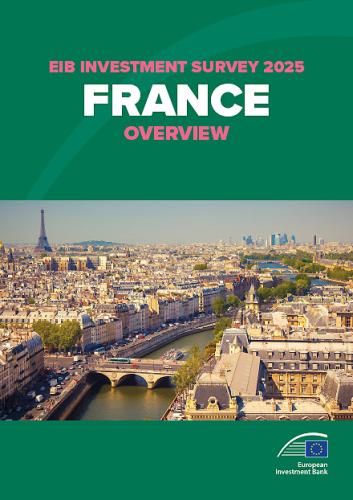
- More than nine in ten French companies have implemented measures to cut greenhouse gas emissions, yet fewer are choosing to insure against climate-related risks.
- Supply difficulties are receding, particularly due to lower energy bills.
- The industrial sector stands out for its resilience, maintaining an appetite for investment and innovation.
French companies remain cautious amid global uncertainty and volatility. 84% of them are continuing to invest, in line with the EU average.
The vast majority (95%) have implemented measures to cut greenhouse gas emissions, mainly investing in waste reduction, recycling and sustainable transport at a rate above the EU average. However, they lag behind their EU peers in insuring against and mitigating the physical risks of climate change.
The annual European Investment Bank Group Investment Survey (EIBIS) – covering around 13 000 EU and US firms – also finds that French companies are broadly as innovative as their counterparts elsewhere in the European Union. Research and development investments are primarily driven by the manufacturing sector, with 94% of firms already investing and most planning to increase their spending in the future. This trend is less pronounced in the services sector and among small and medium-sized enterprises (SMEs).
EIB Vice-President Ambroise Fayolle said: “Despite a backdrop of uncertainty and caution, the results of our survey are encouraging. French companies are continuing their innovation efforts, and some sectors like manufacturing are still investing a substantial amount. While hurdles persist – especially in the pace of digital technology adoption and small and medium business transformation – these findings confirm that businesses see the dual energy and digital transitions as key drivers of productivity and growth.”
EIB Chief Economist Debora Revoltella said: “Our 2025 survey highlights the need to simplify regulation, procedures and market access within the European Union.” “Strengthening the single market remains key to improving the European Union’s competitiveness and accelerating growth.”
Detailed survey reports for each of the 27 EU countries were published today. Other key findings for France include:
Sustainability: Most (55%) French companies have performed an energy audit in the last three years, close to the EU average (56%). Industrial companies (74%) and large corporates (65%) are most active in this field. French firms surpass the EU average in setting and monitoring greenhouse gas reduction targets (52% vs. 47%).
Barriers to investment: Although 58% of French companies see regulation as limiting their investments, this figure is below the EU average (69%). Uncertainty about the future (85% vs. an EU figure of 83%), energy costs (74%) and a lack of qualified staff (72%) were highlighted as holding investment back.
Access to finance: 36% of French companies’ investments are financed from external sources (mainly banks), compared to an EU average of 25%. Dissatisfaction with borrowing conditions is decreasing (18% vs. 24% in 2024).
Artificial intelligence: French companies are using generative AI tools at a rate below the EU average (24% vs. 37%), but adoption is faster among manufacturing companies (30%) and large corporates (27%). The most common applications are in marketing and sales (34%) and customer service (21%), though these figures remain below EU averages of 44% and 31%, respectively.
The full report for France is available here.
The survey results feed into the EIB Group Economics Department’s flagship annual investment report, which assesses the EU economy’s prospects. The next investment report will be published on 3 March 2026 at the annual EIB Group Forum in Luxembourg.
This forum brings together key stakeholders from the public sector, business and finance to discuss investment priorities that support EU policies, including decarbonisation, artificial intelligence, the savings union, security, housing and EU enlargement. The theme for this year’s event is “A strong Europe in a changing world.”
Background information
EIB
The European Investment Bank (EIB) is the long-term lending institution of the European Union, owned by its Member States. Built around eight core priorities, we finance investments that contribute to EU policy objectives, by bolstering climate action and the environment, digitalisation and technological innovation, security and defence, cohesion, agriculture and bioeconomy, social infrastructure, the capital markets union, and a stronger Europe in a more peaceful and prosperous world.
The EIB Group, which also includes the European Investment Fund (EIF), signed nearly €89 billion in new financing for over 900 high-impact projects in 2024, boosting Europe’s competitiveness and security.
All projects financed by the EIB Group are in line with the Paris Climate Agreement, as pledged in our Climate Bank Roadmap. Almost 60% of annual EIB Group financing supports projects that directly contribute to climate change mitigation and adaptation, and a healthier environment.
The EIB Group financed over 100 projects in France last year, with €12.6 billion in investment provided directly or indirectly to private sector companies of all sizes and public sector organisations. EIB activity in France in 2024 focused on loans helping to combat climate change and adapt to its consequences, and backing innovation and small and medium-sized enterprises (SMEs). The EIB has mobilised investments of up to €62 billion to finance the real economy. In 2024, France was the largest beneficiary country of EIB Group financing.
High-quality, up-to-date photos of our headquarters for media use are available here.