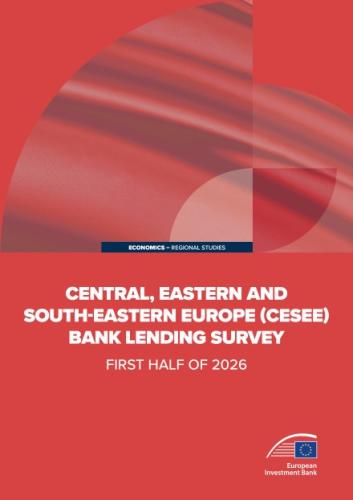
- Credit demand high in Central, Eastern and South-Eastern Europe driven by retail customers, new EIB lending survey finds
- Three-quarters of cross-border banking groups plan to expand operations in region
- Funding conditions favourable and credit quality improving, according to latest biannual report
The banking sector in Central, Eastern and South-Eastern Europe (CESEE) has strong growth potential, according to a new survey by the European Investment Bank (EIB). Credit demand from both businesses and households in the region is robust, supported mainly by consumer and housing loans, the CESEE Bank Lending Survey for the first half of 2026 shows.
At the same time, credit supply in CESEE is projected to soften slightly, reflecting a reduced readiness to extend loans to large companies.
International banks plan further expansion: three-quarters of cross-border banking groups surveyed intend to expand their operations in the region with none of them anticipating a reduction of their operations.
In addition, the profitability of banks in CESEE is strong relative to their overall operations, with particularly robust results in Bosnia and Herzegovina, Bulgaria, Czechia, Hungary, Kosovo, North Macedonia and Serbia.
“These trends are encouraging for investment and economic development in the region, and a sign of the growth potential that CESEE represents for Europe” said EIB Vice-President Marek Mora.
Most banks surveyed regard the market potential in CESEE as high, particularly in countries such as Czechia, Romania and Slovakia. The survey shows medium expectations regarding markets in the Western Balkans.
Access to funding in CESEE for cross-border banking groups and their subsidiaries has been strong over the past six months. The trend has been supported by rising retail and corporate deposits and access to funding from international financial institutions (IFIs), such as the EIB, and wholesale debt issuance.
Furthermore, credit quality has improved over the past six months, with fewer non-performing loans reported. Despite these positive developments, banks remain cautious about the next six months, anticipating a deterioration in credit quality across corporate and retail portfolios. However, similar negative expectations in recent years have often failed to materialise.
Matteo Ferrazzi, principal advisor at the EIB's Economics Department, said: “These results highlight very positive credit trends for the banks operating in the CESEE area, which are benefiting from the strong performance of the global and European banking sectors.”
Background information
The European Investment Bank (EIB) is the long-term lending institution of the European Union, owned by its 27 Member States. Built around eight core priorities, we finance investments that contribute to EU policy objectives by bolstering climate action and the environment, digitalisation and technological innovation, security and defence, cohesion, agriculture and bioeconomy, social infrastructure, the capital markets union, and a stronger Europe in a more peaceful and prosperous world.
The EIB Group, which also includes the European Investment Fund (EIF), signed nearly €100 billion in new financing for over 870 high-impact projects in 2025, boosting Europe’s competitiveness and security.
The European Investment Fund (EIF) is the subsidiary of the EIB Group specialised in providing guarantees and equity to improve access to finance for small and medium-sized businesses and startups across Europe. Acting as an anchor investor, through its extensive network of partnering banks and investment funds, the EIF mobilises private investment and nurtures the ecosystem of venture capital funds to support innovative European entrepreneurs
High-quality, up-to-date photos of our headquarters for media use are available here.
The Eastern and South-Eastern Europe (CESEE) Bank Lending Survey is conducted twice per year by the European Investment Bank, covering 12 international banking groups and 65 local subsidiaries or independent local banks. The survey examines their strategies, as well as domestic banks in specific local markets, to better understand market conditions and expectations.