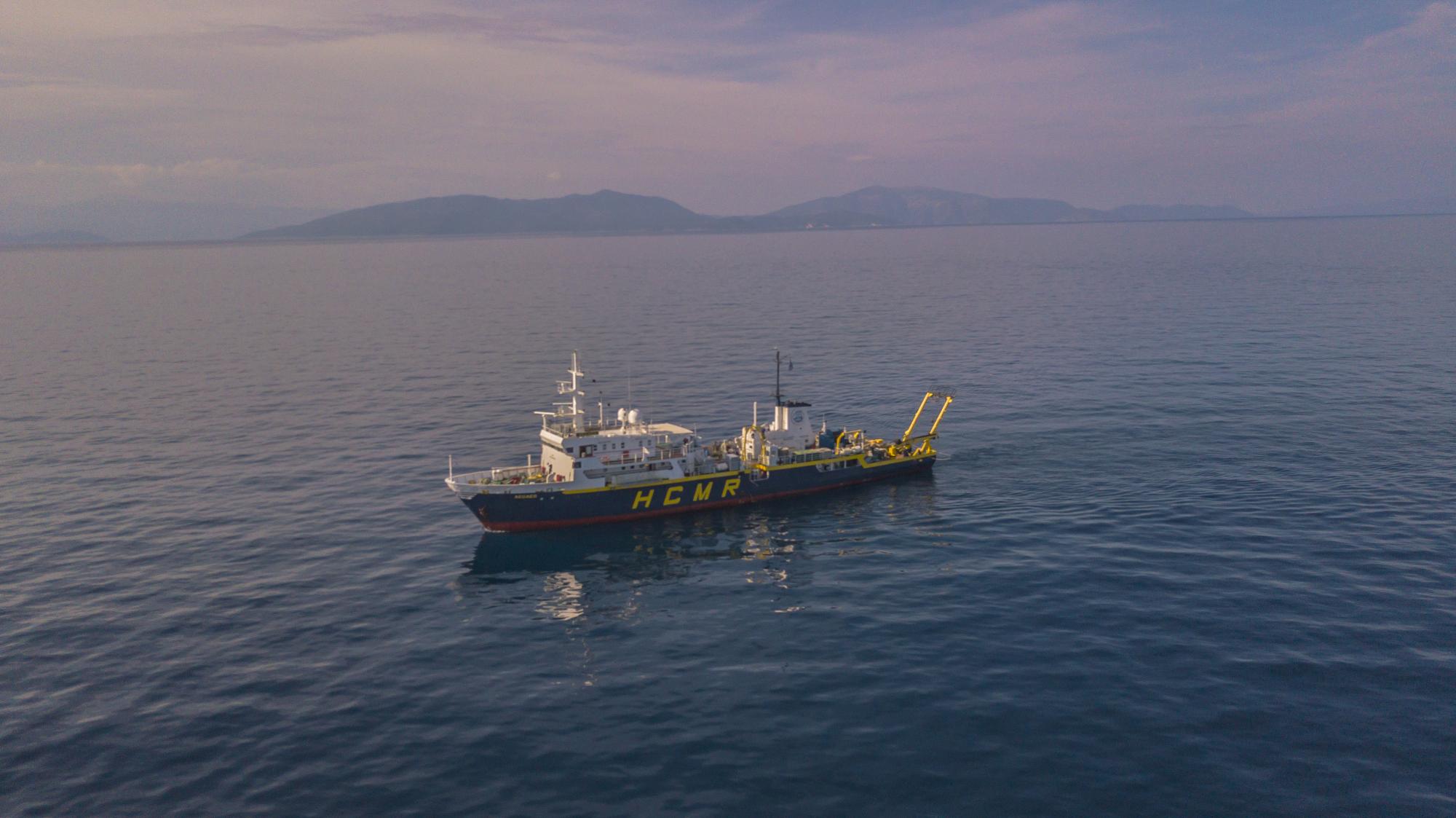
L’observatoire constitue un grand bond en avant dans la mesure des paramètres atmosphériques et dans la construction de modèles climatiques pour le sud-est de la Méditerranée.
Autres liens
Fiche récapitulative
Date de publication
5 février 2020
Statut
Référence
Signé | 08/07/2020
20180743
Nom du projet
Promoteur – Intermédiaire financier
MARINE AND ATMOSPHERIC CLIMATE CHANGE RESEARCH
HELLENIC REPUBLIC
Montant BEI envisagé (montant approximatif)
Coût total (montant approximatif)
EUR 58 million
EUR 78 million
Description
Objectifs
The project concerns investments that will improve our understanding of the sources and impact of climate change and is expected to identify ways to mitigate and adapt to it, including economically, which is a priority on the European political and research agenda.
The new vessel will complement vessels of other countries in terms of coverage of the East Mediterranean Sea, the Black Sea and the Red Sea, which are quickly reachable from Greece. The geophysical observatory PANGEA will provide harmonized, reliable, and documented open access observational data of climate, energy and geophysical parameters. The project has two components: a) the marine component concerns the replacement of the existing oceanographic vessel R/V AEGAEO by a new, ocean-going, multi-purpose, state-of-the-art equipped research vessel b) the atmospheric component refers to the establishment of the Panhellenic Geographical Observatory of Antikythera (PANGEA), a national research infrastructure for climate change.
Aspects environnementaux
Passation des marchés
The project covers research facilities of a kind that are not specifically mentioned in the Environmental Impact Assessment (EIA) Directive 2014/52/EU amending the Directive 2011/92/EU, though the project is covered by Annex II of the Directive in relation to urban development. The EIB ank's services will verify during appraisal whether an EIA is required by the competent authority. In addition, the proposed location for the new atmospheric research infrastructure is the island of Antikythera and is located within two Natura 2000 sites. One site is a Special Conservation Area (SAC) and the other is a Special Protection Area (SPA) for birds species. The Bank's services will verify during the appraisal the project's compliance with the Habitats and Birds Directive (92/43/EEC and 2009/147/EC) and the obtaining of other relevant environmental authorisations for both project components as required. The project will contain new construction of public buildings; therefore, compliance with directive 2010/32/EU on the energy performance in buildings will be verified during the appraisal.
The Promoter will have to ensure that contracts for the implementation of the project will be tendered in accordance with the relevant applicable EU procurement legislation, Directive 2014/24/EU, as well as Directive 89/665/EEC as interpreted by the Court of Justice of the EU, with publication of tender notices in the EU Official Journal, as and where required.
Documents liés
Autres liens
Documents
Fiche technique sur les aspects sociaux et environnementaux - MARINE AND ATMOSPHERIC CLIMATE CHANGE RESEARCH
Date de publication
27 May 2020
Langue
Sujet général
Prêts
Numéro du document
92762126
Thématique du document
Information Environnementale
Type de document
Numéro du projet
20180743
Secteur(s)
Régions
Pays
Disponible au public
Télécharger maintenant
Lien vers la source
Autres liens
Au cœur du projet
Comment et pourquoi
Endiguer la fuite des cerveaux
Pourquoi
- Combler l’absence d’une station de recherche atmosphérique et géophysique entièrement équipée dans le sud de l’Europe, capable de produire des données précises pour les modèles climatiques.
- Remédier au manque de financements à l’appui de projets scientifiques en Grèce.
- Aider à endiguer la fuite des cerveaux qui prive la Grèce de scientifiques hautement qualifiés.
Comment
- L’observatoire géophysique et atmosphérique fournira des données harmonisées, fiables et en libre accès sur des paramètres climatiques, énergétiques et géophysiques.
- Les deux projets aident les scientifiques à observer et à prévoir les changements climatiques à l’échelle mondiale, notamment en surveillant l’activité sismique.
- Construction innovante du navire de recherche : d’une longueur de 70 mètres et d’une largeur de 16 mètres, il sera équipé de grands laboratoires polyvalents et de ponts ouverts spacieux.
- Collecte de données sur la température et la salinité marines, échantillonnage de sédiments issus des fonds marins.
- Suivi de la pollution marine en surface, dans des colonnes d’eau et sur les fonds marins, notamment de la salubrité des habitats côtiers et en pleine mer, ainsi que de leurs écosystèmes.
- Exploration des parties les plus profondes de la Méditerranée, y compris les volcans sous-marins actifs, qui pourraient être à l’origine de découvertes et d’innovations biotechnologiques.
Secteurs et pays

Récit
Observatoire moderne sur un site antique
Il est tout à fait approprié que la petite île grecque d’Anticythère, au large de la pointe ouest de la Crète, accueille le nouveau centre de recherche atmosphérique et géophysique, car l’île renvoie aux scientifiques grecs de l’Antiquité.
Jusqu’à présent, l’île était surtout connue comme le lieu de la découverte de la « machine d’Anticythère » dans l’épave d’un navire ancien. Cet appareil sophistiqué à engrenages, vieux de plus de 2 100 ans, était un ordinateur analogique, capable de calculer le mouvement des planètes et des étoiles ainsi que les éclipses à venir et les dates des prochains Jeux olympiques.
Toutefois, au-delà de tout cela, Anticythère a été choisie pour y installer la station ultramoderne de recherche atmosphérique et géophysique, car elle remplit plusieurs critères scientifiques :
- compte tenu de son éloignement géographique et de son nombre très limité de résidents permanents, l’intervention humaine et la pollution atmosphérique y sont au plus bas ;
- il s’agit d’un carrefour important où circulent des masses d’air transportant la poussière du désert du Sahara, la pollution atmosphérique des grandes zones urbaines et les cendres volcaniques de l’Etna ;
- ses conditions atmosphériques rendent possibles des mesures fiables et représentatives des aérosols atmosphériques et des niveaux naturels de gaz à effet de serre.
L’observatoire sera construit de manière durable et produira sa propre énergie grâce à des panneaux solaires, afin de protéger l’environnement, mais aussi pour ne pas entraver la sensibilité de ses équipements.
Cette station de recherche vient également combler un vide dans la région méditerranéenne, qui, bien qu’étant l’une des zones les plus touchées par les changements climatiques, est celle qui possède le moins d’infrastructures scientifiques pour produire des données.

Nous n’avons pas financé d’opération comparable en Europe. Il s’agit d’une infrastructure de pointe dans ce domaine. Il est satisfaisant de constater que l’investissement peut aussi avoir des retombées sociales en permettant de garder les chercheurs en Grèce.
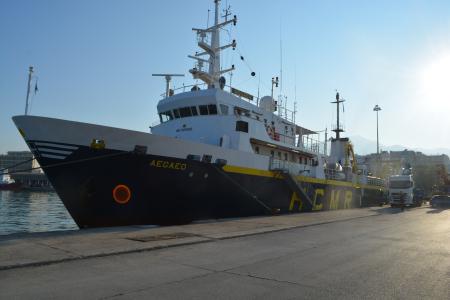
Le nouveau navire de recherche océanographique du Centre hellénique de recherche marine (HCMR), construit pour être économe en carburant, sera capable d’effectuer des missions en Méditerranée, en mer Noire, en mer Rouge et peut-être même dans l’océan Atlantique.
Il transportera un véhicule télécommandé qui peut observer, mesurer et prélever des échantillons à de grandes profondeurs, ainsi que des échosondeurs multifaisceaux de pointe qui peuvent fournir de précieuses informations sur la morphologie des fonds marins et de nombreux instruments scientifiques high-tech à l’appui de recherches innovantes en eaux profondes et peu profondes.
Tanya Zervoudaki, chercheuse au HCMR, affirme que le nouveau bateau donnera au Centre et à d’autres scientifiques des outils essentiels pour mener des recherches.
La grande taille du navire apportera davantage de stabilité pour certaines manipulations délicates en laboratoire comme l’extraction d’ADN, explique Tanya Zervoudaki. Cela étant dit, sa capacité à faire de nouvelles découvertes est tout aussi importante. « À l’heure actuelle, nous ne connaissons pas la biodiversité de l’écosystème des grands fonds marins », précise-t-elle. « Peut-être pouvons-nous trouver de nouvelles espèces, voire des enzymes ou des bactéries susceptibles de nous aider dans différents domaines, tels que la santé humaine ou l’adaptation d’autres organismes. »
Le financement des projets scientifiques est rare, surtout en cette période d’austérité que connaît la Grèce depuis la crise financière.

Sur le même sujet
Athènes mise sur les infrastructures vertes et la biodiversité
À Athènes, un projet d’adaptation aux effets des changements climatiques, fondé sur la nature et financé par une nouvelle initiative de l’UE, prévoit la plantation d’arbres et l’installation de nichoirs dans une mer de béton et d’asphalte afin d’améliorer le cadre de vie.
Suivi des évolutions climatiques sur une île grecque isolée
Un nouveau centre de recherche sur les changements climatiques en Méditerranée, sur l’île grecque d’Anticythère, recueillera des données précieuses pour la modélisation des impacts des changements climatiques dans la région.
Liens
Projets et articles associés
Energy storage: EIB Group supports EU tripartite initiative
The European Investment Bank (EIB) Group supports a new EU-level initiative to scale up energy storage as part of the clean energy transition. Announced alongside the meeting of EU energy ministers in Luxembourg, the tripartite agreement brings together public authorities, energy storage and renewables developers, and financial institutions to accelerate storage deployment, strengthen the energy system, stabilise prices and reduce reliance on fossil fuels.
EIB Global supports Trans-Caspian Transport Corridor with €150 million for road rehabilitation in Kazakhstan
The European Investment Bank (EIB) is providing a €150 million framework loan to Kazakhstan to support the rehabilitation of strategic road infrastructure along the Trans-Caspian Transport Corridor (TCTC), a key route connecting Central Asia and Europe.
Backed by the European Union under the Global Europe (NDICI) framework, the financing will support investments implemented by Kazakhstan's national road operator QazAvtoZhol. The operation will improve transport connectivity, strengthen road safety and climate resilience, and facilitate trade and economic development across the region.
The investment forms part of the European Union's Global Gateway strategy and follows the Memorandum of Understanding signed between the EIB and Kazakhstan in 2024 to strengthen sustainable transport connections between Europe and Asia.
The programme will finance the rehabilitation of approximately 1,370 kilometres of roads across central and southern Kazakhstan, including sections linking the country with neighbouring Central Asian states. By improving transport efficiency and resilience, the investment will reduce travel times, improve road conditions and facilitate the movement of goods and people along one of the region's most important transport corridors.
EIB Vice-President Marek Mora, who oversees the Bank's operations in Central Asia, including Kazakhstan, said:
"Good roads do more than connect places on a map. They connect people, they let businesses reach new markets, make travel safer and faster, and create opportunities for communities. By investing in key transport links across Kazakhstan, we are supporting a corridor that is becoming increasingly important for trade between Europe and Central Asia while delivering tangible benefits locally. Hard infrastructure is the backbone for trades. This is what sustainable connectivity is about: creating practical connections that support growth, resilience and cooperation."
EU Commissioner for International Partnerships, Jozef Síkela, stated:
"The Trans-Caspian Transport Corridor is playing an increasingly important role in connecting Europe and Central Asia. Through this investment, and together with our partners, we are supporting the development of safer, more resilient and more efficient transport infrastructure in Kazakhstan. This is a tangible example of Global Gateway in action, strengthening regional connectivity, supporting sustainable economic development and deepening our partnership with Kazakhstan and the wider region."
EU Ambassador to Kazakhstan Aleška Simkić commented:
"The Trans-Caspian Transport Corridor is one of the key priorities under the EU's Global Gateway strategy. Developing efficient, reliable and sustainable transport connections between Central Asia and Europe strengthens trade, enhances economic cooperation and contributes to the resilience of global supply chains. This investment demonstrates the European Union's long-term commitment to fostering connectivity, prosperity, and strong partnerships across the region."
The programme is expected to generate around 5,900 person-years of employment during implementation, creating opportunities for local communities and supporting economic activity. By strengthening one of the main transport links between Central Asia and Europe, the investment will facilitate trade, improve regional connectivity and contribute to the objectives of the EU-Kazakhstan partnership and the Global Gateway strategy.
EIB and Swedbank have secured EUR 200.75 million in financing for the developer of the Rūdninkai Military Town
The developer of part A of stage II of the Rūdninkai Military Town project, Rudina, has signed loan agreements with the European Investment Bank (EIB) and Swedbank: each institution is providing a loan of EUR 100.37 million. Rudina is indirectly managed by the INVL fund ‘INVL Defence Infrastructure Fund I’, together with the construction companies Conres and Fegda.
Vidéos

Learn more

Learn more
Photogallery
©HCMR
©HCMR
©HCMR