A project financed by EIB typically goes through seven major stages: proposal, appraisal, approval, signature, disbursement, monitoring and repayment. We also provide information about procuring works, goods and services required for projects that are financed by the EIB.
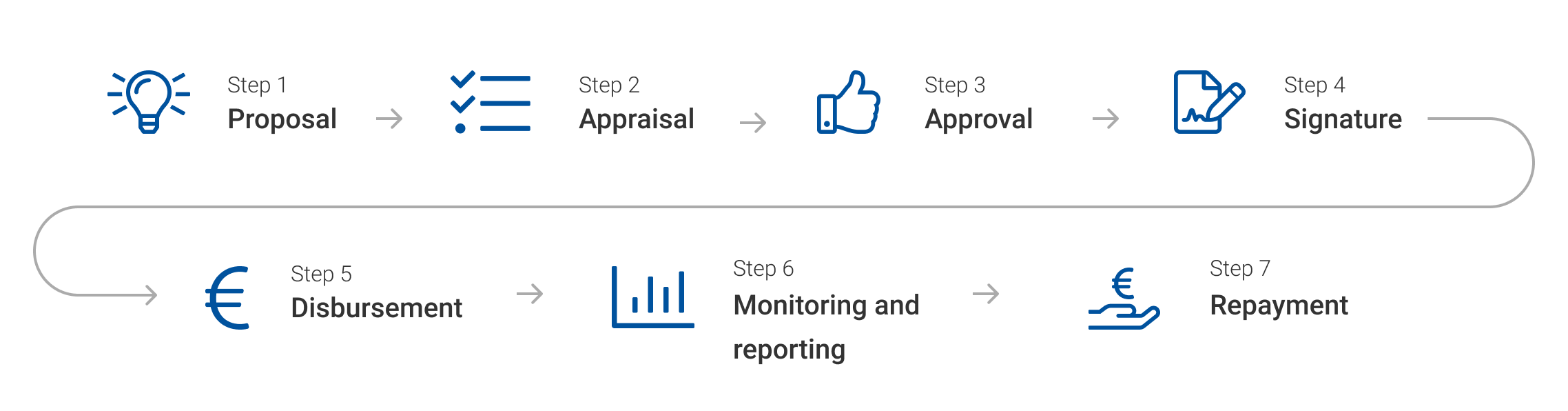
Project cycle explained
How to prepare a project proposal
We offer loans, guarantees, equity investments and advisory services. The most suitable tool will depend on the objectives of the project and on various other factors. The EIB finances projects in most sectors and typically covers up to 50% of a project’s total cost. Our loans usually start at €25 million, although in some cases the EIB can lend lower amounts. To be eligible, projects must promote the priorities and objectives of the European Union and the EIB. Find more product descriptions and eligibility criteria in our What we offer section.
Given the range and diversity of potential projects, there is no standardised documentation requirement. Generally, the EIB expects to receive a comprehensive feasibility study, a detailed description of the capital investment together with the prospective financing arrangements. The project promoter should provide sufficient information to allow the EIB to assess whether the project adheres to EIB lending objectives and has a well-developed business plan.
The EIB will undertake due diligence to ensure the project is eligible for financing by looking, where applicable, at the following aspects:
- financial,
- economic,
- social,
- environmental,
- climate,
- technical assessment
- procurement, and
- promoter organisation and capacity.
Excluded activities
We do not finance the following:
- Weapons and ammunition. Outside of the European Union, military or police equipment and infrastructure are also excluded
- Projects which have the effect of limiting people’s individual rights and freedoms or violating their human rights
- Projects unacceptable in environmental and social terms
- Ethically or morally controversial projects (gambling, tobacco, etc.)
- Activities prohibited by national legislation.
For further details see this list of activities excluded from EIB lending.
What you should know about our project appraisal
The project appraisal is a systematic and comprehensive review of the financial, economic, social, environmental, climate aspects, as well as a technical assessment, and a review of procurement aspects, and the promoter’s organisation and capacity.
In parallel, the EIB consults the European Commission and the Member State(s), in which the project is located.
For projects financed through Financial Intermediaries (FIs), the EIB conducts due diligence on the financial intermediaries, as typically the sub-projects/underlying investments, financed by the EIB through the FI, are not known at the time of appraisal.
A financing proposal then goes from the Management Committee to the Board of Directors for a final decision. Once an operation is approved, the loan documentation can be negotiated and prepared between the EIB and the Borrower, including conditions to be fulfilled. Subsequently, the loan can be drawn down in one or more instalments according to borrower requirements.
An EIB appraisal procedure can take anywhere between six weeks and 18 months depending on the project scope, the degree of complexity of the operation, and the efficiency of the appraisal process on the part of both the EIB itself and the project promoter.
The economic appraisal of projects
The economic appraisal plays a central role in the operations of the EIB. It allows the Bank to judge the contribution of an investment project to the economic growth and cohesion of the European Union and the economic progress of its partners.
The EIB calculates the economic returns of its projects using internationally accepted methods. Find out more information on how the Bank conducts its economic appraisal.
The quality of a project is particularly based on:
- definition of the project's "technical description"
- technical soundness, innovative technology, risks and mitigation measures
- information on capacity for products/services.
- promoter's capability to implement the planned project
- information on timing and employment during implementation
- promoter's capability to operate and maintain the project
- information on production/service, operating and maintenance costs, employment during operational life
- compliance with applicable legislation and EIB guidelines
- compliance with applicable legislation
- information on environmental impact assessment
- alignment with the goals and principles of the Paris Agreement and the EU Sustainable finance action plan
- assessment and minimisation of greenhouse gas (GHG) emissions and of transition and physical climate risks
- analysis of the products/services demand over the project's life, with reference to our sectoral studies
- information on project costs and its detailed components
- comparison with cost of similar projects
- information on financial profitability and related indicators (e.g. rate of return)
- information on economic profitability
The EIB Group Transparency Policy lays down provisions on the publication of project information. According to the EIB Transparency Policy, project summaries shall be published on the project list on the EIB’s website at least three weeks before the project be considered for approval by the EIB’s Board of Directors. A limited number of project summaries may not be published before Board approval and, in some cases, not before loan signature in order to protect justified interests based on the exceptions to disclosure laid down in the articles 4.6 and 4.7 of the EIB Group Transparency Policy.
Project summaries generally include the name of the project, the project promoter or financial intermediary (for intermediated loans), the location of the project, the sector it represents, a project description, its objective(s), its environmental and, if relevant, social aspects, procurement data, proposed EIB finance, the total project cost, and the status of the project.
Where applicable, project summaries include access to the EIB public register, including environmental and social information associated with the project, such as environmental impact assessment (EIA) and environmental and social impact assessment (ESIA) reports, specific environmental studies, and Resettlement Action Plans. The EIB public register also contains the Environmental and Social Data Sheet (ESDS), which reflects the EIB’s environmental and social due diligence review of the project and forms part of the documentation submitted to the Board of Directors for approval.
After signature, project summaries are also accessible through links in project data sheets published on the financed projects list on the EIB’s website. Project data sheets generally include the name of the project, the location of the project, the sector it represents and the loan amounts with their corresponding signature dates.
Project information is removed from the EIB website once the EIB’s involvement in the project is no longer foreseen (article 4.13 of the EIB Group Transparency Policy).
Procurement for EIB-financed projects
The Bank’s policy is to ensure that its funds are used rationally, in the interests of the project it finances and in the interests of the EU. The Bank verifies that a fair process of international tendering takes place according to procedures set out in the EIB Guide to Procurement for projects financed by the EIB.
Calls for tender for EIB projects are listed in the Official Journal of the European Union. This is mandatory for all non-EU projects.
Should you wish to obtain further information on the procurement aspects of a project, the EIB invites you to contact directly the project promoter.
Project procurement complaints
Tendering process for projects by the EIB for its own account
More information is published on our Procurement page.
Please note that the EIB does not keep an official list of consultants and suppliers.
How we monitor projects
We monitor a project from the signature of the loan contract through the project implementation and operation phase until the loan is paid back. Monitoring requirements are determined according to the characteristics of the project.
In particular, the Bank monitors the servicing of the loan, checks that the funds are being used in line with the objectives and projections and keeps itself informed of developments concerning the promoter and its partners. It also ensures that the physical execution and visibility requirements of the project are in accordance with the contract and evaluates the results of the investment.
Financial monitoring
The Portfolio Management and Monitoring Directorate is responsible for the financial monitoring of loans and the restructuring of operations.
Physical monitoring
During the project appraisal phase, the Projects Directorate detects potential problems, in order to enable the necessary corrective measures to be taken where required.
During the project implementation phase, the promoter is obliged to inform the Bank in the event of a significant departure from what was agreed originally.
After project completion, and where applicable, an Environmental and Social Completion Sheet (ESCS) will be published in the Public register for each project. The ESCS summarises the Bank’s assessment of the environmental and social issues at project completion stage.
Lastly, a project completion report establishes any differences with respect to the original plans.
Some projects, such as public-private partnership projects, require monitoring following their completion.
Ex post evaluation
Additionality and Impact Measurement
We make a difference by offering financing conditions that cannot be provided by the market alone, and by supporting project preparation and implementation. We support projects which have an impact on citizens and businesses in the European Union, its neighbourhood and beyond.
We make sure that this is the case through our Additionality and Impact Measurement framework.
Further reading
-
The Economic Appraisal of Investment Projects at the EIB - 2nd Edition
The economic appraisal addresses the wider value generated by the project to society, correcting for market failures in order to measure benefits and costs to project final users, the taxpayer and third parties.
-
European Investment Bank Environmental and Social Standards
The EIB Environmental and Social Standards describe the requirements that all EIB-financed projects must meet.
-
The EIB Group Climate Bank Roadmap 2021-2025
Our new global plan to tackle the urgent climate challenges over the next critical decade.
-
Guidance note for EIB Standard on Stakeholder Engagement in the EIB Operations
The EIB sees meaningful stakeholder engagement as a cornerstone of sustainable and inclusive development and as the foundation for respecting the rights of individuals and communities. On this basis, the EIB has developed a Guidance note to provide recommendations to promoters on how to meet the EIB’s requirements regarding stakeholder engagement in EIB operations. The guidance also includes good practices to help promoters maximise potential project gains. It is also intended to be useful for project-affected persons, communities, civil society organisations, and government agencies, and other parties interested in EIB-supported projects. These stakeholders can use it to see what is suggested regarding engagement in EIB-financed projects, and to identify possible entry points for their own involvement.

Get in touch
Are you a small business or mid-cap looking for finance?

