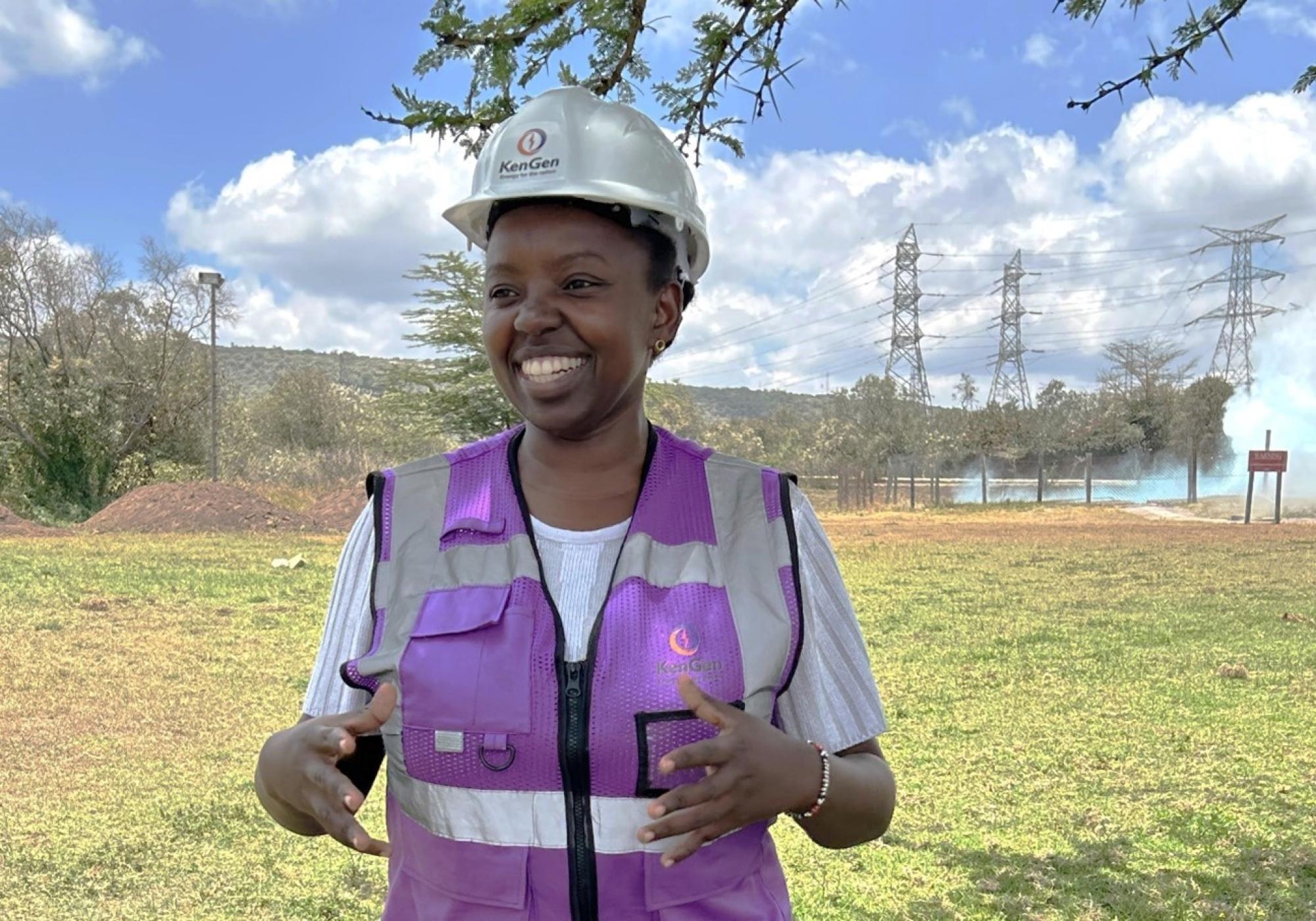
Without geothermal energy, it would be very hard for this country to meet its power demand.
Other links
Summary sheet
Release date
7 January 2016
Status
Reference
Signed | 08/09/2017
20150459
Project name
Promoter - financial intermediary
OLKARIA I GEOTHERMAL EXTENSION
KENYA ELECTRICITY GENERATING COMPANY LTD
Proposed EIB finance (Approximate amount)
Total cost (Approximate amount)
EUR 72 million
EUR 311 million
Description
Objectives
The project consists of the extension of the existing 140 MW Olkaria I Unit 4 & 5 geothermal power plant with an additional 70 MW turbine (Unit 6), the necessary wells, steam-gathering system and interconnection facilities.
The project will help meet growing electricity demand at a competitive cost. Its economic benefits include increased power generation, improved security of supply (geothermal power is unaffected by annual hydrological conditions), reduced national dependence on imported fossil fuels for electricity generation, fewer emissions associated with conventional thermal generation and additional operational flexibility with the greater Olkaria geothermal generation park.
Environmental aspects
Procurement
If located inside the EU, the project would fall under Annex II of the Environmental Impact Assessment (EIA) Directive 2011/92/EU, requiring a screening decision by the competent authority. Kenyan law requires a full EIA. An environmental and social impact assessment (ESIA) has been established for the new unit and has been approved and a respective licence issued by the NEMA (National Environmental Management Authority). As with the other units of Olkaria I power station, the project lies in the Hells Gate National Park, where there is no human settlement. The Bank will ensure that the project complies with its environmental and social standards.
The promoter is a utility majority-owned by the Government of Kenya. For the project it will adopt open competitive tendering procedures and envisages publication in the Official Journal of the EU for the main contracts. The Bank will require the promoter to ensure that any procurement procedures are done in accordance with the Bank's Guide to Procurement.
Comments
The Government of Kenya, in its Vision 2030 development programme launched in 2008, has identified energy as being one of the key enablers to attain 10% GDP growth target. The project will provide renewable energy to bridge the existing gap between energy demand and supply in Kenya and it will help mitigate the impact of climate change. The investment is in line with the Sustainable Development Goals (SDGs), especially SDG 7 "Ensure access to affordable, reliable, sustainable and modern energy for all".
Related documents
Documents
Non-Technical Summary (NTS) - OLKARIA I GEOTHERMAL EXTENSION - For the drilling of 80 Geothermal Steam production Wells
Publication Date
23 Mar 2016
Document language
Main Topic
Lending
Document Number
65357527
Document Focus
Environmental Information
Document Type
Project Number
20150459
Sector(s)
Countries
Publicly available
Download now
Non-Technical Summary (NTS) - OLKARIA I GEOTHERMAL EXTENSION - NTS of the ESIA for the Additional Unit 6 Powerplant
Publication Date
22 Mar 2016
Document language
Main Topic
Lending
Document Number
65362518
Document Focus
Environmental Information
Document Type
Project Number
20150459
Sector(s)
Countries
Publicly available
Download now
Environmental and Social Impact Assessment (ESIA) - OLKARIA I GEOTHERMAL EXTENSION - EIA for the drilling of 80 Geothermal Steam Production Wells
Publication Date
22 Mar 2016
Document language
Main Topic
Lending
Document Number
65369919
Document Focus
Environmental Information
Document Type
Project Number
20150459
Sector(s)
Countries
Publicly available
Download now
Environmental and Social Impact Assessment (ESIA) - OLKARIA I GEOTHERMAL EXTENSION - 70MW Additional Unit 6 geothermal powerplant
Publication Date
22 Mar 2016
Document language
Main Topic
Lending
Document Number
63951928
Document Focus
Environmental Information
Document Type
Project Number
20150459
Sector(s)
Countries
Publicly available
Download now
Environmental and Social Data Sheet (ESDS) - OLKARIA I GEOTHERMAL EXTENSION
Publication Date
25 Jul 2016
Document language
Main Topic
Lending
Document Number
67483700
Document Focus
Environmental Information
Document Type
Project Number
20150459
Sector(s)
Countries
Publicly available
Download now
Environmental and Social Completion Sheet (ESCS) - OLKARIA I GEOTHERMAL EXTENSION
Publication Date
24 Dec 2025
Document language
Main Topic
Lending
Document Number
252644842
Document Focus
Environmental Information
Document Type
Project Number
20150459
Sector(s)
Countries
Publicly available
Download now
Link to source
Other links
Inside the project
How and Why
Africa’s energy leader
Why
- Geothermal power offers clean energy
- Reduces fossil fuel emissions
- Helps Kenya become an African leader in renewable energy
How
- Kenya expands geothermal energy and exports technical knowledge
- Kenya’s Vision 2030 plan aims for country to use 100% renewable energy by 2030
- The success of geothermal helps Kenya invest in other green energy, such as hydropower and solar parks
Sectors & Countries

Story
Leaping past the climate polluting stage
He grew up in rural Kenya without power in a home lit by smoky lanterns, but Peketsa Mangi is now general manager of geothermal development in Kenya at the Olkaria site, one of the largest geothermal operations in the world.
Since the 1950s, “Kenya is the pioneer of geothermal progress in Africa,” says Mangi, who is standing in the middle of a lush field in Kenya’s Great Rift Valley with plumes of thick steam belching noisily up from the earth behind him.

Olkaria’s geothermal plants tap the earth’s energy by drilling several thousand metres into the ground, then capturing steam and transporting it through pipelines to drive turbines that create electricity. Big white pipes carry water or steam all around the Olkaria complex, which covers about 70 square kilometres. The pipes sit on stilts to allow animals to pass underneath, and even have loops that allow tall giraffes to wander freely. In the mornings, the giraffes eat breakfast among the trees near the geothermal buildings.
Kenya has taken a lead not just in the energy sector, but also in empowering women in this field and recognizing the resources of women.
Related media
No grid? No problem
Electricity is a pre-requisite for economic development, just like clean water. One African company, d.light, provides clean energy for remote villages
A helping hand for herders
Kenya climate change finance brings relief to pastoral herders hit by drought. The loans are backed by the European Union, because local banks are reluctant to risk lending to remote regions
Links
Related projects and stories
Spain in the EU: Four decades of transformation
From high-speed rail to space, here’s how four decades of EU membership helped Spain anchor its democracy, modernise its economy, and become an innovation hub.
Energy storage: EIB Group supports EU tripartite initiative
The European Investment Bank (EIB) Group supports a new EU-level initiative to scale up energy storage as part of the clean energy transition. Announced alongside the meeting of EU energy ministers in Luxembourg, the tripartite agreement brings together public authorities, energy storage and renewables developers, and financial institutions to accelerate storage deployment, strengthen the energy system, stabilise prices and reduce reliance on fossil fuels.
EIB Global supports Trans-Caspian Transport Corridor with €150 million for road rehabilitation in Kazakhstan
The European Investment Bank (EIB) is providing a €150 million framework loan to Kazakhstan to support the rehabilitation of strategic road infrastructure along the Trans-Caspian Transport Corridor (TCTC), a key route connecting Central Asia and Europe.
Backed by the European Union under the Global Europe (NDICI) framework, the financing will support investments implemented by Kazakhstan's national road operator QazAvtoZhol. The operation will improve transport connectivity, strengthen road safety and climate resilience, and facilitate trade and economic development across the region.
The investment forms part of the European Union's Global Gateway strategy and follows the Memorandum of Understanding signed between the EIB and Kazakhstan in 2024 to strengthen sustainable transport connections between Europe and Asia.
The programme will finance the rehabilitation of approximately 1,370 kilometres of roads across central and southern Kazakhstan, including sections linking the country with neighbouring Central Asian states. By improving transport efficiency and resilience, the investment will reduce travel times, improve road conditions and facilitate the movement of goods and people along one of the region's most important transport corridors.
EIB Vice-President Marek Mora, who oversees the Bank's operations in Central Asia, including Kazakhstan, said:
"Good roads do more than connect places on a map. They connect people, they let businesses reach new markets, make travel safer and faster, and create opportunities for communities. By investing in key transport links across Kazakhstan, we are supporting a corridor that is becoming increasingly important for trade between Europe and Central Asia while delivering tangible benefits locally. Hard infrastructure is the backbone for trades. This is what sustainable connectivity is about: creating practical connections that support growth, resilience and cooperation."
EU Commissioner for International Partnerships, Jozef Síkela, stated:
"The Trans-Caspian Transport Corridor is playing an increasingly important role in connecting Europe and Central Asia. Through this investment, and together with our partners, we are supporting the development of safer, more resilient and more efficient transport infrastructure in Kazakhstan. This is a tangible example of Global Gateway in action, strengthening regional connectivity, supporting sustainable economic development and deepening our partnership with Kazakhstan and the wider region."
EU Ambassador to Kazakhstan Aleška Simkić commented:
"The Trans-Caspian Transport Corridor is one of the key priorities under the EU's Global Gateway strategy. Developing efficient, reliable and sustainable transport connections between Central Asia and Europe strengthens trade, enhances economic cooperation and contributes to the resilience of global supply chains. This investment demonstrates the European Union's long-term commitment to fostering connectivity, prosperity, and strong partnerships across the region."
The programme is expected to generate around 5,900 person-years of employment during implementation, creating opportunities for local communities and supporting economic activity. By strengthening one of the main transport links between Central Asia and Europe, the investment will facilitate trade, improve regional connectivity and contribute to the objectives of the EU-Kazakhstan partnership and the Global Gateway strategy.